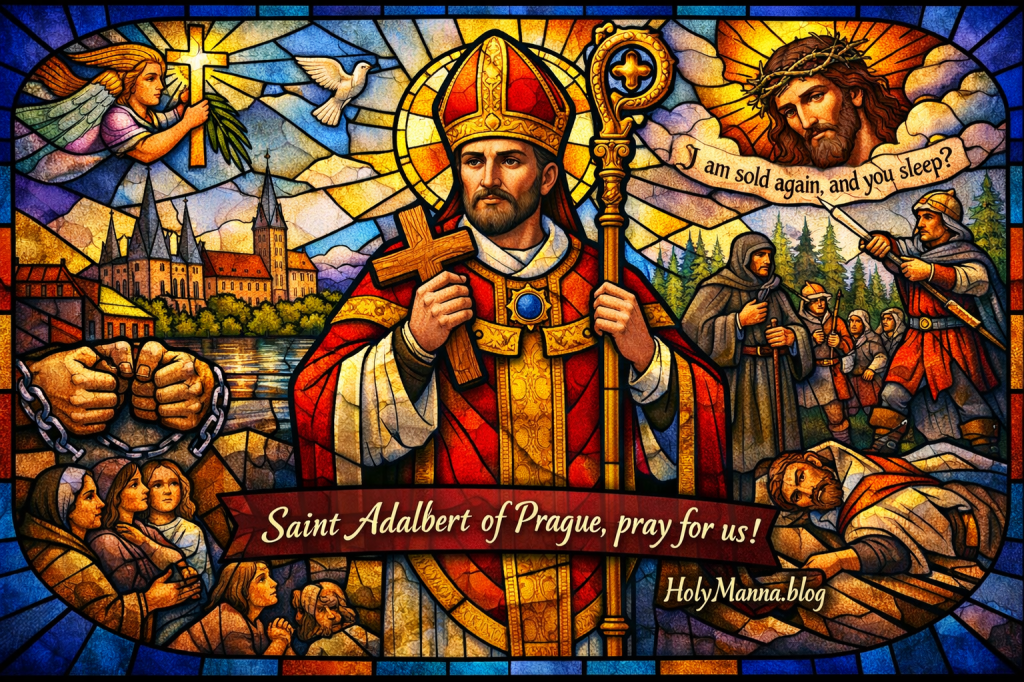
A Bishop Who Refused to Sleep Through Evil
Saint Adalbert of Prague, also known as Saint Wojciech, stands among the great missionary martyrs of the early Church in Central Europe. He was a bishop, a Benedictine monk, a reformer, and finally a martyr who gave his life preaching Christ to those who had not yet received the Gospel. He is revered especially in Bohemia and Poland, and his witness helped shape the Christian identity of an entire region.
What makes Saint Adalbert so compelling is not only that he died for the faith, but that he spent his whole life preparing for that moment. He loved the poor, confronted corruption, opposed the slave trade, embraced monastic humility, and never stopped seeking the will of God even when obedience cost him comfort, reputation, and safety. His life reminds the Church that holiness is not built in one dramatic hour. It is built in daily faithfulness, daily sacrifice, and daily surrender to Christ.
In the language of The Catechism, martyrdom is the supreme witness to the truth of the faith. Saint Adalbert lived that truth long before he sealed it with his blood.
Born for More Than Comfort
Saint Adalbert was born around 956 in Libice in Bohemia into the noble Slavník family. His parents, Slavník and Strzeżysława, raised him in a household of rank and influence, but his life did not unfold as the world might have expected. Catholic tradition remembers that as a child he became gravely ill, and during that illness his parents entrusted him to God in a special way. He recovered, and that recovery was remembered as a sign that his life belonged to the Lord.
He was later sent to Magdeburg for his education, where he studied under Archbishop Adalbert. It was there that he took the name Adalbert, a name that would become known across Europe. His education formed him deeply, but this was not merely the polishing of a nobleman. God was preparing a shepherd.
Still a young man, he was chosen to become bishop of Prague. That alone would have been enough to mark his life as significant, but what he did with that office is what made him unforgettable. He did not treat the episcopacy as a place of privilege. He treated it as a place of sacrifice. He is especially known for striving to reform Christian life in Prague, for defending the poor, for calling sinners to repentance, and for resisting the buying and selling of human beings. In a city where compromise would have been easier, he chose fidelity.
The Shepherd Who Walked Barefoot
Catholic tradition remembers that when Adalbert entered Prague as bishop, he did so barefoot. That image says almost everything. He was a nobleman who did not cling to nobility. He was a bishop who did not cling to power. He wanted his people to see a shepherd, not a prince.
He spent himself for the poor, visited prisoners, and challenged the moral decay that had taken root among both clergy and laity. He was not known for softness in the face of evil, but neither was he driven by pride. He was driven by love for Christ and concern for souls. That is one reason the Church still remembers him. He understood that mercy without truth becomes weakness, and truth without mercy becomes cruelty. In him, the two met in pastoral courage.
One of the most striking traditions associated with his life concerns his opposition to the slave trade. According to Catholic tradition, he once received a dream in which Christ said, “I am sold again, and you sleep?” Whether one reads that moment as a mystical warning or as a hagiographical memory shaped by the Church’s love for him, it perfectly expresses what defined his life. He could not ignore evil once he saw Christ in the suffering and the oppressed.
His life also took a deeply monastic turn. Wounded by resistance and turmoil in Prague, he eventually left for Rome and entered the Benedictine monastery of Saints Boniface and Alexius on the Aventine. There he embraced hiddenness and humility. Tradition remembers him taking up simple work in the monastery, even carrying water for the kitchen. It is a beautiful picture of a bishop learning again that greatness in the Church is measured by service.
His love for monastic life did not separate him from the needs of the Church. In time, he returned and helped found Břevnov Abbey in 993, the first male monastery in Bohemia. That act became part of his lasting legacy. He was not only a missionary to pagans. He was also a builder of Christian life among the baptized.
Signs of Grace in His Earthly Life
Saint Adalbert is not remembered for a large collection of dramatic public miracles in the way some later saints are, but Catholic tradition still preserves several signs of divine grace associated with his life.
The first is the healing in childhood after his parents entrusted him to God during a grave illness. This event was remembered as a sign that the Lord had preserved him for a holy purpose.
Another notable moment is the dream in which Christ rebuked him over the slave trade. This was not a miracle in the sense of a public healing, but it was received as a divine intervention that awakened him more deeply to the suffering around him and strengthened his mission.
There is also the larger miracle of his life itself, though it unfolded quietly. He had every reason to seek security, honor, and influence, yet he repeatedly chose poverty, prayer, reform, and mission. In a culture that was only partially converted, he lived like a man convinced that the Gospel was worth everything. Sometimes the most important miracle is not spectacle, but fidelity.
According to early tradition, when he later preached in Gdańsk and prepared for the mission to the Prussians, he did not advance with military force or worldly protection. He came as a servant of the Gospel. That missionary poverty was itself a sign of confidence in God.
Exile, Loss, and the Crown of Martyrdom
Adalbert’s path was not easy. His reforming zeal stirred resistance. People do not usually welcome the saint who exposes their compromise. In Prague, he faced opposition from those who did not want conversion, and the pressures around him became severe. His own family line also suffered devastation when the Slavník stronghold at Libice was destroyed. The saint who had once stood in a place of prominence came to know rejection, instability, and grief.
Yet he did not allow suffering to make him bitter. He let it purify him.
Eventually he went to Poland, where Bolesław the Brave received him. From there Adalbert turned toward missionary work among the Prussians. He traveled with a small company, including his half-brother Radim, later known as Gaudentius. He passed through Gdańsk, preached, and baptized. Then he entered dangerous territory to proclaim Christ to those who did not yet know Him.
In 997 he was seized and killed during that mission. Catholic tradition holds that he was struck with spears and then beheaded. Early accounts preserve the moving line he is said to have spoken to his companions: “Brothers, do not grieve!” Those words capture the peace of a man already surrendered to God. This saying comes from early tradition and is treasured in the Church’s memory of his martyrdom.
His death was not meaningless violence. It was the culmination of a life spent pouring itself out. He did not become a martyr by accident. He became a martyr because he had long ago decided that Christ was worth more than safety.
Relics, Wonders, and a Legacy That Outlived Empires
After his martyrdom, Bolesław the Brave recovered his body and brought it to Gniezno. Catholic tradition says the body was ransomed for its weight in gold. In 999 Pope Sylvester II canonized him, and his tomb quickly became one of the great centers of devotion in Poland.
His influence after death was astonishing. In the year 1000, the Congress of Gniezno took place at his tomb, and that event became foundational for the life of the Church in Poland. His martyrdom helped shape the ecclesial identity of a nation. That alone would make his legacy extraordinary.
His relics also became deeply important in the life of the Church. There were later disputes, transfers, and losses tied to invasions and political upheaval, especially involving Prague and Gniezno, yet devotion to him endured. Both places remain powerfully connected to his memory. The veneration of his relics became part of a broader Christian culture that saw in him not only a holy bishop, but a father in the faith for peoples across Central Europe.
Catholic tradition also preserves miracle stories after his death. One of the most famous tells of Saint Adalbert appearing in 1097 as an armed rider on a gray horse to save a besieged stronghold. This story belongs to the tradition surrounding his posthumous intercession and cannot be verified with certainty, but it shows how strongly Christian people believed that their martyr still fought for them.
There is also the lasting miracle of his cult itself. Churches, feasts, pilgrimages, sacred art, and national memory all kept his witness alive. The famous Gniezno Doors, with their scenes from his life, stand as a visual sermon on missionary discipleship and martyrdom. His feast on April 23 continues to be celebrated, and in places connected to his memory there are liturgical celebrations, processions, and cultural observances in his honor.
Saint Adalbert became one of the great patron saints of Poland, a patron of Bohemia, and a saint closely associated with the Christian roots of Europe. Empires rose and fell after his death, but his witness remained.
What Saint Adalbert Says to the Church Today
Saint Adalbert’s life speaks with surprising force to modern Christians. He lived in a world that was outwardly Christian in some places but still compromised, violent, and morally confused. That sounds familiar. He did not answer that confusion with cynicism. He answered it with holiness.
His life teaches that fidelity may bring opposition. A Christian who loves the truth should not be surprised when that truth costs something. Adalbert also teaches that reform begins with personal conversion. He was not only trying to fix other people. He became a monk, embraced humility, and allowed God to strip away the parts of himself that still clung to status and comfort.
There is also a lesson here about courage in public life. He opposed the slave trade because he could see Christ in the suffering. Christians today are called to do the same in every form of human exploitation, indifference, and injustice. The saint reminds the faithful that the Gospel must touch real life. It cannot remain a private opinion.
His missionary heart matters too. Adalbert did not stay where he was comfortable. He went where Christ sent him. That does not mean everyone is called to cross national borders, but every Catholic is called to missionary charity. Every home, parish, classroom, workplace, and friendship can become mission territory when lived with love, truth, and patience.
Where might Christ be asking for greater courage? What compromises have become too comfortable? How can a life of prayer, humility, and truth make a person more ready to serve? These are the kinds of questions Saint Adalbert leaves behind.
To imitate him in daily life means choosing truth over convenience, prayer over restlessness, service over self-importance, and faithfulness over fear. It means seeing Christ in the poor and the forgotten. It means remembering that the Christian life is not about preserving comfort. It is about becoming holy.
Engage With Us!
Readers are warmly invited to share their thoughts and reflections in the comments below. Saint Adalbert’s life raises powerful questions about courage, sacrifice, truth, and missionary faith, and those lessons are worth pondering together.
- What part of Saint Adalbert’s life speaks most deeply to the heart right now?
- How can his courage in confronting evil inspire greater faithfulness in daily life?
- What does his willingness to leave comfort behind teach about trusting God more fully?
- How can his love for the poor and his rejection of injustice be lived out in ordinary circumstances today?
- What would it look like to become more missionary in family life, work, friendships, or parish life?
May Saint Adalbert of Prague inspire a life of steady courage, deep prayer, and real charity. May his witness remind every Christian to live with conviction, to suffer with hope, and to do everything with the love and mercy Jesus taught us.
Saint Adalbert of Prague, pray for us!
Follow us on YouTube, Instagram and Facebook for more insights and reflections on living a faith-filled life.


Leave a Reply