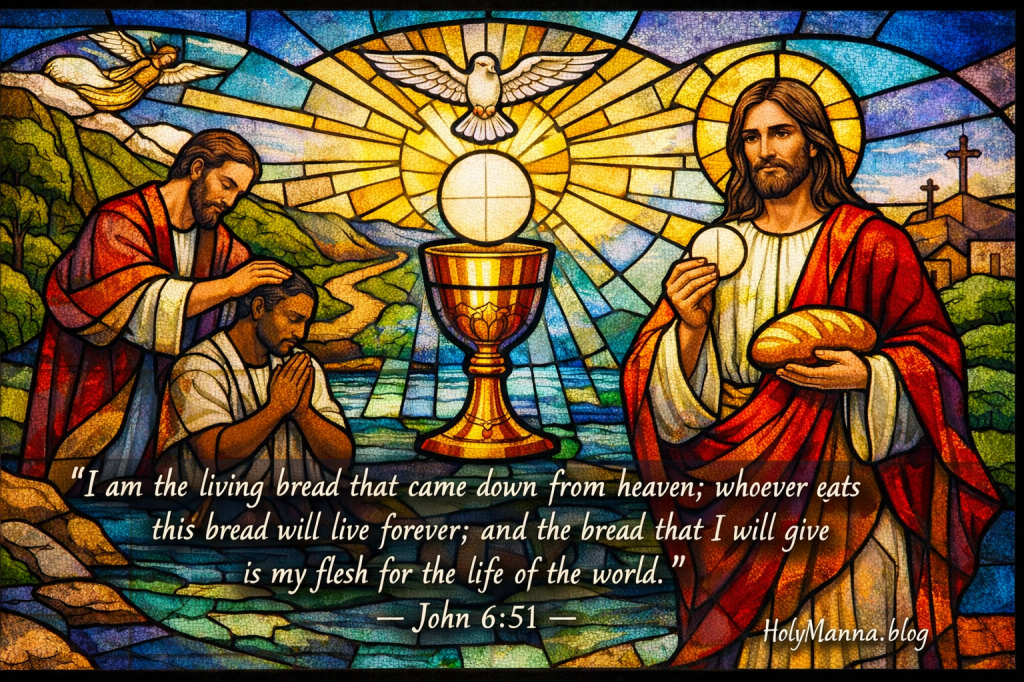
Thursday of the Third Week of Easter – Lectionary: 276
When God Draws a Soul
There are days in the Church’s liturgy when the readings feel like separate windows, and then there are days like this one, when they open into one great scene. Today’s readings tell the story of a soul being drawn by God. That is the central theme running through all three passages. The Father draws the heart, the Word is explained through the Church, Baptism opens the way into new life, and Christ reveals Himself as the Bread from heaven who alone can satisfy the deepest hunger of man.
That theme matters in a special way during Easter season. The Church is not only celebrating that Christ rose from the dead. She is showing what the Resurrection does in real lives. In Acts of the Apostles, the Gospel is already moving beyond Jerusalem, reaching those who were once distant, unfamiliar, or standing at the edge of Israel’s worship. In The Gospel of John, Jesus speaks with that same divine authority that unsettled and attracted His hearers, declaring “I am the bread of life” and revealing that no one comes to Him unless first drawn by the Father. Between those readings, Psalm 66 sounds like the voice of a believer who has tasted mercy and cannot keep quiet about it. “Come and hear… while I recount what has been done for me.” That is the sound of Easter faith. It is personal, joyful, and impossible to hide.
There is also a rich religious backdrop behind these readings as a whole. Israel knew the memory of manna in the desert, bread from heaven that sustained the people on their journey. The early Christians knew the promises of the prophets, who spoke of a day when God Himself would teach His people. The first believers also knew that the nations were being gathered into the covenant in a new and astonishing way through Christ and His Church. So today’s liturgy places desert roads, ancient prophecy, living water, and heavenly bread side by side. None of it is accidental. The Church wants the reader to see that the old promises are reaching their fulfillment in Jesus, and that this fulfillment is not abstract. It is sacramental. It touches the body and the soul. It sends a man down into water, and it lifts the eyes of the faithful toward the living Bread who gives eternal life.
This makes today’s readings both comforting and challenging. They remind every believer that faith does not begin as a personal achievement. It begins when God moves first. He draws. He teaches. He feeds. At the same time, these readings show that grace does not leave a person where he was found. The soul that is drawn by God is led somewhere definite, into truth, into the Church, into worship, and into communion with Christ. That is the road the readings open before us today, and it is a road that still runs through every Catholic life.
Where has the Father been quietly drawing the heart, even before it was fully understood?
Absolutely. Here is the cleaned version with all web links removed.
First Reading – Acts 8:26-40
A Desert Road Becomes the Doorway to the Church
The first reading unfolds like one of those moments in salvation history that seems quiet on the surface, but changes far more than anyone realizes at first. Philip is sent by God to a desert road. There he meets an Ethiopian eunuch, a man of influence, learning, and sincere religious desire. He is returning from Jerusalem, reading the prophet Isaiah, and searching for understanding. In that single meeting, the Church shows what she is: guided by the Holy Spirit, faithful to the Scriptures, missionary by nature, and sacramental in her life. The man is not merely given an inspiring thought. He is led to Jesus, brought to Baptism, and sent on his way rejoicing. That movement fits today’s theme perfectly. God draws the soul, the Church explains the Word, and grace leads the seeker into visible communion with Christ.
There is also a rich historical and religious background behind the scene. The eunuch is a court official under the Candace, the ruler named in the text, and he has come to Jerusalem to worship. That detail matters. He is already a seeker of the God of Israel, yet he still stands in a place of incompleteness. He has the scroll, but he needs the Church’s living voice. He has desire, but he still needs the sacrament. He has reverence, but he still needs Christ. That is why this passage matters so much for Catholics. It shows that God does not save by private interpretation alone. Sacred Scripture is indeed the Word of God, but The Catechism teaches, “Sacred Scripture is written principally in the Church’s heart rather than in documents and records, for the Church carries in her Tradition the living memorial of God’s Word, and it is the Holy Spirit who gives her the spiritual interpretation of the Scripture.” CCC 113
Acts 8:26-40 – New American Bible (Revised Edition)
26 Then the angel of the Lord spoke to Philip, “Get up and head south on the road that goes down from Jerusalem to Gaza, the desert route.” 27 So he got up and set out. Now there was an Ethiopian eunuch, a court official of the Candace, that is, the queen of the Ethiopians, in charge of her entire treasury, who had come to Jerusalem to worship, 28 and was returning home. Seated in his chariot, he was reading the prophet Isaiah. 29 The Spirit said to Philip, “Go and join up with that chariot.” 30 Philip ran up and heard him reading Isaiah the prophet and said, “Do you understand what you are reading?” 31 He replied, “How can I, unless someone instructs me?” So he invited Philip to get in and sit with him. 32 This was the scripture passage he was reading:
“Like a sheep he was led to the slaughter,
and as a lamb before its shearer is silent,
so he opened not his mouth.
33 In (his) humiliation justice was denied him.
Who will tell of his posterity?
For his life is taken from the earth.”34 Then the eunuch said to Philip in reply, “I beg you, about whom is the prophet saying this? About himself, or about someone else?” 35 Then Philip opened his mouth and, beginning with this scripture passage, he proclaimed Jesus to him. 36 As they traveled along the road they came to some water, and the eunuch said, “Look, there is water. What is to prevent my being baptized?” [37 ] 38 Then he ordered the chariot to stop, and Philip and the eunuch both went down into the water, and he baptized him. 39 When they came out of the water, the Spirit of the Lord snatched Philip away, and the eunuch saw him no more, but continued on his way rejoicing. 40 Philip came to Azotus, and went about proclaiming the good news to all the towns until he reached Caesarea.
Detailed Exegesis
Verse 26 – “Then the angel of the Lord spoke to Philip, ‘Get up and head south on the road that goes down from Jerusalem to Gaza, the desert route.’”
The story begins with divine initiative. Philip does not choose the road. He is sent. The desert route sounds empty and unpromising, yet grace often works that way. God sends His servants into places that seem barren so that they may discover the soul already being prepared there. The verse also teaches holy obedience. Philip is fruitful because Philip is docile.
Verse 27 – “So he got up and set out. Now there was an Ethiopian eunuch, a court official of the Candace, that is, the queen of the Ethiopians, in charge of her entire treasury, who had come to Jerusalem to worship,”
Philip obeys immediately. That matters. Delay would have meant missing the moment. The eunuch is no minor figure. He is a high official, a man trusted with royal wealth, and yet he is also a man spiritually hungry. He has come to Jerusalem to worship, which reveals a soul already reaching toward the true God. In him, the reading brings together power and poverty. He has public importance, yet still needs what only God can give.
Verse 28 – “and was returning home. Seated in his chariot, he was reading the prophet Isaiah.”
This is one of the most beautiful images in Acts. A man rides through the wilderness with the word of God open before him. He is not indifferent. He is searching. He is reading Isaiah, the prophet whose suffering servant songs so powerfully prepare for Christ. Even before Philip speaks, grace is already at work.
Verse 29 – “The Spirit said to Philip, ‘Go and join up with that chariot.’”
Now the angel’s command becomes the Spirit’s closer instruction. The Church’s mission is not mechanical. It is personal and Spirit-led. Philip is not only told where to go, but when to step forward. Evangelization in Catholic life is never merely strategy. It is cooperation with the Holy Spirit.
Verse 30 – “Philip ran up and heard him reading Isaiah the prophet and said, ‘Do you understand what you are reading?’”
Philip runs. There is urgency in true evangelization. He does not begin with accusation or argument. He begins with a question. It is a gentle, intelligent, pastoral opening. He meets the man exactly where he is, at the point of his real hunger. This is how the Church ought to teach. She does not crush the seeker. She accompanies him into the truth.
Verse 31 – “He replied, ‘How can I, unless someone instructs me?’ So he invited Philip to get in and sit with him.”
This is one of the clearest Catholic verses in the whole New Testament. The eunuch does not treat Scripture as self-interpreting in isolation. He knows he needs instruction. He is humble enough to say so. That humility becomes the doorway to faith. This verse also shows the proper relationship between the written Word and the Church’s ministry. God gives the Scriptures, and God also gives teachers. The Catechism teaches that Scripture must be read in the same Spirit in which it was written and within the living Tradition of the Church. CCC 111-114
Verse 32 – “This was the scripture passage he was reading: ‘Like a sheep he was led to the slaughter, and as a lamb before its shearer is silent, so he opened not his mouth.’”
The passage is from Isaiah 53, the song of the suffering servant. The Church has always seen this as one of the clearest Old Testament witnesses to Christ’s Passion. The lamb imagery points straight toward Jesus, the true Paschal Lamb, silent before His accusers and freely offering Himself for sinners.
Verse 33 – “In his humiliation justice was denied him. Who will tell of his posterity? For his life is taken from the earth.’”
The servant suffers humiliation, injustice, and apparent defeat. Yet precisely there the mystery of redemption shines. Jesus does not save the world by worldly triumph. He saves it through humble obedience, suffering love, and sacrificial self-gift. This verse invites the reader to see that God’s justice often breaks into the world through what looks, at first, like weakness.
Verse 34 – “Then the eunuch said to Philip in reply, ‘I beg you, about whom is the prophet saying this? About himself, or about someone else?’”
This is the honest question that opens everything. The eunuch is teachable. He does not pretend to understand. He asks. In the spiritual life, that kind of question is often the beginning of conversion. A proud man would have stayed closed. A humble man receives the answer.
Verse 35 – “Then Philip opened his mouth and, beginning with this scripture passage, he proclaimed Jesus to him.”
Here is the heart of apostolic preaching. Philip begins with Scripture and proclaims Jesus. He does not offer vague spirituality. He does not merely explain Isaiah as history. He reveals Christ as the fulfillment of the text. This is exactly how the Church reads the Old Testament. Christ is its center and fulfillment. The whole Bible reaches toward Him. CCC 128-130
Verse 36 – “As they traveled along the road they came to some water, and the eunuch said, ‘Look, there is water. What is to prevent my being baptized?’”
This verse is pure Catholic realism. Philip’s preaching does not end in private emotion. It leads to sacramental action. The eunuch immediately sees that faith in Jesus calls for Baptism. He does not ask for a vague sign of personal affirmation. He asks to enter visibly into the new life of Christ. The Catechism teaches, “Holy Baptism is the basis of the whole Christian life, the gateway to life in the Spirit… and the door which gives access to the other sacraments.” CCC 1213
Verse 37 – “And Philip said, ‘If you believe with all your heart, you may.’ And he said in reply, ‘I believe that Jesus Christ is the Son of God.’”
This verse is omitted in the NABRE lectionary text because the oldest manuscripts of Acts do not include it. Even so, the traditional wording preserves a beautiful baptismal confession of faith. Whether read in a textual note or not read aloud in the lectionary, the truth remains clear: Baptism is joined to faith in Jesus Christ, not separated from it.
Verse 38 – “Then he ordered the chariot to stop, and Philip and the eunuch both went down into the water, and he baptized him.”
The response is immediate. The chariot stops. Both men go down into the water. Baptism happens in history, in the body, in the visible world. Catholic faith is never merely mental. God uses material signs to communicate supernatural grace. The Catechism teaches, “Through Baptism we are freed from sin and reborn as sons of God; we become members of Christ, are incorporated into the Church and made sharers in her mission.” CCC 1213
Verse 39 – “When they came out of the water, the Spirit of the Lord snatched Philip away, and the eunuch saw him no more, but continued on his way rejoicing.”
The sacrament has done its work. Philip disappears, but grace remains. Saint John Chrysostom saw deep wisdom here. He wrote, “It was well and expedient therefore that the Spirit caught Philip away; else the eunuch would have desired to go with him.” Homilies on the Acts of the Apostles, Homily 19 The point is beautiful. The man has not been attached merely to Philip. He has been joined to Christ. And the fruit is joy. Not shallow excitement, but the joy that comes from being washed, illumined, and received into the life of God.
Verse 40 – “Philip came to Azotus, and went about proclaiming the good news to all the towns until he reached Caesarea.”
Philip does not settle into the memory of one successful encounter. He keeps preaching. That is the rhythm of the Church. One soul is reached, and the Gospel keeps moving. Easter faith is missionary. The risen Christ is not for one people, one road, or one moment. He is for the nations.
Teachings
This reading teaches, first of all, that grace comes before human planning. God prepares Philip, prepares the eunuch, prepares the Scripture being read, and even prepares the water on the road. That is how divine providence works. It is not chaotic. It is personal, patient, and precise.
It also teaches that Scripture belongs within the life of the Church. The eunuch has the sacred text in his hands, but he still needs Philip to open it. That is not a weakness in Scripture. It is a witness to God’s design. The same Lord who inspired the Word also founded the Church to preach, guard, and interpret it faithfully. The Catechism says, “Sacred Scripture must be read and interpreted in the light of the same Spirit by whom it was written.” CCC 111 It continues by teaching that Scripture must be read with attention to the unity of the whole Bible, within the living Tradition of the Church, and according to the analogy of faith. Those principles are not abstract classroom rules. They are happening in this chariot. Philip reads Isaiah the way the Church reads Isaiah, with Christ at the center.
The passage also teaches the necessity and beauty of Baptism. The eunuch does not delay once Christ is proclaimed. The Catechism says, “From the very day of Pentecost the Church has celebrated and administered holy Baptism.” CCC 1226 It goes on to show that the apostles and their collaborators offered Baptism to anyone who believed in Jesus, including Jews, the God-fearing, and pagans. That line fits this reading almost perfectly. The Ethiopian official stands as a living example of the Gospel moving outward to the nations. The Church’s missionary life is already taking visible form.
There is also a sacramental depth to the water itself. The Catechism says, “Immersion in water symbolizes not only death and purification, but also regeneration and renewal. Thus the two principal effects are purification from sins and new birth in the Holy Spirit.” CCC 1227 So when Philip and the eunuch go down into the water, this is not only a symbolic gesture. It is a new birth. It is cleansing. It is incorporation into Christ and His Church.
Saint John Chrysostom, preaching on this passage, noticed the joy of the newly baptized man and the wisdom of Philip’s sudden removal. The convert is left rejoicing in God rather than clinging only to the human instrument. That is a needed lesson in every age. Priests, teachers, evangelists, and catechists matter deeply, but none of them is the destination. Christ is the destination. The Church is faithful when she leads souls beyond admiration of the messenger into communion with the Lord Himself.
Historically, this passage has always stood as a luminous sign of the universality of the Gospel. Luke’s wider account in Acts shows the good news moving outward under the Holy Spirit’s guidance, and this Ethiopian official becomes one of the earliest striking signs that the nations are being gathered into Christ. The road to Gaza becomes a sign that no place is too remote, no background too foreign, and no sincere seeker beyond the reach of grace.
Reflection
This reading speaks powerfully to daily life because so many souls live like the eunuch. They are intelligent, serious, and even reverent, but still unsettled. They have questions. They may even be reading Scripture. Yet there remains a gap between curiosity and communion. This passage shows how God closes that gap. He sends help. He opens understanding. He calls for a response.
One practical lesson is humility. The eunuch’s conversion begins, in a human sense, with a simple admission: he needs instruction. That same humility still opens the heart today. A Catholic life grows when there is a willingness to be taught by the Church rather than treating the faith like a private project.
Another lesson is docility to the Holy Spirit. Philip obeys quickly, and because he does, someone meets Christ. Daily life is full of small promptings that can be ignored. A conversation. A nudge to speak. A moment to encourage someone. A chance to explain the faith clearly. The Spirit still sends His people to desert roads.
A third lesson is sacramental seriousness. The eunuch does not stop with admiration for Jesus. He moves toward Baptism. For Catholics, that should stir gratitude for Baptism already received and awaken a deeper love for the grace flowing from it. Baptism is not a sentimental memory. It is the foundation of Christian identity and the beginning of life in Christ.
This reading also invites a hard but fruitful question about the way Scripture is approached. Is the word of God being read with a teachable heart, or only with private opinions already in place? It raises another question just as important. When grace becomes clear, is there a generous response, or a habit of delay? And finally, it asks something very personal. Would the road ahead be marked more by joy if there were deeper trust in the Church’s teaching, the Holy Spirit’s guidance, and the sacraments Christ has given?
The eunuch leaves the scene rejoicing because he no longer has only a scroll in his hands. He now has Christ. That is the destination of every faithful reading of Scripture, every act of evangelization, and every authentic Catholic life.
Responsorial Psalm – Psalm 66:2, 8-9, 16-17, 20
The Song of a Soul That Has Seen Mercy
The responsorial psalm today sounds like the voice of someone who has come through the other side of grace and cannot stay silent about it. After the desert-road conversion in Acts of the Apostles and before the Lord’s great words in The Gospel of John about the Bread of Life, the Church places on our lips a psalm of praise, gratitude, and witness. That placement is not accidental. Psalm 66 gives language to the heart that has been drawn by God, preserved by God, and answered by God. It is the kind of prayer that rises naturally from the Ethiopian eunuch after Baptism, and it is also the kind of prayer that belongs to every Christian who has tasted the Lord’s mercy.
Historically, this psalm stands within Israel’s great tradition of temple worship and public thanksgiving. It carries the sound of liturgical procession, communal praise, and personal testimony. It is both public and intimate. It begins with a cry that reaches all the earth, then narrows into the voice of one believer recounting what God has done. That is one reason the psalms remain so central in Catholic prayer. The Catechism says, “The Psalter is the book in which the Word of God becomes man’s prayer.” CCC 2587 In today’s liturgy, that truth shines clearly. The psalm becomes the bridge between the mighty works of God and the believer’s grateful response. It teaches the soul not only to receive grace, but also to praise God for it.
Psalm 66:2, 8-9, 16-17, 20 – New American Bible (Revised Edition)
2 Shout joyfully to God, all the earth;
sing of his glorious name;
give him glorious praise.8 Bless our God, you peoples;
loudly sound his praise,
9 Who has kept us alive
and not allowed our feet to slip.16 Come and hear, all you who fear God,
while I recount what has been done for me.
17 I called to him with my mouth;
praise was upon my tongue.20 Blessed be God, who did not reject my prayer
and refuse his mercy.
Detailed Exegesis
Verse 2 – “Shout joyfully to God, all the earth; sing of his glorious name; give him glorious praise.”
The psalm opens with a summons that reaches beyond one nation or one private experience. All the earth is called to praise God. That universal note fits beautifully with today’s first reading, where the Gospel reaches an Ethiopian official on a desert road. God’s saving work is not meant to stay hidden inside one corner of the world. Praise expands because grace expands. The verse also reminds the faithful that worship is not meant to be dull or reluctant. Joy belongs to the truth. To sing of God’s glorious name is to acknowledge that His deeds are worthy of public honor.
Verse 8 – “Bless our God, you peoples; loudly sound his praise,”
Here the psalm becomes even more communal. The invitation is no longer only to Israel, but to the peoples. That language prepares the heart to see the Church as catholic, universal, gathering men and women from every background into one song of praise. This verse also carries a kind of holy boldness. God’s praise is not whispered as though His works were uncertain. It is sounded aloud because His mercy is real and His saving action is not a private fantasy.
Verse 9 – “Who has kept us alive and not allowed our feet to slip.”
This verse turns praise into remembrance. God is praised not in the abstract, but for what He has done. He has preserved His people. He has kept them from falling. In the spiritual life, that is deeply important. The believer does not stand by personal strength alone. God sustains, guards, and steadies the soul. The line echoes the whole story of salvation, from Israel’s wilderness journey to the Church’s pilgrimage through history. It also speaks quietly to ordinary Catholic life. There are many moments when grace has kept a person from ruin, even when that protection was only understood later.
Verse 16 – “Come and hear, all you who fear God, while I recount what has been done for me.”
Now the psalm becomes deeply personal. The one who has received mercy begins to testify. This is not self-centered storytelling. It is witness. The believer calls others near, not to admire the speaker, but to hear what God has done. In this sense, the verse sounds very much like Christian evangelization. A soul touched by grace wants to tell the story. This also fits the Church’s liturgical instinct. Praise and testimony belong together. The faithful do not merely state doctrines. They recount the living works of God.
Verse 17 – “I called to him with my mouth; praise was upon my tongue.”
This verse reveals a heart trained in trust. The believer cried out to God, and even in the act of pleading there was already praise. That is a mature kind of prayer. It does not wait until every problem is solved before honoring God. It calls out in need while still confessing His goodness. The verse suggests that true prayer holds petition and praise together. The mouth that asks is also the mouth that blesses.
Verse 20 – “Blessed be God, who did not reject my prayer and refuse his mercy.”
The psalm ends with a conclusion full of relief, gratitude, and reverence. God has heard. God has not turned away. God has not withheld mercy. That final word, mercy, makes the whole psalm shine more brightly. The believer is not celebrating personal achievement, but divine compassion. This is why the verse fits so naturally into Easter season. The Resurrection is the great sign that God has not rejected the cry of His people. In Christ, mercy has answered from the depths.
Teachings
This psalm teaches that praise is not an optional ornament of faith. It is part of the proper response to God’s saving action. The Catechism says, “The Psalter is the book in which the Word of God becomes man’s prayer. In other books of the Old Testament, ‘the words proclaim [God’s] works and bring to light the mystery they contain.’ The words of the Psalmist, sung for God, both express and acclaim the Lord’s saving works; the same Spirit inspires both God’s work and man’s response. Christ will unite the two. In him, the psalms continue to teach us how to pray.” CCC 2587 That is exactly what happens in today’s liturgy. God acts in the First Reading. Christ reveals Himself in the Gospel. The psalm gives the Church her response.
The psalm also teaches that prayer is both personal and communal. It belongs to the worshipping assembly, but it also rises from the wounds, needs, gratitude, and memory of the individual believer. The Catechism says, “The Psalms both nourished and expressed the prayer of the People of God gathered during the great feasts at Jerusalem and each Sabbath in the synagogues. Their prayer is inseparably personal and communal; it concerns both those who are praying and all men.” CCC 2586 That balance matters. Catholic prayer is never merely private emotion, but neither is it a cold public formality. It is the prayer of the Church carried by real human hearts.
There is a second great lesson here, and it is thanksgiving. Psalm 66 is steeped in gratitude for prayers heard and mercy received. That spirit reaches its highest fulfillment in the Church’s Eucharistic life. The Catechism says, “Thanksgiving characterizes the prayer of the Church which, in celebrating the Eucharist, reveals and becomes more fully what she is.” CCC 2637 That line is especially fitting today because the psalm stands beside the Bread of Life discourse in The Gospel of John. The Church praises because the Church has been fed. The Church gives thanks because Christ has not refused His mercy.
The tradition of the saints also helps illuminate this psalm. In speaking of the psalms, the ancient tradition treasured them as the prayer book of the whole Church. A beautiful line preserved in The Catechism says, “Yes, a psalm is a blessing on the lips of the people, praise of God, the assembly’s homage, a general acclamation, a word that speaks for all, the voice of the Church, a confession of faith in song.” CCC 2588 That is a fitting description of today’s responsorial psalm. It is not filler between readings. It is the voice of the Church teaching the soul how to answer grace.
Historically, the psalms have always held a privileged place in Catholic worship. They shaped Israel’s prayer in the Temple, they formed the prayer of Christ Himself, and they remain woven into the Mass and the Liturgy of the Hours. When the Church prays a psalm, she is not borrowing an old religious poem for atmosphere. She is entering into a living stream of prayer that has been fulfilled in Christ and still sanctifies His people.
Reflection
This psalm is a needed correction for modern spiritual life. It is easy to become consumed by anxiety, self-analysis, or constant petition, and to forget the duty and joy of praise. Yet the psalm shows that gratitude is not sentimental decoration. It is spiritual truth. God has kept His people alive. He has steadied their feet. He has heard their cry. He has not refused mercy.
In daily life, that means the heart should learn to remember concrete graces. Prayer deepens when it stops speaking only about what is still missing and starts naming what God has already done. That does not mean pretending suffering is unreal. It means letting praise and trust stand beside suffering, just as this psalm does. It also means speaking about God’s goodness aloud. Verse 16 is a gentle challenge against a silent faith. The believer who has received mercy should not be ashamed to recount it.
This psalm also encourages a more Eucharistic way of living. Thanksgiving should not remain locked inside the church building after Mass. It should shape ordinary speech, family life, work, repentance, and even hardship. A grateful soul becomes steadier, humbler, and more ready to notice grace.
Has prayer become mostly a list of worries, or does it still include real praise for what God has already done? When was the last time there was a deliberate effort to recount the Lord’s mercy rather than only asking for the next favor? Would the heart be more peaceful if it practiced gratitude as faithfully as it practices concern?
The Church gives this psalm today because the soul drawn by God does not remain silent for long. Once mercy has been seen, praise begins to rise. Once prayer has been answered, thanksgiving becomes part of the story. And once Christ has entered the life of a believer, the right response is the same one sung by the psalmist long ago: blessed be God, who has not refused His mercy.
Holy Gospel – John 6:44-51
The Bread From Heaven Who Draws the Heart Home
Today’s Gospel stands in the middle of the Bread of Life discourse in The Gospel of John, and it carries the weight of both promise and decision. Jesus is speaking to a people who knew the story of manna in the desert, a people formed by the memory of Moses, the Exodus, and God’s faithful care in the wilderness. They knew what it meant to hunger. They knew what it meant to be fed by heaven. But now Jesus says something greater than anything Israel had heard before. He does not simply offer bread. He says that He Himself is the bread. He does not merely point toward life. He says that whoever believes in Him has eternal life. He does not speak only of teaching from God. He reveals that the Father Himself draws souls to the Son.
That is why this Gospel fits so perfectly with today’s larger theme. In the first reading, the Ethiopian eunuch is quietly being drawn by God before he even understands the full mystery unfolding around him. In the psalm, the believer gives praise because God has heard, preserved, and shown mercy. Here in the Gospel, Jesus reveals the deepest truth beneath both scenes: grace begins with God. The Father draws. The Son gives life. The believer responds in faith. And this movement does not end in ideas alone. It leads toward the Eucharistic mystery, where Christ gives His flesh for the life of the world.
There is also a strong historical and religious background behind these words. In John 6, Jesus speaks after the multiplication of the loaves, when the crowd is already thinking in terms of bread, Moses, and divine provision. They are measuring Jesus against the memory of manna. But He leads them beyond the old miracle into a far deeper one. The manna in the wilderness kept people alive for a time. Jesus offers a bread that conquers death itself. This is why the Church has always read this discourse with profound Eucharistic seriousness. The Catechism says, “The signs of bread and wine become, in a way surpassing understanding, the Body and Blood of Christ; they continue also to signify the goodness of creation. Thus in the Offertory we give thanks to the Creator for bread and wine, fruit of the ‘work of human hands,’ but above all as ‘fruit of the earth’ and ‘of the vine,’ gifts of the Creator. The Church sees in the gesture of the king-priest Melchizedek, who ‘brought out bread and wine,’ a prefiguring of her own offering.” CCC 1333 The Lord is not offering a passing religious symbol. He is revealing the mystery that will sustain His Church until the end of time.
John 6:44-51 – New American Bible (Revised Edition)
44 No one can come to me unless the Father who sent me draw him, and I will raise him on the last day. 45 It is written in the prophets:
‘They shall all be taught by God.’
Everyone who listens to my Father and learns from him comes to me. 46 Not that anyone has seen the Father except the one who is from God; he has seen the Father. 47 Amen, amen, I say to you, whoever believes has eternal life. 48 I am the bread of life. 49 Your ancestors ate the manna in the desert, but they died; 50 this is the bread that comes down from heaven so that one may eat it and not die. 51 I am the living bread that came down from heaven; whoever eats this bread will live forever; and the bread that I will give is my flesh for the life of the world.”
Detailed Exegesis
Verse 44 – “No one can come to me unless the Father who sent me draw him, and I will raise him on the last day.”
Jesus begins with grace. No one comes to Him by cleverness, force of personality, or religious self-confidence. The Father must draw the soul. This is deeply Catholic. Faith is not self-generated. It is a gift stirred by grace. Yet this drawing is not violent or mechanical. Saint Augustine, preaching on this passage, said, “Do not think that you are drawn against your will; the mind is drawn by love.” That line captures the beauty of this verse. The Father draws the heart by awakening it to truth and goodness in Christ. Jesus also joins that present grace to a future promise. The one drawn to Him will be raised on the last day. Faith, then, is not a temporary emotional experience. It is the beginning of eternal communion.
Verse 45 – “It is written in the prophets: ‘They shall all be taught by God.’ Everyone who listens to my Father and learns from him comes to me.”
Jesus roots His words in the prophetic promises. God had long foretold a day when He would teach His people in a deeper and more direct way. Jesus declares that this promise is now taking shape in Him. To be taught by God is to be led to the Son. This verse also guards against a false idea of religion. Divine teaching is not merely the transfer of information. It is formation of the heart. The person who truly listens to the Father is brought into living faith in Christ.
Verse 46 – “Not that anyone has seen the Father except the one who is from God; he has seen the Father.”
Here Jesus makes a claim that no mere prophet could make. He does not say that He has simply heard about the Father or received a message from afar. He says that He has seen the Father. This verse reveals His unique divine sonship. He alone knows the Father fully because He is from the Father in a way no creature is. The Church hears in these words a window into the mystery of the Trinity. Jesus is not one teacher among many. He is the eternal Son who alone reveals the Father perfectly.
Verse 47 – “Amen, amen, I say to you, whoever believes has eternal life.”
This is one of those sentences that seems simple until it is allowed to settle in the heart. Jesus does not say that eternal life begins only after death. He says that the believer has eternal life even now. That life will reach its fullness in the resurrection, but it already begins through communion with Him. Faith is not merely intellectual assent. It is the beginning of participation in divine life.
Verse 48 – “I am the bread of life.”
This is one of the great declarations in The Gospel of John. Jesus does not merely offer bread that leads to life. He identifies Himself as the bread of life. He is what the human heart has always been hungry for, even when it could not name its hunger clearly. The Church hears in this verse both Christ’s divine identity and the foundation for Eucharistic faith. The deepest hunger of man is not finally for success, comfort, distraction, or applause. It is for Christ.
Verse 49 – “Your ancestors ate the manna in the desert, but they died.”
Jesus speaks with both reverence and clarity. The manna was a real gift from God, but it was not the final gift. It sustained earthly life for a time, yet those who ate it still died. This verse forces the listener to look beyond nostalgia and beyond partial fulfillments. Even the great signs of the old covenant were preparing for something greater. Jesus is not denying the goodness of manna. He is revealing its limits and its purpose as a preparation for Himself.
Verse 50 – “This is the bread that comes down from heaven so that one may eat it and not die.”
Now the contrast becomes sharper. Jesus speaks of a bread from heaven that truly overcomes death. The wording points beyond ordinary food and beyond metaphor alone. The Church hears here the unfolding revelation of the Eucharist, in which Christ gives Himself as heavenly food. Death still touches the body for a time, but it no longer has the final word over the one who lives in Christ.
Verse 51 – “I am the living bread that came down from heaven; whoever eats this bread will live forever; and the bread that I will give is my flesh for the life of the world.”
This verse is the summit of the passage. Jesus is not only bread from heaven. He is the living bread. Then He speaks with startling concreteness: “the bread that I will give is my flesh for the life of the world.” The Church has always recognized the Eucharistic weight of those words. They point forward to the Cross, where His flesh will be given in sacrifice, and to the Eucharist, where that sacrifice is sacramentally made present for the faithful. This is not a private mystical slogan. It is the heart of Catholic worship. Christ gives Himself so that the world may live.
Teachings
This Gospel teaches, first, the primacy of grace. No one comes to Christ unless drawn by the Father. The Catechism speaks plainly here: “Faith is a gift of God, a supernatural virtue infused by him. ‘Before this faith can be exercised, man must have the grace of God to move and assist him; he must have the interior helps of the Holy Spirit, who moves the heart and converts it to God, who opens the eyes of the mind and makes it easy for all to accept and believe the truth.’” CCC 153 That teaching stands directly behind verse 44. The Christian life begins not in human achievement, but in divine mercy.
This Gospel also teaches the unique identity of Christ. He alone has seen the Father because He alone is the eternal Son. The Catechism says, “Jesus Christ is true God and true man, in the unity of his divine person; for this reason he is the one and only mediator between God and men.” CCC 480 That truth matters because the Gospel is not offering one more spiritual path among many. It is revealing the one Son who alone can bring humanity into the Father’s life.
Most importantly, this passage prepares the Church for Eucharistic faith. The Catechism states with beautiful clarity, “The Lord addressed an invitation to us, urging us to receive him in the sacrament of the Eucharist: ‘Truly, I say to you, unless you eat the flesh of the Son of man and drink his blood, you have no life in you.’” CCC 1384 It also teaches, “The signs of bread and wine become, in a way surpassing understanding, the Body and Blood of Christ.” CCC 1333 And again, “The Eucharist is ‘the source and summit of the Christian life.’” CCC 1324 Those teachings are not later inventions laid on top of the Gospel. They arise from the Lord’s own words in John 6, where He reveals Himself as the living bread and says that the bread He gives is His flesh for the life of the world.
Saint Augustine spoke powerfully about this mystery. Reflecting on Christ as heavenly food, he taught that the soul does not consume Christ the way the body consumes ordinary food. Rather, Christ transforms the one who receives Him. Augustine wrote, “I am the food of the grown; grow, and you shall feed upon me. Nor shall you change me into yourself, as you do the food of your flesh; but you shall be changed into me.” That is profoundly Catholic. The Eucharist is not bent to human preference. The communicant is drawn into Christ.
There is also a major historical lesson in this passage. The early Church did not treat the Eucharist as a mere symbol of fellowship. From the earliest centuries, Christians spoke of the Eucharist with striking realism because they received the words of John 6 and the institution narratives with reverence and seriousness. This passage helped shape the Church’s worship, her doctrine, and her martyrdom. Countless saints went to death sustained by the conviction that Christ truly gives Himself as heavenly food.
Reflection
This Gospel reaches directly into modern life because modern life is full of hunger. There is hunger for meaning, for belonging, for peace, for beauty, for forgiveness, for permanence. Many try to feed that hunger with distraction, success, romance, entertainment, control, or constant noise. Yet Christ stands in the middle of all that restless searching and says, “I am the bread of life.” He does not offer a technique. He offers Himself.
The first practical lesson is humility before grace. No one forces his own way into friendship with God. The Father draws. That should make the heart both grateful and docile. Instead of treating faith as a personal achievement, the soul should learn to ask for the grace to listen, to believe, and to follow.
The second lesson is to recover real hunger for the Eucharist. If Christ is the living bread come down from heaven, then the Mass cannot be reduced to habit, obligation, or background noise. It is the place where the faithful are fed with the very gift that gives eternal life. That truth calls for preparation, reverence, confession when needed, and a renewed expectation that Christ truly meets His people there.
The third lesson is to let Christ expose false bread. Every life has substitutes that promise satisfaction and leave the heart emptier than before. This Gospel invites an honest examination of what is actually being relied upon to feel alive. The manna of old was good, but it was not enough. Modern forms of manna are even less so. Only Christ endures.
What has been treated like bread in life, but has never really satisfied the deeper hunger of the soul? Is there a real openness to being drawn by the Father, even when that means surrendering pride and self-direction? Has the Eucharist become familiar in the wrong way, or is there still awe before the Lord who gives His flesh for the life of the world?
This Gospel leaves the reader standing before a choice. Either Jesus is speaking in beautiful exaggerations, or He is revealing the deepest truth about Himself and about the human heart. The Church knows the answer. He is the living bread. He is the Son who has seen the Father. He is the one who raises the faithful on the last day. And He still draws hungry souls to Himself, not to leave them as they were, but to feed them with divine life.
Drawn by Grace, Fed by Christ, Sent With Joy
Today’s readings come together like one steady movement of grace. In Acts of the Apostles, a searching man is met on a desert road, taught the Scriptures through the Church, and brought into new life through Baptism. In Psalm 66, the heart that has seen God’s mercy cannot remain quiet, but breaks into praise and testimony. In The Gospel of John, Jesus reveals the deepest truth beneath it all: the Father is the one drawing souls to the Son, and the Son gives Himself as the living bread for the life of the world.
That is the thread holding the whole day together. God is not distant. He is drawing. He is teaching. He is feeding. He is leading souls out of confusion and into communion. The Ethiopian eunuch begins as a man with questions and ends as a man rejoicing. The psalmist begins with praise and ends with gratitude for mercy. Jesus begins with the mystery of divine grace and ends with the promise of His flesh given for the life of the world. Taken together, the readings show the shape of the Christian life itself. The soul is drawn by the Father, instructed in truth, washed by grace, and sustained by Christ.
There is something deeply consoling here for any believer who feels restless, uncertain, or spiritually hungry. The Lord is not waiting for perfect understanding before He begins His work. He meets people on the road. He sends help. He opens the Word. He gives the sacraments. He fills what the world cannot fill. That is why the Church never grows tired of preaching Christ. He is not one help among many. He is the answer to the deepest hunger of the human heart.
So the invitation today is simple and strong. Stay close to the Word of God. Stay teachable before the Church. Remember the grace of Baptism. Return to the Eucharist with fresh awe. Let prayer become more grateful. Let faith become more obedient. Let the heart be drawn where God wants it to go.
Where is the Lord asking for a deeper yes today? What would change if there were greater trust that He is already drawing the soul closer to Himself? What would daily life look like if it were lived like someone truly fed by the Bread of Life?
The road ahead may still have deserts, questions, and trials. But today’s readings make one thing clear: the soul that lets itself be drawn by the Father, taught by the Church, and fed by Christ will not walk that road empty. It will walk it with joy.
Engage with Us!
Share your reflections in the comments below. These readings speak to the heart in a deeply personal way, and the way the Lord works through His word in one soul often helps strengthen another. Take a moment to pray with what stood out most, then join the conversation.
- First Reading – Acts 8:26-40: Where in life might the Lord be sending a Philip to help bring greater clarity, healing, or direction? Is there enough humility to say, like the Ethiopian eunuch, that guidance is needed in order to understand more fully? What would it look like to respond more quickly when God places living water on the road ahead?
- Responsorial Psalm – Psalm 66:2, 8-9, 16-17, 20: What has God done recently that deserves more gratitude than it has been given? Has prayer become only a place to bring needs, or is it also becoming a place of praise and remembrance? How might daily life change if there were a more deliberate effort to recount the Lord’s mercy?
- Holy Gospel – John 6:44-51: What false bread has been filling space in the heart without truly satisfying it? Is there a real openness to being drawn by the Father, even when that requires surrender and trust? How can there be a deeper love, reverence, and hunger for Jesus in the Eucharist this week?
Keep walking in faith with courage and peace. Let the word of God shape every thought, let the sacraments strengthen every weakness, and let every action be done with the love and mercy Jesus taught us.
Sacred Heart of Jesus, we trust in You!
Immaculate Heart of Mary, pray for us!
Saint Michael the Archangel, defend us in battle!
Follow us on YouTube, Instagram and Facebook for more insights and reflections on living a faith-filled life.


Leave a Reply