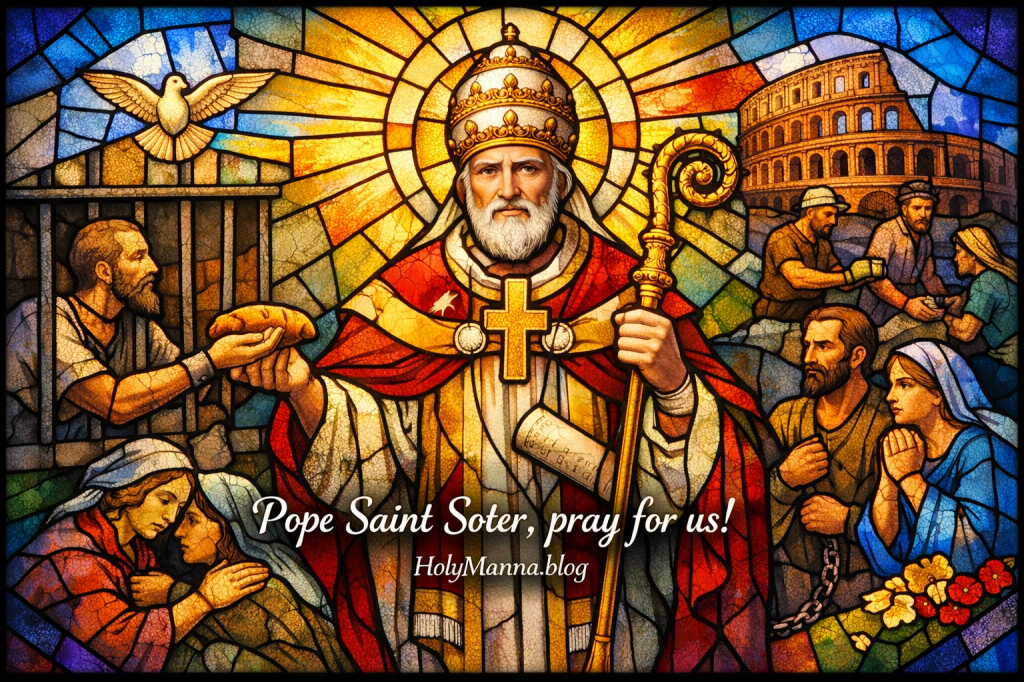
A Quiet Name with a Bright Witness
Some saints arrive in history with dramatic stories, long sermons, and unforgettable miracles. Pope Saint Soter does not come to the Church that way. He comes quietly, almost like a lamp burning in the dark. The surviving details about his life are few, but what remains is beautiful. The Church remembers him as an early pope, a saint, and traditionally a martyr. More than anything else, he is remembered as a shepherd whose heart was wide open to the suffering members of Christ.
Pope Saint Soter served the Church in the second century, during a time when Christianity was still fragile in the eyes of the world and often costly to live. He is traditionally counted as the twelfth pope, following Pope Saint Anicetus and preceding Pope Saint Eleutherius. He is revered because he helped strengthen the Church not by worldly force, but by fatherly care, generosity, and steadfast love for Christians in distress.
What makes him so striking is that the oldest memory of him is not centered on administration or controversy. It is centered on charity. In an age when the Church could not rely on social power, wealth, or political protection, Pope Saint Soter helped Rome live like a true mother to suffering believers. That witness still matters.
A Life Mostly Hidden, A Faith Made Visible
Pope Saint Soter was born in Fondi in Italy, and ancient tradition describes him as being of Greek origin. Very little can be said with certainty about his childhood, family life, or early formation. The Church simply does not possess many firm details from those years. Later traditions supply a few additional biographical notes, but the most careful Catholic treatment of his life keeps close to what can actually be supported.
In one sense, that hiddenness says something important. Holiness does not always leave behind long memoirs. Sometimes it leaves behind the fragrance of fidelity.
No dramatic conversion story survives from his early life. There is no preserved account of a sudden turning point, no famous scene of tears, no long narrative of youthful rebellion followed by grace. Instead, the saint appears already formed within the life of the Church, eventually rising to serve as Bishop of Rome. The absence of a detailed conversion story does not make his witness less powerful. It simply means that his sanctity is known more by the fruit he bore than by the early steps that led him there.
What he is most known for is simple and deeply Christian. He cared for the poor. He strengthened persecuted believers. He supported Christians who had been condemned to the mines. He guided the Church at a time when love had to be practical, courageous, and costly. In that sense, his life reflects the Church’s constant teaching that love of God and love of neighbor belong together. The Catechism teaches that the works of mercy are concrete actions by which believers come to the aid of their neighbor in need, as described in CCC 2447. Pope Saint Soter seems to have lived that truth with great seriousness.
The Shepherd Who Strengthened the Brethren
The clearest testimony about Pope Saint Soter comes from Saint Dionysius of Corinth. Through that ancient witness, the Church learns that the Christians of Rome had a longstanding custom of helping other churches, especially the poor and afflicted, and that Soter continued and strengthened that holy work. He was praised for sending aid to Christians in need and for encouraging those who suffered for the faith.
That matters. It means the Church remembered him first as a pastor with a father’s heart.
His pontificate also included a now-lost letter to the Church in Corinth. Even though the text itself has not survived, the ancient testimony about it is remarkable. The letter was read publicly among the Christians there, much as they also read the earlier letter of Pope Saint Clement. That tells something important about the place of Rome in the early Church and about the respect given to Soter’s pastoral voice. He was not only governing the Roman Church. He was strengthening the wider body of believers.
No verified miracle stories from his lifetime have survived in the standard Catholic record. That can feel surprising, especially because many saints are remembered through healings, wonders, and dramatic interventions. In Soter’s case, the more enduring miracle may be the witness of a Church that loved generously in an era of suffering. His example shows that grace does not only shine through extraordinary signs. Sometimes it shines through perseverance, tenderness, and unwavering care for those who have been forgotten.
This is one reason he should still be remembered and imitated. Christians are often tempted to think holiness must look spectacular. Pope Saint Soter reminds the Church that holiness often looks like faithful service. It looks like taking responsibility for the weak. It looks like remembering prisoners. It looks like giving material help where help is needed. It looks like strengthening the brethren, just as Saint Peter was commanded to do.
Fidelity Under Pressure
Pope Saint Soter lived in a time when being Christian could bring real danger. The second century was not a peaceful age for the Church. Persecution could flare up locally and violently. To be identified publicly with Christ could mean suffering, imprisonment, forced labor, or death. The fact that Soter is especially remembered for aiding Christians condemned to the mines reveals the hard world in which he shepherded the faithful.
Those mines were not merely places of labor. They were often places of punishment, misery, and slow death. To remember those believers, support them, and comfort them was an act of real courage. It was a declaration that no suffering Christian had been abandoned by the Church.
Tradition honors Pope Saint Soter as a martyr. The Church has long venerated him in that way, although the exact details of his death are not preserved with certainty. No fully reliable narrative survives describing how he died or under which persecutor his martyrdom took place. That means Catholic honesty requires care here. He is traditionally revered as a martyr, but the historical details remain obscure.
Even so, the tradition itself is meaningful. Early Christians did not lightly forget those who sealed their witness with suffering. Whether the exact manner of his death is hidden or not, the Church’s memory places him among those who gave themselves fully to Christ and His flock.
His hardships were the hardships of a shepherd in an embattled Church. He led during uncertainty. He carried responsibility for the faithful. He stood with those who suffered. He gave help where there was pain. That is a kind of martyrdom of heart, and according to tradition, it may also have ended in the martyrdom of blood.
The Memory of a Saint Who Still Speaks
After his death, Pope Saint Soter continued to be honored by the Church as a saint. His feast is celebrated on April 22. In older liturgical tradition, he has often been commemorated together with Pope Saint Caius. His burial is traditionally associated with the cemetery of Callistus, linking him to the sacred memory of the early Roman Church.
Unlike some saints, Pope Saint Soter does not have a large and well-preserved cycle of posthumous miracles. No major body of verified healing stories is securely attached to his tomb or relics in the way later medieval saints are often remembered. If any local miracle traditions once existed, they have not survived clearly in the historical record available today. Because of that, it is better to speak plainly and not invent what the Church has not preserved.
His impact after death has taken another form. He has been remembered liturgically, devotionally, and locally, especially in Fondi. There, Catholic memory has kept his name alive with affection. He is honored in annual celebrations, and local devotion has treasured his memory as the city’s saintly pope. In some places he has even been remembered with the title of the pope of charity, which fits the oldest testimony about him with remarkable precision.
That cultural impact matters. Saints do not only shape doctrine through books or councils. They also shape Christian imagination. A place remembers them. A feast keeps their memory alive. A local church teaches new generations to honor what God did in one faithful life. Pope Saint Soter’s posthumous legacy rests especially in that kind of quiet but real endurance.
There are no verified famous quotations from him that survive today. His own letter to Corinth has been lost. That means the saint must be known not by preserved personal sayings, but by the witness others gave about him. In a strange way, that too is fitting. His life points away from himself and toward the life of the Church.
What Pope Saint Soter Teaches the Church Today
Pope Saint Soter speaks clearly to modern Catholics, especially in a time when many people confuse influence with holiness. He was a pope, but the Church remembers him less for authority than for charity. He held one of the most important offices in the world, yet what shines through the centuries is not prestige. It is mercy.
That is profoundly Catholic. The Catechism teaches that martyrdom is the supreme witness given to the truth of the faith, as seen in CCC 2473. It also teaches that the Church is missionary by her very nature, as seen in CCC 852. Pope Saint Soter lived both realities in seed form. He strengthened distant believers. He served the suffering. He stood within the great apostolic mission of the Church. He showed that the shepherd must know where the wounds are.
His life invites a serious examination of conscience. Does the heart still notice the suffering members of Christ? Does faith remain practical when it is inconvenient? Is charity treated as a decorative extra, or as proof that the Gospel is really believed?
There is also a quiet lesson here about hiddenness. Not every saint leaves behind pages of brilliant writing or dramatic stories that fill a book. Some saints are remembered by one shining virtue. In Soter’s case, that virtue is merciful fatherhood. He cared for Christians who were poor, persecuted, and far from comfort. That is enough to make him unforgettable.
A practical way to imitate him begins with looking outward. Care for someone who is suffering. Remember those who are isolated. Pray for persecuted Christians. Offer material help where real need exists. Support the Church’s works of mercy. Write a note of encouragement to someone carrying a heavy cross. Refuse the comfortable lie that holiness lives only in private devotion. True devotion overflows into sacrificial love.
Pope Saint Soter reminds the Church that the faith is not only defended by argument. It is also defended by charity. The world notices when Christians love one another with costly tenderness.
Engage With Us!
Share your thoughts and reflections in the comments below. This saint may not be one of the most famous names in Catholic history, but his witness has a beautiful strength. There is something deeply moving about a pope remembered above all for caring for suffering Christians.
- What stands out most about Pope Saint Soter’s witness of charity?
- How can more concrete works of mercy become part of daily Christian life?
- Does hidden holiness feel less important than public influence? Why does the life of this saint challenge that idea?
- Who are the forgotten, suffering, or isolated people that need prayer and support right now?
- What would it look like to live with the kind of fatherly generosity that made Pope Saint Soter memorable to the early Church?
May the example of Pope Saint Soter encourage a life of steady faith, generous mercy, and courageous love. May every Christian learn to care for others with the tenderness of Christ, and may all things be done with the love and mercy Jesus taught us.
Pope Saint Soter, pray for us!
Follow us on YouTube, Instagram and Facebook for more insights and reflections on living a faith-filled life.


Leave a Reply