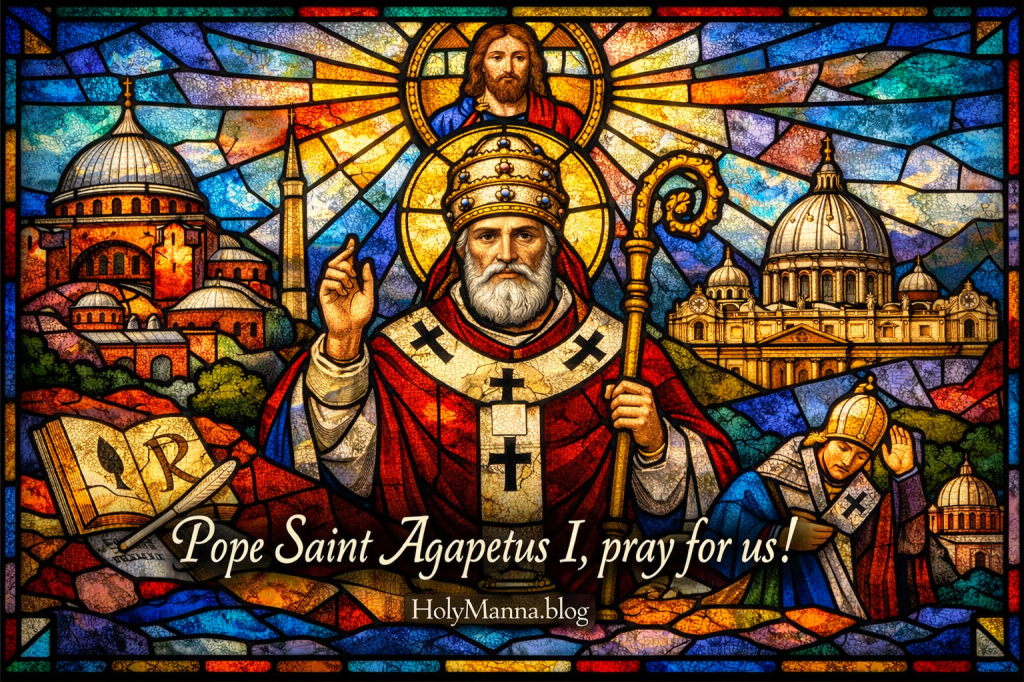
A Shepherd for a Dangerous Hour
Pope Saint Agapetus I is one of those saints whose life can be easy to overlook at first glance. His papacy was short, lasting less than a year, and yet the Church remembers him with deep gratitude because he stood firm at a moment when confusion about the truth of Christ threatened the peace of the Church. He is revered not because he left behind a long reign full of public triumphs, but because he showed what a faithful pope looks like when truth is under pressure.
He is remembered above all for defending orthodox Catholic teaching in the East, especially in Constantinople, where he confronted false doctrine and refused to let political power decide the faith of the Church. In a time when emperors, bishops, and court factions all pulled in different directions, Pope Saint Agapetus I stood where the Successor of Peter was meant to stand. He stood with the truth.
That is why his memory matters. He reminds the faithful that holiness is not measured only by length of years, public admiration, or dramatic miracles. Sometimes holiness looks like courage, clarity, and fidelity when compromise would have been easier.
From Roman Roots to the Chair of Peter
The details of Agapetus’s early life are not abundant, which is often the case with saints from the early centuries of the Church. Catholic tradition identifies him as a Roman by birth and the son of a priest named Gordianus. His father is said to have died during the violent disturbances that marked the time of Pope Symmachus. That detail alone gives a glimpse into the world that helped shape him. He was formed in a Church that was not living in ease or peace, but in the middle of political tension, factional struggles, and doctrinal battles.
Before becoming pope, Agapetus had already risen to prominence in the Roman clergy. He served as an archdeacon, which means he was not an obscure figure suddenly thrust into leadership. He was already known as a man of responsibility, discipline, and ecclesial service. By the time he was elected pope in 535, he was already advanced in age. He did not come to the papacy as a young reformer full of worldly ambition. He came as an older churchman, tested by hardship and prepared by long service.
There is no dramatic conversion story attached to his life in the way that one finds with saints like Augustine or Mary of Egypt. Instead, his life seems to show something quieter and just as beautiful. He appears to have grown steadily into holiness through faithful service to the Church. That kind of sanctity matters too. Not every saint is struck by lightning on the road to Damascus. Some saints become holy by enduring, serving, praying, and remaining steadfast year after year.
Agapetus is most known for defending the doctrine of Christ against heresy and for exercising papal authority with unusual courage in Constantinople. That is the work for which history remembers him, and it is the reason the Church still honors his name.
The Strength of a Quiet Defender
One of the first signs of Agapetus’s wisdom as pope came not in a dramatic confrontation with heresy, but in a humble act of healing. Early in his pontificate, he had an old anathema publicly burned, bringing closure to a past Roman conflict. That may seem like a small thing, but it reveals his heart. He did not begin his papacy by stirring up old grudges. He began by helping the Church breathe again.
He also dealt with important questions of discipline in both Africa and Gaul. He confirmed decrees concerning those who had come from Arianism and addressed the case of a bishop in Gaul who required a new trial. These actions show that he took seriously both truth and justice. He was not careless with doctrine, and he was not careless with souls.
Still, the defining moment of his life came when he traveled to Constantinople. He went there originally as part of a mission tied to the political conflict between the Ostrogoths and Emperor Justinian. Yet what began as a political embassy became a spiritual and doctrinal battle.
In Constantinople, Agapetus found that the patriarch Anthimus had risen to power under troubling circumstances and was associated with false teaching hostile to the Council of Chalcedon. The Catholic Church teaches that Jesus Christ is one divine Person in two natures, fully God and fully man, a truth beautifully summarized in The Catechism at CCC 467. This was not a minor theological disagreement. It was about the identity of Jesus Christ Himself. To distort Christ is to wound the Gospel.
Agapetus refused to ignore the problem. He demanded a profession of true faith. When Anthimus would not comply, Agapetus acted decisively. He broke communion with him and deposed him. Then he consecrated Mennas as the new patriarch of Constantinople.
That moment is one of the great reasons the Church remembers him. He showed that the pope was not merely a ceremonial figure who blessed political arrangements after the fact. He showed that the office of Peter had a real duty to guard the faith.
Catholic sources preserve one striking saying from Agapetus when Emperor Justinian tried to intimidate him. Agapetus said, “With eager longing have I come to gaze upon the Most Christian Emperor Justinian. In his place I find a Diocletian, whose threats, however, terrify me not.” It is a bold line, and it reveals the soul of the man. He was respectful, but he was not afraid. He knew that no emperor had the right to bully the Church into doctrinal surrender.
Another saying attributed to him in Catholic tradition reflects the same spirit. When Justinian submitted a written profession of faith, Agapetus approved it, but maintained that a layman could not claim the role of teacher in religion. His joy was that the emperor’s statement agreed with the Fathers, not that the emperor had authority over the Church’s teaching office.
There are no major, well-attested miracle stories from Agapetus’s life preserved in the standard Catholic sources. That is worth saying plainly. His sanctity is not built on dramatic wonder tales. It is built on courage, fidelity, and a fearless defense of the truth. That may be less sensational, but it is no less saintly.
A Short Reign Filled with Trials
Agapetus’s life was not marked by martyrdom in the technical sense, but it was certainly marked by hardship. He lived in a fractured age when the Church was under pressure from political powers, theological controversy, and regional instability. His papacy was brief and burdened by the enormous tensions of his time.
Even his journey to Constantinople carried sacrifice. Catholic tradition says he had to pledge sacred vessels of the Roman Church to finance the mission. That detail says a great deal about the poverty and strain of the times. He was not traveling as a prince surrounded by luxury. He was a shepherd making costly choices for the good of the Church.
At Constantinople, he faced the resistance of powerful figures, including the influence of Empress Theodora and the pressure of imperial expectations. It would have been easier to soften his position, to speak vaguely, or to preserve peace at the expense of clarity. Instead, he endured the pressure and remained firm.
His body eventually gave way before his spirit did. After his victory in defending the faith and ordering the deposition of Anthimus, Agapetus fell ill in Constantinople. He died there on April 22, 536. There is something deeply moving in that ending. He died far from Rome, having spent his last strength in defense of the truth about Christ.
Though he was not killed by persecutors, his death still carries the beauty of sacrificial witness. He gave himself away in service to the Church, and he died in the middle of that offering.
The Saint Remembered After Death
After his death, the Church did not forget him. His body was brought back to Rome in a lead coffin and buried at Saint Peter’s. Even in death, he was returned to the heart of the Church he had served so faithfully.
His memory endured in both East and West. That is one of the most fascinating parts of his legacy. He was a Roman pope, but one of his greatest acts took place in Constantinople, and Eastern Christians remembered him with gratitude because he had defended orthodox faith against dangerous error. That kind of cross-regional veneration is not a small thing. It shows that his witness reached beyond local politics and into the deeper life of the whole Church.
His feast is commonly kept on April 22, the day of his death, though older traditions also remembered him on September 20. His liturgical remembrance has remained part of the Church’s calendar because the Church does not simply remember powerful men. She remembers holy ones who defended the faith with love and courage.
There are no major miracle traditions widely preserved in Roman Catholic sources concerning healings at his tomb or extraordinary posthumous interventions tied to his relics. If any local traditions once circulated, they have not remained central in the Church’s memory in the way they have for some other saints. Because of that, it would not be honest to invent a long list of miracle stories around him.
What can be said is that his impact after death has been real and enduring. He became part of the Church’s living memory as a pope who would not yield when the truth of Christ was threatened. There is also an archaeological legacy connected with him in Rome, where tradition associates his name with a library on the Caelian Hill. That small detail is beautiful. The man who defended doctrine also cared for the life of the mind, for books, and for the preservation of Christian learning.
One caution is worth mentioning. Pope Saint Agapetus I is sometimes confused with another Agapetus, a deacon who wrote advice for Emperor Justinian. Because of that, not every wise saying found online under the name “Agapetus” belongs to this pope. That confusion cannot always be verified, so it is best to remain careful.
What This Holy Pope Teaches the Church Today
Pope Saint Agapetus I speaks powerfully to a world that is tired, confused, and often afraid to speak clearly. His life teaches that charity and truth belong together. He was not harsh for the sake of harshness. He was firm because souls matter, doctrine matters, and Jesus Christ is too important to be reduced to a slogan or reshaped by politics.
There is also something deeply comforting in the fact that he is remembered more for fidelity than for spectacle. That matters in a time when many people equate importance with visibility. Agapetus shows that a short life, or a short season of influence, can still bear lasting fruit when it is offered fully to God.
His witness also encourages perseverance in daily vocation. He did not become holy through novelty. He became holy through faithfulness. He served the Church steadily, accepted responsibility, endured hardship, and acted bravely when the critical hour arrived. That is a path ordinary Catholics can understand.
What would happen if more Catholics loved the truth enough to defend it gently but firmly? What would happen if more fathers, mothers, priests, teachers, and friends stopped treating doctrine like an optional accessory and began receiving it as a gift that protects souls? What would happen if daily fidelity replaced the constant desire for drama?
The life of Pope Saint Agapetus I invites Catholics to know the faith well, love the Church more deeply, and refuse the temptation to let the spirit of the age dictate what must be believed. He also reminds the faithful to be humble. Truth is not a weapon for winning arguments. It is a gift to be received, guarded, and handed on with love.
A practical way to imitate him is to begin with seriousness about the teachings of the Church. Spend time with The Catechism. Learn why the Church teaches what she teaches about Jesus Christ. Speak clearly when truth is being distorted, but do so with charity. Stay faithful in small responsibilities. Be dependable. Be calm. Be brave. Holiness often grows there.
Engage with Us!
Share your thoughts and reflections in the comments below. Pope Saint Agapetus I may not be one of the most famous saints in popular devotion, but his witness is deeply needed in every age.
- What stands out most in Pope Saint Agapetus I’s courage and defense of the faith?
- How can his example help Catholics remain faithful when the truth becomes unpopular or pressured by the world?
- What part of his life challenges the heart most deeply: his firmness, his sacrifice, or his quiet fidelity?
- How can greater love for Christ and His Church shape daily decisions at home, at work, and in parish life?
May the example of Pope Saint Agapetus I strengthen every heart to live with conviction, humility, and peace. May his witness inspire a life rooted in truth, shaped by charity, and filled with the love and mercy Jesus taught us.
Pope Saint Agapetus I, pray for us!
Follow us on YouTube, Instagram and Facebook for more insights and reflections on living a faith-filled life.


Leave a Reply