Wednesday of the Third Week of Easter – Lectionary: 275
Scattered Into Joy, Gathered by the Bread of Life
Some days in the Christian life feel like gathering, and some feel like scattering. Today’s readings speak to both. They reveal a God who does not lose His people when the world grows violent, uncertain, or hungry. Instead, He draws them deeper into His plan. The central theme tying these passages together is this: Christ sustains His people in every trial, feeds them with divine life, and turns even suffering into a path toward joy, mission, and resurrection.
In Acts of the Apostles, the Church is reeling after the martyrdom of Stephen. Persecution breaks out, believers are driven from Jerusalem, and Saul is ravaging the Church. Humanly speaking, it looks like collapse. But the risen Lord is already at work inside that chaos. Those who are scattered do not stop preaching. Philip goes into Samaria, a place long marked by religious tension and historical division, and proclaims the Messiah there. That detail matters. The Gospel is already breaking past old boundaries. What began in Jerusalem is now reaching the margins, showing that the saving work of Christ is for all peoples. What looked like defeat becomes mission, and what looked like loss becomes fruitfulness.
Psalm 66 gives the Church the right way to read that moment. The psalm remembers the mighty deeds of God, especially His power to lead His people through impossible places. The One who once brought Israel through the sea is the same Lord now guiding the Church through persecution. The pattern is unmistakable. God does not always remove the trial at once, but He never stops leading His people through it. That is why the psalm calls the whole earth to worship. The proper response to God’s power is trust, praise, and awe.
Then The Gospel of John brings everything to its deepest center. Jesus says, “I am the bread of life.” That is the key that unlocks the whole day. The scattered Church can endure because she is not living on human strength alone. She is sustained by the Son who came down from heaven to do the Father’s will. He is not only a teacher to admire or a prophet to remember. He is the living Bread who satisfies the deepest hunger of the soul and the faithful Savior who promises, “I will not reject anyone who comes to me.” In the Easter season, the Church places these words before her children so they can see clearly that the risen Christ is still feeding, guarding, and gathering His people, even when life feels fractured.
Taken together, today’s readings invite the heart to see the Christian life with new eyes. Persecution, displacement, weakness, and spiritual hunger do not have the final word. Christ does. He sends His people into the world, fills them with His life, and promises to raise them up on the last day. That is why sorrow in Acts, praise in Psalm 66, and hope in The Gospel of John all belong in the same story. They tell the story of a Lord who can turn scattering into evangelization, fear into faith, and suffering into great joy.
First Reading – Acts 8:1-8
When the Enemy Scattered the Church, Christ Sent Her Further
The first reading picks up in the shadow of Saint Stephen’s martyrdom, so the air is still heavy with grief, fear, and blood. The Church in Jerusalem is no longer living in the freshness of Pentecost alone. She is now entering the mystery of the Cross in a public and painful way. Saint Luke shows that this persecution was severe, and the ancient context matters here. Many scholars note that the first wave of violence seems to have struck especially the Hellenist believers, the same circle connected to Stephen, while the apostles remained in Jerusalem. At the same time, Philip’s movement into Samaria is not a random travel note. Samaria was a place of old wounds, religious suspicion, and deep separation from mainstream Jewish life. Yet this is exactly where the Gospel goes. What seems like collapse becomes expansion. What seems like defeat becomes mission. That is why this reading fits today’s larger theme so beautifully: Christ does not lose His people when they are scattered. He uses even suffering to spread His saving work and bring joy where division once reigned.
Acts 8:1-8 – New American Bible (Revised Edition)
Persecution of the Church. 1 On that day, there broke out a severe persecution of the church in Jerusalem, and all were scattered throughout the countryside of Judea and Samaria, except the apostles. 2 Devout men buried Stephen and made a loud lament over him. 3 Saul, meanwhile, was trying to destroy the church; entering house after house and dragging out men and women, he handed them over for imprisonment.
Philip in Samaria. 4 Now those who had been scattered went about preaching the word. 5 Thus Philip went down to [the] city of Samaria and proclaimed the Messiah to them. 6 With one accord, the crowds paid attention to what was said by Philip when they heard it and saw the signs he was doing. 7 For unclean spirits, crying out in a loud voice, came out of many possessed people, and many paralyzed and crippled people were cured. 8 There was great joy in that city.
Detailed Exegesis
Verse 1. “On that day, there broke out a severe persecution of the church in Jerusalem, and all were scattered throughout the countryside of Judea and Samaria, except the apostles.”
The phrase “on that day” ties this persecution directly to Stephen’s witness and death. His martyrdom is not an isolated tragedy. It becomes the spark for a wider assault on the Church. Yet Saint Luke quietly shows the reader that this scattering is already moving in the direction Christ foretold in Acts 1:8, from Jerusalem into Judea and Samaria. What looked like the breaking of the Church becomes the spreading of the Church. God does not approve the evil of persecution, but in His providence He can make even the violence of His enemies serve the advance of the Gospel.
Verse 2. “Devout men buried Stephen and made a loud lament over him.”
This verse is tender and important. The Church does not treat martyrdom as something cold or emotionally detached. Stephen died in grace, but the faithful still mourn him deeply. Christian sorrow is never a denial of resurrection. It is love grieving in hope. The burial also honors Stephen’s body, which matters in Catholic thought because the body is not disposable. The body of a baptized believer belongs to Christ and is destined for resurrection. Even in persecution, the Church keeps reverence, mercy, and human dignity.
Verse 3. “Saul, meanwhile, was trying to destroy the church; entering house after house and dragging out men and women, he handed them over for imprisonment.”
Saint Luke does not soften Saul’s fury. He is not merely disagreeing with the Church. He is ravaging her. The detail that he drags out both men and women shows how widespread and ruthless the persecution had become. This verse also gives one of the clearest examples of the mystery that Christ later reveals to Saul on the road to Damascus: to attack the Church is to attack Christ Himself. The Church is not just a human association. She is the Body of Christ. That is why persecution against believers is such a grave offense, and also why the Lord so fiercely guards His own.
Verse 4. “Now those who had been scattered went about preaching the word.”
This is the great surprise of the passage. The scattered believers do not become silent refugees. They become witnesses. They do not wait until life feels safe again. They carry the Word with them. This is profoundly Catholic. The faith is not something hidden in the heart alone. It must be professed, lived, and spread. The Church grows because ordinary believers, driven by grace, speak the name of Jesus where they are sent. Persecution intended to choke the Gospel only multiplies its voices.
Verse 5. “Thus Philip went down to [the] city of Samaria and proclaimed the Messiah to them.”
Philip, one of the Seven, steps into a place marked by centuries of tension. Jews and Samaritans shared certain roots, but their relationship was strained by schism, suspicion, and mutual hostility. That is why this moment matters so much. The Gospel is already healing ancient divisions. Philip does not go to Samaria with a social theory or political message. He proclaims the Messiah. The center of Christian mission is always Christ Himself. The Lord is not simply gathering like-minded people. He is building one people from divided peoples.
Verse 6. “With one accord, the crowds paid attention to what was said by Philip when they heard it and saw the signs he was doing.”
The people listen because proclamation and signs go together. In Catholic theology, miracles are never stage effects. They are signs that confirm the saving presence of Christ. Philip’s preaching is not validated by charisma alone. It is accompanied by works that reveal divine authority. Saint Luke also says the crowds respond “with one accord,” which suggests the beginning of communion. The Gospel does not merely inform minds. It gathers persons into unity around the truth of Christ.
Verse 7. “For unclean spirits, crying out in a loud voice, came out of many possessed people, and many paralyzed and crippled people were cured.”
This verse shows the kingdom of God confronting the kingdom of darkness in visible form. Demons are cast out. The afflicted are healed. The crippled are restored. The Church has always seen such signs as manifestations of the risen Lord’s power. As The Catechism teaches, Christ continues to confirm His mission through signs worked in His name, and these signs reveal that Jesus is truly the Savior. At the same time, Catholic faith never reduces the Gospel to miraculous phenomena. The miracles point beyond themselves. They reveal that Christ has come to free the whole person, body and soul, from the reign of sin, evil, and death.
Verse 8. “There was great joy in that city.”
This is the fruit of the whole passage. Not merely amazement. Not temporary excitement. Joy. That is the mark of the Gospel when it is received. A city once burdened by spiritual oppression and old division becomes a place of rejoicing. Joy in Acts is never shallow emotion. It is the sign that salvation has entered a people. The reading begins with lament over Stephen and ends with joy in Samaria. That arc is deeply Christian. The Cross is real, but grace is stronger. Christ can bring a city from sorrow to joy, just as He can bring a soul from fear to faith.
Teachings
This reading teaches that the Church is missionary even when she is wounded. In fact, some of the Church’s greatest moments of expansion have come through suffering. Saint John Chrysostom saw this clearly when he wrote of persecution, “The persecution turned out to be no slight benefit”, and then added the striking phrase, “they dispersed the teachers.” His point is simple and powerful. The enemies of Christ unintentionally helped spread the Gospel further. What they meant for ruin, God bent toward mission.
That same truth appears in the Church’s official teaching. CCC 1816 says, “The disciple of Christ must not only keep the faith and live on it, but also profess it, confidently bear witness to it, and spread it.” The same paragraph also reminds the faithful that service of and witness to the faith are necessary for salvation, and it speaks honestly of following Christ “amidst the persecutions which the Church never lacks.” That line fits Acts 8 perfectly. The Church in Jerusalem is already walking the road her Lord walked first. Persecution is not proof that Christ has abandoned His Church. It is often the place where her fidelity becomes most visible.
This reading also teaches that the Church’s mission is catholic in the deepest sense of the word. Philip goes to Samaria because the Gospel is not for one tribe, one region, or one social circle. Saint John Paul II expressed this clearly in Redemptoris Missio when he wrote, “The Church is missionary by her very nature.” That is not a side project for especially zealous Christians. It is part of the Church’s identity. Samaria becomes a turning point because Christ is already gathering into one body those whom history had kept apart.
The miracles in this passage also deserve careful Catholic attention. CCC 1507 teaches, “The risen Lord renews this mission and confirms it through the signs that the Church performs by invoking his name.” Then CCC 1508 adds, “The Holy Spirit gives to some a special charism of healing so as to make manifest the power of the grace of the risen Lord.” That is exactly what appears in Philip’s ministry. Yet the Church also insists that physical healing is not the whole story. Every healing sign points toward a greater liberation. Christ has come to conquer sin, Satan, and death itself. The cure of the body is a sign of the deeper salvation of the human person.
There is also a beautiful historical and spiritual lesson in the movement from Stephen to Philip. Stephen dies as a witness. Philip goes out as a preacher. One man’s blood waters the ground, and another man’s preaching gathers the harvest. This has always been part of the Church’s story. The age of martyrs did not weaken Catholicism. It purified it, strengthened it, and spread it. The blood of the witnesses became seed because Christ, the risen Lord, remained alive in His people.
Reflection
This reading lands close to home because most Christian scattering does not look like the Roman persecutions at first. Sometimes it looks like a painful diagnosis, a job loss, rejection from family, a season of dryness, or the quiet humiliation of being mocked for fidelity to the faith. The temptation in those moments is to believe that everything holy has been interrupted. But Acts 8 says otherwise. The Lord can make even unwanted scattering fruitful. He can turn a wound into a witness and a setback into a sending.
One practical lesson from this reading is that the Christian response to hardship cannot be spiritual paralysis. Philip did not arrive in Samaria complaining about Jerusalem. He arrived proclaiming Christ. That does not mean Christians suppress grief. Stephen was mourned loudly, and rightly so. It means grief must not become the grave of mission. Sorrow can coexist with courage. Tears can coexist with witness. The heart can ache and still speak the name of Jesus.
Another lesson is that the Gospel must cross boundaries. Philip went into Samaria, into tension, into old division, into unfamiliar ground. That remains a challenge for Catholic life now. The Lord still asks His people to bring truth and charity into places that feel hostile, indifferent, or spiritually confused. The mission field is often the place that feels uncomfortable.
A third lesson is that joy is one of the clearest signs that Christ is truly present. Not entertainment. Not noise. Not a passing emotional high. Real joy, the kind that comes when bondage is broken and truth is received. The question for the soul is not merely whether it is busy with religious activity. The deeper question is whether it is bringing others closer to the liberating presence of Christ.
What unwanted scattering in life might actually be a place where Christ is sending the soul to witness more faithfully?
Has grief become an excuse for silence, or has it been surrendered to God so that it can become fruitful?
Where is the Lord asking for greater courage to proclaim Christ in places marked by tension, division, or spiritual need?
The path forward is simple, even if it is not easy. Stay close to Christ. Refuse despair. Speak the truth with charity. Carry the Gospel into the place that did not feel chosen. That is how the Church moved from Jerusalem into Samaria. That is also how a Catholic soul learns that Christ can still bring great joy out of seasons that once looked ruined.
Responsorial Psalm – Psalm 66:1-7
The Song of a People Who Have Seen God Make a Way
The responsorial psalm for today sounds like the voice of a people who have walked through terror and come out praising. That matters because it fits perfectly beside the first reading from Acts. The Church is being scattered by persecution, yet the psalm teaches the heart how to interpret such moments. God is not absent in upheaval. He is the Lord who acts, delivers, and leads His people through what looks impossible. Psalm 66 is a hymn of praise that remembers the mighty deeds of God, especially His power over history, nations, and the chaos that frightens human hearts. In the liturgical life of the Church, psalms like this one become the prayer of Christ and His Body. During the Easter season, this language takes on even greater depth. The God who once led Israel through the sea has now raised Christ from the dead, and He still leads His people through every trial toward joy. That is why this psalm belongs so beautifully to today’s theme. The same Lord who scattered the disciples into mission is the Lord who remains worthy of worship because He never stops guiding His people.
Psalm 66:1-7 – New American Bible (Revised Edition)
Praise of God, Israel’s Deliverer
1 For the leader. A song; a psalm.
2 Shout joyfully to God, all the earth;
sing of his glorious name;
give him glorious praise.
3 Say to God: “How awesome your deeds!
Before your great strength your enemies cringe.
4 All the earth falls in worship before you;
they sing of you, sing of your name!”
Selah5 Come and see the works of God,
awesome in deeds before the children of Adam.
6 He changed the sea to dry land;
through the river they passed on foot.
There we rejoiced in him,
7 who rules by his might forever,
His eyes are fixed upon the nations.
Let no rebel rise to challenge!
Selah
Detailed Exegesis
Verse 1. “For the leader. A song; a psalm.”
This opening line is brief, but it tells the reader something important but it tells the reader something important. This prayer was meant for worship. It was not a private spiritual diary. It belonged to the assembly, to the people gathered before God. The Church has always inherited Israel’s psalms as her own prayer because these inspired songs teach the faithful how to adore, lament, hope, and remember. Even before the content begins, the superscription reminds the soul that praise is not a side note in the life of faith. It is part of the Church’s public worship.
Verse 2. “Shout joyfully to God, all the earth; sing of his glorious name; give him glorious praise.”
The psalm opens with an invitation to the whole earth, not just to Israel. That universal language is important. The God of the covenant is not a tribal deity. He is Lord of all creation. This verse also reveals that true praise involves both joy and truth. God is praised for who He really is, and His name is called glorious because His works reveal His holiness, power, and mercy. In light of today’s readings, this universal call to praise foreshadows the widening mission of the Gospel. The Church in Acts is already moving outward, and the psalm had long prepared the world for that expansion.
Verse 3. “Say to God: ‘How awesome your deeds! Before your great strength your enemies cringe.’”
This verse gives words to holy awe. The biblical sense of awe is not shallow excitement. It is the trembling recognition that God is utterly beyond human power and yet actively involved in history. His deeds are not myths or poetic wishes. They are acts of divine intervention. The line about enemies cringing does not celebrate cruelty. It proclaims that no rebellion can finally overthrow the Lord. For believers facing persecution, that truth matters deeply. Oppressors may look strong for a time, but God remains the true ruler of history.
Verse 4. “All the earth falls in worship before you; they sing of you, sing of your name!”
The language widens again. Worship belongs to all the earth because all creation ultimately belongs to God. This verse also reveals the missionary dimension of praise. When God’s deeds are known, the proper human response is worship. In the life of the Church, evangelization is never merely the spread of ideas. It is the invitation of the nations into adoration. The goal is not simply that people know about God, but that they fall in worship before Him.
Verse 5. “Come and see the works of God, awesome in deeds before the children of Adam.”
This verse sounds like an invitation to testimony. The psalmist does not say only, “Think about God,” but “Come and see.” Biblical faith is not built on vague sentiment. It is rooted in what God has done. The phrase “children of Adam” is especially beautiful because it reminds the reader that God’s mighty works address the whole human family. Fallen humanity, descended from Adam, is not left to itself. God enters history and acts for salvation. That line fits the Easter season wonderfully because the risen Christ comes precisely for the children of Adam, to heal what sin had broken.
Verse 6. “He changed the sea to dry land; through the river they passed on foot. There we rejoiced in him.”
This is the great memory at the heart of the psalm. The psalmist recalls the Exodus and also echoes the crossing into the Promised Land. Water, which often symbolizes danger, chaos, and death, becomes the place of divine deliverance. The Church has always seen in these events a foreshadowing of Baptism. God leads His people through the waters, not to destroy them, but to free them. That makes this verse especially important during Easter. The season is saturated with baptismal meaning because Christ’s Resurrection completes the saving pattern already hinted at in Israel’s history. The God who made a way through the sea is the God who now leads souls from sin to grace, from death to life.
Verse 7. “Who rules by his might forever, his eyes are fixed upon the nations. Let no rebel rise to challenge!”
The psalm ends this section with a strong confession of divine kingship. God does not rule only in the past. He rules forever. His eyes are on the nations, which means His providence is active, watchful, and universal. The warning against rebellion is not merely political language. It is a spiritual truth. Human pride always tries to resist God’s reign, but rebellion cannot endure before the Lord who sees all things. For the Christian reader, this verse becomes an anchor of confidence. Empires rise and fall. Persecutors appear and disappear. God remains enthroned.
Teachings
This psalm teaches the soul how to remember. That may sound simple, but it is one of the deepest spiritual disciplines in all of Scripture. The people of God are constantly called to remember what the Lord has done, because forgetfulness leads quickly to fear, ingratitude, and rebellion. Here the psalmist remembers the crossing of the sea, and that memory becomes fuel for present trust. The Church reads this through the light of Christ and sees more than ancient history. She sees the pattern of salvation itself. God delivers. God leads. God deserves praise.
The Catechism teaches that the crossing of the Red Sea prefigures the liberation brought by Baptism. That means Psalm 66 is not only about Israel’s past. It is also about the Christian soul. The same God who made dry land through the sea now leads the baptized through the waters into new life. This is one reason the Church prays the psalms so constantly. They are not relics from an earlier religion. They are living prayer in the mouth of Christ and His people.
This psalm also teaches the universality of salvation. The repeated references to “all the earth” and the “children of Adam” reveal a horizon larger than one nation’s survival. God’s deeds are meant to summon the whole world to worship. That truth fits beautifully with Philip preaching in Samaria. The Church’s mission is already unfolding along the lines the psalm had long anticipated. The Lord who delivered Israel is drawing the nations toward Himself.
Saint Augustine spoke often about the psalms as the prayer of the whole Christ, Head and members together. That insight helps unlock this reading. When the Church sings this psalm, she is not merely recalling someone else’s deliverance. She is praying in Christ, with Christ, and through Christ. The Exodus becomes a sign of the Paschal Mystery. The sea becomes an image of death overcome. The call to all the earth becomes the song of the Gospel going forth.
There is also a deeply moral lesson here. The psalm praises the God whose “eyes are fixed upon the nations.” Nothing is hidden from Him. That truth should both console and purify the heart. It consoles because suffering, injustice, and persecution do not escape His notice. It purifies because the soul cannot live as though God were absent. Praise, trust, obedience, and holy fear belong together. The one who truly remembers God’s mighty deeds cannot live carelessly before His face.
Reflection
This psalm speaks to every soul that has forgotten how to praise in the middle of pressure. That happens more often than people admit. When life becomes exhausting, prayer easily shrinks into petition alone. The heart asks for help, which is good, but forgets to remember. Psalm 66 gently corrects that habit. It teaches that praise is not what remains after the crisis is over. Praise is one of the ways the soul survives the crisis faithfully.
One practical way to live this psalm is to make a habit of remembering God’s past faithfulness. The psalmist does not invent confidence out of thin air. He looks back at what God has done. That is a lesson for daily Catholic life. A soul that remembers past mercies is less likely to panic in present trials. The family that remembers answered prayers, providential rescues, and quiet graces learns to trust more steadily when new hardships come.
Another practical lesson is that worship must stay central. The psalm begins and ends with the greatness of God, not the greatness of human problems. That does not make suffering unreal. It places suffering in the presence of the Lord who rules forever. When worship fades, fear tends to grow louder. When worship deepens, perspective returns.
This psalm also invites the soul to ask whether it has been living more from memory or from anxiety. A Christian who remembers the mighty deeds of God begins to read life differently. Even the waters that seem threatening may become the place where God reveals His power.
Where has the heart forgotten the works God has already done, and how has that forgetfulness weakened trust?
What would change in daily life if praise became a regular part of prayer, not only after blessings are obvious, but even in the middle of uncertainty?
Is the soul living as though God truly rules forever, or as though the loudest crisis has the final word?
The beauty of this psalm is that it does not ask the faithful to pretend everything is easy. It asks them to remember who God is. He is the One who leads through the sea, watches over the nations, receives the worship of the earth, and turns memory into courage. That is why this song belongs in Easter. The Church sings it because Christ is risen, the waters have been crossed, and the people of God still have every reason to rejoice.
Holy Gospel – John 6:35-40
The Bread of Life Who Will Not Cast Out His Own
The Holy Gospel brings the whole day to its deepest center. The Church has heard about believers being scattered in Acts of the Apostles and has sung in Psalm 66 of the God who leads His people through impossible waters. Now the Lord Himself speaks and reveals why the Church can endure persecution, hunger, and uncertainty without losing hope. This passage comes from the Bread of Life discourse in The Gospel of John, delivered after the multiplication of the loaves. The crowd has already seen a miracle, but Jesus is leading them beyond amazement at material bread into the mystery of faith, divine sonship, and eternal life. He is not offering temporary relief alone. He is revealing Himself as the true nourishment of the human soul.
This setting matters deeply. In the ancient world, bread was a daily necessity, not a decorative extra. To speak of bread was to speak of survival. So when Jesus says, “I am the bread of life,” He is not using a casual image. He is claiming to be as necessary to the soul as food is to the body, and even more so. The Church has always read this discourse with Eucharistic reverence, especially in light of the Mass, where the faithful receive not a symbol emptied of power, but the Lord who gives Himself for the life of the world. That is why this Gospel fits so perfectly with today’s theme. The scattered Church in Acts is not sustained by courage alone. She is sustained by Christ. He is the Bread who feeds His people, the Son who obeys the Father, and the Savior who promises to raise up those who belong to Him on the last day.
John 6:35-40 – New American Bible (Revised Edition)
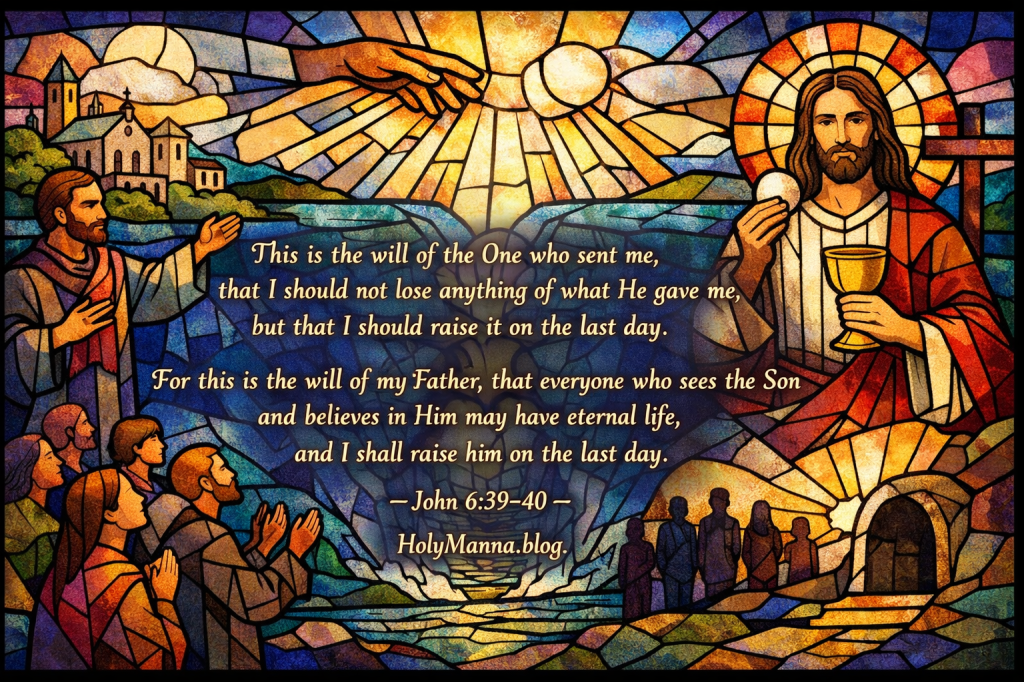
35 Jesus said to them, “I am the bread of life; whoever comes to me will never hunger, and whoever believes in me will never thirst. 36 But I told you that although you have seen [me], you do not believe. 37 Everything that the Father gives me will come to me, and I will not reject anyone who comes to me, 38 because I came down from heaven not to do my own will but the will of the one who sent me. 39 And this is the will of the one who sent me, that I should not lose anything of what he gave me, but that I should raise it [on] the last day. 40 For this is the will of my Father, that everyone who sees the Son and believes in him may have eternal life, and I shall raise him [on] the last day.”
Detailed Exegesis
Verse 35. “Jesus said to them, ‘I am the bread of life; whoever comes to me will never hunger, and whoever believes in me will never thirst.’”
This is one of the great “I am” declarations in The Gospel of John, and it carries tremendous weight. Jesus does not merely say that He gives bread. He says that He is the bread of life. That means life is not found apart from Him. The deepest hunger of the human person is not merely for comfort, success, affection, or even earthly peace. It is for communion with God. Christ alone satisfies that hunger because He alone brings divine life.
The two phrases, “comes to me” and “believes in me,” belong together. To come to Christ is not only to approach Him physically or admire Him intellectually. It is to entrust the whole self to Him. Faith, in the Catholic sense, is personal adherence to Jesus Christ. This verse also prepares the Church for the Eucharistic mystery. The Lord first speaks in the language of faith, but the whole Bread of Life discourse unfolds toward sacramental depth. The soul must believe in the One who will later say that His flesh is true food and His blood true drink. The hunger Christ satisfies is spiritual, but it is not vague. It is fulfilled in union with Him.
Verse 36. “But I told you that although you have seen [me], you do not believe.”
This is a sobering line. The crowd has seen miracles, yet sight alone has not led them into faith. That remains a warning for every age. It is possible to be close to holy things and still remain inwardly closed. It is possible to witness signs and still refuse surrender. Jesus exposes the tragedy of unbelief here. The real problem is not lack of evidence alone. The deeper problem is the hardness of the human heart.
This verse also reminds the faithful that faith is grace. It is not merely the result of collecting data. Miracles can open the door, but the heart must still yield. Many people want the gifts of God without wanting God Himself. The crowd wants bread that fills the stomach, but Jesus is offering Himself as the Bread that gives eternal life. Unbelief begins whenever the soul prefers the lesser gift to the Giver.
Verse 37. “Everything that the Father gives me will come to me, and I will not reject anyone who comes to me.”
This verse is full of tenderness and security. Jesus reveals that salvation begins in the Father’s loving initiative. Those who come to the Son do so because the Father is drawing them. Yet the verse also gives one of the most consoling promises in the Gospel: “I will not reject anyone who comes to me.” The Catholic heart should linger here. Christ is not reluctant to receive sinners who come in faith and repentance. He is not looking for a reason to cast them away. He receives those whom the Father draws.
This does not erase human freedom, nor does it support spiritual laziness. Rather, it shows that grace precedes, invites, and sustains conversion. The soul is not saved by forcing its way upward. It is drawn by the Father and welcomed by the Son. This line is also deeply pastoral. Many souls carry shame, fear, or the memory of serious sin and quietly wonder if Christ will really receive them. This verse answers that fear with astonishing clarity. No one who truly comes to Him is turned away.
Verse 38. “Because I came down from heaven not to do my own will but the will of the one who sent me.”
Here Jesus reveals both His heavenly origin and His perfect obedience. He has come down from heaven, which means He is not merely another prophet raised up from the earth. He is the eternal Son sent by the Father. At the same time, His mission is marked by total filial obedience. He does not act independently or competitively against the Father. The Father’s will and the Son’s mission are perfectly united.
This verse opens the mystery of salvation at its deepest level. Human history was wounded by disobedience, beginning with Adam. Christ comes as the obedient Son who repairs what sin has broken. He does not seek His own agenda. He fulfills the Father’s saving will. That is why the Cross will later become not a defeat, but the supreme act of loving obedience. Even here, in the Bread of Life discourse, the shadow of Calvary is already present.
Verse 39. “And this is the will of the one who sent me, that I should not lose anything of what he gave me, but that I should raise it [on] the last day.”
This verse strengthens the promise of the previous one. The Father’s will is not vague goodwill. It is the concrete saving purpose that the Son should lose nothing of what has been entrusted to Him. Christ is not a fragile shepherd who misplaces His flock. He is the faithful Son who guards what the Father gives Him. That promise becomes even more striking with the words about resurrection. Salvation is not complete until the body itself is raised on the last day.
Catholic teaching takes this with full seriousness. The final hope of the Christian is not an escape from embodiment, but the resurrection of the dead. Jesus does not promise merely spiritual survival. He promises victory over death itself. This verse lifts the eyes of the Church beyond present suffering. Persecution, illness, weakness, and death do not write the last chapter. Christ will raise up His own.
Verse 40. “For this is the will of my Father, that everyone who sees the Son and believes in him may have eternal life, and I shall raise him [on] the last day.”
The final verse gathers the whole passage into one luminous promise. Eternal life begins now through faith, but it reaches its fullness in the resurrection on the last day. To “see the Son” here is more than physical sight. Many saw Jesus with bodily eyes and still did not believe. This is the seeing of faith, the recognition that the man before them is the eternal Son sent by the Father.
The repeated promise, “I shall raise him [on] the last day,” gives the passage its unmistakable horizon. The Bread of Life discourse is not only about present consolation. It is about final destiny. The believer lives now with hope rooted in a future that Christ Himself guarantees. The soul that feeds on Him by faith and, in the fullness of the discourse, by the Eucharistic mystery, is being prepared for everlasting communion with God.
Teachings
This Gospel teaches first that faith in Jesus Christ is necessary for salvation. CCC 161 states, “Believing in Jesus Christ and in the One who sent him for our salvation is necessary for obtaining that salvation.” That teaching rests beautifully inside today’s Gospel. Jesus does not present belief as an optional spiritual enhancement. He presents it as the path to eternal life. To believe is to entrust oneself to the Son whom the Father has sent.
This Gospel also opens naturally into the Church’s Eucharistic faith. Even though today’s passage comes before the later and more explicit Eucharistic lines in John 6, the Church has always heard this chapter as deeply sacramental. CCC 1324 gives one of the Church’s clearest statements on the Eucharist: “The Eucharist is ‘the source and summit of the Christian life.’” That matters here because the Bread of Life discourse is not exhausted by metaphor. Jesus does not merely inspire. He feeds. He gives Himself. The Church hears in this passage the beginning of a mystery that reaches the altar.
Saint Augustine expresses this with remarkable simplicity when he says, “Believe, and you have eaten.” That line does not reduce the Eucharist to a symbol. It shows that faith is the necessary interior beginning of communion with Christ. One cannot receive the Lord fruitfully without faith. The heart must come before the mouth receives. Augustine also helps guard against a shallow reading of the passage. Christ is not discussing physical appetite alone. He is addressing the hunger of the soul for truth, mercy, and divine life.
This Gospel also teaches the stunning security of those who belong to Christ. CCC 989 says, “We firmly believe, and hence we hope that, just as Christ is truly risen from the dead and lives for ever, so after death the righteous will live for ever with the risen Christ and he will raise them up on the last day.” That is almost a direct echo of today’s Gospel. The Christian hope is not wishful thinking. It rests on the promise of the risen Son who came from heaven to do the Father’s will and who will not fail in that mission.
Another beautiful teaching comes from CCC 1391, which says, “Holy Communion augments our union with Christ.” That line helps connect today’s Gospel to daily Catholic life. The soul does not live on inspiration alone. It needs sacramental union with Jesus. The Christ who promises never to reject those who come to Him is the same Christ who gives Himself in the Eucharist to strengthen, heal, and preserve His people on the way to eternal life.
Historically, the Church has always cherished John 6 as a pillar of Eucharistic doctrine and devotion. The Fathers returned to it often because it reveals both the necessity of faith and the mystery of divine nourishment. In times of persecution, exile, and doctrinal confusion, Catholics have clung to these words because they reveal that Christ is not merely the teacher of truth, but the food of pilgrims. He feeds His Church while leading her toward resurrection.
Reflection
This Gospel reaches straight into the ordinary hunger of daily life. Every heart is hungry for something. Some hunger for security. Some hunger for affection. Some hunger for success, control, distraction, or relief. The problem is not that the soul hungers. The problem is that it often feeds on what cannot satisfy. Jesus steps into that restless human condition and says, “I am the bread of life.” He does not offer another temporary fix. He offers Himself.
That means daily Catholic life has to begin with honesty. Many people still live as though Christ were an accessory rather than nourishment. Prayer becomes occasional. Mass becomes negotiable. Confession becomes delayed. Scripture becomes background noise. Then the soul wonders why it feels spiritually weak. A body cannot stay strong without food, and a soul cannot stay strong while starving itself of Christ.
One practical step from this Gospel is to examine what the heart runs to first when it feels empty. Does it run to prayer, or only to noise. Does it turn toward the Eucharist, or only toward distraction. Does it bring its hunger to Christ, or try to smother it with lesser comforts. Another practical step is to take the Lord’s promise seriously. He says He will not reject the one who comes to Him. That means there is no reason to delay repentance. Shame often whispers that it is better to stay far away until the soul is stronger. Jesus says the opposite. Come now. Come poor. Come weak. Come hungry.
This Gospel also asks the faithful to live with the horizon of the last day in view. Modern life narrows everything to the immediate moment. The Gospel widens it again. The believer is not moving aimlessly through time. The believer is being carried toward resurrection. That changes how suffering is endured, how sin is resisted, and how death itself is faced.
What has the soul been feeding on lately, and has any of it truly satisfied the deeper hunger of the heart?
Does the heart really believe that Christ will not cast out the one who comes to Him, or is fear still keeping it at a distance?
How would daily life change if the promise of resurrection on the last day became more real than the anxieties of the present day?
The beauty of this Gospel is that it does not flatter human strength. It speaks to hunger, weakness, and dependence. That is why it is such good news. The soul does not need to become self-sufficient before approaching Christ. It needs to come to Him. He is the Bread of Life. He is the obedient Son. He is the One who loses nothing the Father has given Him. And He is still saying, with quiet divine authority, that whoever comes to Him will not be cast out, but will be raised up on the last day.
Fed for the Journey, Sent Into the World
Today’s readings tell one beautiful story from three different angles. In Acts 8:1-8, the Church is scattered by persecution, yet the Gospel spreads even farther. In Psalm 66:1-7, the people of God remember that the Lord has always made a way through waters that looked impossible. In John 6:35-40, Jesus reveals the deepest reason the faithful can endure every storm: He is the Bread of Life, and He will not cast out those who come to Him.
That is the heart of the day. The Christian life is not built on comfort, control, or human strength. It is built on Christ. When life feels scattered, He still sends. When the road feels uncertain, He still leads. When the soul feels empty, He still feeds. And when the fear of loss or death begins to whisper, He still promises resurrection on the last day.
There is something deeply comforting in seeing how these readings fit together. Stephen’s death does not stop the Church. Philip’s preaching brings joy to Samaria. The psalm recalls the God who once split the sea for His people. Then Jesus speaks with divine calm and says, in effect, that none of this is random. The Father is at work. The Son has come down from heaven. The faithful are not abandoned. They are being gathered, nourished, and carried toward eternal life.
That is why today is an invitation to trust more deeply. Not in passing emotions. Not in outward stability. Not in the illusion that life will become holy only when it becomes easy. Today is an invitation to come to Christ again with honesty and confidence. Come with the scattered parts of life. Come with grief. Come with fatigue. Come with hunger. Come with the sins that still need repentance and the fears that still need surrender. The Lord who fed the crowds, strengthened the Church, and conquered death has not changed.
Let today be a quiet turning point. Stay close to the Word of God. Return to prayer with attention. Approach the Eucharist with greater hunger and reverence. Refuse the lie that hardship means God is distant. He is often doing some of His deepest work there. The soul that remains near Christ will never be empty for long, and the life entrusted to Him will never be lost.
What would change if the heart truly believed that Jesus is enough for today’s hunger and tomorrow’s fear?
The answer begins the same way it always has. Come to Him. Trust Him. Follow Him. Let Him feed the soul, steady the heart, and lead the way home.
Engage with Us!
Readers are invited to share their reflections in the comments below. What stood out most in today’s readings, and where did the Lord seem to speak most clearly to the heart?
- In the First Reading from Acts 8:1-8, how does Philip’s courage in the middle of persecution challenge the way hardship is handled in daily life? Where might God be asking for faithfulness and witness even in an uncomfortable or painful situation?
- In the Responsorial Psalm from Psalm 66:1-7, what mighty works of God need to be remembered more often? How might daily prayer change if it included more gratitude, praise, and trust in the Lord’s power to lead through difficult waters?
- In the Holy Gospel from John 6:35-40, what does it mean personally that Jesus says, “I am the bread of life” and “I will not reject anyone who comes to me”? What has the soul been turning to for satisfaction, and how is Christ inviting a deeper trust in His presence and His promise of eternal life?
May today’s readings stir a deeper love for Christ, a greater trust in His providence, and a stronger desire to live the Gospel with conviction. Keep walking in faith, stay close to the Eucharistic Lord, and do everything with the love, mercy, and truth that Jesus taught.
Sacred Heart of Jesus, we trust in You!
Immaculate Heart of Mary, pray for us!
Saint Michael the Archangel, defend us in battle!
Follow us on YouTube, Instagram and Facebook for more insights and reflections on living a faith-filled life.


Leave a Reply