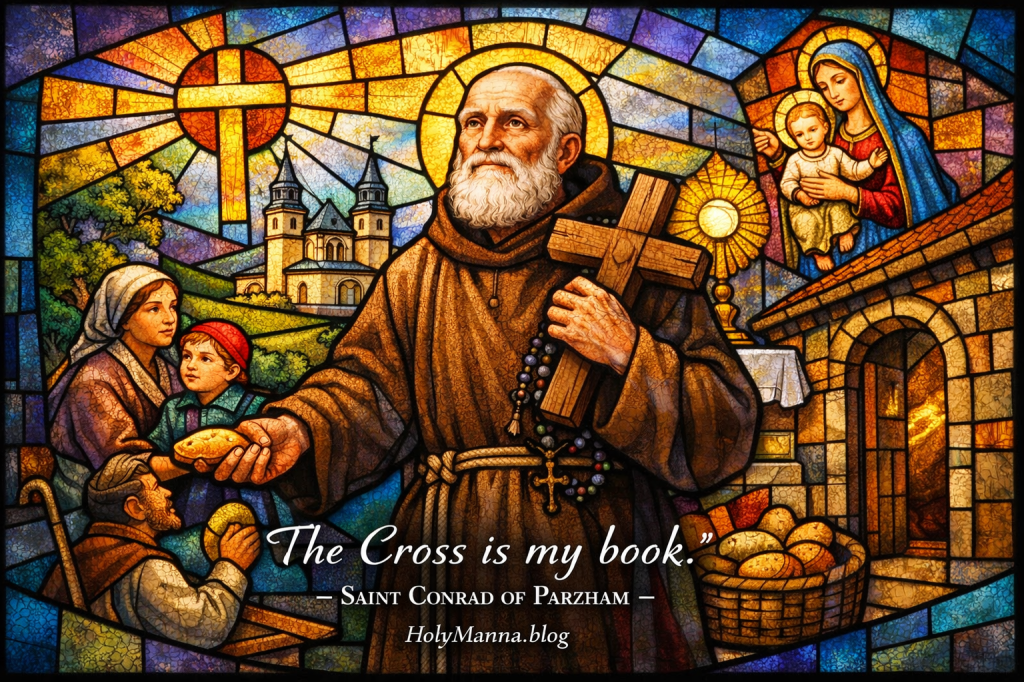
The Saint at the Door Who Opened Hearts to Heaven
Saint Conrad of Parzham is one of those saints who gently surprises the soul. He was not a bishop, not a missionary crossing oceans, and not a martyr shedding blood before a crowd. He was a Capuchin lay brother who spent most of his life answering a door. Yet the Church remembers him as a great saint because he turned that simple duty into a living work of mercy.
Born Johann Evangelist Birndorfer in Bavaria, Saint Conrad became known as the holy porter of the Capuchin friary in Altötting. For more than forty years he welcomed pilgrims, fed the poor, comforted the sorrowful, and quietly carried people’s burdens to God in prayer. He is revered because his life proves something the Church has always taught: holiness is not reserved for the powerful or the visible. Holiness is for the faithful. The Catechism teaches that all Christians are called to the fullness of Christian life and to the perfection of charity, CCC 2013. Saint Conrad lived that truth in a way that still speaks powerfully today.
What made him so beloved was not worldly success, but the way Christ seemed to shine through his humility, patience, silence, and love. He did small things with great love, and in doing so he became a saint for the universal Church.
From Bavarian Fields to the House of Our Lady
Saint Conrad was born on December 22, 1818, in Parzham in Lower Bavaria, Germany. He came from a large farming family and was the eleventh child. His birth name was Johann Evangelist Birndorfer. His early life was simple, rural, and marked by work, family duty, and the steady rhythm of Catholic life. But it was also marked by sorrow. His mother died when he was still young, and his father died not long afterward. These losses placed heavy responsibilities on his shoulders early in life.
As a young man, he worked on the family farm and could easily have remained there. His siblings expected that he would continue in that life. Yet the Lord was already drawing him more deeply. He was known for prayer, devotion to the Blessed Virgin Mary, and a serious love for the Mass. One striking detail from his early life shows the kind of man he was becoming: on Sundays he would sometimes walk long distances just to attend Mass. That is not the behavior of a man casually going through the motions. That is the heart of a man already being formed by grace.
Eventually, he recognized that God was asking for more. He gave up the security of inheritance and family property and sought entrance into the Capuchins. In 1849 he entered as a postulant. In 1851 he began his novitiate and received the name Conrad. In 1852 he made his profession. This was not a dramatic conversion from unbelief, but it was a deep and costly surrender. He left behind what was dear to him because he believed that God’s will was worth more than earthly security.
One of the lines associated with him captures that surrender beautifully: “It was God’s will: I had to leave everything that was dear and precious to me.” That sentence says so much. Saint Conrad did not build his life around comfort. He built it around obedience.
He is most known for what came next. After entering the Capuchins, he was assigned to the friary of Saint Anne in Altötting, one of Bavaria’s great pilgrimage towns dedicated to Our Lady. There he served as porter, the brother who answered the door, welcomed visitors, and cared for those who came seeking help. What looked like a small role became the path of his sanctification.
The Porter Who Preached Without a Pulpit
Saint Conrad’s life in Altötting was hidden, but it was anything but small. Day after day, year after year, he stood at the monastery gate receiving pilgrims, beggars, the sick, children, workers, and strangers. He distributed food to the poor, especially bread, and gave drink to those in need. On many days hundreds of people came to the door. He dealt with human weakness constantly. Some were grateful. Some were impatient. Some were rude. Some came simply because they were desperate.
And still he remained patient.
This is why he matters so much. Saint Conrad teaches that holiness is often tested not in rare heroic moments, but in repeated, ordinary interruptions. He lived the corporal works of mercy in a very direct way. The Catechism teaches that the works of mercy include feeding the hungry and comforting those who suffer, CCC 2447. Saint Conrad did not merely admire that teaching. He practiced it every day.
He also carried people spiritually. In the little time left to him, he withdrew to a tiny prayer space known as the Alexius cell, where he could direct his heart toward the altar and pray for the intentions people had entrusted to him. This is one of the most beautiful parts of his story. He was not simply a kind man at a door. He was a deeply prayerful religious brother whose service flowed from Eucharistic devotion and love for the Blessed Mother.
Several sayings preserved from him reveal the soul behind the labor. One of the best known is “The Cross is my book.” Another says, “My way of life consists mostly in loving and suffering, marveling and adoring.” Those are not the words of a man chasing comfort. Those are the words of a man who had learned how to find Christ in sacrifice, wonder, silence, and surrender.
As for miracles during his lifetime, Catholic accounts focus more on his hidden holiness than on dramatic public wonders. He was widely regarded as a man of unusual spiritual insight, and some traditions associate him with reading hearts or perceiving what people needed before they spoke. These stories fit the reputation he had among the faithful, but the details are not always fully documented. What can be said with confidence is that people sought him out not just for bread, but for counsel, peace, and prayer. That in itself says a great deal.
His daily life also included smaller moments that shine like little household miracles of grace. Children would sometimes ring the bell again and again just to test his patience. He did not lash out. A poor girl once dropped and shattered the dish she had brought to collect food for her family. Saint Conrad comforted her and made sure she received both the meal and a new container. These are not miracles in the spectacular sense, but they reveal something truly supernatural: a man whose heart had been conformed to Christ.
Trials at the Threshold
Saint Conrad was not a martyr, but that does not mean his path was easy. His hardships were the long, wearing trials of hidden sacrifice. He lived in obedience. He gave up his own plans. He accepted a humble office that would never make him important in the world’s eyes. He endured fatigue, interruption, misunderstandings, and the sharp edges of other people’s neediness.
This kind of suffering is easy to overlook, but it is real. Some of the poor and needy who came to the friary were demanding. Some insulted him when they did not receive what they wanted. He was often called away even at night. He had little privacy and little rest. Yet he did not allow hardship to harden him.
That may be one of the most needed lessons in his story. It is possible to become sour when life becomes repetitive and thankless. Saint Conrad chose another road. He bore hidden burdens with peace. He accepted the Cross without bitterness. His whole life became a quiet witness to the truth of Christ’s words in The Gospel of Matthew: “Take my yoke upon you and learn from me, for I am meek and humble of heart” Mt 11:29.
His hardships also included the discipline of fidelity. For over forty years he remained at the same post. In an age that constantly praises change, novelty, and visible achievement, Saint Conrad’s perseverance can feel almost shocking. He did not need a platform. He needed grace. He did not need applause. He needed Christ. That is why his hidden endurance has the fragrance of sanctity.
The Saint Who Kept Working After Death
Saint Conrad died on April 21, 1894, in Altötting at the age of seventy five. He had already gained the reputation of a saint by the time of his death. The faithful did not need a newspaper campaign to tell them that a holy man had lived among them. They had seen it at the monastery door.
After his death, devotion to him grew quickly. His tomb in Altötting became a place of prayer and pilgrimage, and his birthplace in Parzham also became associated with his memory and veneration. The Church later recognized his sanctity formally. He was beatified in 1930 and canonized in 1934 by Pope Pius XI.
Catholic tradition also attributes miracles to his intercession after death. One of the most notable accounts concerns Auguste Scheidle, a young woman from Tyrol who was suffering from severe tuberculosis in 1928. After prayers through Brother Conrad’s intercession and participation in a solemn liturgy, she reportedly experienced a sudden healing that doctors recognized as extraordinary. This healing is associated with the causes that advanced his public veneration.
Another local tradition tells of healing connected to the Bruder Conrad fountain in Altötting, where water flowed over one of his relics. One story speaks of a woman whose badly infected finger improved and healed after prayer and contact with the water. This story has been preserved in devotional tradition, though it cannot be fully verified.
Other traditions also speak of favors, healings, and help received through his intercession, especially by ordinary working people, the poor, and those carrying hidden burdens. Not every story can be proven with historical precision, and where that is the case, honesty matters. But the steady devotion surrounding Saint Conrad shows how deeply the faithful came to trust his prayers before God.
His cultural and spiritual impact has remained especially strong in Bavaria. His feast is celebrated on April 21, and Altötting continues to honor him with liturgical celebrations, processions, prayer, and devotion before his relics. His birthplace in Parzham remains a place of memory and pilgrimage. He has become one of the beloved saints of the region, not because he conquered armies or wrote masterpieces, but because he loved Christ in hidden service.
There is something profoundly Catholic about that. The Church has always treasured the saints who reveal the beauty of grace in ordinary life. Saint Conrad belongs to that family of souls who make sanctity feel close enough to touch.
Holiness in the Ordinary
Saint Conrad of Parzham speaks directly to modern life because so much of modern life feels repetitive, tiring, and hidden. Many people live in routines that seem small. They answer emails, clean kitchens, care for children, show up to work, help aging parents, carry private grief, and wonder whether any of it matters. Saint Conrad answers that question with his life.
Yes, it matters.
It matters when it is offered to God. It matters when it is done with love. It matters when ordinary duties become places of obedience, mercy, and prayer.
His life invites a serious examination of conscience. Is there patience at the doors of daily life? Is there kindness toward the interruptions that feel inconvenient? Is there room for prayer in the middle of service? Is there trust that Christ is present in the needy, the burdensome, and the forgotten? Saint Conrad did not become holy by escaping ordinary life. He became holy by receiving it from God and filling it with charity.
There are practical ways to live this out. Begin by treating daily duties as an altar of offering. Speak more gently, especially when tired. Be generous with time and attention. Keep devotion to the Eucharist at the center, because Saint Conrad’s hidden strength came from Christ truly present. The Catechism teaches that Christ is present in the Eucharist in a unique and substantial way, CCC 1374. Stay close to Our Lady as he did, especially through the Rosary. Learn to see interruptions not only as inconveniences, but sometimes as invitations to love.
Saint Conrad also teaches the beauty of hidden fidelity. The culture often asks, “How visible is this?” The Gospel asks, “How faithful is this?” That difference changes everything.
Engage with Us!
Readers are warmly invited to share thoughts and reflections in the comments below. Saint Conrad’s life has a quiet power, and it often speaks differently to each soul.
- What part of Saint Conrad’s hidden life speaks most strongly to the heart right now?
- How can ordinary daily responsibilities become a path to holiness instead of a burden to resent?
- Is there a person in daily life who needs more patience, more mercy, or a kinder welcome?
- What would it look like to make prayer and the Eucharist the hidden strength behind everyday work?
- How is Christ asking for greater humility, obedience, or compassion in this season of life?
Saint Conrad reminds the Church that holiness does not need noise to be real. It needs love. May his example encourage a life of quiet faith, steady prayer, and generous mercy. May every task, every interruption, and every meeting with another soul be offered to Jesus with the love and mercy He taught us.
Saint Conrad of Parzham, pray for us!
Follow us on YouTube, Instagram and Facebook for more insights and reflections on living a faith-filled life.


Leave a Reply