The Mind That Knelt Before God
Some saints are remembered for dramatic martyrdoms. Some are remembered for miracles that shook cities. Saint Anselm of Canterbury is remembered for something quieter and no less powerful: a mind completely surrendered to God. He was a monk, an abbot, an archbishop, a defender of the Church, and one of the greatest teachers in Catholic history. The Church honors him as a Doctor of the Church because his life helped generations of Christians see that faith and reason do not compete with one another. They belong together when both are placed under the lordship of Jesus Christ.
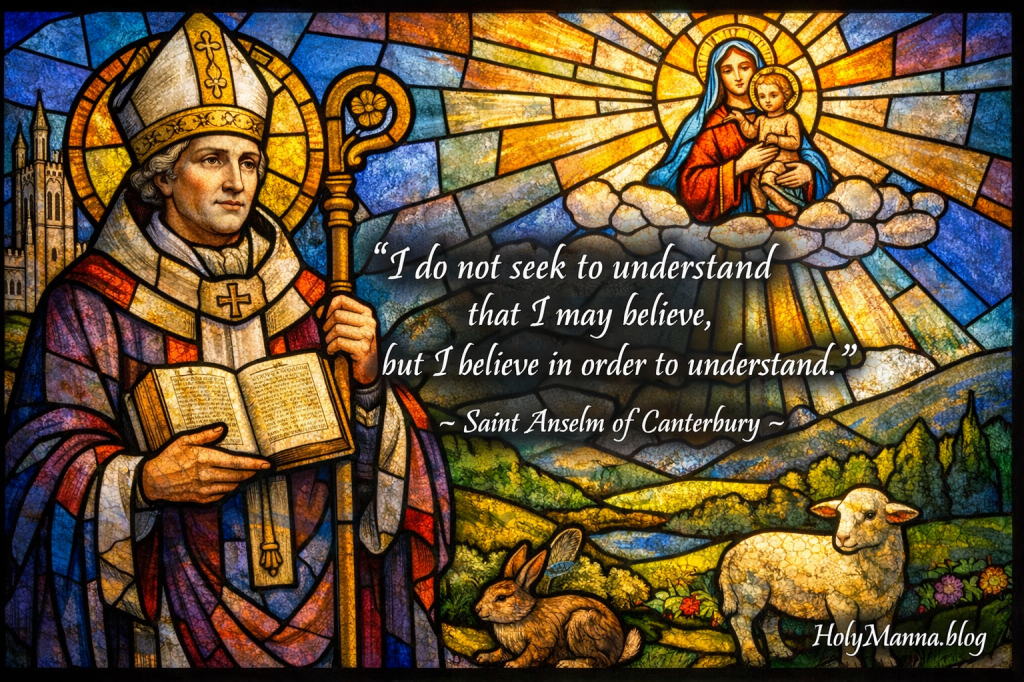
Saint Anselm is revered because he showed that holiness is not opposed to deep thinking. He loved prayer, silence, study, and truth. He defended the freedom of the Church when kings tried to control what belonged to God. He suffered exile rather than betray his conscience. He also left behind words that still echo through Catholic thought: “I do not seek to understand that I may believe, but I believe in order to understand.” That one sentence says a great deal about the man. He did not approach God as a skeptic demanding proof before obedience. He approached God as a son who trusted first and then longed to see more clearly.
A Child of the Alps, Marked for Heaven
Anselm was born in Aosta around 1033 or 1034, in the shadow of the Alps. His family was noble, but his home was not entirely peaceful. His father, Gundulf, is remembered as harsh and worldly, while his mother, Ermenberga, was deeply devout and gave him his earliest formation in the faith. From her, he learned something that never left him: that the things of God are worth loving with the whole heart.
One of the most memorable stories from his youth tells of a dream or vision in which he imagined climbing into the heights of heaven and being welcomed by the Lord, who gave him white bread to eat. Catholic tradition has preserved this scene as an early sign of grace in his life. It is not usually treated as a formal miracle in the strict historical sense, but it has long been cherished as a providential glimpse of the soul God was shaping.
As a young man, Anselm wanted to enter religious life, but his father refused. That disappointment was heavy. After his mother’s death, his life lost some of its order, and for a time he drifted. Yet even this wandering became part of God’s design. He eventually made his way to the Abbey of Bec in Normandy, where he encountered Lanfranc, a brilliant teacher and holy monk. That meeting changed everything. At Bec, Anselm’s faith deepened, his vocation matured, and his gifts for prayer and study began to flourish. He entered the Benedictine monastery in 1060, and from that point forward his life took on a clear shape.
What is Saint Anselm most known for? He is most known for uniting faith and reason, for defending the freedom of the Church from political control, and for helping shape Catholic theology in a way that still matters today. He was one of those rare men whose holiness made his intellect fruitful instead of proud.
The Scholar Who Prayed Before He Spoke
Anselm became prior of Bec and later its abbot. In those years he developed a reputation not only for intelligence but also for gentleness. He was not a cold academic. He was a spiritual father. Those under his care remembered him as patient, persuasive, and attentive. He preferred to guide rather than dominate. That is important because it shows the kind of saint he really was. He was not building his own reputation. He was trying to form souls.
During his years at Bec, he wrote works that would shape Catholic thought for centuries, including Monologion, Proslogion, and Cur Deus Homo. His theology was never an exercise in pride. It was an act of contemplation. He wanted to understand better the God he loved. That is why his thought fits so beautifully with The Catechism, which teaches that faith seeks understanding and that there can never be any real contradiction between faith and truth, as seen in CCC 158-159.
A verified saying from Saint Anselm reveals the heart behind his theology: “I pray, O God, to know you, to love you, that I may rejoice in you.” That is not the voice of a man playing intellectual games. That is the voice of a saint whose learning came from prayer.
When speaking about miracles during his lifetime, Catholic sources are more cautious than they are with some other saints. No long list of rigorously documented public miracles during his earthly ministry survives in the way many later canonization causes preserve them. What does survive are strong traditions of holiness, providence, and unusual moments that reveal God’s hand in his life. His childhood vision belongs in that category. Another beloved story recalls his tenderness toward creation when he protected a hunted hare that ran beneath him for safety. That story is not presented as a miracle, but it has endured because it reveals the saint’s compassion, gentleness, and instinctive mercy.
In truth, one of the greatest wonders of his life was not spectacular in an outward sense. It was the transformation of the Christian mind. He helped countless believers see that loving God with the mind is itself a holy calling when it is rooted in humility and worship.
A Bishop Against Kings
Anselm did not seek worldly power. In fact, when he was chosen to become Archbishop of Canterbury in 1093, he resisted the appointment. He understood what it would cost. He was stepping into a dangerous place where kings expected bishops to serve political interests. Anselm would not do that.
As Archbishop, he entered into long and painful conflicts with King William II and later King Henry I. The central issue was simple but enormous: who governs the Church? Anselm held firmly that the Church belongs to Christ and must remain free in her spiritual authority. He would not allow kings to dominate episcopal appointments or interfere with what had been entrusted by God to the Church.
Because of this, he suffered exile not once but twice. That matters. Saint Anselm was not martyred in blood, but he was a confessor in the old Christian sense. He endured loss, pressure, humiliation, and displacement for the sake of fidelity. He accepted suffering rather than compromise the truth. That is a kind of white martyrdom, and it should not be overlooked.
There were no dramatic prison escapes or fiery execution scenes in his story. Instead, there was something more familiar to many Christians: the long burden of being misunderstood, resisted, and punished for doing what is right. His endurance helped secure an important settlement in England regarding investiture and the freedom of the Church. In that sense, his suffering bore fruit not only for his own soul but for the life of the Church herself.
Another striking part of his public life is that he took a strong stand against the buying and selling of human beings. At the Council of Westminster in 1102, he supported action against the slave trade. That is one of the surprising and important parts of his legacy. It reminds modern readers that sanctity is never only private. A saint’s love for God must also affect how human beings are treated.
Wonders Remembered After His Death
Saint Anselm died on April 21, 1109, at Canterbury. His earthly work ended, but his influence only grew. He was later canonized, and in time the Church declared him a Doctor of the Church. That title was not given lightly. It was the Church’s way of saying that his teaching remains a trustworthy light for the faithful.
Catholic tradition does preserve accounts of miracles associated with Saint Anselm after his death. Early writers, especially those close to his memory, recorded miracles and favors attributed to his intercession. At the same time, the surviving documentation is not as neat or as fully standardized as that of many later saints. Some stories are part of early medieval tradition but cannot now be verified with the kind of historical certainty that modern readers often want. It is important to be honest about that.
There are traditions of miracles connected with devotion to Saint Anselm and with his memory after death, and these contributed to his veneration over time. However, the individual stories are not always preserved in full detail in a way that allows firm verification today. Because of that, Catholic honesty requires saying clearly that while miracle traditions do exist around him, many of the specific accounts cannot be verified in their particulars.
His relics have long been associated with Canterbury, and his memory has endured not only in liturgical devotion but also in the intellectual and spiritual life of the Church. His cultural impact reaches far beyond England. He influenced the course of Catholic theology in the West, shaped later thinkers including Saint Thomas Aquinas indirectly through the tradition he helped establish, and even entered the Christian imagination of literature, including The Divine Comedy. His name also lives on in places of Catholic study and prayer, especially through institutions dedicated to his memory.
He is also remembered for his devotion to the Blessed Virgin Mary. That matters because it shows again that his theology was never detached from love. He was not simply analyzing doctrines. He was living the life of the Church.
Why This Saint Still Matters
Saint Anselm matters because modern people are often tempted in two different directions. Some think faith is emotional and reason is dry, as if the heart and mind must live in separate rooms. Others imagine that intelligence is enough, as if a sharp mind can save a soul. Saint Anselm stands between those errors like a wise father. He teaches that the mind must kneel, and the heart must seek truth.
His life asks some uncomfortable questions. Does faith shape the way daily decisions are made, or is it only a private comfort? Is truth being pursued with humility, or only used to win arguments? Is there enough courage to suffer for what belongs to God?
There is something deeply encouraging in his example. He was not famous because he chased fame. He was fruitful because he was faithful. He prayed, studied, obeyed, suffered, taught, and loved the Church. He reminds readers that holiness is possible in the classroom, in the monastery, in the chancery, in exile, and in the battles no one applauds.
A practical way to live Saint Anselm’s example is to stop separating prayer from thought. Read Scripture slowly. Study The Catechism. Ask hard questions without fear, but ask them on your knees. Defend truth with charity. Refuse to let pressure from the world define what belongs to God. And when suffering comes, remember that not every martyrdom is red. Some are lived quietly in fidelity.
Engage With Us!
Readers are invited to share their thoughts and reflections in the comments below. Saint Anselm speaks powerfully to anyone who has ever struggled to hold together faith, truth, suffering, and courage. His life still has something to say.
- What stands out most in Saint Anselm’s life: his intellect, his prayer, or his courage before kings?
- How can faith and reason work together more fully in daily life?
- What is one area of life where greater courage is needed in order to remain faithful to Christ and His Church?
- How can time be made for both prayer and study so that love for God grows deeper and not merely louder?
- What does Saint Anselm teach about suffering for truth without becoming bitter or proud?
May Saint Anselm of Canterbury pray for every soul seeking wisdom, courage, and deeper love for God. May his example help hearts live with conviction, minds seek truth with humility, and lives reflect the love and mercy Jesus taught.
Saint Anselm of Canterbury, pray for us!
Follow us on YouTube, Instagram and Facebook for more insights and reflections on living a faith-filled life.


Leave a Reply