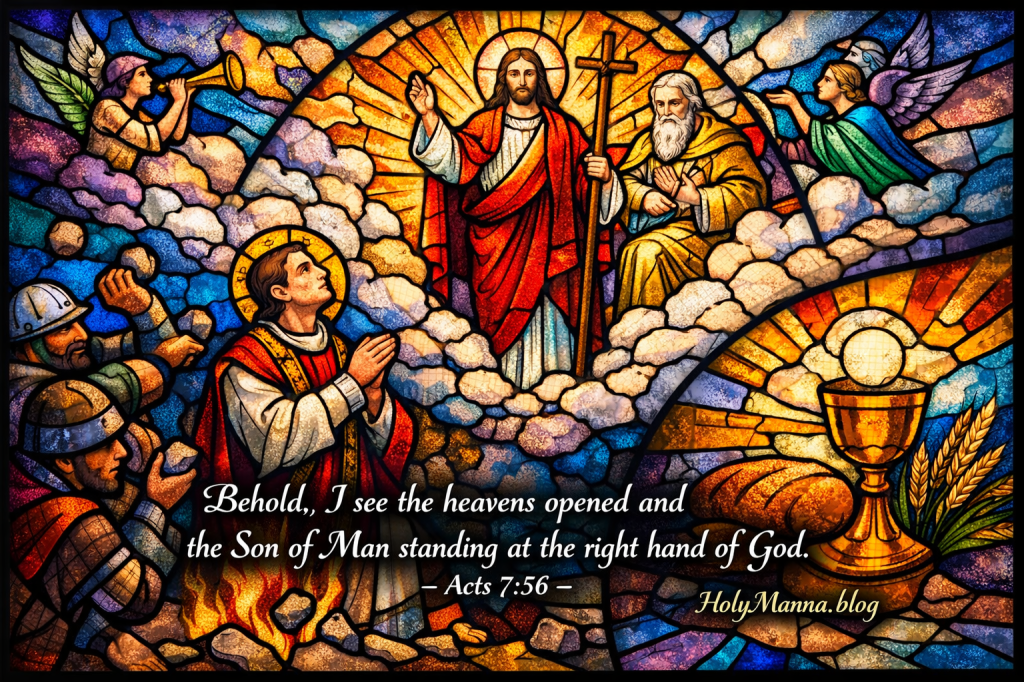
Tuesday of the Third Week of Easter – Lectionary: 274
The Bread That Strengthens the Faithful
There are days in the Church’s liturgy when the readings seem to take the soul by the hand and lead it straight to the heart of the Christian life. Today is one of those days. The central theme binding these passages together is this: Christ, the true Bread from heaven, gives his people the strength to remain faithful, to suffer with trust, and to surrender everything into the hands of the Father.
The Church gives these readings during Easter, and that matters. Easter is not only the celebration of Christ rising from the dead. It is also the season when the early Church begins to show what resurrection faith actually looks like in real human lives. In Acts 7:51–8:1, Saint Stephen stands before a hostile crowd with the courage of a man who belongs completely to Jesus. In Psalm 31, the faithful soul cries out in trust, “Into your hands I commend my spirit,” words that echo through the suffering of the just and reach their fullness on the lips of Christ. Then in John 6:30-35, Jesus reveals the source of such courage and such surrender when he declares, “I am the bread of life.”
There is also a deeper religious background running beneath all three readings. The people in the Gospel are still thinking about the manna in the desert, the bread God gave Israel during the Exodus. They remember Moses, the wilderness, and the long journey of dependence on divine providence. But Jesus lifts their eyes higher. He tells them that the Father is now giving the true bread from heaven, not simply food for a day, but the One who gives life to the world. That is why Stephen can face death with peace. That is why the Psalm can speak with such confidence in the middle of distress. The God who fed Israel in the wilderness now feeds his Church with his Son.
Taken together, today’s readings prepare the heart for a serious question. What happens when a soul is truly nourished by Christ? It becomes steady when the world turns cruel. It becomes prayerful when fear closes in. It becomes merciful even when wounded. Today’s liturgy invites readers to see that the Bread of Life is not just meant to comfort the weak. He is meant to transform them into saints.
First Reading – Acts 7:51-8:1
When Truth Is Met with Stones and Grace Answers Back
Saint Stephen’s martyrdom stands at one of the great turning points in the life of the early Church. The Resurrection has already shaken Jerusalem. The Apostles have been preaching boldly. The Church has been growing. Stephen, one of the seven chosen for service and a man described earlier in Acts as full of grace and power, has just finished a long speech before the Sanhedrin. He has traced Israel’s history and shown that God’s people repeatedly resisted the messengers God sent to save them. Now, at the end of that speech, the truth comes down like a hammer. Stephen tells his hearers that they have done what their fathers did. They resisted the Holy Spirit, rejected the prophets, and betrayed the Righteous One.
This reading matters because it shows what Easter faith looks like when it is tested. Stephen is not simply a brave man with strong convictions. He is a disciple so conformed to Christ that, in the hour of his death, he begins to speak like Christ, pray like Christ, and forgive like Christ. That is why this reading fits today’s theme so powerfully. Jesus has just revealed himself in the Gospel as the Bread of Life. Stephen shows what happens when a man is truly fed by heaven. He becomes steadfast under pressure, faithful in suffering, and merciful even toward those who destroy him.
There is also an important historical and religious backdrop here. The Sanhedrin was the highest Jewish council in Jerusalem, charged with guarding the Law and religious life of the people. Stephen’s words strike directly at their self-understanding. He accuses them not merely of misunderstanding him, but of resisting God himself. That is why the reaction is so violent. Yet Luke, the inspired author of Acts, does not tell this story simply to describe a tragedy. He tells it to reveal a mystery. The first martyr’s blood becomes seed. Saul consents to Stephen’s execution, yet the grace at work in Stephen will one day help break open Saul’s hardened heart. What looks like defeat becomes the beginning of a wider victory.
Acts 7:51-8:1 – New American Bible (Revised Edition)
Conclusion. 7:51 “You stiff-necked people, uncircumcised in heart and ears, you always oppose the holy Spirit; you are just like your ancestors. 52 Which of the prophets did your ancestors not persecute? They put to death those who foretold the coming of the righteous one, whose betrayers and murderers you have now become. 53 You received the law as transmitted by angels, but you did not observe it.”
Stephen’s Martyrdom. 54 When they heard this, they were infuriated, and they ground their teeth at him. 55 But he, filled with the holy Spirit, looked up intently to heaven and saw the glory of God and Jesus standing at the right hand of God, 56 and he said, “Behold, I see the heavens opened and the Son of Man standing at the right hand of God.” 57 But they cried out in a loud voice, covered their ears, and rushed upon him together. 58 They threw him out of the city, and began to stone him. The witnesses laid down their cloaks at the feet of a young man named Saul. 59 As they were stoning Stephen, he called out, “Lord Jesus, receive my spirit.” 60 Then he fell to his knees and cried out in a loud voice, “Lord, do not hold this sin against them”; and when he said this, he fell asleep.
8:1 Now Saul was consenting to his execution.
Persecution of the Church. On that day, there broke out a severe persecution of the church in Jerusalem, and all were scattered throughout the countryside of Judea and Samaria, except the apostles.
Detailed Exegesis
Verse 51 – “You stiff-necked people, uncircumcised in heart and ears, you always oppose the holy Spirit; you are just like your ancestors.”
Stephen ends his defense with language drawn from the Old Testament prophets. To be “stiff-necked” is to be stubborn before God, like an ox refusing the yoke. To be uncircumcised in heart and ears means that outward religious identity is not enough when the inner man is closed to grace. Stephen is not rejecting the covenant. He is accusing the people of failing to live it from within. This is a deeply biblical charge. The prophets had long taught that God desires not external observance alone, but a heart made obedient and alive. Stephen’s words reveal that the real battle is spiritual. The problem is not lack of information. The problem is resistance to the Holy Spirit.
Verse 52 – “Which of the prophets did your ancestors not persecute? They put to death those who foretold the coming of the righteous one, whose betrayers and murderers you have now become.”
Stephen places Jesus within the whole history of salvation. The rejection of Christ did not happen in a vacuum. It was the climax of a long pattern of resistance to God’s messengers. By calling Jesus “the righteous one,” Stephen gives him a messianic and holy title, one that emphasizes both his innocence and his divine mission. The charge is devastating. Those who prided themselves on being guardians of the covenant have handed over the very one to whom the covenant pointed. This verse also reminds readers that God’s truth often comes through witnesses the world does not want. The prophets were not persecuted because they were unclear. They were persecuted because they were clear.
Verse 53 – “You received the law as transmitted by angels, but you did not observe it.”
Stephen cuts even deeper here. The Law was a gift, holy and good, and Israel received it through God’s marvelous providence. Yet possessing the Law is not the same as obeying God. This is the heart of Stephen’s accusation. The leaders claim fidelity to Moses while rejecting the one to whom Moses pointed. In Catholic understanding, the Law was never an end in itself. It prepared the people for Christ. To cling to the sign while rejecting its fulfillment is not faithfulness. It is blindness. Stephen is exposing a religion of possession without conversion.
Verse 54 – “When they heard this, they were infuriated, and they ground their teeth at him.”
The reaction reveals the state of their hearts. Luke does not describe repentance, sorrow, or honest debate. He describes rage. Truth can humble a man, but it can also provoke him when pride rules the soul. The grinding of teeth suggests a kind of animal fury, a loss of interior self-command. Stephen has spoken with spiritual clarity, but the council responds with hardened violence. This verse is a warning. Religious status does not automatically make a man docile to God. A soul can know sacred things and still resist grace.
Verse 55 – “But he, filled with the holy Spirit, looked up intently to heaven and saw the glory of God and Jesus standing at the right hand of God,”
This is one of the most beautiful contrasts in the reading. The crowd is filled with fury, but Stephen is filled with the Holy Spirit. While others look at him with hatred, he looks toward heaven with faith. He sees the glory of God and Jesus at the right hand of the Father. This is not imagination or emotional escape. It is a real grace given at the hour of witness. Jesus is usually described as seated at the right hand of the Father, the place of divine authority and completed victory. Here he is standing, as if to receive his faithful witness and honor him before heaven. The Church has always seen in this verse a profound encouragement. Christ does not abandon his martyrs. He receives them.
Verse 56 – “and he said, ‘Behold, I see the heavens opened and the Son of Man standing at the right hand of God.’”
Stephen speaks openly about what he sees. He calls Jesus the Son of Man, a title rich with meaning from the vision of Daniel 7. It is a title connected with divine authority, heavenly glory, and final judgment. Stephen’s confession is therefore not only mystical. It is doctrinal. He proclaims Jesus as exalted Lord even in the face of death. The heavens are opened because Christ has opened the way. Easter is not an idea in this verse. It is a living reality. Stephen sees what the Church believes: the crucified Jesus is alive, glorified, and reigning.
Verse 57 – “But they cried out in a loud voice, covered their ears, and rushed upon him together.”
This is one of the saddest images in the reading. They literally cover their ears. It is a physical sign of spiritual refusal. They do not want to hear. When men are determined not to receive the truth, they will often drown it out with noise, anger, and collective force. The rush of the crowd also shows how quickly mob passion can overtake reason. Once truth is rejected, violence often follows. Stephen’s words have become intolerable because they have touched the conscience.
Verse 58 – “They threw him out of the city, and began to stone him. The witnesses laid down their cloaks at the feet of a young man named Saul.”
Stephen is cast out of the city, just as Christ suffered outside the gate. Stoning was a traditional penalty for blasphemy, and the witnesses laying down their cloaks suggests a formal participation in the execution. But Luke includes one detail that changes everything. A young man named Saul is there, consenting and watching. At this moment, Saul appears as an enemy of the Church. Yet the Holy Spirit is already writing a larger story. The one who watches the first martyr die will become the Apostle Paul. This verse is a quiet testimony to divine providence. God can bring a future apostle out of the shadow of a martyr’s death.
Verse 59 – “As they were stoning Stephen, he called out, ‘Lord Jesus, receive my spirit.’”
Stephen’s prayer clearly echoes Christ’s words from the Cross and the prayer of Psalm 31. But now the prayer is addressed directly to Jesus. That matters. Stephen entrusts his soul to Christ because Christ shares in the authority and glory of God. This is one of the striking early testimonies to the divine identity of Jesus in the life of the Church. Stephen dies not with despair, not with hatred, and not with empty stoicism. He dies in prayer. The body is being crushed, yet the soul is being handed over in trust.
Verse 60 – “Then he fell to his knees and cried out in a loud voice, ‘Lord, do not hold this sin against them’; and when he said this, he fell asleep.”
Here Stephen becomes transparently like Christ. He does not merely endure suffering. He loves his enemies in the very act of being murdered by them. This is not human niceness. This is supernatural charity. He asks that their sin not be held against them, echoing Christ’s prayer for those who crucified him. Luke then says that Stephen “fell asleep,” a deeply Christian way of speaking about the death of the just. Death has not vanished, but for the believer it has been transformed. The martyr dies in hope, awaiting the resurrection.
Verse 8:1 – “Now Saul was consenting to his execution.”
This brief line closes the scene with tension and purpose. Saul is not a neutral observer. He approves the killing. Yet his presence is more than narrative detail. It signals the next movement in salvation history. Persecution will intensify. The Church will be scattered. The Gospel will spread beyond Jerusalem. And the man who consents to this death will later be conquered by the risen Christ. Grace is already at work in hidden ways.
Teachings
This reading is one of the clearest biblical portraits of martyrdom, and the Church has always honored Stephen as the first to seal his witness to Christ with his blood. In The Catechism of the Catholic Church, the Church teaches in CCC 2473: “Martyrdom is the supreme witness given to the truth of the faith: it means bearing witness even unto death. The martyr bears witness to Christ who died and rose, to whom he is united by charity. He bears witness to the truth of the faith and of Christian doctrine. He endures death through an act of fortitude.” Stephen does exactly this. He is not reckless. He is not theatrical. He is united to Christ by charity, and that union gives him fortitude.
The reading also reveals the Catholic understanding of forgiveness. Stephen does not excuse evil. He names it clearly. Yet he refuses to let hatred take root. In CCC 2844, the Church teaches: “Christian prayer extends to the forgiveness of enemies, transfiguring the disciple by configuring him to his Master. Forgiveness is a high-point of Christian prayer; only hearts attuned to God’s compassion can receive the gift of prayer.” Stephen’s final words are the living embodiment of that teaching. His heart has been so attuned to Christ that even while dying, he prays with the mercy of Christ.
The Fathers of the Church saw in Stephen’s death the mystery of grace already working on Saul. A line often attributed to Saint Augustine captures this beautifully: “If Stephen had not prayed, the Church would not have had Paul.” Whether taken as a polished summary or as the heart of Augustine’s insight, the point is unmistakable. The martyr’s forgiveness was not wasted. God used it in ways Stephen himself could not yet see. This is one of the great consolations in Christian suffering. A hidden act of mercy can bear fruit far beyond what appears possible.
Saint John Chrysostom also recognized that Stephen’s death was not the end of the Church’s strength, but the beginning of a wider spread of the Gospel. The persecution that followed scattered believers into Judea and Samaria, just as Christ had foretold in Acts 1:8. What the enemies of the Church intended for destruction, God turned into mission. Historically, this moment marks the end of a more concentrated Jerusalem phase of the Church and the beginning of a broader expansion. The blood of Stephen becomes, in a real sense, missionary seed.
There is one more lesson here that deserves attention. Stephen’s vision of Christ standing at the right hand of God shows that the glorified Jesus is not distant from the sufferings of his people. The Church does not preach a Savior who merely once suffered in the past. She preaches the risen Lord who remains present, active, and victorious. Stephen’s eyes are fixed on heaven because heaven is not shut. Christ has opened it.
Reflection
Stephen’s story is not meant to be admired from a safe distance. It is meant to unsettle the soul a little. It asks whether faith has become too comfortable, too quiet, too trimmed down to avoid conflict. Most believers will never face stones hurled by an angry crowd, but every Christian will face moments when fidelity to Christ costs something real. There will be pressure to soften the truth, to keep quiet about sin, to avoid speaking clearly for fear of being disliked. There will also be the quieter martyrdoms of daily life, the moments when forgiveness feels impossible, when charity feels costly, and when prayer feels like the only thing left.
Stephen teaches that holiness begins long before the crisis. A man does not suddenly become merciful in the hour of death if he has not been learning mercy in ordinary life. A soul does not suddenly trust God in catastrophe if it has not practiced surrender in smaller trials. That is where this reading becomes very practical. The path of Stephen starts in daily fidelity. It starts in prayer. It starts in receiving correction. It starts in refusing resentment. It starts in keeping the eyes lifted toward Christ instead of being consumed by the rage of the world.
A good way to live this reading is to begin by speaking honestly with God about the places where the heart is still stiff-necked. There may be an old sin being defended, an old wound being clutched, or an old pride being protected. Another step is to pray for the grace to forgive concretely, not vaguely. Stephen did not forgive in theory. He forgave real men committing real evil. That kind of forgiveness is impossible without grace, but it is never impossible with grace. It is also worth asking whether the faith is truly centered on Christ, or only on comfort, familiarity, and habit. Stephen could die in peace because Christ was not an idea to him. Christ was his Lord.
Where has the heart been covering its ears when the Holy Spirit is trying to speak?
Who needs to be forgiven, not because the wound was small, but because Christ is greater than the wound?
What would change if the eyes were fixed more often on the risen Jesus than on the anger, chaos, and noise of the world?
Stephen’s death reads like a tragedy at first, but the Church knows better. It is a victory of grace. A man full of the Holy Spirit became so like Christ that even his last breath proclaimed the Gospel. That is the invitation hidden in this reading. Stay near to Jesus long enough, and even suffering begins to speak his language.
Responsorial Psalm – Psalm 31:3-4, 6-8, 17, 21
A Prayer for the Soul That Refuses to Panic
There is something deeply human and deeply Catholic about this psalm. It does not come from a man floating above pain. It comes from a man under pressure, a man surrounded by distress, a man who knows what it is like to need rescue now, not later. Psalm 31 belongs to that part of Israel’s prayer life where suffering and trust meet each other face to face. Traditionally associated with David, it carries the voice of someone hunted, opposed, and tested, yet still convinced that God is a rock, a fortress, and a refuge.
That is why the Church places this psalm beside Stephen’s martyrdom and Christ’s Bread of Life discourse. Stephen is being crushed by violence, yet he entrusts his spirit to the Lord. Jesus reveals himself as the true bread from heaven, the one who alone can satisfy the starving soul. Between those two readings stands this psalm like a bridge of prayer. It teaches the heart what to say when life becomes too heavy to carry alone. It teaches the soul to run toward God, not away from him. In the history of salvation, this prayer becomes even more radiant because its most famous line will later be taken up by Christ himself in his Passion. The psalm of the afflicted becomes the prayer of the Crucified, and then the prayer of every Christian who wants to die, suffer, and live in trust.
Psalm 31:3-4, 6-8, 17, 21 – New American Bible (Revised Edition)
3 incline your ear to me;
make haste to rescue me!
Be my rock of refuge,
a stronghold to save me.
4 For you are my rock and my fortress;
for your name’s sake lead me and guide me.6 Into your hands I commend my spirit;
you will redeem me, Lord, God of truth.
7 You hate those who serve worthless idols,
but I trust in the Lord.
8 I will rejoice and be glad in your mercy,
once you have seen my misery,
[and] gotten to know the distress of my soul.17 Let your face shine on your servant;
save me in your mercy.
Detailed Exegesis
Verse 3: “incline your ear to me; make haste to rescue me! Be my rock of refuge, a stronghold to save me.”
This verse begins with urgency. The psalmist is not speaking in vague religious language. He is crying out like a man who knows he cannot save himself. The request that God “incline” his ear is the language of covenant intimacy. The believer knows that the Lord is not distant, cold, or unreachable. He is a God who hears.
The images of rock, refuge, and stronghold are especially important. In the ancient world, a fortified height or rocky shelter could mean survival in the face of enemies. Spiritually, the meaning is even deeper. God is not merely emotional comfort. He is protection, stability, and defense. In today’s readings, this is exactly what Stephen experiences. The world around him becomes chaos, but inwardly he is held fast because his refuge is not in public approval or physical safety. His refuge is God.
Verse 4: “For you are my rock and my fortress; for your name’s sake lead me and guide me.”
The psalmist moves from request to confidence. God is not asked to become a rock as though he were uncertain or changing. He is already the rock and fortress. The prayer rests on who God is. That is one of the great lessons of biblical prayer. Trust is not built on mood. It is built on the character of God.
The phrase “for your name’s sake” matters a great deal. The believer is appealing to God’s own faithfulness, holiness, and reputation. In Scripture, the divine name is not a label. It reveals God’s identity and presence. So the prayer is really saying, “Lord, act in a way that is consistent with who you are.” This is humble confidence. It does not manipulate God, but it does cling to his revealed goodness. In Catholic life, this is how prayer matures. It becomes less about demanding terms and more about entrusting oneself to the God who cannot deceive or fail.
Verse 6: “Into your hands I commend my spirit; you will redeem me, Lord, God of truth.”
This is the heart of the psalm, and one of the most important lines in all of Scripture. It is a prayer of surrender, but not of surrender to emptiness or fate. It is surrender into hands. That image changes everything. The believer is not falling into darkness. He is being placed into the care of a Father.
This verse carries enormous weight in Christian tradition because Jesus prays it from the Cross, and Stephen echoes it in his martyrdom. What begins here as the prayer of Israel becomes the prayer of Christ and then the prayer of the Church. The phrase “God of truth” also deepens its meaning. The Lord is not only powerful. He is trustworthy. He is faithful to his promises. He is real, steady, and incapable of betrayal. That is why the soul can be entrusted to him.
The Church has long understood this verse as a school of holy death, but it is also a school of holy living. A man who wants to commend his spirit to God at the end must learn to commend his day, his wounds, his fears, and his future to God now.
Verse 7: “You hate those who serve worthless idols, but I trust in the Lord.”
The psalm draws a sharp contrast here. On one side stand idols. On the other stands trust in the Lord. Scripture always treats idolatry seriously because idols are never just statues or pagan rituals. At the deepest level, an idol is anything false that claims the place that belongs to God alone. It promises security, identity, or control, but it cannot save.
That makes this verse surprisingly modern. The idol may not be carved wood or stone. It may be image, money, influence, lust, self-will, comfort, or the need to be praised. The psalmist knows that false gods are worthless precisely because they cannot hold the soul in the day of trouble. Only the Lord can do that. Today’s theme comes into focus again here. The Bread of Life satisfies because Christ is real. Idols always leave a man hungry.
Verse 8: “I will rejoice and be glad in your mercy, once you have seen my misery, [and] gotten to know the distress of my soul.”
This is a striking verse because joy appears in the middle of affliction. The psalmist does not say that misery is pleasant. He says that God sees it. That changes the whole spiritual landscape. The mercy of God is not abstract pity from a distance. It is the mercy of the Lord who knows the distress of the soul.
This is one of the tenderest features of biblical prayer. God is not embarrassed by human weakness. He is not irritated by anguish honestly brought to him. He sees misery and responds with mercy. That is why Christian joy is different from superficial optimism. It does not depend on denying pain. It depends on knowing that pain has been seen by God.
Verse 17: “Let your face shine on your servant; save me in your mercy.”
Here the psalm echoes the language of priestly blessing and covenant favor. To ask for the face of God to shine is to ask for his gracious presence, his nearness, and his loving regard. The believer is not simply asking for escape from trouble. He is asking for the light of God’s countenance.
That desire runs through the whole Bible. The faithful do not merely want relief. They want God. Salvation is never less than rescue, but it is always more than rescue. It is restored communion. This fits beautifully with the Gospel, where Jesus offers not just bread as a gift from afar, but himself as the Bread of Life. The shining face of God is no longer only a poetic hope. In Christ, the face of the Father comes near.
Verse 21: “You hide them in the shelter of your presence, safe from scheming enemies. You conceal them in your tent, away from the strife of tongues.”
The psalm ends this selection with one of its most consoling images. God shelters his faithful in his presence. The image of the “tent” recalls sacred space, the dwelling place of God among his people. It suggests intimacy, protection, and covenant closeness. The Lord does not merely defend from a distance. He draws near and covers.
The mention of “the strife of tongues” is especially revealing. Enemies do harm not only through weapons, but through words, accusations, mockery, and schemes. That fits both the experience of Stephen and the experience of many Christians now. Sometimes the sharpest wounds come through hostility, slander, and public pressure. This verse reminds the faithful that even when the world grows loud, God still has a hidden place for the soul.
Teachings
This psalm teaches that trust is not passivity. It is a deliberate act of the soul rooted in the character of God. The Catechism presents the Psalms as a privileged school of prayer, because in them the Word of God becomes the prayer of God’s people. That truth shines brightly here. Psalm 31 gives language to fear, sorrow, surrender, confidence, and hope. It teaches the believer how to speak honestly before God without losing faith in his mercy.
The Church has also long heard this psalm through the voice of Christ. When Jesus prays, “Into your hands I commend my spirit,” he gathers this ancient prayer into his Passion and fills it with new depth. From that moment on, the verse becomes inseparable from Christian death, Christian suffering, and Christian confidence. It is no longer only David’s prayer. It is the prayer of the Son, and therefore of all those united to him.
Saint Augustine gives a beautiful key for reading the Psalms in the life of the Church: “As our priest, He prays for us; as our Head, He prays in us; and He is prayed to by us as our God.” That insight is especially fitting here. In this psalm, Christ prays for his people, prays in his people, and receives the prayer of his people. That is why Psalm 31 can belong at once to David, to Jesus on the Cross, to Stephen under the stones, and to every Catholic kneeling in the quiet of night.
There is also a rich liturgical significance here. The Church has long prayed this psalm in the Liturgy of the Hours, especially in night prayer. That is not accidental. Before sleep, the Christian rehearses the surrender that one day will be final. The soul is trained to place itself in God’s hands again and again. Over time, that rhythm forms a person. It teaches peace. It teaches dependence. It teaches the heart not to live like an orphan.
This psalm also speaks powerfully against idolatry. In a culture full of distractions and false promises, it reminds the faithful that only the Lord is solid enough to bear the weight of a human life. Idols are always “worthless” because they cannot know the distress of the soul, cannot forgive sin, cannot redeem suffering, and cannot raise the dead. Christ alone can do that. That is why the psalm stands so naturally beside the Gospel. The one whom the psalm calls refuge is the same one who says, “I am the bread of life.”
Reflection
There are seasons when this psalm feels almost too honest. It speaks of misery, distress, enemies, and the need for rescue. But that honesty is one of its gifts. It gives permission to stop pretending before God. A faithful Christian does not have to act unshaken all the time. The saints were not holy because they never trembled. They were holy because they learned where to bring their trembling.
That makes this psalm intensely practical for daily life. One good way to live it is to begin the day with surrender before the day begins to pull in ten different directions. A simple prayer taken from verse 6 can re-center the whole heart: “Into your hands I commend my spirit.” It can be prayed in traffic, in conflict, before a hard conversation, in anxiety about the future, or in the quiet after receiving bad news. Another practical step is to identify the idols that still compete for trust. Most people do not kneel before statues, but many still hand over peace to approval, pleasure, control, or fear. The psalm invites a clean break from all that is false.
It also helps to remember that the face of God is not turned away from the believer in affliction. That is often the real temptation. It is not only pain itself, but the suspicion that pain means abandonment. This psalm answers that lie. God sees misery. He knows the distress of the soul. He hides his own in the shelter of his presence. That does not always mean immediate change in circumstances, but it does mean that suffering is never suffered alone.
What has been carrying too much weight in the heart because it has not yet been placed into the hands of God?
What false refuge has been trusted more than the Lord?
What might change if this psalm became not just a reading at Mass, but a real prayer in the middle of ordinary life?
The beauty of Psalm 31 is that it does not teach the soul to deny danger. It teaches the soul to remain anchored while danger rages. That is why the Church still prays it. It prepares the believer to suffer without despair, to trust without naivety, and to rest in the mercy of the God whose hands are strong enough to hold everything.
Holy Gospel – John 6:30-35
The Hunger Beneath Every Other Hunger
The sixth chapter of The Gospel of John unfolds like a slow unveiling. Jesus has already multiplied the loaves, and the crowd has already seen something extraordinary. Yet they still press him for another sign. That moment says a great deal about the human heart. Even after God has acted, people often want one more proof, one more reassurance, one more visible guarantee. The setting matters here. Israel’s memory of the Exodus was always alive. The manna in the desert was not just a miracle from the past. It was part of the people’s identity, part of the story that told them who they were before God. So when the crowd brings up the bread from heaven, they are not speaking randomly. They are testing Jesus against Moses, against the wilderness, against the great acts of God that shaped Israel.
That is what makes this Gospel so important. Jesus does not simply promise help from heaven. He reveals that he himself is heaven’s gift. He does not offer a better system, a better philosophy, or a better earthly security. He offers himself. This fits today’s theme perfectly. Stephen can die with peace because Christ is not an abstract idea. The Psalm can speak of surrender because God is not distant. And now the Gospel reveals why. The true Bread from heaven is not something. He is Someone. The soul is not saved by religious nostalgia or by signs alone. The soul is saved by Christ, who alone can satisfy the deepest hunger of man and give life to the world.
John 6:30-35 – New American Bible (Revised Edition)
30 So they said to him, “What sign can you do, that we may see and believe in you? What can you do? 31 Our ancestors ate manna in the desert, as it is written:
‘He gave them bread from heaven to eat.’”
32 So Jesus said to them, “Amen, amen, I say to you, it was not Moses who gave the bread from heaven; my Father gives you the true bread from heaven. 33 For the bread of God is that which comes down from heaven and gives life to the world.”
34 So they said to him, “Sir, give us this bread always.” 35 Jesus said to them, “I am the bread of life; whoever comes to me will never hunger, and whoever believes in me will never thirst.
Detailed Exegesis
Verse 30 – “So they said to him, ‘What sign can you do, that we may see and believe in you? What can you do?’”
This question is almost shocking because it comes after the multiplication of the loaves. The crowd has already witnessed a miracle, yet they still demand another sign. That is the tragedy of a heart that wants God on its own terms. It is not always lack of evidence that keeps a person from faith. Often it is resistance, spiritual dullness, or the desire to remain in control.
There is also a deeper irony here. The people speak as though Jesus has not already revealed anything worth believing. In doing so, they represent a pattern seen throughout salvation history. God acts, and man still asks for more before he will surrender. The demand for signs can become a way of postponing obedience. In Catholic life, this remains a real temptation. A person can keep asking for extraordinary reassurance while ignoring the ordinary graces already given through Scripture, the sacraments, the Church, and the quiet promptings of the Holy Spirit.
Verse 31 – “Our ancestors ate manna in the desert, as it is written: ‘He gave them bread from heaven to eat.’”
The crowd reaches back to the Exodus, the defining story of Israel’s deliverance. Manna was the bread God gave his people in the wilderness when they had no way to feed themselves. It was a miracle of providence, and it became a lasting sign of God’s care. Their appeal is understandable, but it is also incomplete. They are measuring Jesus by the memory of Moses, as though the point is simply whether he can repeat an old wonder.
The deeper problem is that they are still thinking in material terms. They remember bread that kept the body alive for a day, but they do not yet understand the Bread that gives eternal life. In the religious imagination of many Jews of the time, the coming of the Messiah was associated with a renewal of God’s mighty deeds. The crowd is therefore testing Jesus against those expectations. But Jesus is about to show that the true fulfillment of the Exodus is far greater than another daily ration in the wilderness.
Verse 32 – “So Jesus said to them, ‘Amen, amen, I say to you, it was not Moses who gave the bread from heaven; my Father gives you the true bread from heaven.’”
Jesus gently but firmly corrects them. First, he corrects their source. It was not Moses who ultimately gave the manna. God did. Moses was the servant. The Father was the giver. Then Jesus corrects their timeline. He does not say merely that the Father gave bread in the past. He says the Father gives the true bread now. The movement is from memory to fulfillment, from shadow to reality.
This verse is deeply important in Catholic theology because it reveals that God’s saving action is not locked in the past. The Father is still giving. Salvation is not a museum of old miracles. It is a living gift. The manna was real, but it was provisional. It sustained earthly life for a time. The true bread from heaven will do what manna never could. It will give divine life. It will satisfy the heart in a way no earthly provision can.
Verse 33 – “For the bread of God is that which comes down from heaven and gives life to the world.”
Here Jesus widens the horizon dramatically. The bread of God is not only for one generation in the desert. It is for the world. That word matters. The gift of Christ is universal in scope. Israel’s history is not discarded, but it is brought to fulfillment in a salvation meant for all peoples.
This verse also moves the listener toward a personal reading. The bread of God is not merely a thing sent down. It is bound up with the one who comes down from heaven. Jesus is speaking of himself, though the crowd does not fully grasp it yet. This is why the Church has always read this passage as both a call to faith in Christ and a preparation for the Eucharist. The one who gives life is the one who descends from the Father. Eternal life is not an impersonal force. It is communion with the Son.
Verse 34 – “So they said to him, ‘Sir, give us this bread always.’”
At first glance, this sounds like a beautiful response, and in one sense it is. The crowd desires the gift. They want the bread Jesus describes. But like the Samaritan woman earlier in John 4, they still seem to be hearing him on a lower level than he intends. They want something beneficial. Jesus is preparing to reveal someone indispensable.
Still, this verse carries a powerful spiritual lesson. Even imperfect desire can become the beginning of grace. The crowd does not yet understand fully, but they are at least moved enough to ask. That matters. Many souls begin there. They cannot yet explain the mysteries of Christ, but they know they need what only he can give. The prayer itself becomes important: “Sir, give us this bread always.” The Church can place those words on her own lips, especially in relation to the Eucharist, where Christ continues to feed his people.
Verse 35 – “Jesus said to them, ‘I am the bread of life; whoever comes to me will never hunger, and whoever believes in me will never thirst.’”
This is one of the great declarations in The Gospel of John. Jesus does not merely say that he gives bread. He says, “I am the bread of life.” He is not just a messenger of nourishment. He is the nourishment. He is not just a guide toward life. He is life given as food to a starving world.
The verse joins coming to Jesus and believing in Jesus. That is essential. Before the discourse reaches its explicitly Eucharistic climax later in the chapter, Jesus first calls the crowd to faith in his person. To come to him is to turn toward him in trust. To believe in him is to stake one’s life on him. Yet in Catholic understanding, this does not reduce the passage to symbolism. It prepares for something greater. The one who is received by faith is the same one who will later give his flesh for the life of the world. Spiritual hunger and thirst are satisfied in Christ because he gives himself fully, both as the object of faith and as sacramental food in the Eucharist.
Teachings
This Gospel stands at the heart of the Church’s Eucharistic faith. The Church has always understood John 6 as more than a metaphor about general religious satisfaction. It is certainly a call to believe in Christ, but it is also a preparation for the mystery of the Eucharist. The Catechism teaches in CCC 1338: “The three synoptic Gospels and Saint Paul have handed on to us the account of the institution of the Eucharist; Saint John, for his part, reports the words of Jesus in the synagogue at Capernaum that prepare for the institution of the Eucharist: Christ calls himself the bread of life, come down from heaven.” That is the Church’s reading. This passage prepares the heart to understand that Christ not only teaches life. He gives himself as life.
The Eucharist is not a side devotion in Catholic life. It is the center. The Catechism says in CCC 1324: “The Eucharist is ‘the source and summit of the Christian life.’ ‘The other sacraments, and indeed all ecclesiastical ministries and works of the apostolate, are bound up with the Eucharist and are oriented toward it. For in the blessed Eucharist is contained the whole spiritual good of the Church, namely Christ himself, our Pasch.’” That teaching sheds light on today’s Gospel. If Christ is the Bread of Life, then the hunger of the Christian life can never be satisfied by activism, information, or emotional experience alone. The heart needs Christ himself.
The Church also teaches that Holy Communion truly nourishes the soul. In CCC 1392, the Church says: “What material food produces in our bodily life, Holy Communion wonderfully achieves in our spiritual life. Communion with the flesh of the risen Christ, a flesh ‘given life and giving life through the Holy Spirit,’ preserves, increases, and renews the life of grace received at Baptism.” That line helps explain why today’s Gospel belongs so naturally with Stephen’s martyrdom. The first martyr is not sustained by willpower alone. He is a living witness to what grace can do in a man who belongs to Christ.
Saint Augustine saw the deep connection between faith and this Bread from heaven. In his preaching on John 6, he wrote: “Believe, and you have eaten.” Augustine was not denying the Eucharist. He was showing that reception begins in faith. Before a person can receive Christ fruitfully in the sacrament, the heart must come to him in trust. Belief is already a kind of spiritual feeding, because it clings to Christ as life.
At the same time, Catholic tradition never stops at a merely inward interpretation. The Church hears this Gospel moving toward the altar. That is why saints across the centuries spoke of the Eucharist as the place where hunger is healed at its root. Saint Thomas Aquinas expressed the mystery beautifully in the antiphon O Sacred Banquet: “O sacred banquet in which Christ is received, the memory of his Passion is renewed, the mind is filled with grace, and a pledge of future glory to us is given.” That is the Bread of Life in the language of the Church. Christ is received. Grace fills the soul. Heaven begins even now.
Historically, John 6 has always stood as one of the great biblical foundations for Catholic Eucharistic doctrine. In times of confusion, controversy, or indifference, the Church has returned to this chapter again and again. It keeps teaching the same truth. The human heart is hungry, and Christ did not leave that hunger unanswered. He came down from heaven and remains with his Church in a way that is real, sacramental, and life-giving.
Reflection
This Gospel reaches right into ordinary life because hunger is something every person understands. There is bodily hunger, of course, but there is also the deeper hunger that no snack, no paycheck, no romance, no entertainment, and no success can finally satisfy. It is the hunger to be held, forgiven, guided, cleansed, strengthened, and brought home to God. The world offers substitutes constantly. Some are shiny. Some are addictive. Some even look respectable. But none of them can say, “I am the bread of life.”
That is why one practical way to live this Gospel is to become more honest about what has been used as bread instead of Christ. Sometimes the false bread is comfort. Sometimes it is distraction. Sometimes it is lust, control, approval, work, or endless noise. A second step is to approach Christ concretely. Come to him in prayer before asking him for explanations. Come to him in Eucharistic adoration with the poverty of a hungry soul. Come to him at Mass not as a spectator but as one who needs to be fed. Come to him in confession when sin has made the appetite disordered and the heart dull. Hunger often becomes holy when it is finally brought to the right place.
This Gospel also teaches perseverance. The crowd wanted signs. Many people still do. But Jesus offers something better than spectacle. He offers himself. There are seasons when faith feels dry, when prayer feels quiet, and when no dramatic sign appears. In those seasons, this Gospel becomes especially precious. Christ remains the Bread of Life whether the emotions run high or not. His truth does not wobble with mood. His presence does not vanish because the soul feels tired. He remains.
What has been treated like bread in life, even though it has only made the soul hungrier?
What would change if Christ were approached as true nourishment and not merely as a distant religious idea?
How might daily life look different if the heart really believed that the deepest hunger of the soul is answered at the altar?
This passage is not only an invitation to admire Jesus. It is an invitation to come to him. The crowd asked for bread from heaven, and heaven answered with a Person. The Church still hears that answer today. In every age, in every wilderness, in every kind of human poverty, Christ stands before the hungry and says the words that change everything: “I am the bread of life.”
Strength for the Journey, Mercy for the Fight
Today’s readings come together like a steady hand on the shoulder. They remind the soul that the Christian life is not built on vague inspiration or passing emotion. It is built on Christ. Saint Stephen shows what a life anchored in Jesus can look like when the cost becomes real. Psalm 31 gives the prayer that carries a faithful heart through fear, sorrow, and surrender. Then the Holy Gospel reveals the deepest reason any of this is possible at all: Jesus is “the bread of life.”
That is the thread running through the whole day. The one who feeds the soul is the same one who strengthens it to endure, teaches it to trust, and forms it to forgive. Stephen does not face death with empty courage. He faces it as a man filled with Christ. The psalmist does not commend his spirit into darkness. He places it into the hands of the God of truth. The crowd in John 6 asks for bread, and Jesus answers with something far greater than they expected. He gives not merely a gift, but himself.
That is still the invitation now. Come to Christ before the heart grows hard. Come to Christ before resentment settles in. Come to Christ before the noise of the world begins to sound more believable than the voice of God. Come to him in prayer. Come to him in the Scriptures. Come to him in confession. Come to him at Mass with real hunger and real honesty. The soul was not made to live on distraction, comfort, or self-reliance. It was made for the living God.
There is great hope in that truth. The same Lord who received Stephen, heard the cry of the psalmist, and fed the crowd in Capernaum is still present and still giving life. He still strengthens weak hearts. He still forgives sinners. He still feeds his people with heavenly bread. He still teaches his Church how to live with courage and how to die with peace.
Where is Christ asking for greater trust today?
What part of the heart still needs to be fed by his mercy instead of by the world’s substitutes?
Let today’s readings be more than something admired for a moment. Let them become a call to live differently. Stay close to Jesus. Stay near the altar. Stay rooted in prayer. Let the heart learn how to say, with greater sincerity each day, “Into your hands I commend my spirit.” A soul fed by Christ can face far more than it thinks, because the Bread of Life never fails those who come to him.
Engage with Us!
Readers are invited to share their reflections in the comments below. What stood out most in today’s readings? What challenged the heart, brought conviction, or opened a new sense of hope? Honest reflections, questions, and insights can help build one another up in faith.
- In the First Reading from Acts 7:51-8:1, what part of Saint Stephen’s witness speaks most powerfully to the heart? Is it his courage, his vision of Christ, or his mercy toward those who killed him? Where might God be calling for that same kind of faithfulness and forgiveness in daily life?
- In Psalm 31, what does it mean personally to pray, “Into your hands I commend my spirit”? What fears, burdens, or wounds need to be placed more fully into God’s hands? What false refuges might still be competing with trust in the Lord?
- In the Holy Gospel from John 6:30-35, Jesus says, “I am the bread of life”. What hungers in life have been pulling the soul away from Christ? How is Jesus inviting a deeper trust in his presence, especially through prayer, the Eucharist, and daily dependence on his grace?
May today’s readings bear real fruit in daily life. May faith grow stronger, prayer grow deeper, and charity grow more visible. May every word, every choice, and every sacrifice be shaped by the love and mercy Jesus taught, so that life itself becomes a witness to his goodness.
Sacred Heart of Jesus, we trust in You!
Immaculate Heart of Mary, pray for us!
Saint Michael the Archangel, defend us in battle!
Follow us on YouTube, Instagram and Facebook for more insights and reflections on living a faith-filled life.


Leave a Reply