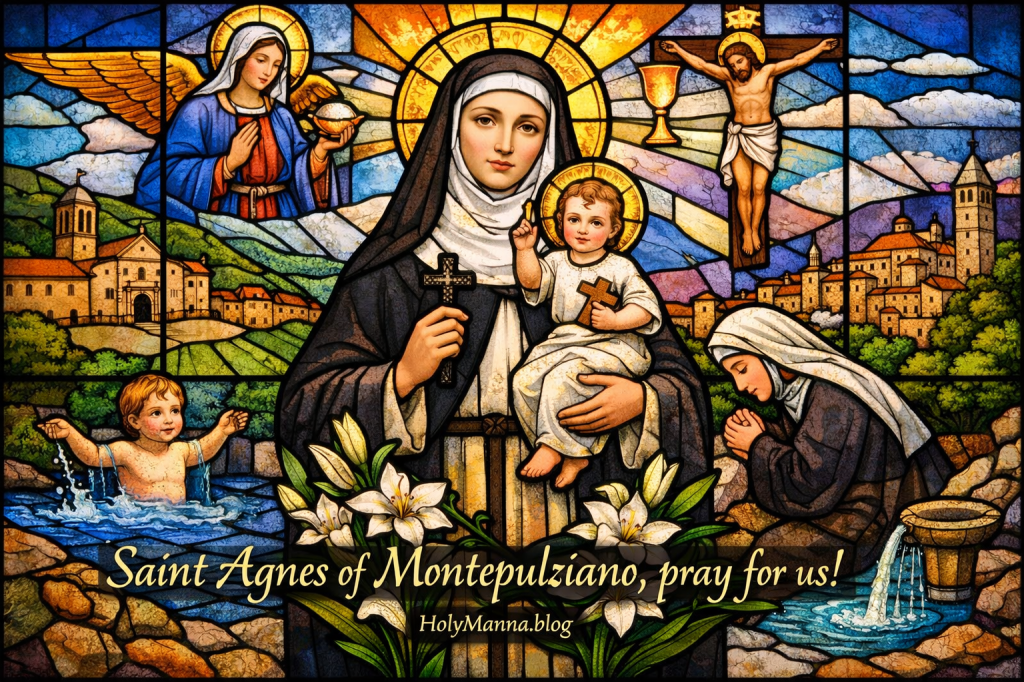
The Hidden Flower of Tuscany
Saint Agnes of Montepulciano is one of those saints who seems to have stepped out of a medieval fresco and yet still speaks with surprising force to modern hearts. She was a Dominican holy woman, a foundress, a mystic, and a miracle-working abbess whose life was marked by prayer, penance, humility, and a deep love for Jesus Christ. The Church reveres her because she shows what happens when a soul belongs completely to God, even from childhood.
She is remembered above all for her holiness, her astonishing wisdom at a very young age, her devotion to the Eucharist, and the many miracles associated with her life and tomb. She became a superior while still in her teens, founded a monastery in Montepulciano, and lived with such transparent love for Christ that generations of Catholics never forgot her. Long after her death, her memory continued to draw pilgrims, inspire Dominican spirituality, and strengthen the faith of the people of Tuscany.
Saint Agnes matters because she reminds the Church that sanctity does not always arrive with noise, public fame, or worldly power. Sometimes it grows quietly in a cloister, hidden from the world, and yet shines so brightly that the whole Church eventually sees it.
A Child Given Early to God
Saint Agnes was born near Montepulciano in Tuscany in the late thirteenth century, most likely around 1268, though some Catholic accounts place her birth a few years later. She came from a respected family and grew up in a world shaped by noble households, local politics, and the strong religious culture of medieval Italy. From childhood, though, her heart seemed to be set on something higher.
While most girls her age would have been prepared for marriage or noble domestic life, Agnes desired consecration to God. At about nine years old, she entered the community known as the Sisters of the Sack, an austere religious group known for simplicity and penance. That alone would have been unusual enough, but what happened next made her even more remarkable. Her maturity, judgment, and holiness were so evident that she was later sent to help establish a new religious house at Proceno.
There, while still very young, she eventually became superior by papal permission. That fact still startles people. A girl of about fifteen was entrusted with authority over a monastery because her prudence and sanctity were already impossible to ignore. Catholic tradition sees in this not merely youthful talent, but the grace of God at work in a soul that had surrendered everything.
As her life unfolded, Agnes became most known for three things. She was known for her extraordinary prayer. She was known for her holiness expressed through humility. She was known for the miracles and signs that seemed to follow her wherever she lived.
The Abbess, the Mystic, and the Miracles
The most visible work of Saint Agnes’s life came when the people of Montepulciano asked her to return and found a monastery there. She did, establishing the convent of Santa Maria Novella, which later came under the care of the Dominican Order. Catholic tradition also preserves a striking detail that the site had once been associated with serious moral disorder. In that sense, the foundation of the monastery became a living sign of grace triumphing over sin. A place once marked by vice became a place of prayer.
This was one of the great themes of her life. Agnes did not merely flee the world. She helped transform it by holiness.
During her lifetime, many miracles and mystical favors were associated with her. Catholic sources commonly recount that she experienced visions of the Blessed Virgin Mary, of Christ, and of angels. One tradition says that the Christ Child was placed in her arms. Another says that He left her a small cross. This story belongs to the long Catholic tradition surrounding her life, but it cannot be independently verified.
Other accounts say that heavenly white flakes or dew fell around her, sometimes in the form of small crosses, especially in connection with her election as superior. A Dominican prayer tradition still remembers this imagery of heavenly dew and flowers. This story belongs to the long Catholic tradition surrounding her life, but it cannot be independently verified.
She was also known for miracles of charity and providence. Some stories say food multiplied at her convent when resources were scarce. Others say flowers sprang up where she prayed. Catholic retellings also speak of ecstasies so deep that an angel brought her Holy Communion when she could not get to Mass. These stories belong to the long Catholic tradition surrounding her life, but they cannot be independently verified.
One of the best known miracle stories from her earthly life is the account of a drowned child brought back to life through her prayers while she was at the baths of Chianciano during her final illness. This miracle is widely preserved in Catholic sources about her and is one of the signs most closely associated with her compassion and intercessory power.
Saint Agnes is important not simply because marvels surrounded her, but because those marvels pointed to a deeper truth. Her life showed total dependence on God. Her holiness was not spectacle. It was surrender. That is why Catholics continue to remember her. She lived what The Catechism teaches about the universal call to holiness, that all the faithful are called to the fullness of Christian life and the perfection of charity, as seen in CCC 2013.
The Cross She Carried Without Complaint
Saint Agnes was not a martyr in the strict sense. She did not die by execution for the faith. Yet her life was still marked by real hardship, and the Church does not overlook hidden suffering simply because it is not dramatic.
She embraced severe penance from an early age. She carried the burden of leadership while still young. She lived in a religious world that demanded discipline, sacrifice, and patience. Later, she endured prolonged illness, weakness, and physical suffering. By the end of her life, her body was worn down, but her soul remained fixed on Christ.
This is one of the beautiful parts of her witness. Some saints preach with sermons. Others preach with endurance. Agnes taught through steadfastness. She accepted suffering not as meaningless pain, but as a way of union with the Lord. Her life reflects the truth that Christians do not merely admire the Cross from a distance. They learn to carry it with Christ.
Even her final days reflected this calm confidence in God. A saying preserved in Catholic tradition places these words on her lips as she prepared to die: “You will discover that I have not abandoned you. You will possess me for ever.” Whether heard by her sisters as comfort, promise, or farewell, the line captures the tenderness and faith that marked her life.
Wonders at Her Tomb and a Legacy That Would Not Fade
After her death on April 20, 1317, devotion to Saint Agnes grew quickly. Her tomb became a place of pilgrimage, and many Catholics believed they received favors through her intercession. Her body was said to emit a sweet fragrance, and she became associated with incorruptibility, one of the signs that has often stirred devotion among the faithful. The Church does not teach that incorruption is necessary for sainthood, but in Catholic tradition it has often been received as a sign that points toward the holiness of the person.
Stories of healings and answered prayers continued after her death. Pilgrims came to seek her intercession. Her relics were venerated. Her shrine at Montepulciano became a center of devotion. Even where some details of individual miracle stories are difficult to verify in a modern historical sense, the enduring Catholic testimony is clear. The faithful believed she was close to God, and they continued to experience her as an intercessor.
One of the most beloved posthumous stories connected to her involves Saint Catherine of Siena. Catherine had a deep devotion to Agnes and is said to have called her “our mother, the glorious Agnes.” According to Dominican tradition, when Catherine bent down to kiss Agnes’s foot in reverence, the foot rose to meet her lips. This story has been lovingly preserved in Dominican memory, but it cannot be independently verified.
Her legacy after death is not limited to miracle stories. It is also liturgical, local, and cultural. She was canonized by Pope Benedict XIII in 1726. She is honored on April 20. She remains closely associated with Montepulciano, where she is still remembered as a patroness of the city. Local Catholic celebrations, novenas, solemn liturgies, and public acts of devotion continue to keep her memory alive. She is not merely a medieval figure buried in the past. She still belongs to the living memory of the Church.
Her influence also spread through the Dominican family. Blessed Raymond of Capua wrote her life only a few decades after her death, preserving her story for the Church. Later Dominican generations held her up as a model of contemplative life, humility, and fidelity. In this sense, her impact was both local and universal. She belonged to Montepulciano, but she also belonged to the whole Church.
What Her Life Still Says to the Church
Saint Agnes of Montepulciano teaches that holiness begins with belonging. She belonged to Christ from childhood, and everything else in her life flowed from that. Her humility kept her grounded. Her prayer kept her strong. Her love of the Eucharist kept her close to the Lord. Her penance purified her heart. Her charity made her fruitful.
There is something deeply needed in her witness today. Modern life often rewards self-promotion, speed, visibility, and comfort. Agnes stands in quiet contradiction to all of that. She reminds the faithful that the deepest work of God often happens in hidden places. A cloistered nun who never chased fame became a saint whose memory outlived noble houses, political powers, and passing fashions.
Her life also points toward several great Catholic truths. Her devotion to Christ in the Eucharist reflects what The Catechism teaches about the Real Presence of Jesus in the Blessed Sacrament in CCC 1374. Her enduring intercession after death reflects the Church’s teaching on the communion of saints in CCC 956. Her whole witness shows the beauty of a soul purified by grace and made radiant through charity.
For daily life, her example is surprisingly practical. Pray faithfully even when no one sees it. Accept small sacrifices with love. Remain humble when entrusted with responsibility. Let suffering become a school of union with Christ instead of a cause for bitterness. Stay close to the Eucharist. Trust that hidden fidelity matters more than public recognition.
What would change if prayer were treated not as an extra part of life, but as the center of it? What hidden place in the heart still needs to be turned from an old life of sin into a monastery for the Lord? What would it look like to carry present sufferings with the quiet strength Saint Agnes showed?
The saints are not preserved by the Church merely to be admired. They are given so that Christians may imitate them. Saint Agnes shows that even a hidden life can become radiant with grace when it is offered completely to Jesus.
Engage with Us!
Share your thoughts and reflections in the comments below. Saint Agnes of Montepulciano lived a hidden life, but her witness still speaks loudly. Her story invites deeper trust, deeper prayer, and deeper surrender.
- What part of Saint Agnes’s life stands out the most: her humility, her miracles, her endurance in suffering, or her love for the Eucharist? Why?
- How can a life that seems small or hidden become powerful in the eyes of God?
- Is there an area of life where greater prayer and sacrifice might open more space for grace?
- What does Saint Agnes teach about trusting God even when holiness is quiet and unseen?
- How can her example help Catholics live with more love, reverence, and fidelity in ordinary daily life?
May Saint Agnes of Montepulciano inspire a life of steady faith, deep prayer, and humble love. May every hidden sacrifice be offered to Christ with confidence. And may everything be done with the love and mercy Jesus taught us.
Saint Agnes of Montepulciano, pray for us!
Follow us on YouTube, Instagram and Facebook for more insights and reflections on living a faith-filled life.


Leave a Reply