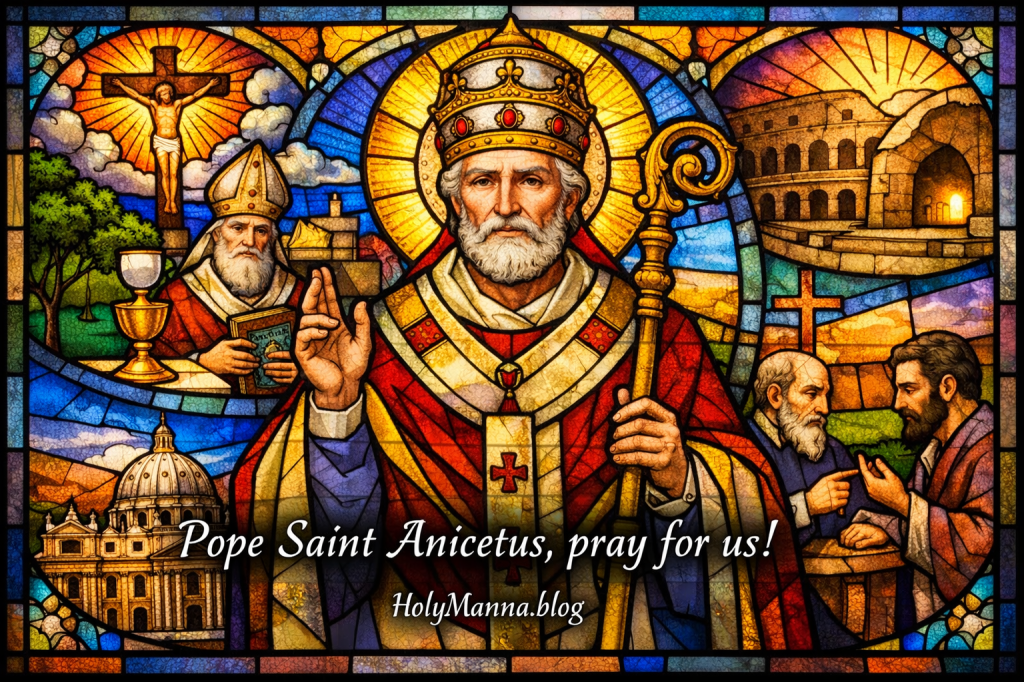
The Shepherd Who Kept the Church Together
There are saints who thunder across history with long sermons, dramatic miracles, or famous final words. Then there are saints like Pope Saint Anicetus, whose greatness is quieter, steadier, and in some ways even more needed. He belongs to the early centuries of the Church, when Christianity was still fighting for its life, heresies were spreading, persecution was real, and the faithful were learning what it meant to remain one body in Christ. Pope Saint Anicetus is revered because he stood at the heart of that struggle and helped preserve the unity of the Church.
He is remembered above all as an early Bishop of Rome who guarded apostolic faith and maintained communion during a serious disagreement about the date of Easter. That may sound like a small thing at first, but it was not small at all. It touched the Church’s worship, memory, and common life. In a time when division could easily have hardened into schism, Anicetus helped show that truth and charity belong together. That alone makes him worth remembering.
His life also matters because it reflects what The Catechism teaches about apostolic succession and the Church’s visible unity under the successors of the Apostles and the successor of Saint Peter. Pope Saint Anicetus did not become famous by drawing attention to himself. He became holy by faithfully holding his place in the line of shepherds who protected the flock Christ entrusted to His Church.
A Son of Syria in the Chair of Peter
Very little is known with certainty about the early life of Pope Saint Anicetus, and that silence is part of the humility that surrounds so many of the earliest saints. Catholic tradition holds that he came from Syria, and more specifically from Emesa, which is modern Homs. Some later traditions even preserve the name of his father as John. These details have been handed down in Catholic memory, though not every part of them can be verified with the same historical strength.
What can be said with confidence is that Anicetus came from the Christian East and eventually became Bishop of Rome during the middle of the second century. That alone is striking. From the beginning, the Church was never meant to be a narrow local movement. Even in those early years, the Catholic Church already showed her universality. A Syrian Christian sat in Rome as successor of Peter, guiding believers from many lands, languages, and customs into one communion.
There is no dramatic conversion story attached to Anicetus in the way there is for saints like Augustine or Mary Magdalene. Instead, his life seems to have unfolded within the steady path of fidelity. He appears as a man already formed by the faith, one who stepped into leadership when the Church desperately needed clarity, courage, and peace. Sometimes holiness does not enter with a crash. Sometimes it arrives as a man quietly taking up the burden placed on his shoulders and carrying it without compromise.
Anicetus is most known for his role in preserving unity while defending truth. That is the center of his legacy. He lived in a Church under pressure from both outside persecution and internal confusion. He did not leave behind a long body of writings or famous speeches. What he left behind was something even more essential. He helped keep the Church one.
Holding the Line in an Age of Confusion
The years of Anicetus’s pontificate were difficult years for Christians. False teachers were trying to pull believers away from the apostolic faith. Among them were men like Marcion and Valentinus, whose errors wounded many souls. Marcion rejected the fullness of the faith handed on by the Church and tried to cut Christianity loose from its roots in the Old Testament. Valentinian thought in ways that opened the door to Gnostic confusion, replacing the simplicity of the Gospel with spiritual pride and speculation.
Pope Saint Anicetus governed during this dangerous atmosphere. He is important because he stood in continuity with the Apostles and helped defend the Church against teachings that could have distorted the Gospel beyond recognition. In that sense, he reminds the faithful that holiness is not softness toward error. Charity is never served by surrendering the truth.
The most famous event of his life was his meeting with Saint Polycarp of Smyrna, that holy bishop who had been a disciple of Saint John. The issue between them was the date of Easter. Christians in some parts of the East followed one custom, while Rome followed another. It would have been easy for pride to take over. It would have been easy for either side to turn a dispute into a rupture. But that is not what happened.
Instead, the Church remembers this meeting as a moment of deep mutual respect. The disagreement remained, but communion remained too. The witness handed down from that time says they “parted in peace” and that the matter did not destroy “the harmony of our common faith.” Those are not verified words spoken by Anicetus himself, but they are among the most beautiful lines associated with his conduct and legacy.
That is why he should be remembered. He did not choose unity over truth, and he did not choose truth in a way that destroyed charity. He held both together. In an age that constantly tempts people toward either compromise or needless hostility, Pope Saint Anicetus still has something to teach.
The Quiet Miracle of Fidelity
When people read about saints, they often look for dramatic miracles. In the case of Pope Saint Anicetus, reliable Catholic sources do not preserve a clear set of miracle stories from his lifetime. No famous healings, resurrections, or supernatural signs are securely attached to his name in the way they are for some other saints.
That does not make his life less holy. In fact, it may help reveal something deeper. The great miracle of Anicetus’s life was fidelity. He helped steady the Church when she was vulnerable. He preserved communion when division seemed possible. He guarded apostolic faith when false teachers were trying to remake Christianity into something else. Those are not small things. They are the sort of hidden victories that make the visible life of the Church possible.
There is also an old disciplinary tradition that attributes to him a decree concerning clerical grooming, often described as a rejection of vanity among the clergy. Whether that decree comes directly from his own time is uncertain, but the tradition itself reflects something fitting about his memory. He belonged to a generation of shepherds who understood that the Church’s leaders were not meant to be men of self-display. They were meant to be servants, witnesses, and guardians.
That is one reason his example still matters. The Church does not only need brilliant thinkers, fiery preachers, or heroic martyrs. She also needs steady fathers who keep watch through the night and refuse to let the flock scatter.
Trial, Tradition, and the Question of Martyrdom
The Church has long honored Pope Saint Anicetus with deep reverence, and older traditions often refer to him as a martyr. At the same time, the historical evidence for his martyrdom is not strong enough to speak with full certainty. It is one of those cases where Catholic tradition preserves an ancient title, while historians admit that the surviving documentation is thin.
What can be said is that he lived in a dangerous age. Christians were never far from threat, and the office he held placed him in a particularly exposed position. Even if the details of a martyr’s death cannot be firmly proven, his life itself was lived under the shadow of hostility toward the faith. That alone demanded courage.
There are no well-attested stories of miraculous escapes or spectacular protections in his case. Instead, his hardships seem to have been the ordinary sufferings of an early pope. He had to shepherd the Church while heresies spread, customs differed, and the Christian community still lived without worldly security. That may not sound dramatic by modern standards, but it was a real cross.
If he was not martyred by blood, he was certainly a confessor of the faith by burden, sacrifice, and perseverance. Some saints die in one public moment. Others spend themselves over years for the good of the Church. Pope Saint Anicetus belongs, at the very least, to that second kind of witness.
A Legacy That Outlived the Centuries
After his death, Pope Saint Anicetus remained in the memory of the Church not because of a flood of legends, but because of the strength of his place in apostolic succession. Later Catholic writers such as Saint Irenaeus remembered him as part of the chain of bishops of Rome that testified to the continuity of the true faith. In an age of confusion, that mattered immensely. The Church could point to the line of her shepherds and say that the apostolic faith had not disappeared into private theories or secret teachings. It had remained public, visible, sacramental, and guarded.
This is one of the most important parts of his legacy. He became a witness not only through what he did during his life, but through what his place in the Church continued to signify after his death. His memory helped later generations defend the truth against heresy. He was part of the living proof that the Catholic faith was not an invention of the moment, but something handed down.
Catholic tradition also preserves burial and relic traditions connected with him. He was remembered as buried near Saint Peter, and later devotion associated relics of the saint with places of veneration in Rome. These traditions show that his memory endured in the Church’s prayer and liturgical life, even if they are not accompanied by a large body of miracle stories.
As for miracles after death, no famous and widely attested posthumous miracle cycle stands out in the principal Catholic sources on Pope Saint Anicetus. No major healing shrine, no extensive list of wonders, and no verified apparition tradition appears prominently in the historical record. Some traditions of relic veneration remain part of his memory, but specific miracle stories tied to those relics are not strongly preserved in the main sources. So the honest Catholic answer is simple. The Church remembers him chiefly for his office, his faithfulness, and his witness to unity, not for a famous body of miracle accounts after death.
His cultural impact is mostly ecclesial rather than popular. He is not among the most famous saints in the devotional imagination of ordinary Catholics, yet his influence is real and lasting. He stands in the memory of the Church as one of the early popes who helped preserve Catholic unity in a fragile age. His feast is observed in Catholic tradition, and differences in calendar usage have placed his commemoration on both April 17 and April 20 in different contexts. Even that small detail is a reminder that the Church carries a long and living memory across centuries.
Why Pope Saint Anicetus Still Matters
There is something refreshing about a saint like Pope Saint Anicetus. He does not overwhelm with spectacle. He does not dominate the page with dramatic stories. He simply stands there, steady and faithful, like a lamp burning in a dark room.
That is exactly why his life is so helpful now. The modern world is full of noise, outrage, and confusion. People are often pushed to choose between conviction and charity, as if one must cancel out the other. Pope Saint Anicetus shows another way. He teaches that truth does not require cruelty, and peace does not require compromise.
His life also reminds Catholics to love the visible Church Christ founded. The faith is not a private spirituality stitched together from favorite ideas. It is something handed on. It has pastors. It has sacraments. It has continuity. It has a history that runs through real men in real places, carrying real burdens. Saints like Anicetus make that visible.
There is also a personal lesson here. Most people will never settle a dispute between East and West. Most people will never serve as bishop of Rome. But everyone is called to be faithful in the place God has given. Everyone is called to protect unity in the family, the parish, and the wider Church. Everyone is called to reject falsehood without losing charity. Everyone is called to persevere when holiness looks ordinary and hidden.
Is there patience to defend the truth without becoming harsh? Is there courage to remain faithful even when no one notices? Is there love for the Church not only when she is triumphant, but also when she is wounded and under pressure? Those are the kinds of questions Pope Saint Anicetus places before the soul.
To live his example in daily life means staying close to the faith handed down by the Church, studying The Catechism, praying with humility, honoring lawful authority in the Church, and guarding the peace of one’s home and community. It means refusing gossip, refusing division, and refusing the temptation to treat every disagreement as a war. It means remembering that real strength is often quiet.
Engage with Us!
Share your thoughts and reflections in the comments below. What stands out most in the life of Pope Saint Anicetus, and what speaks most clearly to the heart today?
- What does Pope Saint Anicetus teach about holding onto truth without losing charity?
- How can greater patience and peace be brought into disagreements at home, at work, or in parish life?
- What does apostolic succession mean personally, and how does it deepen trust in Christ’s Church?
- Where is God asking for quiet fidelity instead of dramatic recognition?
- How can the example of this early pope help strengthen love for the unity of the Catholic Church?
May the witness of Pope Saint Anicetus encourage a life of steady faith, patient charity, and deep love for the Church Christ founded. May everything be done with the love and mercy Jesus taught us.
Pope Saint Anicetus, pray for us!
Follow us on YouTube, Instagram and Facebook for more insights and reflections on living a faith-filled life.


Leave a Reply