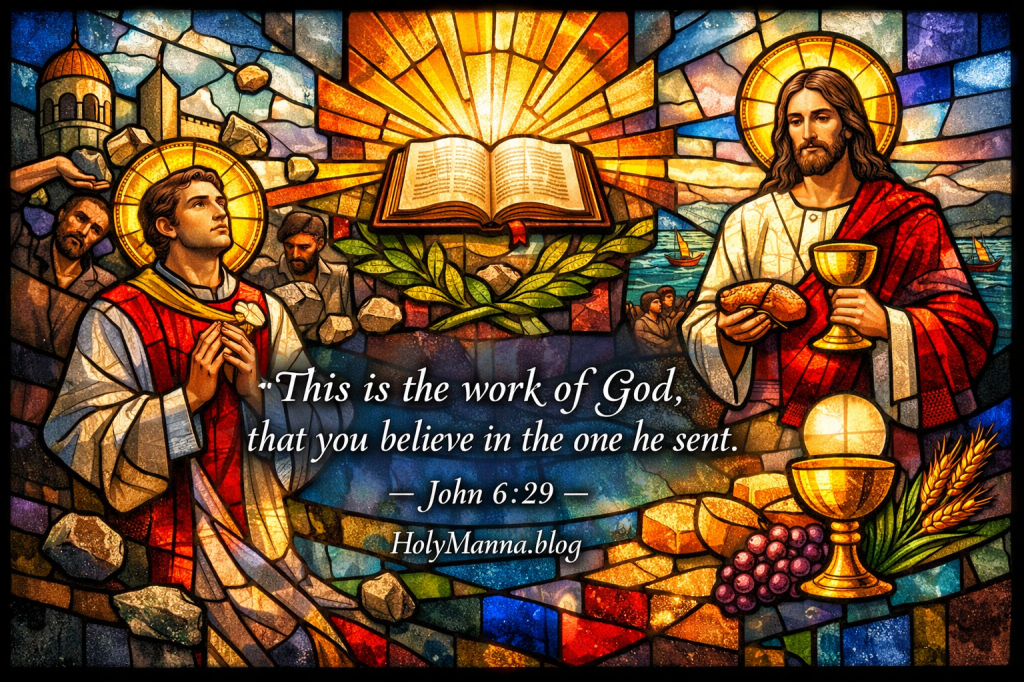
Monday of the Third Week of Easter – Lectionary: 273
Hungry for More Than Bread
There are days in the Church’s liturgy when the readings seem to reach across centuries and speak with one voice, and today is one of those days. Beneath the tension of accusation, the ache of opposition, and the hunger of a searching crowd, a single theme rises to the surface: God is drawing His people beyond appearances, beyond earthly security, and beyond passing satisfactions into a deeper fidelity that rests in Him alone. Today’s readings are about what happens when a soul is forced to choose between what is temporary and what is eternal, between human approval and divine truth, between bread that fills for a moment and the Lord who alone can satisfy forever.
That is why Acts of the Apostles, Psalm 119, and The Gospel of John fit together so beautifully. Stephen stands before men who cannot bear the wisdom given him by the Holy Spirit. The psalmist clings to the law of the Lord even while princes speak against him. The crowd in the Gospel searches for Jesus, but the Lord, who sees straight into the heart, reveals that they are still thinking too small. They want bread. He wants to give them belief. They want satisfaction for the body. He is leading them toward food that endures for eternal life. In each reading, the question is not simply whether someone will seek God, but why. Is the heart seeking the Lord because He is Lord, or merely because He gives something useful?
This is an especially rich theme during the Easter season. The Church is still basking in the light of the Resurrection, but she is also teaching her children what it means to live as people who truly believe Christ is risen. Easter is not just the celebration of a miracle from the past. It is the unveiling of a new way of living. The risen Jesus calls men and women to set their hearts on what lasts. That is why the liturgy places Stephen before the faithful so soon after the Resurrection narratives. The Church wants her children to see that belief in the risen Christ is not sentimental or shallow. It produces courage. It produces clarity. It produces saints whose faces, like Stephen’s, begin to reflect heaven even while they are still standing in the middle of earthly conflict.
There is also an important religious background tying these readings together. Stephen is accused of speaking against the Temple and the law, which touches the deepest concerns of Jewish religious life in the first century. The Temple was not merely a building. It was the visible sign of covenant worship, the sacred place of sacrifice, identity, and the presence of God among His people. At the same time, in The Gospel of John, the crowd is still thinking in terms shaped by the wilderness story of Israel, where bread from heaven had once sustained God’s people. Jesus steps directly into that world and begins lifting their understanding higher. He is not abolishing what came before. He is bringing it to fulfillment. The Temple, the law, the manna, the signs, the prophets, all of it points toward Him. That is why the tension in today’s readings feels so sharp. Some are ready to follow fulfillment into the person of Christ. Others cling to the shadows because they cannot yet bear the light.
What makes these readings so piercing is that they do not stay in the ancient world. They expose something deeply familiar in every age, including this one. It is possible to admire religion and still resist God. It is possible to seek Jesus and still want only earthly comfort. It is possible to speak about truth and still shrink back when truth becomes costly. That is why today’s liturgy feels so personal. It invites every reader to ask what kind of disciple he is becoming. Is the heart being shaped by the word of God like the psalmist’s? Is it willing to stand firm like Stephen? Is it learning, at last, to seek Christ not merely for what He gives, but for who He is?
Today’s readings prepare the soul for a deeper conversion. They invite the faithful to move from convenience to conviction, from fascination to faith, and from temporary hunger to eternal desire. The same Lord who fed the crowd, strengthened Stephen, and guided the psalmist now speaks through the Church’s liturgy with the same loving firmness. He still calls His people away from what perishes. He still teaches them how to endure opposition. And He still leads them, patiently and powerfully, toward the only food that can truly give life.
First Reading – Acts 6:8-15
When Truth Shines Brightest Under Pressure
Stephen steps into today’s liturgy at a tense and decisive moment in the life of the early Church. The apostles have already begun preaching the Resurrection boldly in Jerusalem, and the Gospel is spreading beyond a small inner circle into the wider life of the city. Stephen, one of the seven chosen to serve the community, is not merely helping with practical needs. He has become a powerful witness to the risen Christ. That matters because his ministry shows that the Church’s life is never divided between action and truth, charity and proclamation. A man formed by grace begins to radiate Christ in both word and deed.
Historically, this scene unfolds in Jerusalem not long after the Resurrection and Ascension of the Lord. Religious tensions are high. The Temple still stands, the Sanhedrin still holds influence, and many Jewish leaders see the preaching about Jesus as a threat to the order they know. The mention of the Synagogue of Freedmen, along with Cyrenians, Alexandrians, and others from Cilicia and Asia, reminds readers that Jerusalem was filled with Jews from across the Mediterranean world. Stephen is speaking into a religious environment shaped by deep reverence for Moses, the Law, and the Temple. That is why the accusations against him are so explosive. He is not being charged with a minor offense. He is being accused of attacking the sacred foundations of Jewish life.
This reading fits beautifully into today’s theme because Stephen stands as the opposite of the crowd in the Gospel. The crowd chases bread that passes away. Stephen clings to the truth that endures. The crowd seeks Jesus for earthly satisfaction. Stephen bears witness to Jesus even when that witness places his life in danger. In Stephen, the Church sees what happens when a soul no longer lives for comfort, approval, or safety, but for Christ alone.
Acts 6:8-15 – New American Bible (Revised Edition)
Accusation Against Stephen. 8 Now Stephen, filled with grace and power, was working great wonders and signs among the people. 9 Certain members of the so-called Synagogue of Freedmen, Cyrenians, and Alexandrians, and people from Cilicia and Asia, came forward and debated with Stephen, 10 but they could not withstand the wisdom and the spirit with which he spoke. 11 Then they instigated some men to say, “We have heard him speaking blasphemous words against Moses and God.” 12 They stirred up the people, the elders, and the scribes, accosted him, seized him, and brought him before the Sanhedrin. 13 They presented false witnesses who testified, “This man never stops saying things against [this] holy place and the law. 14 For we have heard him claim that this Jesus the Nazorean will destroy this place and change the customs that Moses handed down to us.” 15 All those who sat in the Sanhedrin looked intently at him and saw that his face was like the face of an angel.
Detailed Exegesis
Verse 8: “Now Stephen, filled with grace and power, was working great wonders and signs among the people.”
Stephen is introduced with language that sounds almost apostolic. He is filled with grace and power, and those gifts overflow in visible wonders and signs. This is important because it shows that the risen Christ continues His work through His Church. The miracles are not a performance and they are not proof of Stephen’s personal greatness. They are signs that God is acting through a man fully surrendered to Him. In Catholic understanding, grace is never static. It transforms the person and bears fruit. Stephen’s public witness begins in an interior fullness.
Verse 9: “Certain members of the so-called Synagogue of Freedmen, Cyrenians and Alexandrians, and people from Cilicia and Asia, came forward and debated with Stephen.”
Opposition rises from men formed in serious religious traditions. These are not casual skeptics. They are men trained to argue, interpret, and defend what they believe. Their coming forward to debate Stephen shows that Christianity from the beginning entered into the heart of religious and intellectual conflict. The truth of Christ was not announced in a vacuum. It confronted long-standing expectations and exposed hearts that were unwilling to follow revelation to its fulfillment.
Verse 10: “But they could not withstand the wisdom and the spirit with which he spoke.”
Stephen’s strength is not merely rhetorical skill. The text says they cannot withstand the wisdom and the spirit with which he spoke. This echoes Christ’s promise that the Holy Spirit would teach His disciples what to say in times of trial. Stephen is not winning because he is cleverer. He is speaking from communion with God. The Church has always seen in this verse a sign that authentic Christian witness comes from the Holy Spirit. Truth has a force that goes beyond argument when it is carried by holiness.
Verse 11: “Then they instigated some men to say, ‘We have heard him speaking blasphemous words against Moses and God.’”
When truth cannot be defeated honestly, it is often attacked dishonestly. The debate gives way to conspiracy. False testimony begins to replace sincere engagement. This is a familiar biblical pattern. It happened to the prophets, and it happened supremely to Christ Himself. The accusation is carefully chosen. By claiming that Stephen speaks against Moses and God, his enemies frame him as both irreligious and dangerous. Yet the irony is striking. Stephen is not rejecting Moses. He is proclaiming the One to whom Moses pointed.
Verse 12: “They stirred up the people, the elders, and the scribes, accosted him, seized him, and brought him before the Sanhedrin.”
The conflict widens quickly. What began as debate becomes public agitation. The crowd, the elders, and the scribes are stirred up. This is how mob pressure often works in salvation history. Once truth becomes inconvenient, passions are inflamed and institutions are enlisted. Bringing Stephen before the Sanhedrin places him in the same broad pattern as Jesus. The disciple is now walking the path of the Master. For the early Church, this would have been a sober reminder that fidelity to Christ can lead straight into misunderstanding and persecution.
Verse 13: “They presented false witnesses who testified, ‘This man never stops saying things against this holy place and the law.’”
The phrase “this holy place” refers to the Temple. The Temple was the heart of Jewish worship, sacrifice, and national identity. To be accused of speaking against it was to be painted as a threat to the covenant itself. But Stephen’s real message is not destruction for its own sake. He is proclaiming fulfillment in Christ. The law and the Temple were never ends in themselves. They were part of God’s saving plan, preparing His people for the coming of the Messiah. False witnesses twist that fulfillment into rebellion.
Verse 14: “For we have heard him claim that this Jesus the Nazorean will destroy this place and change the customs that Moses handed down to us.”
This accusation echoes the words spoken against Jesus concerning the Temple. It is a distorted version of a deeper truth. Jesus did speak of the Temple in a new way, because He Himself is the true Temple, the meeting place between God and man. In Him, worship is no longer centered on a building alone but on His person, His sacrifice, and His Body the Church. The customs handed down through Moses are not being mocked. They are reaching their fulfillment. Stephen is being condemned because he sees what his opponents refuse to see: the old order has found its completion in the risen Christ.
Verse 15: “All those who sat in the Sanhedrin looked intently at him and saw that his face was like the face of an angel.”
This final detail is one of the most beautiful in the whole passage. In the middle of accusation and danger, Stephen’s face shines with a heavenly calm. The image recalls Moses descending from the mountain with his face radiant after speaking with God. It also points forward to Stephen’s martyrdom. The man who is united to Christ begins to bear the light of Christ. The Sanhedrin sees something supernatural, even if many of them do not yet understand it. Holiness has a beauty that cannot be fully hidden, even in the hour of judgment.
Teachings
This reading reveals that Christian witness is not first about strategy, popularity, or personal confidence. It is about grace. Stephen is strong because God is strong in him. That is why the Church teaches that the Holy Spirit gives the faithful the courage to bear witness even under pressure. The Catechism teaches, “The Holy Spirit makes us discern between trials, which are necessary for the growth of the inner man, and temptation, which leads to sin and death” (CCC 2847). Stephen is facing a trial, and grace is turning that trial into testimony.
The reading also touches the Church’s understanding of false witness and truth. Stephen is dragged before the Sanhedrin through distortion and slander. That is not a small detail. It shows that lies are not merely social failures. They are spiritual weapons. The Catechism says, “False witness and perjury. When it is made publicly, a statement contrary to the truth takes on a particular gravity. In court it becomes false witness” (CCC 2476). The charges against Stephen are grave not only because they are false, but because they attempt to destroy an innocent man through religious manipulation.
The Fathers of the Church saw Stephen as a radiant example of Christlike witness. Saint Augustine preached of him with great tenderness and force: “Stephen was persecuted by the same people as those by whom Christ was persecuted. Christ was driven to the cross, Stephen to his stoning. Christ, while hanging on the cross, said, ‘Father, forgive them, for they know not what they do.’ Stephen, while being stoned, said, ‘Lord, do not hold this sin against them.’” This insight matters because it shows that Stephen’s witness is not merely doctrinal. It is deeply personal. He does not only speak like Christ. He suffers like Christ and forgives like Christ.
Saint John Chrysostom also marveled at Stephen’s fearless clarity. He saw in him a man so possessed by divine wisdom that opponents could not bear his words. That is one of the great Catholic lessons of this passage. Holiness does not make a man vague. It makes him luminous. It gives him the kind of clarity that unsettles those attached to half-truths and appearances.
There is also a profound teaching here about fulfillment. Stephen is accused of speaking against Moses and the Temple, yet the Church understands that Christ does not abolish the old covenant as though it were evil. He fulfills it. The Catechism states, “The Old Law is a preparation for the Gospel. ‘The Law is a pedagogy and a prophecy of things to come.’ It prophesies and presages the work of liberation from sin which will be fulfilled in Christ” (CCC 1964). Stephen’s preaching stands firmly within that truth. He is not rejecting God’s earlier works. He is proclaiming their completion in Jesus.
Finally, this reading prepares the Church to think about martyrdom, even before Stephen’s actual death appears in the verses that follow. The Catechism teaches, “Martyrdom is the supreme witness given to the truth of the faith: it means bearing witness even unto death” (CCC 2473). Stephen’s martyrdom begins here, in fidelity under accusation. Before the stones ever strike him, he has already given his heart completely to Christ.
Reflection
Stephen’s story speaks powerfully to daily life because most souls will not first be tested by dramatic persecution, but by smaller moments of pressure. There are times when truth becomes inconvenient. There are times when silence feels safer than clarity. There are times when a person is misunderstood, unfairly judged, or spoken against for trying to remain faithful. This reading reminds the faithful that holiness is not measured by how comfortable life becomes after meeting Christ. Holiness is measured by whether the soul remains with Christ when the cost goes up.
There is also a quiet challenge here for anyone who wants a faith that stays easy and agreeable. Stephen’s face shines like an angel, but that radiance appears in a courtroom, not in comfort. Grace does not always remove conflict. Sometimes it makes a man capable of standing in the middle of conflict without losing peace. That is a lesson badly needed in a loud and reactive age.
A practical way to live this reading begins with prayer for truthfulness. The soul that wants to stand like Stephen must first learn to live honestly before God. It must ask for a clean tongue, a courageous heart, and freedom from the need to please everyone. It must stay close to Scripture, close to the sacraments, and close to the Holy Spirit, because that is where wisdom is formed. Another important step is learning not to panic when criticized unfairly. Stephen does not unravel. He remains rooted. That kind of steadiness grows slowly through grace, daily fidelity, and trust in God’s judgment.
This reading also invites an examination of motives. When opposition comes, is the first instinct to defend personal pride, or to remain faithful to Christ? When others misunderstand the faith, is there patience to speak with wisdom, or a rush into anger? When the cost of discipleship becomes real, is the heart still willing to choose what is true? These are not abstract questions. They reach into family life, work, friendships, parish life, and public witness.
Stephen’s example leaves the faithful with a hopeful truth. A soul filled with grace can shine even in hostile places. It can remain calm when others become agitated. It can speak clearly without becoming cruel. It can endure falsehood without surrendering to bitterness. That is the kind of witness the Church still needs. That is the kind of witness the Holy Spirit still forms.
Responsorial Psalm – Psalm 119:1, 23-24, 26-27, 29-30
When the Heart Finds Its Counsel in the Word of God
The responsorial psalm today sounds like the prayer of a soul that has already been tested and has learned where true stability is found. Psalm 119 is the great psalm of love for the law of the Lord. It is the longest psalm in Scripture, and it unfolds like a patient meditation on divine instruction, using many words for God’s revelation: law, statutes, precepts, decrees, judgments, testimonies, and commands. In the world of ancient Israel, this was not cold legal language. The law of the Lord was the gift that shaped the covenant people, the path that taught them how to live in communion with the God who had rescued them. To love the law was to love the wisdom of the Lord Himself.
That makes this psalm especially fitting beside Stephen’s trial and the crowd’s restless search for Jesus in today’s other readings. Stephen stands firm under accusation because he has clearly been formed by God. The crowd in the Gospel is still learning that what they need most is not passing bread but the One sent by the Father. The psalm stands in the middle like a window into the faithful heart. It shows what happens when a person stops being governed by fear, pressure, and deceit, and instead becomes governed by the word of God. In that sense, this psalm is not merely a prayer about obedience. It is a prayer about interior loyalty. It teaches the soul how to remain steady when others speak against it and how to delight in truth when the world offers easier paths.
Psalm 119:1, 23-24, 26-27, 29-30 – New American Bible (Revised Edition)
A Prayer to God, the Lawgiver
1 Blessed those whose way is blameless,
who walk by the law of the Lord.23 Though princes meet and talk against me,
your servant meditates on your statutes.
24 Your testimonies are my delight;
they are my counselors.26 I disclosed my ways and you answered me;
teach me your statutes.
27 Make me understand the way of your precepts;
I will ponder your wondrous deeds.29 Lead me from the way of deceit;
favor me with your law.
30 The way of loyalty I have chosen;
I have kept your judgments.
Detailed Exegesis
Verse 1: “Blessed those whose way is blameless, who walk by the law of the Lord.”
The psalm opens with beatitude language. Blessedness in Scripture is not shallow happiness or passing emotional comfort. It is the deep condition of a life ordered rightly before God. To walk by the law of the Lord means more than following external rules. It means living under God’s wisdom, allowing His truth to shape one’s steps. The phrase “whose way is blameless” does not describe sinless perfection achieved by human effort alone. It points to integrity, to a life that is whole, honest, and directed toward the Lord. In Catholic teaching, this kind of uprightness is always the fruit of grace cooperating with human freedom.
Verse 23: “Though princes meet and talk against me, your servant meditates on your statutes.”
This verse brings the drama of opposition into the psalm. The speaker is not sheltered from conflict. Powerful people speak against him. Yet his response is not panic, revenge, or despair. He meditates on God’s statutes. That is the mark of spiritual maturity. The faithful man does not let hostile voices become his inner guide. He returns to the word of God. This verse connects strongly with Stephen, who faces hostility from religious authorities yet remains calm and luminous. It also reminds the Church that meditation on divine truth is not a luxury for peaceful times. It is a necessity for moments of trial.
Verse 24: “Your testimonies are my delight; they are my counselors.”
This is one of the most beautiful lines in the psalm. God’s testimonies are not merely tolerated. They are loved. They are not heavy burdens. They are counselors. In other words, the word of God becomes the voice that advises, corrects, and steadies the heart. A world full of competing voices always offers counsel of some kind. The question is whether that counsel leads toward God or away from Him. The psalmist declares that divine revelation is not restrictive but life-giving. The law becomes delight because it is recognized as the wisdom of a loving Father.
Verse 26: “I disclosed my ways and you answered me; teach me your statutes.”
There is humility in this verse. The psalmist opens his life before God. He discloses his ways. This is the posture of prayerful honesty, the kind of openness that belongs to repentance and trust. The request that follows is important: “teach me your statutes.” The faithful soul does not assume it already understands itself or God perfectly. It asks to be taught. This is deeply Catholic. The spiritual life begins to deepen when a person stops trying to justify every path and starts allowing God to interpret and correct the heart.
Verse 27: “Make me understand the way of your precepts; I will ponder your wondrous deeds.”
The psalmist seeks not only information, but understanding. He does not merely want commands. He wants wisdom. This is the prayer of someone who knows that God’s precepts are not arbitrary. They reveal the order of divine love. Once that understanding begins to open, the soul naturally ponders God’s wondrous deeds. Doctrine and wonder belong together. Obedience and awe belong together. The more the believer understands the way of God, the more he recognizes that the Lord’s works in history and salvation are marvelous beyond measure.
Verse 29: “Lead me from the way of deceit; favor me with your law.”
The psalm now becomes sharper and more personal. There are two ways before the human heart: the way of deceit and the way of God’s law. Deceit here is not only lying to others. It includes self-deception, false paths, and ways of living that promise life but do not deliver it. The prayer is striking because the psalmist does not ask merely for information about deceit. He asks to be led away from it. He knows that grace is needed. The law of the Lord is then described as a favor, a gift, a mercy. This is a beautiful correction for modern ears that often hear divine law as a burden. The psalmist sees it as rescue.
Verse 30: “The way of loyalty I have chosen; I have kept your judgments.”
The psalm ends today with decision and fidelity. The “way of loyalty” is the path of covenant faithfulness. It is the road of constancy, truth, and obedience. This choice is not fleeting emotion. It is a settled direction of life. To keep God’s judgments is to live within the truth He has revealed. The verse reveals the cooperation of grace and human response. God teaches, leads, and favors. The believer chooses, clings, and keeps. That balance is at the heart of Catholic spirituality. Grace does not erase freedom. It heals it and directs it toward fidelity.
Teachings
This psalm teaches that true blessedness comes from conformity to God’s will, not from escaping difficulty. That is a lesson the saints understood well. The righteous man of Psalm 119 is not free from pressure, but he is free from being ruled by pressure. His heart has found a deeper center. That is why the Church has always loved this psalm as a school of prayer. It trains the believer to see divine law not as legalism, but as wisdom, light, and covenant love.
The Catechism speaks with real beauty about the moral law and helps illuminate this psalm: “The moral law is the work of divine Wisdom. Its biblical meaning can be defined as fatherly instruction, God’s pedagogy. It prescribes for man the ways, the rules of conduct that lead to the promised beatitude; it proscribes the ways of evil which turn him away from God and his love. It is at once firm in its precepts and, in its promises, worthy of love” (CCC 1950). That line could almost serve as a summary of today’s responsorial psalm. The law is not random command. It is fatherly instruction that leads to blessedness.
The psalm also reflects the truth that the interior life must be formed if outward fidelity is to endure. The Catechism teaches, “The New Law is called a law of love because it makes us act out of the love infused by the Holy Spirit, rather than from fear; a law of grace, because it confers the strength of grace to act, by means of faith and the sacraments; a law of freedom, because it sets us free from the ritual and juridical observances of the Old Law, inclines us to act spontaneously by the prompting of charity” (CCC 1972). This does not cancel the beauty of Psalm 119. It brings it to fulfillment. What the psalmist loves and longs for reaches its perfection in the grace of Christ, who writes the law more deeply into the heart.
Saint Augustine often spoke of the relationship between law and love, insisting that God’s commands are not opposed to joy. He understood that the heart must be reordered, not merely restrained. One of his most famous lines captures the spirit behind this psalm: “Give what You command, and command what You will.” That prayer is profoundly fitting here. The psalmist asks to be taught, led, and rescued because he knows that God’s grace must make possible what God’s wisdom commands.
Pope Benedict XVI, reflecting on Psalm 119, taught that the word of God becomes a lamp for the believer because it reveals the meaning of life itself. He emphasized that the divine law is not an oppressive imposition but a place of encounter, where the soul comes to know the wisdom and closeness of the Lord. That insight helps explain why today’s refrain fits the whole day’s theme so well. The soul that feeds on the word of God becomes less vulnerable to the false food of the world. It begins to recognize that the Lord’s instruction is already a form of nourishment.
Historically, Israel’s love for the law was rooted in covenant identity. The commandments were given to a people already rescued from Egypt. In other words, God’s law came after deliverance, not before it. It was not a ladder by which Israel earned love. It was the path by which a beloved people learned how to live as God’s own. The Church inherits and fulfills that pattern. Christians do not obey in order to become loved. They obey because in Christ they have been called, redeemed, and taught to live as children of the Father.
Reflection
This psalm lands gently but firmly in ordinary life. It asks what has been allowed to counsel the heart. Is it the word of God, or the constant noise of opinion, anxiety, trends, resentment, and self-justification? Every day, the soul is being advised by something. That is why the line “they are my counselors” is so revealing. The real issue is not whether there is counsel, but whose counsel is being trusted.
A practical way to live this psalm begins with making space for God’s word before the world’s voices take over the day. Even a few minutes of quiet attention to Scripture can begin to reorient the heart. Another step is learning to bring one’s actual ways before God, not a polished version. The psalmist says, “I disclosed my ways and you answered me.” That kind of honesty belongs in prayer, in examination of conscience, and in confession. It is how the way of deceit begins to lose its grip.
This psalm also invites a deeper change in how obedience is viewed. Many people still carry the suspicion that God’s commands are there to limit joy. Today’s reading tells a very different story. The law of the Lord is favor. It is counsel. It is delight. The soul that begins to trust that truth finds a strange freedom, because it no longer has to invent its own path. It can walk in one already marked out by divine wisdom.
What voices have been shaping the heart most strongly lately? When criticism or pressure comes, does the soul return to God’s word, or run first to self-defense? Is the law of the Lord being treated like a burden to manage, or like a gift to receive? What would it look like this week to choose the way of loyalty more deliberately?
The beauty of this psalm is that it does not pretend the path is easy. Princes still speak against the faithful. Deceit still tempts the heart. Understanding still has to be sought. But the psalm offers something steadier than easy circumstances. It offers a formed soul. It offers a heart taught by God. And when the heart is truly taught by God, it can stand firm, like Stephen, and it can begin to hunger, like a true disciple, for what really endures.
Holy Gospel – John 6:22-29
From Chasing Bread to Trusting the Bread of Life
Today’s Gospel opens the great Bread of Life discourse in The Gospel of John, and it begins in a way that feels surprisingly human. The crowd is searching for Jesus after the multiplication of the loaves. They had eaten. They had been filled. They had seen something extraordinary. Now they go looking for the man who fed them. On the surface, that sounds like devotion. But Jesus, as He so often does, looks past the movement of their feet into the motives of their hearts.
The setting matters. This passage comes right after the feeding of the five thousand and after Jesus’ mysterious crossing of the sea. The crowd has seen a sign, but they have not yet understood what the sign means. In the world of first century Judaism, bread was never just bread. It carried the memory of manna in the desert, the daily dependence of Israel on God, and the hope that the Lord would once again feed His people in the age of salvation. So when Jesus begins speaking about food that endures for eternal life, He is not drifting into a spiritual metaphor detached from history. He is stepping into Israel’s deepest hopes and revealing that those hopes are fulfilled in Himself.
This Gospel fits perfectly into today’s theme. Stephen in the first reading stands firm because his heart is anchored in what lasts. The psalmist delights in the law of the Lord because he has learned where true counsel is found. Now Jesus confronts a crowd still living at the level of appetite and earthly satisfaction. He does not reject their hunger. He purifies it. He calls them higher. He invites them beyond passing bread, beyond temporary relief, beyond material expectation, into the work that matters most: faith in the One whom the Father has sent. This is where the Church begins to lead the faithful toward the mystery of the Eucharist, where Christ does not merely give bread, but gives Himself.
John 6:22-29 – New American Bible (Revised Edition)
The Bread of Life Discourse. 22 The next day, the crowd that remained across the sea saw that there had been only one boat there, and that Jesus had not gone along with his disciples in the boat, but only his disciples had left. 23 Other boats came from Tiberias near the place where they had eaten the bread when the Lord gave thanks. 24 When the crowd saw that neither Jesus nor his disciples were there, they themselves got into boats and came to Capernaum looking for Jesus. 25 And when they found him across the sea they said to him, “Rabbi, when did you get here?” 26 Jesus answered them and said, “Amen, amen, I say to you, you are looking for me not because you saw signs but because you ate the loaves and were filled. 27 Do not work for food that perishes but for the food that endures for eternal life, which the Son of Man will give you. For on him the Father, God, has set his seal.” 28 So they said to him, “What can we do to accomplish the works of God?” 29 Jesus answered and said to them, “This is the work of God, that you believe in the one he sent.”
Detailed Exegesis
Verse 22: “The next day, the crowd that remained across the sea saw that there had been only one boat there, and that Jesus had not gone along with his disciples in the boat, but only his disciples had left.”
John begins with concrete detail, and that detail matters. The crowd notices something unusual. They know Jesus did not leave with the disciples, yet now He is gone. The Gospel often uses such details to awaken wonder and prepare the reader to look beneath the surface. The crowd is trying to solve a practical mystery, but the deeper mystery is still ahead. Their search begins with curiosity, but Jesus will turn it into a confrontation with the state of their souls.
Verse 23: “Other boats came from Tiberias near the place where they had eaten the bread when the Lord gave thanks.”
This verse quietly draws attention back to the miracle of the loaves. John also notes that Jesus had given thanks, language that already carries Eucharistic resonance. The Church has long seen in this miracle a foreshadowing of the Eucharist, not because the two are identical, but because the multiplication of the loaves points beyond itself to the greater gift Christ will give. The people remember the place of bread. Jesus wants them to remember the One who blessed it.
Verse 24: “When the crowd saw that neither Jesus nor his disciples were there, they themselves got into boats and came to Capernaum looking for Jesus.”
There is something admirable here. The crowd does not remain passive. They go looking for Jesus. Yet the Gospel quickly shows that outward searching is not the same as inward conversion. It is possible to go after Jesus for mixed reasons. That is an important lesson for every age. Religious movement is not always the same as faith. A person can pursue Jesus because of need, fear, fascination, or advantage, while still not truly surrendering to Him as Lord.
Verse 25: “And when they found him across the sea they said to him, ‘Rabbi, when did you get here?’”
The question sounds innocent, but Jesus does not answer it directly. He has no interest in feeding mere curiosity when a deeper spiritual issue is at stake. The crowd is preoccupied with how He arrived. Jesus is preoccupied with why they came. This is one of the revealing habits of the Lord in the Gospels. He refuses to stay on the surface when the soul needs something deeper.
Verse 26: “Jesus answered them and said, ‘Amen, amen, I say to you, you are looking for me not because you saw signs but because you ate the loaves and were filled.’”
This is the turning point. Jesus exposes the crowd’s motive with unsettling clarity. They did not truly “see” the sign. In Saint John’s Gospel, a sign is never just a marvel. It is a divine act that points beyond itself to the identity and mission of Jesus. The crowd enjoyed the gift, but missed the revelation. They received the bread, but did not let the bread lead them to the Son. This is one of the most piercing warnings in all of Scripture. A person can receive blessings from God and still fail to recognize God Himself as the treasure.
Verse 27: “Do not work for food that perishes but for the food that endures for eternal life, which the Son of Man will give you. For on him the Father, God, has set his seal.”
Jesus is not telling the crowd to neglect ordinary labor or material responsibilities. The Church has never read this verse as contempt for earthly life. He is teaching about priority. Human beings spend enormous energy chasing things that cannot last. Wealth fades. comfort fades. health fades. success fades. Even bread is gone by tomorrow. Christ redirects that labor toward what endures.
The line about the Son of Man giving food for eternal life is especially important. The food that truly satisfies is not something humanity can manufacture or earn. It is given. And it is given by the Son, the one upon whom the Father has set His seal. That seal expresses divine authorization, divine identity, and divine mission. Jesus is not one teacher among many. He is the One sent and marked by the Father. The crowd must move from admiration of a miracle worker to faith in the Son of God.
Verse 28: “So they said to him, ‘What can we do to accomplish the works of God?’”
This is the question of every serious religious heart. What must be done? How does one respond rightly to God? The people instinctively ask in the plural: “works.” They are thinking in terms of actions to perform, obligations to fulfill, religious tasks to complete. That question is not wrong, but it is incomplete. Jesus is about to shift the entire conversation from human effort as the starting point to faith as the beginning of all true obedience.
Verse 29: “Jesus answered and said to them, ‘This is the work of God, that you believe in the one he sent.’”
This verse is the heart of the passage. Jesus answers with a singular work, not a list. The work that matters first is faith. In Catholic teaching, this does not mean that outward obedience, charity, sacramental life, and moral conversion no longer matter. It means that everything begins with receiving the Son in faith. To believe in the one sent by the Father is not bare intellectual agreement. It is trust, surrender, adherence, and acceptance of Jesus as the living revelation of God.
This answer also preserves the right order of grace. Before a soul can bear fruit, it must receive Christ. Before works can be pleasing, they must flow from faith animated by grace. The crowd wants a formula. Jesus gives them a person. He does not simply tell them what to do. He tells them whom to believe.
Teachings
This Gospel teaches that the human heart can remain shallow even in the presence of miracles. That is one of its hardest lessons. The crowd had seen the loaves multiplied, yet Jesus says they had not truly grasped the sign. The Church understands from this that signs and sacraments are never magical events that bypass freedom. They invite faith. They call for response. They reveal Christ, but they do not force a soul to love Him.
The Catechism of the Catholic Church teaches with great clarity, “Believing in Jesus Christ and in the One who sent him for our salvation is necessary for obtaining that salvation” (CCC 161). That line stands right at the center of today’s Gospel. Jesus does not offer faith as one option among many. He presents it as the decisive response to the Father’s saving action. The crowd asks about works, but the Lord teaches that the first and most necessary work is to believe in Him.
At the same time, the Church never separates faith from a transformed life. Faith is not mere opinion. It is living adherence to Christ. The Catechism teaches, “Faith is first of all a personal adherence of man to God. At the same time, and inseparably, it is a free assent to the whole truth that God has revealed” (CCC 150). That definition helps illuminate verse 29. Jesus is not asking for vague spirituality or admiration. He is asking for a personal surrender to the One whom the Father has sent.
This passage also opens onto the Eucharist. The Church hears in Jesus’ words the beginning of a deeper teaching that will unfold through the rest of John 6. The Catechism states, “The miracles of the multiplication of the loaves, when the Lord says the blessing, breaks and distributes the loaves through his disciples to feed the multitude, prefigure the superabundance of this unique bread of his Eucharist” (CCC 1335). That is why the Gospel matters so much in the Easter season. The risen Christ does not merely satisfy earthly need. He draws His people toward sacramental communion, where He becomes the food that endures for eternal life.
Saint Augustine saw the force of this passage with unusual sharpness. Commenting on Christ’s words about the work of God, he wrote, “Believe, and you have eaten already.” That short line says something beautiful and deeply Catholic. Faith is already a participation in the life Christ offers, even as it stretches toward its sacramental fulfillment. Augustine did not mean that faith replaces the Eucharist. He meant that true faith already begins to receive the One whom the Eucharist gives in fullness.
There is also an important Christological teaching in Jesus’ words about the Father’s seal. The Son is not self-appointed. He is sent, marked, and authenticated by the Father. The whole mission of Jesus flows from His eternal relationship with the Father. The crowd must learn that the true gift is inseparable from the true giver. Bread apart from Christ leaves man hungry again. Bread from Christ is meant to lead into Christ.
Historically, this passage became central in the Church’s Eucharistic faith and preaching. The Fathers returned to John 6 again and again because it revealed the deep poverty of a merely material religion. A person can seek divine help while still resisting divine intimacy. Jesus corrects that poverty with patience and authority. He does not shame hunger. He sanctifies it by reordering it toward eternal life.
Reflection
This Gospel reaches into daily life with uncomfortable honesty because it asks why Jesus is being sought. That question can be easy to avoid. Many people approach the Lord when they need something, when life falls apart, when anxiety rises, when plans fail, or when a door needs to open. None of that is wrong. The Lord invites the needy to come. But this passage presses deeper. Is Jesus being sought only for help, or is He being sought because He is the Son sent by the Father? Is faith being lived as relationship, or merely as emergency support?
The crowd wanted bread that solved today’s problem. Jesus offered food that answers the deepest hunger of the human heart. That same contrast still appears everywhere. There is always the temptation to reduce religion to earthly benefit: peace of mind, moral stability, family blessing, crisis management, or cultural identity. Those things can accompany faith, but they are not its center. The center is Christ Himself.
A practical way to live this Gospel begins by bringing motives honestly before the Lord. It is good to ask Him for daily needs. It is also good to ask for purification of desire. A soul grows when it begins to pray not only for gifts, but for deeper union with the giver. Another step is to examine how seriously the Eucharist is being received. If Jesus speaks of food that endures for eternal life, then Mass cannot be treated as routine, optional, or secondary. The altar is where the Lord continues to feed His people with what the world cannot give.
There is also a challenge here about spiritual effort. The crowd asks what they must do. Many people still ask that question with either anxiety or pride. Some want a checklist to master. Others want reassurance that little is required. Jesus gives neither. He calls for faith in Himself. That means daily surrender. It means trusting His word when it cuts across comfort. It means receiving His teaching through the Church. It means allowing belief to become obedience, worship, repentance, and love.
When Jesus is sought in prayer, what is usually being asked for first: His gifts or His presence? Has faith become a real surrender to Christ, or mostly a habit built around moments of need? What “food that perishes” has been consuming too much time, energy, and emotional weight? How would daily life change if the Eucharist were approached as the food that truly endures?
This Gospel does not condemn hunger. It reveals its true destination. The heart was made for more than temporary relief. It was made for communion with the Son. That is why Jesus speaks so directly. He loves the crowd too much to let them settle for bread alone. And He loves His people the same way now. He still meets them in their need, but He refuses to leave them there. He keeps drawing them upward, from curiosity to faith, from appetite to adoration, and from what passes away to the living food that will never perish.
When the Heart Finally Chooses What Lasts
Today’s readings come together like one steady invitation from the Lord: stop living on what passes away, and begin living from what endures. Stephen stands before accusation with a face full of peace because his life is rooted in Christ and not in human approval. The psalmist clings to the law of the Lord because he has learned that God’s word is not a burden, but wise and faithful counsel. And in the Gospel, Jesus lovingly exposes the shallow hunger of the crowd so He can lead them toward the deeper gift they do not yet fully understand: not just bread from His hand, but life in Him.
That is the great movement of the day. The Lord takes the soul from restlessness to loyalty, from fear to witness, from appetite to faith. He shows that a life built on comfort, success, praise, or temporary satisfaction will always remain fragile. But a life built on His truth, His word, and His presence begins to grow strong, even in hardship. Stephen proves it. The psalm sings it. Jesus reveals it.
There is something beautiful and challenging in that for every Catholic trying to live faithfully in an anxious, distracted, and hungry world. The heart is always being formed by something. It will either be shaped by the noise of the crowd, or by the word of God. It will either chase food that perishes, or learn to hunger for the Bread of Life. It will either bend under pressure, or be made radiant by grace. The difference is not found in human strength alone. It is found in staying close to Christ.
So the call today is simple and serious. Return to the Lord with a more honest heart. Open the Scriptures with more attention. Approach the Eucharist with more hunger and reverence. Ask for the kind of faith that does not only seek Jesus for help, but seeks Him because He is the Son of God, the Savior of the world, and the only One who can truly satisfy the human soul. Let today be a day to choose again the way of loyalty.
What would change if Christ were sought not merely for what He gives, but because He is everything? That is the question lingering beneath all three readings. And it is also the beginning of a deeper life. The Lord is still feeding His people. He is still teaching them. He is still strengthening them to stand firm. The only thing left is to follow Him with a whole heart.
Engage with Us!
Readers are invited to share their reflections in the comments below. What stood out most in today’s readings? What challenged the heart, strengthened hope, or revealed something new about the Lord’s call to deeper faith?
- In the First Reading from Acts 6:8-15, what stands out most about Saint Stephen’s courage and peace under pressure? How can that same kind of faithfulness be lived when truth becomes costly in daily life?
- In the Responsorial Psalm from Psalm 119, which line speaks most deeply to the heart today? What does it mean to let God’s word become a true counselor rather than turning first to fear, distraction, or the opinions of others?
- In the Holy Gospel from John 6:22-29, where might there be a temptation to seek Jesus mostly for passing help rather than for who He is? How is the Lord inviting the soul to hunger more deeply for the food that endures for eternal life?
- Looking at all three readings together, what is the Lord asking to be surrendered today: fear, comfort, self-reliance, spiritual laziness, or attachment to things that do not last?
- What is one concrete step that can be taken this week to live with greater loyalty to Christ through prayer, Scripture, the Eucharist, charity, or courage in witness?
May today’s readings stir hearts to live with deeper conviction, steadier trust, and greater love for Jesus Christ. Let every word, every choice, and every act of mercy reflect the faithfulness of Saint Stephen, the wisdom of God’s word, and the hunger for eternal life that only Christ can satisfy. Live boldly, love generously, and do everything with the love and mercy Jesus taught us.
Sacred Heart of Jesus, we trust in You!
Immaculate Heart of Mary, pray for us!
Saint Michael the Archangel, defend us in battle!
Follow us on YouTube, Instagram and Facebook for more insights and reflections on living a faith-filled life.


Leave a Reply