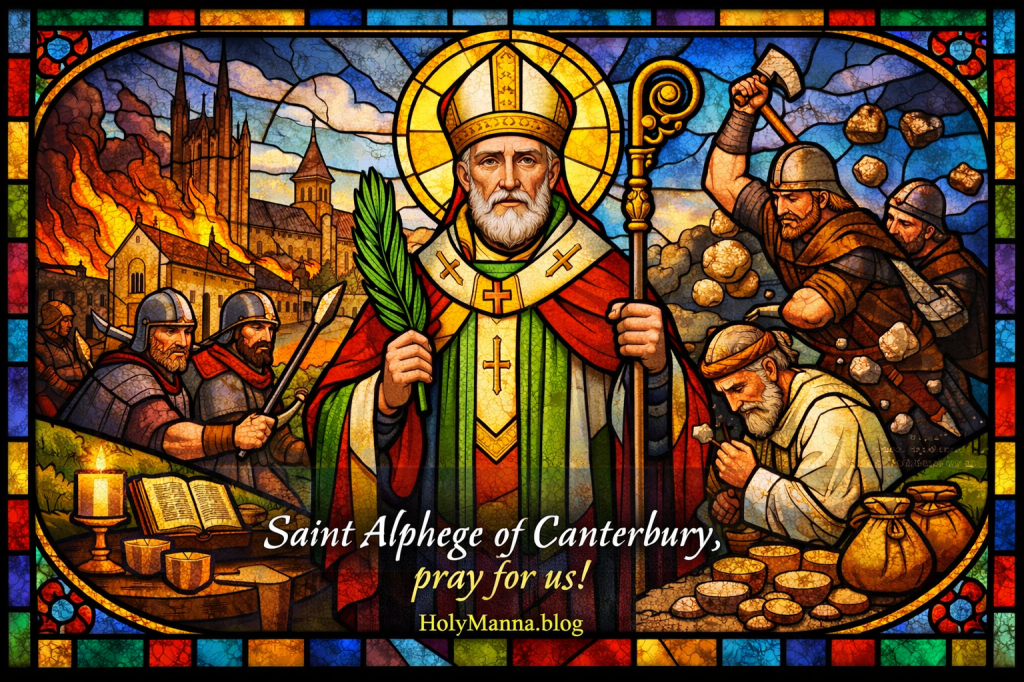
The Shepherd Who Refused to Save Himself
Saint Alphege of Canterbury, also known as Ælfheah, stands among the great martyr-bishops of the early English Church. He is revered because he lived as a true shepherd of souls and died as one. Long before his martyrdom, he was known for holiness, discipline, compassion for the poor, and deep loyalty to the Church. In the end, he became most famous for refusing to let a massive ransom be paid for his freedom, choosing instead to protect the goods of the Church for the sake of the needy. That decision led to his death and sealed his witness as a martyr.
His life matters because it shows what Christian leadership is supposed to look like. Saint Alphege did not treat the Church as a place for comfort, power, or status. He treated it as a flock to be guarded, a house to be kept holy, and a treasure to be spent for the poor. That is why the Church remembers him not just as an archbishop of Canterbury, but as a man who imitated Christ the Good Shepherd.
From Noble Beginnings to a Life of Renunciation
Saint Alphege was born in England around the middle of the tenth century, traditionally around the year 954. Catholic tradition remembers him as coming from a noble background. He had the kind of beginning that could have led to worldly security, but he chose something far more demanding. He left behind family wealth and entered the monastic life, first at Deerhurst and later as a hermit near Bath.
That decision says a great deal about the kind of man he was. He did not drift into holiness by accident. He deliberately embraced prayer, sacrifice, and separation from worldly ambition. The hidden years matter because they formed the soul that would later carry the burdens of a bishop and finally the crown of martyrdom.
His reputation for holiness grew, and he eventually became abbot in Bath. Later he was chosen as Bishop of Winchester, and after that he became Archbishop of Canterbury. This rise was not the story of a man climbing a ladder. It was the story of a monk whose sanctity became too obvious to remain hidden.
What Saint Alphege is most known for is his refusal to buy his own safety at the expense of the poor. Yet that final act only makes sense when seen against his earlier life. He had already spent years learning how to detach himself from comfort, possessions, and self-interest. His martyrdom did not come out of nowhere. It was the final flowering of a life already given away.
Mercy in Action and Wonders Remembered
As bishop and archbishop, Saint Alphege became known for pastoral charity and practical holiness. Catholic tradition remembers him as a man whose care for the poor was so generous that beggars were scarcely seen in his diocese. He was not only a churchman but a father to the suffering. He understood that love of God and love of neighbor could never be separated.
He also played an important role in the religious and political life of England during a dangerous time. Tradition holds that he was involved in the confirmation of Olaf of Norway and that his influence helped restrain further violence from Scandinavian raiders. Even in an age marked by war and instability, Saint Alphege was remembered as a man who brought peace where others brought fear.
There is also a traditional miracle story associated with his lifetime. During his captivity, an epidemic reportedly broke out among the Danes holding him. According to later tradition, Saint Alphege prayed for the sick and distributed blessed bread, and many were healed. The story fits the kind of bishop he appears to have been, a man who showed mercy even to his enemies. This miracle story has been preserved in tradition, but it cannot be verified with certainty.
Why should this part of his life still matter now? Because Saint Alphege reminds the Church that holiness is not vague or sentimental. It feeds the poor. It prays for enemies. It speaks truth in dangerous times. It refuses to separate prayer from sacrifice.
The Price of a Shepherd’s Love
The most dramatic chapter of Saint Alphege’s life came during the Danish attacks on England. In 1011, Canterbury was besieged and sacked. The city suffered terribly, and Alphege was taken captive. Even in that moment, tradition remembers him pleading for the innocent. One saying attributed to him is “Spare those poor innocent victims. Turn your fury rather against me.”
That line captures the whole saint. He did not run from danger. He stepped into it for the sake of others.
His captors demanded a heavy ransom for his release. This was the turning point. Saint Alphege refused to let the money be paid. Tradition preserves another saying associated with that refusal: “What reward can I hope for if I spend upon myself what belongs to the poor?” Whether preserved word for word or through faithful tradition, the spirit of the statement is entirely consistent with the life he lived.
He would not let the Church’s wealth be poured out to save his own life while the poor still needed help. That is one of the most powerful details in his whole story. He did not simply die bravely. He died because he believed a bishop must love his people more than himself.
On April 19, 1012, at Greenwich, his drunken captors turned on him in fury. He was struck with stones and ox bones, and finally killed with an axe. His martyrdom shocked the Christian world, and he came to be honored as a martyr of pastoral charity. In the light of The Catechism, martyrdom is “the supreme witness given to the truth of the faith” and is a sharing in Christ’s own death for love of God and neighbor, CCC 2473. Saint Alphege lived that teaching in flesh and blood.
Relics, Memory, and the Saint Who Still Speaks
After his death, Saint Alphege’s legacy only deepened. His body was first buried in London, and later King Canute had his relics translated to Canterbury in an act remembered as one of repentance and honor. That translation mattered deeply. The same world that had seen him murdered now began to exalt him publicly as a saint.
Tradition also preserves the story that when his body was examined in 1105, it was found incorrupt. This was taken as a sign of sanctity and helped strengthen devotion to him. This story has been handed down in Catholic tradition, but it cannot be verified with certainty.
Relics associated with Saint Alphege were venerated in several places in England, and his memory remained especially strong in Canterbury and in places connected to his early life. His feast is kept on April 19, and he has also been remembered in connection with the translation of his relics. Churches and parishes have borne his name, and sacred art has often shown him with the axe or stones of his martyrdom. Even the way he is depicted teaches a lesson. The Church does not hide the violence done to her saints. She transforms it into a testimony of grace.
His impact also reaches into the later history of Canterbury itself. Tradition remembers that Saint Thomas Becket invoked Saint Alphege before Becket’s own martyrdom. That detail gives Saint Alphege a lasting place in the spiritual memory of English Catholic history. He became, in a real sense, a model for later shepherds who would suffer for fidelity.
What Saint Alphege Teaches the Soul
Saint Alphege speaks with unusual force to a world obsessed with self-preservation. Everything in modern life pushes people to protect comfort, reputation, security, and control. Saint Alphege shows a different path. He shows what it looks like when love of Christ reshapes a person’s instincts so completely that even life itself becomes secondary to fidelity.
His example asks difficult questions. What is being clung to that really belongs to God? What would it look like to trust Christ enough to stop negotiating with discipleship? How often is charity delayed because comfort still has too much power?
His life also offers practical lessons. A deeper prayer life does not begin with dramatic gestures. It begins with the same kind of quiet surrender that shaped his early years as a monk. Care for the poor is not an optional extra in Christian life. It is part of the Gospel itself. Courage is not built in a single crisis. It is built through daily fidelity, daily sacrifice, daily obedience, and daily trust.
Saint Alphege should be remembered and imitated because he proves that true Christian leadership is sacrificial. He did not use holy office to shield himself. He let holy office demand everything from him. That is why his witness remains so powerful. He teaches that the Church is strongest when her shepherds and her people love Christ more than safety.
Engage With Us!
Share your thoughts and reflections in the comments below. Saint Alphege’s story is intense, moving, and deeply challenging, and it invites serious reflection on courage, charity, and what it really means to belong to Christ.
- What part of Saint Alphege’s life speaks most strongly to the heart right now?
- Does his refusal to save himself at the expense of the poor change the way Christian charity is viewed?
- Where might God be asking for greater courage, sacrifice, or trust in daily life?
- How can love for the poor become more concrete, consistent, and Christ-centered this week?
- What does Saint Alphege teach about the difference between worldly leadership and holy leadership?
May Saint Alphege of Canterbury inspire a stronger faith, a braver heart, and a deeper love for the poor. May his witness help souls live with greater conviction, endure suffering with hope, and do everything with the love and mercy Jesus taught us.
Saint Alphege of Canterbury, pray for us!
Follow us on YouTube, Instagram and Facebook for more insights and reflections on living a faith-filled life.

 Holy Manna!
Leave a comment