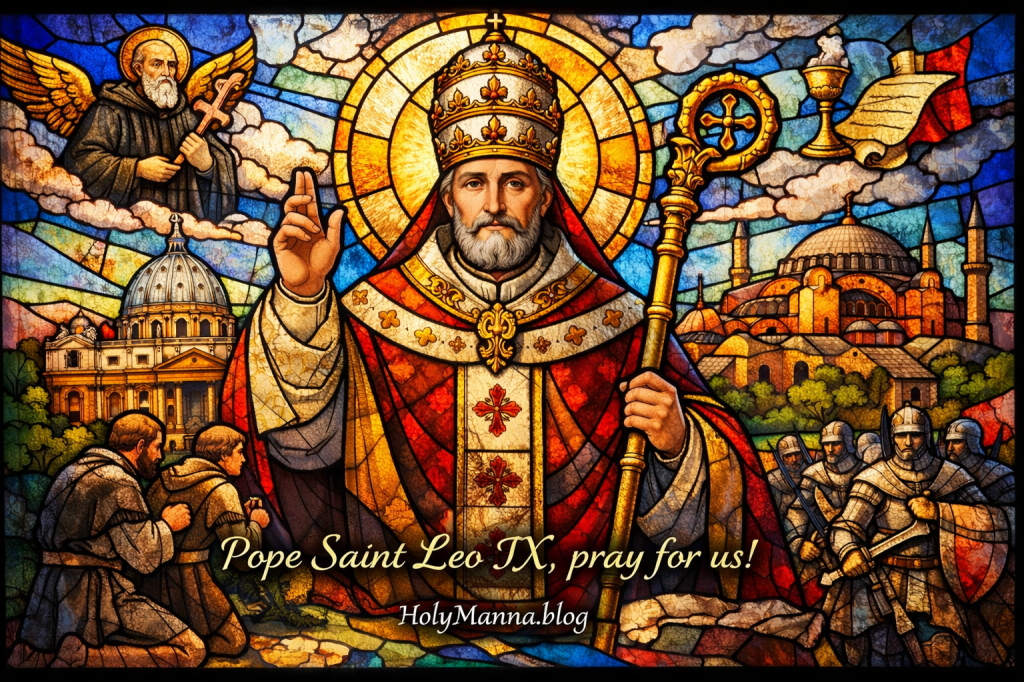
The Pilgrim Pope Who Fought to Purify the Church
Pope Saint Leo IX stands out in Catholic history as one of those saints whose holiness was not hidden in silence alone, but poured out into the public life of the Church. He was a pope, a reformer, a pastor, and a man of real courage during one of the most troubled periods of the eleventh century. Born Bruno of Egisheim-Dagsburg, he would become the pope who helped set the Church on the road toward deep reform at a time when corruption, political pressure, and spiritual decay were wounding the Bride of Christ.
He is revered because he loved the Church enough to fight for her purification. He is remembered for confronting simony, correcting abuses among the clergy, defending the authority of the Apostolic See, and traveling widely to strengthen the faithful. He is also remembered as a pope of sorrow, because his pontificate unfolded near the tragic tensions that led to the break between Rome and Constantinople in 1054. Even so, his life was marked not by bitterness, but by fidelity. He lived as a man convinced that the Church belongs to Christ and must be governed with holiness, truth, and love.
From Noble Birth to a Life Set Apart
Bruno was born on June 21, 1002, in Alsace, into a noble and deeply Catholic family connected to the imperial house. His upbringing gave him access to education, influence, and privilege, but the most important thing about his childhood was not his rank. It was the way grace seemed to shape him early. Catholic tradition remembers him as intelligent, disciplined, gentle, and serious about God from a young age.
As a young man, he became a canon at Toul, and his gifts quickly became clear. He was well educated, capable in administration, and respected for his judgment. He also lived in a world where bishops and rulers often stood close together, and that meant he had to learn early how to navigate both the spiritual and political pressures of his time. Before becoming pope, he served for many years as Bishop of Toul, and that long season of shepherding prepared him for the much heavier burden he would later carry in Rome.
One of the early traditions connected to his life tells of a serious injury in childhood after an attack by an animal. According to ancient Catholic accounts, he received a vision of Saint Benedict and was healed. That story belongs to the tradition surrounding his sanctity and has long been repeated in Catholic sources. It reflects the way the faithful came to see his life as marked by divine favor from an early age.
Bruno did not undergo a dramatic conversion from unbelief to faith. His story is different. His life shows the deepening of a soul already rooted in Christianity, a man who kept saying yes to God as his responsibilities grew. That matters, because many saints are made not only in moments of crisis, but in long obedience.
The Pope Who Walked Into Rome Like a Pilgrim
After the death of Pope Damasus II, Emperor Henry III nominated Bruno for the papacy. That could have become just another example of political influence over the Church. Instead, Bruno did something that revealed his soul. He agreed to accept the office only if the Roman clergy and people freely elected him. He then entered Rome dressed as a pilgrim and barefoot, and there he was received and chosen as pope. He took the name Leo IX.
That moment says almost everything about what kind of pope he would be. He did not want the papacy to look like a prize handed down by worldly power. He wanted it to stand again in apostolic dignity. From the beginning, his papacy had the mark of humility and reform.
Pope Saint Leo IX is most known for helping launch the great papal reform movement of the eleventh century. He confronted simony, which is the buying and selling of spiritual offices, something the Church condemns clearly and consistently. He also fought clerical immorality and sought to restore discipline, reverence, and integrity to Church life. In this, his life harmonizes with the moral seriousness found in The Catechism, which teaches that holy things cannot be treated like merchandise and that the life of the Church must reflect the holiness of Christ.
He did not govern from a distance. He traveled. He preached. He held synods. He corrected bishops. He strengthened churches across Italy, France, and Germany. In many ways, he looked like a shepherd trying to gather scattered sheep while wolves prowled nearby. That is why some remembered him as the Apostolic Pilgrim.
Signs of Grace in a Life of Reform
The miracles most closely connected to Leo IX during his lifetime are fewer and more restrained than in the lives of some other saints, but Catholic tradition still remembers him as a man marked by divine favor. The childhood healing associated with the vision of Saint Benedict is the most notable miracle story connected to his early life.
Older Catholic sources also describe him as a worker of miracles in life and in death. Even where details are not always extensive, the tradition surrounding him presents him as a holy pastor whose prayers were believed to carry unusual power. That kind of reputation did not arise because he was theatrical or sensational. It arose because people encountered in him the seriousness, purity, and spiritual authority that often surround true sanctity.
His life itself was a kind of miracle of grace. He came from nobility, yet used his rank in service of holiness. He possessed influence, yet wanted reform. He held power, yet walked into Rome like a penitent pilgrim. He was a strong ruler, but he also carried the heart of a pastor. That is worth remembering because many people assume holiness and leadership do not mix well. Pope Saint Leo IX proves that authority can become a path of sanctification when it is surrendered to Christ.
One of the most important reasons to remember him is this: he loved the Church enough to correct what was sick within her. That kind of love is rare. It is easy to criticize the Church from a distance. It is much harder to suffer for her purification from the inside.
A Heart That Carried the Church
The life of Pope Saint Leo IX was not peaceful in any ordinary sense. He inherited a Church wounded by corruption and surrounded by political tension. He also had to face the growing conflict between the Latin West and the Greek East. The tensions with Constantinople were already serious before his death, and although he did not live to see the full aftermath, his pontificate stood at the edge of that painful rupture.
This part of his life should be approached carefully and with charity. The split between East and West was not the fault of one man alone. The causes were old, complex, and tangled in theology, culture, language, custom, and politics. Leo IX defended the authority of the Roman See firmly, as a Catholic pope should. He also tried to understand the issues more deeply, even taking steps to study Greek. That detail is easy to miss, but it is revealing. He was not a careless polemicist. He was dealing with a grave wound in Christendom.
He also suffered deeply over the Norman threat in southern Italy. After attempts at peace and mediation, Leo became involved in military resistance. In 1053 his forces were defeated at the Battle of Civitate. He was then held by the Normans, though they treated him with a certain respect and even spoke of themselves as his loyal men. Still, the defeat weighed heavily on him. Catholic accounts describe him as a man whose heart was broken by the cost of the conflict. He was not martyred, but he endured humiliation, grief, and the crushing burden of leadership in a violent age.
That matters spiritually. Not every saint dies by execution. Some are worn down by responsibility, sorrow, and the cost of fidelity. Pope Saint Leo IX was one of those saints.
A Legacy That Outlived His Lifetime
Pope Saint Leo IX died on April 19, 1054, and was buried in Saint Peter’s Basilica. After his death, devotion to him spread, and Catholic tradition continued to speak of miracles through his intercession. Some older accounts say that many cures were reported near the time of his burial, and one tradition claims that seventy cures took place within forty days of his death. That specific number belongs to the tradition surrounding his cult and cannot be fully verified with the kind of documentation people often look for today. Still, it shows how strongly the faithful believed that God continued to work through him after his death.
He entered the memory of the Church not merely as a deceased pope, but as a saint. His feast is celebrated on April 19. His tomb in Saint Peter’s became a place of honor, and his legacy continued to shape the Church long after his passing.
His impact after death was not limited to miracle stories. His reforming vision helped prepare the way for later popes who would continue cleansing abuses and strengthening the independence of the Church from worldly domination. In that sense, his influence reached far beyond his own century. He helped reshape the papacy into a more active, morally serious, and visibly apostolic office.
There are also surprising details that make his story more memorable. He is associated with the earliest mention of the papal Golden Rose, a custom that would later become famous. He also canonized Saint Gerard of Toul, showing that this sainted pope not only became an object of veneration himself, but also took part in publicly honoring sanctity in others. These are small details, but they reveal how widely his life touched the liturgical and devotional life of the Church.
As for famous quotations, Pope Saint Leo IX is not remembered for many short devotional sayings. What survives most clearly are doctrinal statements. One of the most notable is his teaching that the soul is not divine by nature, but created by God. In English, this is often rendered as “The soul is not a part of God, but is created from nothing.” That line is important because it reflects the clarity of Catholic teaching about the human person, creation, and the difference between God and the soul. Even his remembered words carry the mark of a pope concerned with truth.
What Pope Saint Leo IX Still Teaches the Church
Pope Saint Leo IX teaches that holiness is not softness. It is not passivity. It is not pretending everything is fine when the Church is in need of reform. His life shows that real love for the Church includes courage, correction, sacrifice, and sometimes suffering.
He also teaches that reform begins with reverence. He did not try to remake the Church in the image of the world. He tried to call the Church back to her own identity. That is a lesson worth holding onto in every age. The answer to corruption is not surrender. The answer is sanctity.
There is also something deeply human in his story. He was not a saint because every decision he made worked out neatly. He was a saint because he remained faithful while carrying real burdens. He stood in hard places. He faced conflict. He made painful choices. He suffered losses. Yet he continued to serve the Church.
What would happen if more Catholics loved the Church enough to help purify her instead of only complaining about her?
What would change if daily life were lived with the same seriousness about truth, holiness, and obedience that shaped Pope Saint Leo IX?
What wounds in the Church or in the soul need to be brought before Christ with courage instead of avoidance?
A practical way to imitate this saint is to begin with reverence for the things of God. Speak about the faith with seriousness. Pray for priests and bishops. Refuse cynicism. Go to Confession regularly. Defend truth with charity. Learn the faith more deeply. Live in a way that says the Church is worth loving, even when she is wounded, because she belongs to Jesus Christ.
Engage with Us!
Share your thoughts and reflections in the comments below. This saint’s life has a lot to say to Catholics trying to live faithfully in confusing times, and your reflections may help someone else see his witness more clearly.
- What stands out most in Pope Saint Leo IX’s life: his reforming courage, his humility, or his endurance in suffering?
- How can the example of this saint help Catholics respond when they see sin, weakness, or confusion within the Church?
- What is one concrete way to practice greater reverence, discipline, or fidelity this week in honor of Pope Saint Leo IX?
May the witness of Pope Saint Leo IX encourage a life of steady faith, brave charity, and deep loyalty to Christ and His Church. May every thought, word, and action be shaped by the love and mercy Jesus taught us.
Pope Saint Leo IX, pray for us!
Follow us on YouTube, Instagram and Facebook for more insights and reflections on living a faith-filled life.


Leave a Reply