Third Sunday of Easter – Lectionary: 46
When the Risen Lord Draws Near
Some Sundays feel like standing at the edge of a fire and slowly realizing the warmth has already reached the heart. Today’s readings are woven together by one beautiful theme: the risen Jesus draws near to His people, opens their eyes, and turns frightened, confused, wandering hearts into believing witnesses. From Saint Peter’s bold preaching in Acts 2, to the confidence of Psalm 16, to Saint Peter’s reminder in 1 Peter 1 that the faithful were redeemed by the precious Blood of Christ, and finally to the road to Emmaus in Luke 24, the Church places one truth before the soul again and again. Jesus is truly risen, and His Resurrection changes everything.
The setting of these readings matters. Easter is not only about the memory of an empty tomb. It is about the living Christ still acting in His Church. The First Reading comes from Peter’s preaching at Pentecost, when the Holy Spirit gives the apostles courage to proclaim that the Jesus who was crucified has been raised and exalted. The Psalm is one the early Church heard as a prophecy of the Resurrection. The Second Reading speaks to Christians as pilgrims and sojourners, reminding them that they do not belong to this passing world in the deepest sense, because they have been ransomed by Christ. Then the Gospel brings that truth down to the level of ordinary human experience. Two disciples walk away from Jerusalem carrying disappointment, confusion, and broken hopes, and the risen Lord comes close enough to walk beside them.
That is what makes today’s readings so personal and so Catholic. The risen Christ does not save from a distance. He comes through apostolic preaching, through the opening of the Scriptures, and through the breaking of the bread. He meets His people in the very places where the Church still meets Him now. Today’s readings invite the faithful to see Easter not as a season of vague joy, but as a living encounter with the Lord who still teaches, still feeds, still strengthens, and still sends His people back into the world with burning hearts.
Where has the heart grown discouraged, confused, or slow to believe? And where might the risen Jesus already be walking near, ready to lead it back to hope?
First Reading – Acts 2:14, 22-33
When Peter Stands Up and the Church Begins to Speak
This reading takes place on Pentecost, only days after the Resurrection and Ascension of Jesus, when Jerusalem was crowded with Jewish pilgrims from many regions for one of the great feast days of Israel. The Holy Spirit has just descended upon the apostles, and the frightened disciples who once hid behind locked doors are now standing in public. That setting matters. Saint Peter is not speaking in a quiet room to a few close friends. He is speaking in the heart of the holy city, before the same world that rejected Christ. The Church’s first great public sermon begins not with vague inspiration, but with the bold proclamation that Jesus, who was crucified, has been raised and exalted.
This fits today’s theme beautifully. The risen Lord does not leave His people in confusion. He opens their eyes, strengthens their faith, and sends them out as witnesses. In the Gospel, the disciples on the road to Emmaus have their hearts set on fire as Christ opens the Scriptures. Here in Acts, Peter does the same thing for the crowd. He proclaims Christ, reads the Old Testament through the lens of the Resurrection, and shows that what seemed like defeat was in fact the unfolding of God’s saving plan. This is one of the clearest examples in all of Scripture of how the Church reads the Bible, preaches the Gospel, and calls the world to faith in the risen Jesus.
Acts 2:14, 22-33 – New American Bible (Revised Edition)
Peter’s Speech at Pentecost. 14 Then Peter stood up with the Eleven, raised his voice, and proclaimed to them, “You who are Jews, indeed all of you staying in Jerusalem. Let this be known to you, and listen to my words.
22 You who are Israelites, hear these words. Jesus the Nazorean was a man commended to you by God with mighty deeds, wonders, and signs, which God worked through him in your midst, as you yourselves know. 23 This man, delivered up by the set plan and foreknowledge of God, you killed, using lawless men to crucify him. 24 But God raised him up, releasing him from the throes of death, because it was impossible for him to be held by it. 25 For David says of him:
‘I saw the Lord ever before me,
with him at my right hand I shall not be disturbed.
26 Therefore my heart has been glad and my tongue has exulted;
my flesh, too, will dwell in hope,
27 because you will not abandon my soul to the netherworld,
nor will you suffer your holy one to see corruption.
28 You have made known to me the paths of life;
you will fill me with joy in your presence.’29 My brothers, one can confidently say to you about the patriarch David that he died and was buried, and his tomb is in our midst to this day. 30 But since he was a prophet and knew that God had sworn an oath to him that he would set one of his descendants upon his throne, 31 he foresaw and spoke of the resurrection of the Messiah, that neither was he abandoned to the netherworld nor did his flesh see corruption. 32 God raised this Jesus; of this we are all witnesses. 33 Exalted at the right hand of God, he received the promise of the holy Spirit from the Father and poured it forth, as you [both] see and hear.
Detailed Exegesis
Verse 14 – “Then Peter stood up with the Eleven, raised his voice, and proclaimed to them, ‘You who are Jews, indeed all of you staying in Jerusalem. Let this be known to you, and listen to my words.’”
This opening verse is full of quiet power. Peter stands with the Eleven, which shows that he is not acting as an isolated preacher with a private opinion. He speaks as the head of the apostolic body, in communion with the others. The Church is already visible here in seed form: one apostolic faith, one apostolic witness, one public proclamation. Peter’s raised voice marks the end of fear and the beginning of mission. The man who once denied Jesus now speaks openly in Jerusalem itself. That transformation is one of the first fruits of Easter and Pentecost.
Verse 22 – “You who are Israelites, hear these words. Jesus the Nazorean was a man commended to you by God with mighty deeds, wonders, and signs, which God worked through him in your midst, as you yourselves know.”
Peter begins with what his hearers already know. Jesus was not a hidden figure. His ministry was public, and His miracles were real signs worked by God. Peter is not presenting a myth or a secret teaching. He is pointing to events that happened in history, before witnesses, in the midst of the people. The phrase about mighty deeds, wonders, and signs shows that Jesus’ works revealed His divine mission. These were not merely acts of compassion, though they certainly were that. They were also signs that the kingdom of God had arrived in Him.
Verse 23 – “This man, delivered up by the set plan and foreknowledge of God, you killed, using lawless men to crucify him.”
This verse holds together two truths that must never be separated. First, Christ’s Passion happened according to the plan and foreknowledge of God. The Cross was not an accident. It was not a failed mission. It was part of the Father’s saving design. Second, human beings remain morally responsible for their actions. Peter does not erase guilt by appealing to providence. He tells the truth plainly. Jesus was handed over and crucified by sinful men. Catholic teaching always preserves both divine sovereignty and human freedom. God can bring salvation out of evil without ever becoming the author of evil.
Verse 24 – “But God raised him up, releasing him from the throes of death, because it was impossible for him to be held by it.”
This is the heart of Peter’s sermon. Death could not hold Jesus. The Resurrection is not presented as a symbolic statement that love lives on. It is the decisive act of God in history. The phrase about the throes of death suggests death as a kind of bondage or agony, but Christ bursts those bonds from within. It was impossible for death to hold Him because Jesus is the Holy One, the eternal Son, and the author of life. The Resurrection is the Father’s vindication of the Son and the triumph of divine life over sin and death.
Verse 25 – “For David says of him: ‘I saw the Lord ever before me, with him at my right hand I shall not be disturbed.’”
Now Peter turns to Psalm 16. This is important because he is preaching to Jews who revere David and the Scriptures. He shows that the Resurrection of Christ is not a novelty disconnected from Israel’s history. It is the fulfillment of what David spoke prophetically. The image of the Lord at one’s right hand is a picture of strength, stability, and protection. Peter is teaching the crowd to see that the psalm reaches beyond David’s own life and finds its true fulfillment in the Messiah.
Verse 26 – “Therefore my heart has been glad and my tongue has exulted; my flesh, too, will dwell in hope,”
Here the joy of the Resurrection begins to shine through. Heart, tongue, and flesh are all drawn into hope. This is not only spiritual comfort. It includes the body. That matters deeply in Catholic faith. The Christian hope is not escape from the body, but redemption of the whole person. The Resurrection of Jesus is the beginning of that new creation. His flesh dwells in hope because His body will not remain in death.
Verse 27 – “because you will not abandon my soul to the netherworld, nor will you suffer your holy one to see corruption.”
This verse becomes the centerpiece of Peter’s argument. David’s body did see corruption. Therefore David must have been speaking beyond himself, prophetically, of the Messiah. Jesus truly died, but He was not abandoned to the realm of the dead, nor did His body undergo decay in the ordinary way. Peter is not denying the reality of death. He is proclaiming that Christ passed through death without being conquered by it. The Holy One entered the tomb, but the tomb could not keep Him.
Verse 28 – “You have made known to me the paths of life; you will fill me with joy in your presence.”
The Resurrection is not only about escape from death. It is about entrance into fullness of life in the presence of God. This is why Easter is joy. The path of life is now opened in Christ. What Adam closed through sin, Christ reopens through His obedience, Passion, and Resurrection. This verse also quietly points forward to the life of grace and the hope of heaven. In Christ, humanity is brought again into communion with the Father.
Verse 29 – “My brothers, one can confidently say to you about the patriarch David that he died and was buried, and his tomb is in our midst to this day.”
Peter now applies the text with practical force. David died. David was buried. David’s tomb was still known. The point is simple but decisive. Psalm 16 cannot finally refer to David himself. Peter is reasoning from Scripture and from historical fact together. Catholic faith is never afraid of history. The Gospel is not less true because it happened in time. It is more glorious because God entered time and acted there.
Verse 30 – “But since he was a prophet and knew that God had sworn an oath to him that he would set one of his descendants upon his throne,”
Peter reminds the crowd of God’s covenant with David. The promise of an everlasting kingdom would be fulfilled through one of David’s descendants. That promise reaches its climax in Jesus. He is the Son of David, but far more than David’s earthly heir. He is the eternal King whose throne is established forever. Peter is showing that the Resurrection is royal as well as personal. Jesus is not merely alive again. He is the enthroned Messiah.
Verse 31 – “he foresaw and spoke of the resurrection of the Messiah, that neither was he abandoned to the netherworld nor did his flesh see corruption.”
This verse makes Peter’s interpretation explicit. David foresaw the resurrection of the Messiah. The Church’s reading of the Old Testament is crystal clear here. The inspired Scriptures point to Christ. The Messiah’s Resurrection was not invented after the fact to make sense of disaster. It was already present in God’s Word, waiting to be unveiled. Peter is reading Scripture as Christ Himself taught the disciples to read it: everything converges on Him.
Verse 32 – “God raised this Jesus; of this we are all witnesses.”
Peter moves from prophecy to testimony. The apostles are not only interpreters of ancient texts. They are witnesses to what God has done in Christ. Christianity rests on both. It is rooted in the fulfillment of Scripture and in the testimony of those who encountered the risen Lord. This is part of what makes apostolic faith so solid. The Church does not believe in an idea created by later generations. She believes in the risen Jesus proclaimed by those who saw Him.
Verse 33 – “Exalted at the right hand of God, he received the promise of the holy Spirit from the Father and poured it forth, as you both see and hear.”
Peter ends this section by connecting the Resurrection, Ascension, and Pentecost. Jesus has been exalted at the right hand of the Father, and from that place of divine glory He pours out the Holy Spirit upon the Church. What the crowd sees and hears is proof that the risen Christ is reigning now. Pentecost is not a separate story from Easter. It is one of Easter’s greatest fruits. The Lord who conquered death is now actively forming His Church through the gift of the Spirit.
Teachings
This reading is one of the clearest biblical witnesses to the Church’s teaching on the Resurrection, divine providence, and apostolic preaching. Peter presents Christ’s death as both the result of human sin and the unfolding of God’s redemptive plan. That balance is preserved beautifully in The Catechism. CCC 600 teaches, “To God, all moments of time are present in their immediacy. When therefore he establishes his eternal plan of ‘predestination’, he includes in it each person’s free response to his grace.” That line helps explain why Peter can say that Jesus was handed over according to God’s foreknowledge while still holding sinners accountable for the Crucifixion.
The Resurrection itself stands at the center of Christian faith. CCC 638 says, “We bring you the good news that what God promised to the fathers, this day he has fulfilled to us their children by raising Jesus.” That is exactly what Peter is doing in this sermon. He is bringing the good news that God has fulfilled His promises by raising Jesus from the dead. Then CCC 651 says, “The Resurrection above all constitutes the confirmation of all Christ’s works and teachings.” The crowd had seen Jesus’ mighty deeds. Now Peter declares that the Resurrection confirms everything Jesus said and did.
The reading also shows how the apostles understood the Psalms and the promises made to David. Saint Augustine often preached that the psalms speak in the voice of Christ, the Head, and also of Christ’s Body, the Church. That insight fits this reading perfectly. Peter hears David’s words not as a dead relic of ancient devotion, but as living prophecy fulfilled in Christ. The promises to David find their true completion not in a temporary earthly throne, but in the risen and exalted Jesus.
Historically, this sermon matters because it shows the birth of apostolic preaching in the public life of the Church. The first great proclamation after Pentecost is not a vague message about spirituality or morality. It is the announcement that Jesus was crucified, raised, and exalted, and that the Holy Spirit now testifies to His reign. That pattern still shapes Catholic preaching. The Church does not begin with self-help. She begins with the saving acts of God in Christ.
Reflection
There is something deeply moving about Peter in this reading. He had failed publicly, feared publicly, and denied publicly. Yet by the grace of God, he now stands and witnesses publicly. That should give hope to every soul that has stumbled. The risen Jesus does not merely forgive. He restores, strengthens, and sends. A past failure does not have the final word when grace takes hold of a life.
This reading also challenges the modern habit of trying to keep Jesus at a safe distance. Peter does not present Christ as an inspiring figure from long ago. He presents Him as the risen Lord who reigns now, pours out the Holy Spirit now, and demands a response now. Easter is not a soft religious mood. It is a call to conversion, faith, courage, and witness.
The practical lesson is simple, but not easy. The soul must learn to read life the way Peter reads Scripture. What looks like defeat may be the place where God is already at work. What feels confusing may still be inside the Father’s providence. What seems dead may be the very place where resurrection power is about to appear. That does not remove suffering, but it changes how suffering is carried.
A good way to live this reading is to speak the name of Jesus more openly, to trust that God is still at work even when circumstances seem dark, and to pray for the courage to stand with the Church rather than shrinking back in fear. It is also a fitting time to thank God for the gift of apostolic faith, because the faith received today is the same faith Peter preached in Jerusalem.
Where has fear kept the heart silent when it should have spoken of Christ? What part of life feels like a place of defeat, but may actually be part of God’s deeper plan? Does the soul truly live as though Jesus is risen, reigning, and still pouring out His Spirit upon His Church?
Responsorial Psalm – Psalm 16:1-2, 5, 7-11
The Prayer That Becomes Easter Joy
This psalm sounds at first like a deeply personal prayer, the kind of prayer spoken by someone who has learned to cling to God when the ground feels uncertain beneath his feet. In its original setting, Psalm 16 is a song of trust attributed to David, shaped by the faith of Israel, and prayed within the worshipping life of God’s people. It speaks of refuge, inheritance, counsel, security, and joy in the presence of the Lord. Yet on this Sunday, the Church gives it to the faithful during Easter because this psalm is more than a private prayer of trust. It is also a prophetic song that the apostles heard fulfilled in the risen Christ.
That is why this psalm fits today’s theme so beautifully. In the First Reading, Saint Peter uses these very words to proclaim that Jesus is the Holy One whom death could not hold. In the Gospel, the disciples on the road to Emmaus slowly come to understand that all the Scriptures point to Christ. Here, in the Responsorial Psalm, the Church lets the heart linger over one of those Scriptures. What David sang in hope, Christ fulfilled in glory. The One who trusted the Father completely was not abandoned to the netherworld. The One who entered death came forth in victory. And because He is risen, the faithful can now pray this psalm not only as a cry for help, but as a song of Resurrection hope.
Psalm 16:1-2, 5, 7-11 – New American Bible (Revised Edition)
God the Supreme Good
1 A miktam of David.
Keep me safe, O God;
in you I take refuge.
2 I say to the Lord,
you are my Lord,
you are my only good.5 Lord, my allotted portion and my cup,
you have made my destiny secure.7 I bless the Lord who counsels me;
even at night my heart exhorts me.
8 I keep the Lord always before me;
with him at my right hand, I shall never be shaken.
9 Therefore my heart is glad, my soul rejoices;
my body also dwells secure,
10 For you will not abandon my soul to Sheol,
nor let your devout one see the pit.
11 You will show me the path to life,
abounding joy in your presence,
the delights at your right hand forever.
Detailed Exegesis
Verse 1 – “Keep me safe, O God; in you I take refuge.”
The psalm begins with dependence. There is no pride here, no illusion of self-sufficiency, no attempt to manage life alone. The speaker knows he needs protection and turns directly to God as refuge. In the light of Easter, this verse takes on even greater depth. Jesus entrusted Himself perfectly to the Father, even through betrayal, suffering, and death. For the Christian, this verse becomes a school of holy surrender. Refuge in God is not cowardice. It is the beginning of wisdom.
Verse 2 – “I say to the Lord, you are my Lord, you are my only good.”
This is one of the most searching lines in the psalm. God is not called one blessing among many. He is called the soul’s only good. That does not mean created goods are evil. It means they are not ultimate. They are not God. In a world constantly urging the heart to place its identity in comfort, success, pleasure, money, relationships, or control, this verse restores proper order. The soul becomes stable when it names God as its highest good. That is also the logic of Easter. If Christ is risen, then the greatest good is not found in what passes away, but in communion with the living God.
Verse 5 – “Lord, my allotted portion and my cup, you have made my destiny secure.”
This verse carries covenant language. In the Old Testament, the idea of one’s portion or inheritance often referred to what had been assigned or given. Here the psalmist says that the Lord Himself is the portion. God is the inheritance. God is the cup. That is profoundly rich language. It suggests not merely receiving blessings from God, but receiving God as the true possession of the soul. In the light of Christ, this verse opens toward both the Eucharist and eternal life. The Christian’s security does not rest in changing circumstances, but in belonging to the Lord.
Verse 7 – “I bless the Lord who counsels me; even at night my heart exhorts me.”
The psalmist recognizes that God guides from within, teaching and steadying the heart even in darkness. Night in Scripture often symbolizes uncertainty, danger, testing, or interior struggle. Yet even there, the Lord counsels. This verse is especially beautiful when read beside the road to Emmaus. The disciples were confused, disappointed, and spiritually darkened, yet the risen Christ came near and instructed them. God does not abandon His people to confusion. He teaches, often quietly, often patiently, and sometimes in the very hours when the soul feels most unsettled.
Verse 8 – “I keep the Lord always before me; with him at my right hand, I shall never be shaken.”
This verse describes the stability that comes from ordered vision. To keep the Lord always before oneself is to live with God at the center. It is not a passing devotional feeling. It is a whole way of seeing. The right hand is the place of strength and protection. When the Lord is there, the soul is not ultimately shaken, even if life around it trembles. This is not a promise that suffering disappears. It is a promise that suffering does not get the final word. That is the heart of Easter faith.
Verse 9 – “Therefore my heart is glad, my soul rejoices; my body also dwells secure,”
Joy enters here as the fruit of trust. The whole person is involved. Heart, soul, and body are drawn into confidence before God. This is important because Christian hope is not merely spiritual in a narrow sense. The body matters. The Resurrection of Christ reveals that salvation is not escape from creation, but the redemption of creation. The body also dwells secure because the risen Lord has transformed the meaning of death itself. For those who belong to Christ, the grave is no longer the final horizon.
Verse 10 – “For you will not abandon my soul to Sheol, nor let your devout one see the pit.”
This is the great Easter verse in the psalm. In its first sense, it is a cry of confidence that God will not surrender His faithful one to the power of death. But the apostles saw that these words reached beyond David and found their full truth in Jesus. David died and was buried. His body saw corruption. Christ, however, entered death and rose in glory. This verse therefore becomes a prophetic witness to the Resurrection. The Church hears it not only as ancient poetry, but as a hidden announcement of the victory of Christ over the grave.
Verse 11 – “You will show me the path to life, abounding joy in your presence, the delights at your right hand forever.”
The psalm ends in triumph, not because the speaker has mastered life, but because God leads him into life. The path is shown by God. Joy is found in God’s presence. Delight is found at God’s right hand forever. This is the true destination of the human person. Easter does not simply announce that Jesus came back. It announces that in Him the path to life has been opened. Heaven is not an abstract reward. It is the fullness of communion with the living God.
Teachings
This psalm helps reveal how the Church reads the Old Testament in the light of Christ. What begins as David’s prayer becomes, in the fullness of revelation, a song that reaches its summit in the risen Jesus. Saint Peter makes that exact move in Acts 2, showing that Psalm 16 is not exhausted by David’s own life. It points forward to the Messiah whose flesh would not see corruption. This is one of the clearest examples of apostolic exegesis in the New Testament.
The Catechism speaks beautifully about the psalms and their place in the life of the Church. “The Psalter is the book in which the Word of God becomes man’s prayer. In the other books of the Old Testament, ‘the words proclaim [God’s] works and bring to light the mystery they contain.’ The words of the Psalmist, sung for God, both express and celebrate his saving works. The same Spirit inspires both God’s work and man’s response. Christ will unite both. In him, the psalms continue to teach us how to pray.” CCC 2587
That teaching matters here because Psalm 16 is doing exactly that. It is the Word of God becoming prayer, and then becoming fulfilled in Christ. The faithful do not merely study it from a distance. They pray it in union with Jesus.
The line about not being abandoned to the realm of the dead also connects directly to the Church’s teaching on Christ’s descent among the dead. The Catechism says, “The frequent New Testament affirmations that Jesus was ‘raised from the dead’ presuppose that the crucified one sojourned in the realm of the dead prior to his resurrection.” CCC 632 This helps explain why the psalm became so central in apostolic preaching. The Church saw in it a Spirit-inspired anticipation of Christ’s victory over death.
Saint Augustine gives a beautiful key for reading the psalms with Christ at the center. He writes, “He prays for us as our priest, prays in us as our Head, and is prayed to by us as our God.” That insight opens this psalm in a rich Catholic way. The faithful hear David’s words, but they also hear the voice of Christ, and in Christ they hear the voice of the Church. The psalm is personal, but never merely private. It belongs to the whole Body of Christ.
Historically, this psalm became one of the great Resurrection texts of the early Church because Saint Peter used it at Pentecost to proclaim that Jesus had truly risen. That moment is significant. The Church’s first public preaching after the descent of the Holy Spirit includes this psalm as a witness to Easter. From the very beginning, the Church read Israel’s Scriptures as fulfilled in the risen Lord.
Reflection
This psalm is a medicine for restless hearts. It teaches the soul to speak simply, honestly, and confidently before God. It begins with refuge and ends with joy. That movement is not accidental. Joy does not come from pretending life is easy. Joy comes from learning where safety truly is.
There is also a challenge here. The verse “you are my only good” can sound beautiful in prayer, but it becomes demanding in daily life. It asks whether the heart really believes that God is enough. It exposes the false refuges that quietly compete for first place. It reveals how often peace is sought in control, entertainment, comfort, or approval instead of in the Lord.
A practical way to live this psalm is to return to it when anxiety rises, when disappointment settles in, or when the future feels uncertain. It teaches the heart to say, with simplicity and conviction, that God is refuge, God is portion, God is counsel, and God is the path to life. It also invites a more Easter-shaped view of suffering. If Christ has passed through death and opened the path to life, then even the darkest road is not without hope.
This psalm also prepares the soul for the Eucharist. The One who is the believer’s portion and cup is not distant. He gives Himself sacramentally to His people. The same Lord who was not abandoned to the grave now feeds the faithful with His risen life. That makes the psalm intensely personal on Sunday. It is not only sung about Christ. It is prayed in His presence.
What has been treated as a refuge that cannot truly save? Can the heart honestly say to the Lord, “you are my only good”? And when fear rises, does the soul run first toward distraction, or toward the God who shows the path to life?
Second Reading – 1 Peter 1:17-21
Redeemed for Reverence, Ransomed by the Blood of the Lamb
This passage from 1 Peter carries the steady voice of a pastor speaking to Christians who are learning how to live in a world that does not fully understand them. The letter is addressed to believers scattered through regions of Asia Minor, men and women trying to remain faithful amid pressure, uncertainty, and the daily temptation to drift back into old patterns. That background matters. Saint Peter is not writing to people living in comfort and ease. He is writing to pilgrims, to sojourners, to baptized people who must remember who they are while passing through a world that is not their final home.
That makes this reading a perfect fit for today’s theme. In the Gospel, the disciples on the road to Emmaus move from confusion to recognition when the risen Christ opens the Scriptures and is made known in the breaking of the bread. In the First Reading, Peter boldly proclaims the Resurrection of Jesus as the center of history. Here, in the Second Reading, the same apostolic voice turns toward the Christian life that flows from Easter. If Christ is risen, then life cannot remain cheap, careless, or spiritually sleepy. The faithful have been ransomed at an astonishing price. They now belong to the Father, live under His holy judgment, and place their faith and hope in the God who raised Jesus from the dead. This reading reminds the soul that Easter joy is never casual. It is purchased, personal, and meant to transform the way a Christian walks through the world.
1 Peter 1:17-21 – New American Bible (Revised Edition)
Reverence. 17 Now if you invoke as Father him who judges impartially according to each one’s works, conduct yourselves with reverence during the time of your sojourning, 18 realizing that you were ransomed from your futile conduct, handed on by your ancestors, not with perishable things like silver or gold 19 but with the precious blood of Christ as of a spotless unblemished lamb. 20 He was known before the foundation of the world but revealed in the final time for you, 21 who through him believe in God who raised him from the dead and gave him glory, so that your faith and hope are in God.
Detailed Exegesis
Verse 17 – “Now if you invoke as Father him who judges impartially according to each one’s works, conduct yourselves with reverence during the time of your sojourning,”
Saint Peter begins with a tension that is deeply Catholic and deeply biblical. God is called Father, which speaks of intimacy, adoption, and confidence. But this same Father also judges impartially according to each one’s works, which speaks of holiness, justice, and accountability. The Christian life is never meant to swing into false familiarity on one side or servile fear on the other. The faithful are meant to live as beloved children who also know that God is holy and cannot be mocked.
The phrase “during the time of your sojourning” reminds believers that earthly life is a pilgrimage. This world is real, meaningful, and full of duties, but it is not the final homeland. Reverence, then, is not mere religious politeness. It is the attitude of a pilgrim who knows he is walking through sacred territory under the gaze of God. Easter does not erase moral seriousness. It deepens it, because the Resurrection reveals both the mercy and the majesty of God.
Verse 18 – “realizing that you were ransomed from your futile conduct, handed on by your ancestors, not with perishable things like silver or gold”
Peter now explains why reverence is necessary. The faithful have been ransomed. That word evokes slavery, captivity, and costly liberation. Christianity is not a hobby added to ordinary life. It is rescue. It is deliverance from a “futile conduct” that was inherited, absorbed, and lived out before grace intervened. The word futile is important. It suggests emptiness, vanity, a way of life that may appear normal or respectable, but ultimately leads nowhere.
Peter’s contrast with silver and gold is striking. In the ancient world, those were among the clearest signs of value, power, and ransom. But before God, even the most prized earthly things are perishable. No amount of wealth can purchase freedom from sin, heal the wound of death, or restore communion with God. This verse cuts directly against every temptation to think salvation can be earned, bought, managed, or substituted with worldly success.
Verse 19 – “but with the precious blood of Christ as of a spotless unblemished lamb.”
Here the reading reaches its center. The ransom price is the precious Blood of Christ. Peter draws on the language of sacrifice, especially the Passover lamb and the unblemished offerings of the Old Covenant. Jesus is not merely a martyr whose death inspires admiration. He is the Lamb whose sacrifice redeems. The word precious carries weight. Christ’s Blood is not precious because it is rare in a sentimental sense. It is precious because it belongs to the sinless Son of God who freely offers Himself for the salvation of the world.
This verse also reveals the cost of redemption. Sin is not healed by vague goodwill. It is not erased by time. It is answered by sacrifice. Easter cannot be understood apart from Good Friday. The risen Christ is the crucified Christ. The glory of the Resurrection shines with even greater force when the soul remembers the price at which that glory was opened to sinners.
Verse 20 – “He was known before the foundation of the world but revealed in the final time for you,”
Peter lifts the eyes from the Cross into the eternity of God’s plan. Christ was not a backup plan. He was known before the foundation of the world. The Incarnation, Passion, and Resurrection belong to the divine plan of salvation from the beginning. This does not mean evil is good, or that sin did not truly wound creation. It means that God’s wisdom and love are deeper than human rebellion.
The phrase “revealed in the final time for you” gives this mystery a startling personal edge. Christ was revealed for you. Salvation history is vast, but it is not impersonal. The eternal Son entered time for the sake of real sinners in real need. Peter wants the faithful to know that redemption is not only cosmic. It is intimate. It is directed toward those who now believe.
Verse 21 – “who through him believe in God who raised him from the dead and gave him glory, so that your faith and hope are in God.”
This final verse draws everything together. Through Christ, believers come to faith in God. Through Christ crucified and risen, the Father is known more fully. Through Christ exalted in glory, faith and hope are anchored where they belong. Peter does not say that faith and hope are placed in circumstances, outcomes, or earthly security. They are placed in God.
This is one of the clearest fruits of Easter. The Resurrection of Jesus gives believers a reason to trust that the Father’s promises are true. The One who raised Jesus from the dead and glorified Him will not abandon those who belong to His Son. Faith, then, is not wishful thinking. Hope is not vague optimism. Both stand on what God has actually done in Christ.
Teachings
This reading reveals several core Catholic truths with remarkable clarity: the holiness of God, the pilgrim nature of the Christian life, the cost of redemption, and the centrality of Christ’s sacrificial Blood. The Catechism speaks directly to this mystery when it says, “The redemption won by Christ consists in this, that he came ‘to give his life as a ransom for many.’” CCC 622 That line fits this reading perfectly. Peter’s language of ransom is not decorative. It is doctrinal. Christ redeems by giving His life.
The Catechism also teaches, “Christ’s whole life is a mystery of redemption. Redemption comes to us above all through the blood of his cross, but this mystery is at work throughout Christ’s entire life.” CCC 517 This helps explain why Peter can speak of Christ as known before the foundation of the world and revealed in these last times. Redemption is not an isolated religious event detached from the rest of Christ’s life. It is the great mystery running through His whole mission, reaching its summit in His Passion and shining forth in His Resurrection.
There is also a profound connection here to the Old Testament Passover. Peter’s phrase “spotless unblemished lamb” brings to mind the sacrificial lamb of Exodus and the broader sacrificial life of Israel. The Church sees these as fulfilled in Christ. The Catechism says, “Jesus atoned for our faults and made satisfaction for our sins to the Father.” CCC 615 That is why the Blood of Christ stands at the center of Christian worship, devotion, and hope. The faithful are not saved by moral effort alone, nor by ancestry, culture, or religious atmosphere. They are saved by the sacrifice of Jesus.
This reading also speaks powerfully to how the Church understands life in the world. Christians are not called to withdraw into fear, but neither are they called to settle comfortably into spiritual compromise. Saint Peter’s word “sojourning” reminds the faithful that baptism gives them a new identity. Historically, this mattered enormously for the early Christians living under Roman authority, social pressure, and at times direct hostility. Their courage came from knowing that they belonged to a kingdom greater than any earthly order. That same truth remains urgent now. A Christian still lives in the world as a pilgrim, not as a permanent citizen of passing fashions and false gods.
The passage also guards against a sentimental view of God. The Father is loving, but He is also judge. This is not a contradiction. It is part of divine perfection. Reverence belongs in the Christian life because grace is not cheap. Holiness matters. Works matter. Conduct matters. Yet Peter roots all of this not in anxiety, but in redemption. Christians strive for holiness because they have been ransomed already, not because they are trying to purchase God’s love.
Reflection
This reading lands with unusual force in a culture that often treats life as disposable, identity as self-invented, and sin as something too small to matter. Saint Peter does not allow any of those illusions to stand. He reminds the faithful that life is a pilgrimage, that conduct matters, and that redemption came at the price of Christ’s precious Blood. That changes the way a Christian should look at everything, from personal habits to speech, from entertainment to relationships, from hidden thoughts to public witness.
There is something especially searching in the phrase “futile conduct”. It is easy to hear that and think only of obviously sinful lives far away. But Peter is speaking to believers. He is warning that even inherited habits and respectable patterns can be empty if they are not transformed by Christ. Futility is not always loud. Sometimes it looks ordinary, comfortable, and socially approved. A Christian has to learn to ask whether daily life is actually ordered toward God, or merely moving in circles.
This reading also brings tremendous hope. The soul is not left trapped in what it inherited. Old sins, old wounds, old family patterns, old ways of thinking, and old spiritual laziness do not have absolute power. Christ has ransomed His people. That means change is possible. Holiness is possible. A new life is possible. But Peter makes clear that this new life begins with reverence, with remembering the cost of redemption, and with placing faith and hope entirely in God.
A practical response to this reading could begin with a serious examination of life. It is worth asking where conduct has grown careless, where reverence has weakened, and where the Blood of Christ has been treated as a background truth instead of the center of salvation. It is also worth praying slowly with gratitude for the price of redemption, especially before the Crucifix or in Eucharistic adoration. The heart becomes steadier when it remembers what it cost Christ to bring sinners home.
Does daily life reflect the truth that this world is a place of sojourning rather than a final home? What habits or patterns have become spiritually futile, even if they appear ordinary? Does the soul live as though it was truly ransomed by the precious Blood of Christ? And when faith feels weak, does hope rest in passing comforts, or in the God who raised Jesus from the dead and gave Him glory?
Holy Gospel – Luke 24:13-35
When the Risen Jesus Walks Beside the Disappointed
By the time this Gospel begins, the worst has already happened, and the best has already happened, but the disciples do not yet know how to live inside either reality. Jesus has been crucified. The tomb has been found empty. Rumors are spreading. Hearts are unsettled. It is still the first day of the week, the day of Resurrection, but for these two disciples the road out of Jerusalem feels more like a retreat than a triumph. They are walking away from the place where everything seemed to fall apart.
That setting matters. In the world of the Gospel, roads were places of danger, conversation, and revelation. Travelers shared stories as they walked, and hospitality at day’s end was a serious moral duty. Jerusalem itself was the holy city, the place of the temple, sacrifice, and covenant memory. To walk away from Jerusalem after the death of Jesus is not just a change of location. It carries the sadness of disappointed hope. The disciples thought they understood what God was doing, and then the Cross shattered their expectations.
This is why the Emmaus account is one of the most beloved Resurrection stories in the Church. It gathers together the great themes of today’s readings and places them inside an unforgettable scene. The risen Christ draws near to discouraged believers. He opens the Scriptures. He reveals that the Messiah had to suffer before entering glory. Then He is made known in the breaking of the bread. The Church has always loved this Gospel because it feels so close to ordinary life. Confusion, grief, half-formed faith, the slow reopening of the heart, the warmth of the Word, the recognition of Christ in the Eucharistic gesture, and the sudden return to apostolic witness all appear here. The whole Christian life is somehow on this road.
Luke 24:13-35 – New American Bible (Revised Edition)
13 Now that very day two of them were going to a village seven miles from Jerusalem called Emmaus, 14 and they were conversing about all the things that had occurred. 15 And it happened that while they were conversing and debating, Jesus himself drew near and walked with them, 16 but their eyes were prevented from recognizing him. 17 He asked them, “What are you discussing as you walk along?” They stopped, looking downcast. 18 One of them, named Cleopas, said to him in reply, “Are you the only visitor to Jerusalem who does not know of the things that have taken place there in these days?” 19 And he replied to them, “What sort of things?” They said to him, “The things that happened to Jesus the Nazarene, who was a prophet mighty in deed and word before God and all the people, 20 how our chief priests and rulers both handed him over to a sentence of death and crucified him. 21 But we were hoping that he would be the one to redeem Israel; and besides all this, it is now the third day since this took place. 22 Some women from our group, however, have astounded us: they were at the tomb early in the morning 23 and did not find his body; they came back and reported that they had indeed seen a vision of angels who announced that he was alive. 24 Then some of those with us went to the tomb and found things just as the women had described, but him they did not see.” 25 And he said to them, “Oh, how foolish you are! How slow of heart to believe all that the prophets spoke! 26 Was it not necessary that the Messiah should suffer[c] these things and enter into his glory?” 27 Then beginning with Moses and all the prophets, he interpreted to them what referred to him in all the scriptures. 28 As they approached the village to which they were going, he gave the impression that he was going on farther. 29 But they urged him, “Stay with us, for it is nearly evening and the day is almost over.” So he went in to stay with them. 30 And it happened that, while he was with them at table, he took bread, said the blessing, broke it, and gave it to them. 31 With that their eyes were opened and they recognized him, but he vanished from their sight. 32 Then they said to each other, “Were not our hearts burning [within us] while he spoke to us on the way and opened the scriptures to us?” 33 So they set out at once and returned to Jerusalem where they found gathered together the eleven and those with them 34 who were saying, “The Lord has truly been raised and has appeared to Simon!” 35 Then the two recounted what had taken place on the way and how he was made known to them in the breaking of the bread.
Detailed Exegesis
Verse 13 – “Now that very day two of them were going to a village seven miles from Jerusalem called Emmaus,”
Saint Luke anchors the story in time by saying “that very day”, the day of the Resurrection. What happened at the tomb is already spilling into the ordinary movement of life. The mention of Emmaus, about seven miles away, gives the story a concrete, earthly realism. This is not myth floating above history. It is the risen Christ entering an actual journey taken by real disciples on a real road.
Verse 14 – “and they were conversing about all the things that had occurred.”
The disciples are trying to make sense of what they have lived through. They are not cold observers. They are wounded participants. Their conversation shows that human hearts naturally return again and again to what has shaken them. Before Christ illumines the mystery, sorrow often circles around events without finding peace.
Verse 15 – “And it happened that while they were conversing and debating, Jesus himself drew near and walked with them.”
This is one of the most tender moments in the Gospel. Jesus takes the initiative. The disciples are not searching triumphantly for Him. He comes near to them. He joins them in the middle of their confusion. The risen Lord is not distant from the wounded heart. He walks beside it. That is one of the deepest consolations of Easter.
Verse 16 – “but their eyes were prevented from recognizing him.”
Their lack of recognition is not merely a failure of eyesight. Something deeper is at work. The disciples cannot yet perceive the truth because their understanding has not yet been healed. God permits this hiddenness as part of a divine pedagogy. Christ will be recognized not by instinct alone, but through the opening of the Scriptures and the breaking of the bread.
Verse 17 – “He asked them, ‘What are you discussing as you walk along?’ They stopped, looking downcast.”
Jesus asks a question He already knows the answer to. He draws them out. He invites them to speak their grief aloud. This is how the Lord often heals. He does not crush the wounded soul with immediate correction. He allows it to tell the truth about its sorrow. Their downcast faces show that hope has been dimmed.
Verse 18 – “One of them, named Cleopas, said to him in reply, ‘Are you the only visitor to Jerusalem who does not know of the things that have taken place there in these days?’”
Cleopas speaks with a mixture of astonishment and pain. To him, the events surrounding Jesus are so overwhelming that ignorance of them seems impossible. There is quiet irony here. The One who knows these events most fully is the very One standing before them. Yet the disciples still see only a stranger.
Verse 19 – “And he replied to them, ‘What sort of things?’ They said to him, ‘The things that happened to Jesus the Nazarene, who was a prophet mighty in deed and word before God and all the people,’”
Again Jesus invites them to speak. Their description of Him is reverent, but still incomplete. They call Him a prophet mighty in deed and word, which is true, but not enough. They have not yet arrived at the fullness of Easter faith. They know much about Jesus, but they do not yet grasp who He truly is in the light of the Resurrection.
Verse 20 – “how our chief priests and rulers both handed him over to a sentence of death and crucified him.”
The disciples name the scandal directly. Jesus was condemned by leaders and crucified. The Cross remains a wound in their memory. They have not yet learned to see that the humiliation of Christ is also the place of His obedient love. They see the event, but not yet its redemptive necessity.
Verse 21 – “But we were hoping that he would be the one to redeem Israel; and besides all this, it is now the third day since this took place.”
This is one of the saddest sentences in all of Scripture. “We were hoping” reveals a heart that feels its hopes have died. The disciples wanted redemption, but imagined it in a narrower and more earthly way. The mention of the third day is important because it suggests that the pieces are already present, yet not yet understood. The timing of God is unfolding, but they cannot read it clearly.
Verse 22 – “Some women from our group, however, have astounded us: they were at the tomb early in the morning”
Now the first cracks of light begin to enter the story. The testimony of the women has unsettled the disciples. They are astounded, but not yet convinced. Grace often begins this way, not by resolving everything at once, but by disturbing despair.
Verse 23 – “and did not find his body; they came back and reported that they had indeed seen a vision of angels who announced that he was alive.”
The empty tomb and angelic message have already been given, yet the disciples remain in uncertainty. This shows something important about faith. Evidence alone does not heal the heart. The heart must be opened. Revelation must be received. The message is true, but it has not yet fully penetrated them.
Verse 24 – “Then some of those with us went to the tomb and found things just as the women had described, but him they did not see.”
The disciples admit that the report was confirmed in part. The tomb was as the women said. Yet they still say, “him they did not see.” There is a subtle sorrow in that line. They have facts, but not yet encounter. They know something has happened, but they have not yet met the risen Lord personally.
Verse 25 – “And he said to them, ‘Oh, how foolish you are! How slow of heart to believe all that the prophets spoke!’”
Christ’s rebuke is merciful, not cruel. He is correcting not their intelligence, but their slowness of heart. They had portions of revelation, but not the fullness of trust. The real problem is not lack of information alone. It is a heart that has not yet surrendered to the total witness of God’s Word.
Verse 26 – “Was it not necessary that the Messiah should suffer these things and enter into his glory?”
This is the turning point. Jesus reveals that the Passion was not an interruption of the mission, but its necessary path. In God’s plan, suffering and glory belong together. The Messiah does not avoid the Cross on the way to kingship. He passes through the Cross into glory. This verse corrects every attempt to imagine salvation without sacrifice.
Verse 27 – “Then beginning with Moses and all the prophets, he interpreted to them what referred to him in all the scriptures.”
Here the risen Lord becomes the supreme interpreter of Scripture. He reads the entire history of Israel as converging upon Himself. Moses and the prophets are not isolated voices. They are part of one great divine story fulfilled in Christ. The Church learns here how to read the Bible rightly, not as disconnected texts, but as a unified witness to Jesus.
Verse 28 – “As they approached the village to which they were going, he gave the impression that he was going on farther.”
Jesus does not force Himself upon them. Even in His risen glory, He honors human freedom. He invites desire. He stirs the disciples to ask for more. This gentle restraint reveals the delicacy of divine love. God does not invade. He draws.
Verse 29 – “But they urged him, ‘Stay with us, for it is nearly evening and the day is almost over.’ So he went in to stay with them.”
This is one of the great prayers of the Christian life: “Stay with us.” It arises from a heart that has begun to sense something holy and does not want to lose it. Their hospitality becomes the doorway to revelation. They still do not fully know who He is, but they know His presence has become precious.
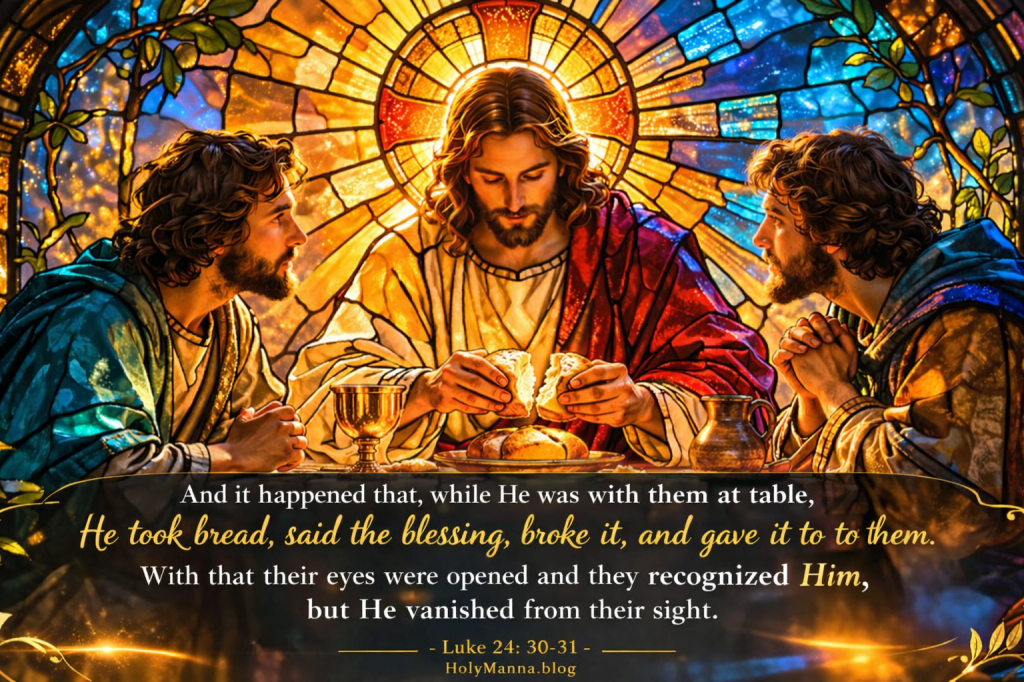
Verse 30 – “And it happened that, while he was with them at table, he took bread, said the blessing, broke it, and gave it to them.”
Saint Luke deliberately uses language that recalls the Last Supper and anticipates the Eucharistic life of the Church. Jesus takes, blesses, breaks, and gives. This action is more than a meal gesture. It is a sacramental sign loaded with memory and meaning. The same Lord who opened the Scriptures now acts in a way the Church would never forget.
Verse 31 – “With that their eyes were opened and they recognized him, but he vanished from their sight.”
Recognition comes at the breaking of the bread. That detail is central to the Church’s Eucharistic reading of this passage. Their physical sight had been restrained, but now deeper sight is granted. He vanishes from ordinary sight at the very moment He is recognized, teaching the disciples that His presence will now be known in a new way. The risen Christ is not absent. He is present sacramentally and ecclesially.
Verse 32 – “Then they said to each other, ‘Were not our hearts burning within us while he spoke to us on the way and opened the scriptures to us?’”
Now the disciples look back and recognize what grace had already been doing within them. The burning heart is the sign of the Word received, the soul awakened, the mind illumined, and hope rekindled. Christ’s explanation of Scripture was not an academic exercise. It was a living encounter that set the interior life on fire.
Verse 33 – “So they set out at once and returned to Jerusalem where they found gathered together the eleven and those with them”
Once Christ is recognized, the direction of travel changes immediately. They had been leaving Jerusalem in sorrow. Now they return at once in joy. Encounter with the risen Lord reverses the path of discouragement. It sends the disciples back toward the apostolic community, not away from it.
Verse 34 – “who were saying, ‘The Lord has truly been raised and has appeared to Simon!’”
The Resurrection is not private inspiration. It is apostolic proclamation. The disciples arrive to find that the Church is already confessing the risen Lord. Peter, who denied Jesus, has himself received a Resurrection appearance. Grace is restoring the fallen and gathering the witnesses together.
Verse 35 – “Then the two recounted what had taken place on the way and how he was made known to them in the breaking of the bread.”
The story ends in testimony. The disciples do not keep the encounter to themselves. They recount both the road and the table, both the opened Scriptures and the breaking of the bread. That is the full shape of the Church’s life. Christ teaches, Christ feeds, and Christ sends His people to bear witness.
Teachings
This Gospel is one of the clearest biblical windows into the Catholic understanding of the Mass. The risen Jesus first opens the Scriptures, then is made known in the breaking of the bread. The Catechism says, “The Eucharistic liturgy unfolds according to a fundamental structure which has been preserved throughout the centuries down to our own day. It displays two great parts that form a fundamental unity: the gathering, the liturgy of the Word, with readings, homily and general intercessions; the liturgy of the Eucharist, with the presentation of the bread and wine, the consecratory thanksgiving, and communion. The liturgy of the Word and liturgy of the Eucharist together form ‘one single act of worship’; the Eucharistic table set for us is the table both of the Word of God and of the Body of the Lord.” CCC 1346
Then The Catechism speaks even more directly about Emmaus itself: “Is this not the same movement as the Paschal meal of the risen Jesus with his disciples? Walking with them he explained the Scriptures to them; sitting with them at table ‘he took bread, blessed and broke it, and gave it to them.’” CCC 1347 The Church is not forcing a Eucharistic meaning onto this story from the outside. She is recognizing the pattern Christ Himself established.
The ancient name “Breaking of Bread” also comes into focus here. The Catechism says, “The Breaking of Bread, because Jesus used this rite, part of a Jewish meal, when as master of the table he blessed and distributed the bread, above all at the Last Supper. It is by this action that his disciples will recognize him after his Resurrection, and it is this expression that the first Christians will use to designate their Eucharistic assemblies.” CCC 1329 That one paragraph gathers Emmaus, the Last Supper, and the early Church into a single Eucharistic line.
This Gospel also teaches the Church how to read all of Scripture. Jesus begins with Moses and all the prophets and interprets what refers to Him. The Catechism says, “It was necessary that the Christ should suffer these things and enter into his glory. The disciple of Christ must not only keep the faith and live on it, but also profess it, confidently bear witness to it, and spread it.” CCC 1816 The first sentence echoes Emmaus directly. The Cross and glory belong together. The Christian who understands Christ rightly cannot remain silent about Him.
The Emmaus story has also been treasured by the saints because it captures the journey of the soul. Saint Augustine saw in it the movement from blindness to sight, from sorrow to sacramental recognition. Saint Gregory the Great reflected that the disciples were not denied Christ’s presence, but prepared for a deeper way of knowing Him. Historically, the Church has returned to this passage constantly in Eastertide because it reveals how the risen Lord continues to form His people after the Resurrection. He does not merely prove that He is alive. He teaches them how to live in His presence.
Reflection
The road to Emmaus feels so close because it tells the truth about how many people actually move through faith. Hearts can love Jesus and still feel confused. They can know facts about Him and still be slow to believe. They can hear that the tomb is empty and still walk around with the sadness of “we were hoping.” This Gospel does not shame that weakness. It reveals that the risen Christ comes looking for people inside it.
There is deep comfort in the way Jesus acts here. He draws near before He is recognized. He listens before He rebukes. He teaches before He reveals Himself fully. He does not discard the discouraged disciples. He walks with them patiently until their hearts begin to burn again. That is still how He works. He still meets wounded people in conversation, in Scripture, in prayer, in liturgy, and in the quiet invitation to say, “Stay with us.”
This Gospel also challenges the habit of wanting Christ without the Cross. The disciples were disappointed because they expected redemption to look different. Many hearts still do the same thing. They want victory without suffering, holiness without repentance, faith without obedience, and consolation without surrender. But Jesus teaches that glory comes through the Passion. That is not only a truth about Him. It becomes a pattern for every disciple.
A practical way to live this Gospel is to return seriously to both Scripture and the Eucharist. The heart grows cold when either one is neglected. The soul needs the Word opened and the Bread broken. It also helps to notice the movement of the story. The disciples invite Jesus to stay, recognize Him, and then return at once to Jerusalem. Real encounter with Christ moves a person back toward the Church, back toward witness, back toward hope.
This Gospel is also a gentle question for anyone tempted to walk away. The two disciples were leaving Jerusalem, but Jesus met them on the road and turned them around. That means discouragement does not have to be the end of the story. Confusion does not have to be final. The risen Lord still knows how to find His people while they are walking in the wrong direction.
Where has the heart quietly whispered, “we were hoping”, and begun to settle into disappointment? Has the soul been willing to let Christ interpret suffering through the Scriptures, or has it tried to judge everything by wounded expectations? Does the Eucharist still feel like the place where the risen Jesus makes Himself known? And if the heart has been walking away from Jerusalem, what would it look like to turn around and return at once?
When Burning Hearts Return to the Lord
Today’s readings tell one beautiful story from different angles. In Acts 2, Saint Peter stands and proclaims that Jesus who was crucified has truly been raised and exalted. In Psalm 16, the Church sings with confidence that God does not abandon His faithful one to death, but leads him on the path of life. In 1 Peter 1:17-21, the faithful are reminded that they were not redeemed by passing things, but by the precious blood of Christ. Then, in Luke 24:13-35, the risen Jesus walks beside weary disciples, opens the Scriptures, and makes Himself known in the breaking of the bread.
Taken together, the message is clear and deeply comforting. The Resurrection is not a distant event remembered once a year. It is the living truth that changes everything. Jesus is risen. He still speaks. He still draws near to discouraged hearts. He still opens the meaning of suffering through the Scriptures. He still feeds His people with His presence. He still turns wandering disciples into joyful witnesses.
That is why this Sunday feels so personal. These readings are not only about Peter preaching long ago, or disciples walking toward Emmaus long ago. They are about the life of the Church now. There are still hearts that feel confused. There are still souls carrying disappointment. There are still people quietly saying, “We were hoping” while walking through grief, uncertainty, or spiritual fatigue. And there is still the risen Jesus, patient as ever, strong as ever, drawing near as ever.
The invitation is simple. Stay close to the Word of God. Stay close to the Eucharist. Stay close to the Church. Let Christ teach the heart again. Let Him burn away discouragement. Let Him turn fear into faith, routine into reverence, and sorrow into witness. Easter is not asking the faithful to pretend life is easy. Easter is asking them to remember that death did not win, sin did not win, and disappointment does not get the final word.
What would change if this week were lived like Jesus is truly risen and truly near? What would happen if the heart stopped walking away and began asking again, “Stay with us, Lord”? The beautiful answer running through every reading today is that He does stay. He stays with His people in truth, in grace, in His Church, and in the breaking of the bread. So the call is to rise, return, and walk with Him with a steadier heart.
Engage with Us!
Share your reflections in the comments below. What stood out most in today’s readings? Which verse stayed with the heart, challenged the conscience, or brought peace in a place that needed it? This Sunday’s readings speak with so much beauty about the risen Jesus who still draws near, still opens the Scriptures, and still makes Himself known to His people.
- In the First Reading from Acts 2:14, 22-33, what does Saint Peter’s bold witness teach about trusting the truth of the Resurrection, even in a world that may resist it? Where might greater courage be needed to speak clearly about Jesus?
- In the Responsorial Psalm, Psalm 16:1-2, 5, 7-11, which line speaks most deeply to the heart today? What would it look like to live more fully as though the Lord is truly the soul’s portion, refuge, and path to life?
- In the Second Reading from 1 Peter 1:17-21, how does the truth that the faithful were redeemed by the precious blood of Christ change the way daily life, choices, and struggles are viewed? What habits or ways of living may need to be surrendered to God with greater reverence?
- In the Holy Gospel from Luke 24:13-35, where does the story of the road to Emmaus feel especially personal? Has there been a season of walking with disappointment, confusion, or fading hope, and how might Jesus already be drawing near through Scripture, prayer, or the Eucharist?
Keep walking with faith, even when the road feels long. Keep listening for the voice of Christ in His Word and keep seeking Him in the breaking of the bread. May every part of life be lived with the love, mercy, and tenderness that Jesus taught, so that others may meet Him through the way His people speak, serve, forgive, and endure.
Sacred Heart of Jesus, we trust in You!
Immaculate Heart of Mary, pray for us!
Saint Michael the Archangel, defend us in battle!
Follow us on YouTube, Instagram and Facebook for more insights and reflections on living a faith-filled life.


Leave a Reply