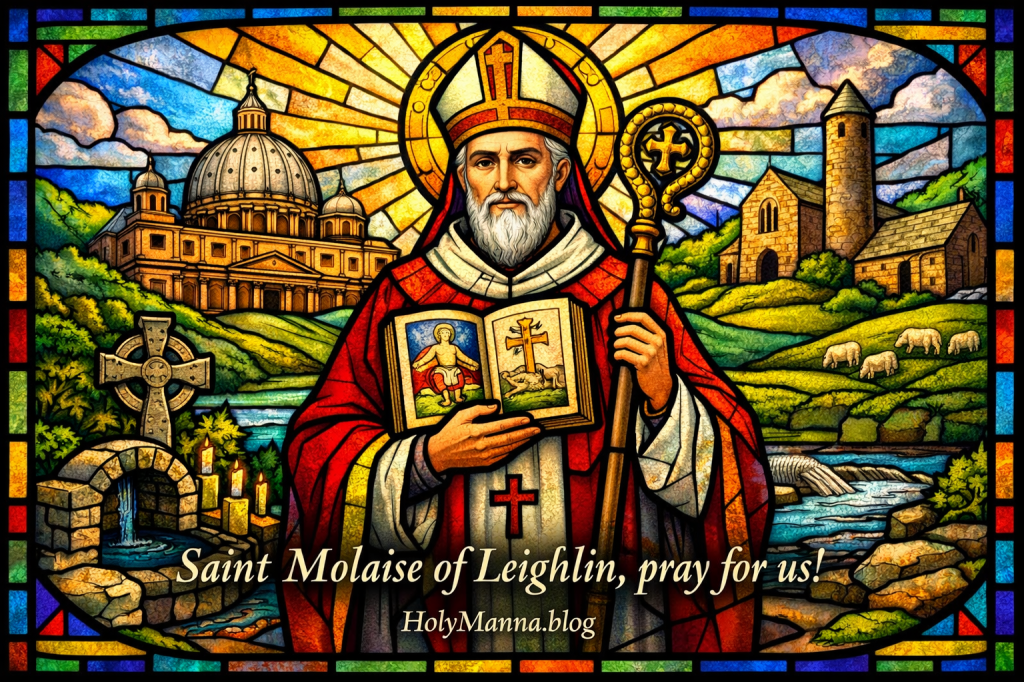
The Flame That Helped Light Ireland
Saint Molaise of Leighlin, also known as Saint Laserian, stands among the great early Irish saints who helped shape the life of the Church in a decisive moment. He is remembered as an abbot, a bishop, a man of deep prayer, and a defender of unity with Rome. In Irish Catholic memory, he is especially honored as the first bishop of Leighlin and as the holy leader whose name remains tied to Old Leighlin in County Carlow.
What makes Saint Molaise so important is not simply that he lived a holy personal life. It is that his holiness bore fruit for the whole Church. He is most known for helping Ireland embrace the Roman calculation of Easter, a matter that may sound technical at first, but in his own day touched the deeper question of communion, obedience, and unity within the Body of Christ. He helped lead the Church in Ireland toward greater visible harmony with the See of Rome, and that alone would have secured his place in Catholic history.
Still, his story is not only about councils and disputes. It is also about a man who left behind worldly honor, embraced the monastic life, accepted suffering, and gave himself over to Christ with great seriousness. His memory has endured because he was not merely an able churchman. He was a saint.
From Noble Origins to the Service of Christ
Catholic tradition remembers Saint Molaise as having been born around the year 566. He was said to be the son of Cairel de Blitha and Gemma, and later tradition connects his youth in part with Scotland. Some accounts preserve that he had the possibility of worldly advancement and even the leadership of his people before him, yet he refused that path. That detail says much about the man. He did not want earthly prominence. He wanted God.
His early life points to a familiar pattern in the lives of the saints. God often places a soul in circumstances where worldly success is possible, only for that soul to hear a deeper call. Saint Molaise chose not ambition, but surrender. He embraced a life of prayer and discipline, and tradition says that he traveled to Rome, where he spent many years in study and formation. Catholic memory holds that his Roman years deeply marked him and prepared him for the work God would later entrust to him in Ireland.
This was not a dramatic conversion story in the way some saints have one. Saint Molaise seems instead to have deepened into holiness through obedience, asceticism, study, and fidelity to the Church. That matters. Not every saint is converted in a blaze of public drama. Some saints are formed by years of hidden faithfulness. Saint Molaise appears to have been one of them.
When he returned to Ireland, he became associated with Leighlin, where an earlier foundation already existed. There he would become abbot and later bishop, and there he would become one of the most influential churchmen of his time. He is most known for his leadership in the Easter controversy, but that leadership only makes sense because it rested on a life already anchored in prayer, discipline, and communion with the wider Church.
The Saint Who Helped Keep Ireland in Communion
Saint Molaise lived during a time when the Church in Ireland was wrestling with the calculation of Easter. To many modern readers, that might seem like a small matter, but in the life of the Church it was not small at all. The date of Easter touched the shared worship of the whole Christian people. It touched visible unity. It touched whether local custom would prevail over the wider order of the Church.
Saint Molaise became one of the leading defenders of the Roman reckoning of Easter. He argued strongly that Ireland should celebrate the Resurrection in communion with the universal Church. His role in synods connected with this controversy made him one of the great church leaders of his age. Tradition also holds that he traveled to Rome in connection with this matter and was later consecrated bishop, strengthening his authority in the struggle for unity.
This is the heart of what he is remembered for. Saint Molaise was not simply a pious monk tucked away in private devotion. He was a public witness to Catholic unity. He understood that holiness is not merely personal. It is ecclesial. A saint loves Christ, and because he loves Christ, he loves the Church Christ founded.
Catholic tradition also remembers Leighlin under his leadership as a place of remarkable spiritual life, with later sources describing a monastery of great size and influence. Whether every number in those ancient accounts can be confirmed with precision, the larger point is clear. Leighlin became a major center of Christian life, and Saint Molaise stood at the center of it.
As for miracles during his lifetime, tradition remembers him broadly as a miracle worker, though surviving sources do not preserve a long and tightly documented list of individual miracles in the way later centuries sometimes do. One of the most memorable stories connected with him comes from his exchange with Saint Munnu during the Easter controversy. When a dramatic miracle test by fire was proposed to settle the matter, Saint Molaise did not seek spectacle. Instead, he responded with humility and reverence, saying of the other holy man, “If you told Slieve Margy over there to move to Magh Ailbe, and Magh Ailbe over to where Slieve Margy is, God would do it for you.” Even in conflict, he recognized holiness in another. That moment reveals something beautiful. The saint defended truth without losing charity.
This may be one reason he remains so worth remembering. In a world that easily turns disagreement into pride, Saint Molaise shows that fidelity and humility belong together.
Trials, Illness, and the Hidden Cross
Saint Molaise was not a martyr in the strict sense. He did not die by execution for the faith. Yet that does not mean his path was free from suffering. In fact, the saint appears to have endured deep hardship in the form of ecclesial struggle, personal austerity, and serious bodily illness.
The Easter controversy itself was not a small intellectual debate. It involved resistance, tension, and the burden of standing publicly for what one believed the wider Church required. There is a kind of suffering in that sort of responsibility. To lead in the Church is often to carry misunderstanding, opposition, and the weight of decision.
More striking still is the tradition about his final illnesses. One later account describes Saint Maighnean visiting Saint Molaise while he was suffering intensely. In that account, the saint explains his suffering in words that are severe, sobering, and deeply Catholic in spirit: “My sinfulness goes like a flame through my body, for I want to have my purgatory in this life and find eternal life in the next… I want my body threshed with infirmities.” Whether every word has come down with exact historical certainty, the tradition captures the spirit in which he was remembered. He was seen as a man who did not run from suffering, but offered it to God.
That is not a message modern people always like to hear. Comfort is easy to praise. Penance is harder. But the saints remind the Church that suffering united to Christ can purify the heart. Saint Molaise seems to have understood that deeply. His hardships were not meaningless interruptions to holiness. They were part of the road by which holiness was refined.
The Memory That Never Left Leighlin
After Saint Molaise died on 18 April, his legacy did not fade. In many ways, it deepened. His memory remained tied to Leighlin, where later generations continued to honor him as the founding bishop and patron. His name remained attached to the cathedral, to the local holy well, and to the identity of the Church in that region.
This enduring devotion is one of the clearest signs of his posthumous impact. The Church did not remember him merely as an administrator or historical figure. The faithful remembered him as a holy intercessor and spiritual father. Annual observances of his feast have continued in the life of the local Church, and sacred places associated with him still form part of the Catholic landscape of the area.
There are also broader signs of cultural impact. His name survives in churches dedicated to him, in diocesan memory, and in the continuing story of Old Leighlin as a place of prayer and Christian heritage. He remains one of those saints whose influence is woven into the life of a people, even when the details are not always widely known outside the region.
As for miracles after death, surviving Catholic sources do not preserve a detailed and verified catalogue of posthumous miracle accounts in the way that later canonization records sometimes do. His enduring veneration, the sacred sites associated with him, and the reputation for sanctity that remained attached to his name are clear. Any more specific posthumous miracle stories are not well established in the surviving material that has come down. That should be said plainly. The saint’s legacy is real, but not every detail is equally documented.
Even so, what can be seen clearly is powerful enough. Saint Molaise helped shape the Church in Ireland while he lived, and after his death he remained a source of memory, devotion, and identity for the faithful. That is no small thing.
What Saint Molaise Still Teaches the Church
Saint Molaise speaks strongly to the modern Catholic heart because his life brings together several virtues that are badly needed now. He shows the beauty of obedience to the Church. He shows the courage to stand for truth without becoming cruel. He shows the value of hidden formation before public mission. He shows that suffering can be endured with purpose when it is offered to God.
There is also something deeply timely in the fact that he is remembered above all for helping preserve unity. The Church today lives in an age of confusion, noise, and fracture. Everyone wants to build a camp around a personality, a preference, or a personal interpretation. Saint Molaise points in another direction. He reminds the faithful that Catholic life is not self-made. It is received. It is lived in communion. It is safeguarded in union with the Church Christ established.
His witness also challenges the soul on a personal level. He refused status. He embraced discipline. He did not seek spectacle. He carried suffering seriously. He gave himself to the work God placed before him. That kind of holiness does not look flashy, but it is the kind that helps hold the Church together.
Where is the heart still resisting obedience because pride prefers its own way? Where is God asking for fidelity that feels hidden, unrewarded, or difficult? Where can suffering be offered instead of wasted? These are not comfortable questions, but they are good ones. The saints do not exist merely to be admired. They exist to help lead souls to Christ.
A practical way to live Saint Molaise’s example is to begin with a renewed love for the Church. Pray for unity. Study the faith seriously. Accept correction with humility. Do the duties of the day without needing applause. Offer small sufferings in union with Jesus. Stay close to the sacraments. Remain faithful even when the work is quiet and unseen. That is how sanctity grows.
Engage with Us!
Share your thoughts and reflections in the comments below. Saint Molaise may not be as widely known as some of the more famous saints, but his life has a lot to say to the Church today.
- What stands out most in Saint Molaise’s life: his humility, his defense of unity, or his acceptance of suffering?
- How does his example challenge the way personal opinions sometimes overshadow obedience and communion in the Church today?
- What is one hidden sacrifice or hardship that can be offered to God this week with greater trust?
- How can greater love for the Church become more concrete in daily life through prayer, study, and fidelity?
May Saint Molaise intercede for every soul seeking deeper faith, greater humility, and a stronger love for the Church. Let life be lived with courage, with obedience, and with the love and mercy Jesus taught us.
Saint Molaise of Leighlin, pray for us!
Follow us on YouTube, Instagram and Facebook for more insights and reflections on living a faith-filled life.


Leave a Reply