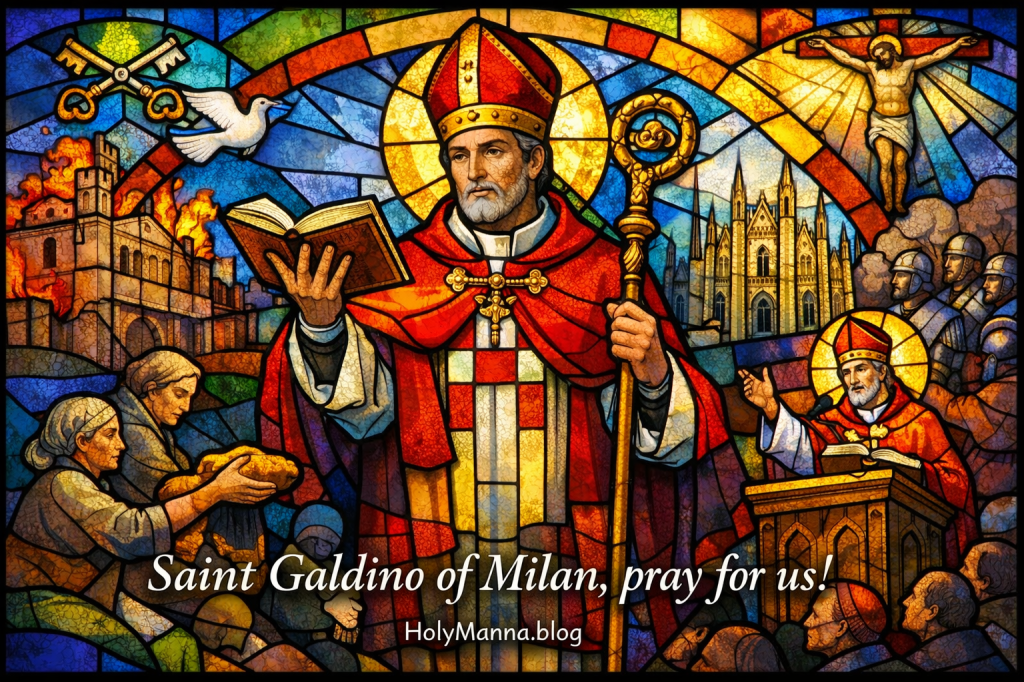
The Cardinal Who Rebuilt a Broken City
Saint Galdino of Milan stands in Catholic memory as one of those strong bishops the Church seems to receive precisely when everything feels unstable. He lived in the twelfth century, when Milan was wounded by political violence, ecclesial division, and the spread of error. In that chaos, Saint Galdino became a loyal son of the Church, a defender of the true pope, a father to the poor, and a fearless preacher of Catholic truth.
He is revered because he did not serve Christ only in peaceful times. He served Christ when the city was torn apart, when powerful rulers tried to bend the Church to their will, and when ordinary people were humiliated by poverty and fear. Catholic tradition remembers him as a rebuilder of Milan, a protector of the faithful, and a pastor whose heart was especially close to the poor. He is also remembered for the striking way his earthly life ended. He died while preaching, as though the Lord allowed him to spend his last breath doing the very work he had given his whole life to do.
Roots in Milan and a Life Formed for Service
Saint Galdino was born in Milan in the early decades of the twelfth century. The exact year is not firmly established, but Catholic tradition places his origins clearly in that city which he would later serve so sacrificially. He came from Milanese society with enough standing to receive a serious ecclesiastical formation, and before becoming archbishop he served the Church of Milan as chancellor and archdeacon. Those offices mattered. They meant he was not a stranger to responsibility, and they also meant that when trouble came he already knew the life of the local Church from within.
His early years do not include the kind of dramatic conversion story found in some saints. His deepening of faith seems to have come through steady fidelity, ecclesial service, and courage under pressure. Sometimes that is how holiness grows. It is not always born from one sudden moment. Sometimes it is formed through years of obedience, clear judgment, and a willingness to stand with the Church when doing so becomes costly.
What Saint Galdino became most known for grew directly from those years of formation. He became known for loyalty to the legitimate pope, resistance to schism, care for the poor, and courageous defense of Catholic doctrine. He was not a saint remembered mainly for private visions or dramatic outward miracles. He was remembered because he acted like a true bishop when the flock most needed one.
Faithful in the Ruins
The great trial of Saint Galdino’s life came during the conflict surrounding Emperor Frederick Barbarossa and the schism that afflicted the Church in that age. Barbarossa supported antipopes against the rightful Pope Alexander III, and Milan itself suffered terribly in the struggle. Saint Galdino opposed the emperor’s interference and remained faithful to the legitimate pope. That faithfulness led to exile and suffering.
This part of his story matters because it shows the Catholic heart of his witness. He did not treat unity with the true Church as something optional or secondary. He understood that communion with the rightful successor of Saint Peter was not a political preference. It was part of fidelity to Christ. The Catechism teaches that the Roman Pontiff is the perpetual and visible source and foundation of unity for the bishops and for the faithful, and Saint Galdino lived that truth with great courage in a time of confusion.
After the death of Archbishop Oberto, Pope Alexander III entrusted Galdino with the Church of Milan and raised him to the dignity of cardinal. When he returned to Milan, he did not return to comfort. He returned to a city that had been devastated and to a people who needed both material and spiritual restoration. He helped rebuild what had been broken. He supported the wider effort of the Lombard cities resisting oppression. He worked to restore order in the diocese. He strengthened the clergy and the faithful. He labored so that the Church in Milan would not merely survive, but recover her soul.
The Miracle of Charity in a Time of Need
When people ask about miracles in the life of Saint Galdino, the honest Catholic answer is that the strongest traditions do not preserve a long list of spectacular miracle stories attached to his lifetime. Instead, what shines through the sources is something no less saintly. His life itself became a sign of grace. He poured himself out for the poor with such seriousness that later memory held onto his charity almost as tightly as his courage.
He organized the distribution of bread to the needy, and this charitable effort became associated with the name “the bread of Saint Galdino.” That detail says a great deal. He was not content to defend doctrine in words while ignoring bodily hunger. He cared for souls and bodies together. He knew that a bishop must preach the truth and feed the suffering. In that sense, his life reflected the Gospel pattern of Christ himself, who taught the crowds and also had compassion on them in their need.
This is one reason he should still be remembered and imitated. Saint Galdino shows that orthodoxy and mercy belong together. The saint who fought heresy was the same saint who fed the poor. The man who defended the Church from error was the same man who helped lift up those crushed by debt and poverty. In a world that often tries to separate truth from love, Saint Galdino stands as a Catholic witness that the two were never meant to be rivals.
A Preacher Against Error and a Father to the Poor
Saint Galdino also spent himself combating heresy, especially errors that threatened the life of the Church in his region. He preached vigorously against false teaching, not because he enjoyed conflict, but because error harms souls. A shepherd who loves his flock does not remain silent when wolves are near. Catholic tradition remembers him as an intrepid defender of the faith and an untiring preacher of the word of God.
At the same time, Milanese memory gave him titles that reveal the tenderness of his legacy. He was remembered as a defender of the city and as a father of the poor. Those are not small honors. They show how deeply the people recognized both his strength and his compassion. He rebuilt the cathedral and the archiepiscopal residence. He helped restore the city’s moral and spiritual life. He did not serve Milan from a distance. He entered into her wounds.
There are saints who dazzle by extraordinary phenomena. Saint Galdino moves the heart in a different way. He shows what grace looks like when it takes the form of steadfast duty, sacrificial leadership, and pastoral charity. His life reminds the faithful that holiness is not always loud. Sometimes holiness looks like showing up for a devastated people and refusing to abandon them.
The Pulpit, the Struggle, and a Holy Death
Saint Galdino faced hardship not in one moment only, but throughout the whole public work of his life. He endured exile. He lived through the destruction of his city. He bore the burden of governing a wounded diocese. He confronted the confusion of schism and the persistence of heresy. None of this was easy. Yet Catholic memory does not present him as a man broken by those burdens. It presents him as a man made more faithful through them.
His death has become the defining image of his final witness. On April 18, 1176, while preaching against heresy in the church of Saint Thecla in Milan, he was struck by a fatal illness and died. Tradition also remembers this as dying on the pulpit while addressing the people. There is something deeply beautiful about that ending. The bishop who had defended the Church with courage and served the poor with mercy died still engaged in the care of souls.
He was not a martyr in the strict sense of being executed for the faith, but his death still carries the spiritual force of a life consumed in service. It was a death in harness. It was a death in mission. It was the end of a shepherd who did not step down from the work until the Lord himself called him home.
Memory, Veneration, and the Grace of His Legacy
After his death, Saint Galdino’s impact did not disappear. He was buried in the Duomo of Milan, and his memory remained deeply rooted in the life of the local Church. He came to be honored as one of Milan’s co-patrons, a remarkable sign of how strongly the people remembered his role in their history. Even centuries later, he remained associated with the identity of Milan as a city that had suffered, endured, and been spiritually rebuilt.
His feast is celebrated on April 18. In the Ambrosian tradition, the liturgy remembers him especially for mercy toward the poor, steadfast faith, and pastoral courage. That liturgical memory is important because it shows how the Church herself interprets his life. She does not remember him merely as a political figure or a local hero. She remembers him as a holy bishop whose charity glorified God.
As for miracles after death, the most careful Catholic approach is to be honest. There is not a widely preserved body of famous posthumous miracle stories attached to Saint Galdino in the strongest sources commonly cited today. His legacy after death rests more clearly on his enduring veneration, his place in the liturgical life of Milan, and the spiritual fruits of his witness than on a large collection of verified miracle accounts. Some later devotional traditions may have attached favors and graces to his intercession, as often happens in the life of the Church, but no major posthumous miracle cycle stands out in the principal accounts. Because of that, nothing further should be claimed with certainty.
His cultural impact, however, is plain. He became part of Milan’s Catholic memory not only as an archbishop, but as a symbol of fidelity, courage, and mercy. He represented the kind of shepherd who protects both the Church’s truth and the city’s poor. That is no small legacy.
What Saint Galdino Teaches the Church Today
Saint Galdino has something to say to Catholics now. He speaks to an age tired of confusion, suspicious of authority, and tempted to separate doctrine from charity. His life says that truth matters, and so does mercy. Fidelity to the Church matters, and so does love for the poor. Courage matters, and so does perseverance in ordinary responsibility.
His example also speaks to anyone carrying the burden of rebuilding after loss. Milan was not whole when he returned to it. The city had wounds. The Church had wounds. The people had wounds. Saint Galdino did not complain that the situation was unfair and impossible. He got to work. He served, rebuilt, preached, corrected, and gave himself away. That kind of holiness is deeply needed now.
What needs rebuilding in life right now? Perhaps it is trust in God after disappointment. Perhaps it is a neglected prayer life. Perhaps it is a family relationship wounded by resentment. Perhaps it is courage to stand openly with the Church when the world pressures silence. Saint Galdino teaches that rebuilding starts with fidelity. It starts with refusing to give up on what belongs to God.
His life also invites practical imitation. Feed the poor. Defend the truth without cruelty. Stay close to the Church in times of confusion. Serve the people right in front of you. Do not wait for dramatic holiness. Live the duties God has already given with love, clarity, and perseverance. That is how saints are made.
Engage With Us!
Share thoughts and reflections in the comments below. Saint Galdino’s life has a lot to say to anyone trying to stay faithful in a difficult time, and it would be good to hear what stood out most.
- What part of Saint Galdino’s life speaks most deeply right now: his courage, his loyalty to the Church, or his love for the poor?
- How can greater mercy toward the needy become a real part of daily Christian life, not just a good intention?
- Where is God asking for stronger fidelity in the middle of confusion or pressure?
- What does Saint Galdino’s death while preaching teach about living with perseverance to the very end?
- How can truth and charity be held together more faithfully in ordinary conversations and relationships?
May Saint Galdino pray for every heart that feels tired, every soul trying to remain faithful, and every believer learning how to rebuild what has been broken. Live with courage, stay close to Christ and his Church, and do everything with the love and mercy Jesus taught us.
Saint Galdino of Milan, pray for us!
Follow us on YouTube, Instagram and Facebook for more insights and reflections on living a faith-filled life.


Leave a Reply