Saturday of the Second Week of Easter – Lectionary: 272
When the Risen Lord Orders the Storm
There are days in the Christian life when everything feels stretched at once. The needs are real, the waters are rough, and the heart wonders how God is guiding His people through it all. Today’s readings speak directly into that tension. The central theme weaving them together is this: the risen Christ brings order, mercy, and courage to His Church in the middle of real human need and real human fear. In Acts 6:1-7, the early Church faces growing pains from within. In Psalm 33, the faithful are reminded that the Lord’s word is upright and His mercy fills the earth. In John 6:16-21, the disciples are caught in darkness and wind until Jesus comes to them with the words “It is I. Do not be afraid.”
This is a fitting message for the Easter season, because Easter is not only about the fact that Christ rose from the dead. It is also about what His risen life continues to do in His Church. The community in Jerusalem is expanding quickly, and with that growth comes tension between Hebrew and Hellenist believers. Even in those earliest days, the Church had to learn how to protect both charity and apostolic mission. At the same time, the Gospel places the disciples on troubled waters after the multiplication of the loaves, showing that the One who feeds His people is also the One who rules the deep. Set beside them, Psalm 33 becomes the song of the Church’s confidence. The Lord sees, the Lord provides, and the Lord does not abandon those who hope in Him.
Taken together, these readings prepare the soul to see something beautiful and deeply Catholic. Christ does not save His people in abstraction. He enters the mess, strengthens the weak, guides the apostles, cares for the vulnerable, and comes near when darkness seems to be winning. Today’s passages invite a deeper trust in the Lord who governs both the life of the Church and the hidden storms of the heart. Where is the Lord trying to bring order, trust, and holy courage into life today?
First Reading – Acts 6:1-7
When the Church Learns to Serve Without Losing Her Soul
The first reading opens a window into the life of the early Church at Jerusalem, and it does not present a romantic picture of a community without problems. It shows a Church alive, growing, generous, and already facing the strain that comes when grace is at work in real human lives. The Hellenists were Greek-speaking Jewish Christians, while the Hebrews were Aramaic or Hebrew-speaking Jewish Christians. Both belonged to the same Christian community, yet cultural difference and practical neglect created real pain. Widows were among the most vulnerable members of society, and to be overlooked in the daily distribution was no small matter. The Church had already embraced a life of shared goods and concrete care for the needy, so this complaint struck at the heart of Christian charity. At the same time, the apostles made clear that the ministry of the word and prayer could not be sacrificed. This reading fits beautifully into today’s larger theme because it shows that the risen Christ brings order to His Church not by removing difficulty, but by guiding His people through it with wisdom, charity, and apostolic authority.
Acts 6:1-7 – New American Bible (Revised Edition)
The Need for Assistants. 1 At that time, as the number of disciples continued to grow, the Hellenists complained against the Hebrews because their widows were being neglected in the daily distribution. 2 So the Twelve called together the community of the disciples and said, “It is not right for us to neglect the word of God to serve at table. 3 Brothers, select from among you seven reputable men, filled with the Spirit and wisdom, whom we shall appoint to this task, 4 whereas we shall devote ourselves to prayer and to the ministry of the word.” 5 The proposal was acceptable to the whole community, so they chose Stephen, a man filled with faith and the holy Spirit, also Philip, Prochorus, Nicanor, Timon, Parmenas, and Nicholas of Antioch, a convert to Judaism. 6 They presented these men to the apostles who prayed and laid hands on them. 7 The word of God continued to spread, and the number of the disciples in Jerusalem increased greatly; even a large group of priests were becoming obedient to the faith.
Detailed Exegesis
Verse 1. “At that time, as the number of disciples continued to grow, the Hellenists complained against the Hebrews because their widows were being neglected in the daily distribution.”
Luke begins by showing that growth brings new demands. The problem does not arise because the Church is dying, but because she is multiplying. The complaint of the Hellenists reveals that unity in Christ does not erase the need for justice, attentiveness, and wise administration. The neglect may not have been deliberate malice, but it was still serious. In Scripture, widows stand among those whom God especially defends, and the early Church had to reflect that divine concern. St. John Chrysostom noticed the realism of this moment and called it another trial arising from within, a reminder that even from the beginning the Church had to face wounds both external and internal. This verse teaches that holiness is not proved by pretending there is no problem. Holiness begins when the truth is faced in the light of charity.
Verse 2. “So the Twelve called together the community of the disciples and said, ‘It is not right for us to neglect the word of God to serve at table.’”
The Twelve do not ignore the complaint, and they do not respond defensively. They gather the community. That matters. The Church answers tension through communion, not faction. Yet the apostles also defend their primary vocation. Their refusal is not a rejection of service, but a recognition of order. Christ entrusted them with the word, with prayer, and with the shepherding of the flock. If they abandoned that work, the whole Church would suffer. The phrase about serving at table likely includes the practical administration of resources for the needy. The apostles are not saying that material service is beneath them. They are saying that different forms of service must be rightly ordered if the Church is to remain faithful to her mission. Chrysostom put it plainly when he said, “Well said: for the needful must give precedence to the more needful.”
Verse 3. “Brothers, select from among you seven reputable men, filled with the Spirit and wisdom, whom we shall appoint to this task,”
This verse is rich with Catholic insight. The solution is not random volunteering. The men chosen must be reputable, Spirit-filled, and wise. Even practical charity requires holiness of life. The Church does not separate administration from sanctity. These seven are selected by the community, but appointed by apostolic authority, showing the harmony of participation and hierarchy. The number seven may suggest completeness, but the deeper point is clear: mercy in the Church must be entrusted to men shaped by grace. Chrysostom saw the depth of this requirement when he wrote, “For think not, because he has not the word committed unto him, that such an one has no need of wisdom: he does need it, and much too.” Service in the Church is never merely logistical. It is spiritual work.
Verse 4. “whereas we shall devote ourselves to prayer and to the ministry of the word.”
This verse reveals the beating heart of apostolic life. Prayer comes first, and then the ministry of the word. That order is not accidental. The apostle must receive before he gives. He must remain with God if he is to speak for God. This is a warning for every age of the Church. Whenever prayer is neglected, preaching becomes thin, and service eventually loses its supernatural center. The apostles understand that their mission is not merely organizational leadership. It is spiritual fatherhood rooted in communion with the Lord. The Church grows strong when her shepherds pray, preach, and remain faithful to their proper office.
Verse 5. “The proposal was acceptable to the whole community, so they chose Stephen, a man filled with faith and the holy Spirit, also Philip, Prochorus, Nicanor, Timon, Parmenas, and Nicholas of Antioch, a convert to Judaism.”
The whole community receives the apostles’ judgment with peace. That is a sign of wisdom and humility. Luke names the seven, beginning with Stephen, who will soon become the Church’s first martyr, and Philip, who will later appear prominently in evangelization. Nicholas is identified as a convert to Judaism, reminding readers again of the ethnic and religious diversity within the early Church. Many scholars have noted that the names are Greek, which suggests a sensitive and charitable response to the Hellenists’ concern. The Church does not deepen division. She answers it by raising up trustworthy men whose very appointment promotes justice and peace. This is one of the quiet beauties of Catholic life. Grace does not erase human difference, but it sanctifies it and orders it toward communion.
Verse 6. “They presented these men to the apostles who prayed and laid hands on them.”
This is one of the most important moments in the passage. The seven are not simply assigned work. They are presented to the apostles, who pray and lay hands on them. The laying on of hands is a deeply biblical sign of designation, blessing, and the invocation of divine power for a sacred task. The Church has long seen in this scene a foundational moment for ordained service, especially in relation to the diaconate, even if Acts presents the office here in an early stage. The gesture shows that ministry in the Church is not self-created. It is received. It comes through apostolic mediation under God’s grace. Chrysostom beautifully said of this act, “the hand of the man is laid upon the person, but the whole work is of God.” That line captures the Catholic vision of ministry perfectly.
Verse 7. “The word of God continued to spread, and the number of the disciples in Jerusalem increased greatly; even a large group of priests were becoming obedient to the faith.”
The fruit of this holy ordering is missionary growth. Once charity is protected and apostolic ministry is preserved, the word of God spreads even more. Luke makes the result unmistakable. Good order in the Church serves evangelization. It is striking that even many priests become obedient to the faith. That detail shows the Gospel penetrating deeply into the heart of Jewish religious life. The resurrection of Christ is not creating a passing movement. It is forming a real people, with real structure, real charity, and real spiritual authority. Chrysostom saw in this verse the connection between almsgiving, good order, and growth. In other words, the Church becomes fruitful when mercy and truth are held together.
Teachings
This reading is one of the clearest biblical windows into the Catholic conviction that the Church is both spiritual and visible, both mystical and ordered. She is not a loose spiritual association. She is a real communion with apostolic authority, defined ministries, and concrete responsibility for the poor. The apostles do not allow the ministry of charity to disappear, and they do not allow the ministry of the word to be swallowed by administration. Instead, they discern a structure that protects both. That is profoundly Catholic. The Church is never most herself when she chooses between doctrine and mercy. She is most herself when both are preserved in right order under the guidance of the Holy Spirit.
The Church’s later teaching on the diaconate helps illuminate this passage. The Catechism says, “Deacons are ministers ordained for tasks of service of the Church; they do not receive the ministerial priesthood, but ordination confers on them important functions in the ministry of the word, divine worship, pastoral governance, and the service of charity, tasks which they must carry out under the pastoral authority of their bishop.” CCC 1596 This does not mean Acts 6 is a fully developed textbook on the diaconate as later theology expresses it, but it does show the apostolic pattern from which the Church’s understanding of sacred service grows. The seven are appointed to a concrete task, yet Stephen and Philip also appear as powerful witnesses and preachers. Service in the Church is never reduced to paperwork or logistics. It belongs to the living mission of Christ.
This passage also stands firmly inside the Church’s constant love for the poor. The Catechism says, “The Church’s love for the poor . . . is a part of her constant tradition.” CCC 2444 It continues, “Love for the poor is even one of the motives for the duty of working so as to ‘be able to give to those in need.’” CCC 2444 The neglected widows in Acts 6 are not a side issue. They are at the center of the Church’s fidelity. A parish, a ministry, a family, or a soul cannot claim closeness to Christ while overlooking those who are weak, lonely, elderly, poor, or invisible. This reading reminds the Church that charity must become visible in organized, practical, persevering love.
St. John Chrysostom offers one of the sharpest insights into this reading when he writes, “For what profits it, that the dispenser of alms steal not, if nevertheless he waste all, or be harsh and easily provoked?” That is classic Chrysostom. He understands that Christian service requires more than honesty. It requires holiness of character. A ministry can be technically correct and still spiritually damaging if it is rude, impatient, vain, or cold. That insight still lands hard today. The Church needs competent people, but even more than that, she needs people who are governed by the Holy Spirit.
There is also a deep historical beauty here. As tensions rise within the Jerusalem Church, the apostles do not fracture the community. They preserve communion. They invite participation. They act with authority. They pray. They lay hands on the chosen men. Then the word of God spreads. This is not accidental. It is one of the earliest signs that the Church founded by Christ is not sustained by charisma alone, but by apostolic order under grace. That same pattern continues throughout Catholic history wherever the Church remains faithful to prayer, the word, sacramental life, and the works of mercy.
Reflection
This reading speaks with unusual clarity to modern Catholic life because the same temptations still show up. It is easy to become so focused on practical concerns that prayer dries up. It is also easy to speak constantly about prayer while quietly overlooking real people in need. Acts 6 refuses both errors. The apostles protect prayer and preaching, and they make sure the widows are not forgotten. The lesson is simple, but it cuts deep. Real Catholic life is never less than prayer, truth, and concrete charity held together.
In daily life, this means learning to notice the overlooked person before the complaint becomes a wound. It means taking parish service seriously and not treating ministry as casual volunteerism. It means asking whether leadership in the Church, in the home, or in any apostolate is marked by reputation, wisdom, patience, and the Holy Spirit. It also means protecting time for prayer even when many urgent needs press in. The apostles did not say service was unimportant. They showed that every work of love becomes stronger when it flows from prayer and remains ordered to the mission of Christ.
Who is being quietly overlooked in daily life right now? Has busyness pushed prayer to the margins? Is service offered with holiness of heart, or only with efficiency? What would it look like to serve in a way that protects both charity and truth? These are not abstract questions. They belong in the parish office, at the family table, in friendships, in ministry, and in the hidden places of the soul. The Church in Acts 6 became stronger because she listened, discerned, prayed, and acted. The same path still bears fruit now.
Responsorial Psalm – Psalm 33:1-2, 4-5, 18-19, 22
A Song for the Soul That Trusts the Lord in Every Season
The Responsorial Psalm today sounds like the steady heartbeat of a faithful soul. After the practical tension of the early Church in Acts 6 and before the disciples tremble on dark waters in John 6, Psalm 33 teaches the Church how to stand before God with confidence. This psalm comes from Israel’s long tradition of worship, where praise was not just an emotional response but a disciplined act of covenant faith. The harp and lyre point to the liturgical life of the people of God, where music, prayer, and memory were woven together. Israel sang because the Lord had acted, because His word was true, because His justice endured, and because His mercy never failed. That is why this psalm fits today’s theme so beautifully. The same Lord who orders the Church in the first reading and approaches the frightened disciples in the Gospel is the Lord whose eye watches over those who hope in Him. This is a psalm for people learning how to trust when life is full, when the road is uncertain, and when the heart needs to remember that God is not absent.
Psalm 33:1-2, 4-5, 18-19, 22 – New American Bible (Revised Edition)
Praise of God’s Power and Providence
1 Rejoice, you righteous, in the Lord;
praise from the upright is fitting.
2 Give thanks to the Lord on the harp;
on the ten-stringed lyre offer praise.4 For the Lord’s word is upright;
all his works are trustworthy.
5 He loves justice and right.
The earth is full of the mercy of the Lord.18 Behold, the eye of the Lord is upon those who fear him,
upon those who count on his mercy,
19 To deliver their soul from death,
and to keep them alive through famine.22 May your mercy, Lord, be upon us;
as we put our hope in you.
Detailed Exegesis
Verse 1. “Rejoice, you righteous, in the Lord; praise from the upright is fitting.”
The psalm begins with a summons, not a suggestion. The righteous are called to rejoice in the Lord. This joy is not shallow excitement, nor is it based on changing moods or comfortable circumstances. It is the fitting response of those who know who God is. Praise belongs naturally to the upright because a rightly ordered heart recognizes the goodness of the Lord. In today’s readings, this matters deeply. The Church in Acts 6 is dealing with real need, and the disciples in the Gospel are facing real fear, yet the psalm still begins with praise. That is a lesson worth keeping close. Christian praise does not wait for problems to disappear. It rises from the certainty that God remains faithful in the middle of them.
Verse 2. “Give thanks to the Lord on the harp; on the ten-stringed lyre offer praise.”
This verse places worship in a public, embodied, and beautiful setting. Israel did not worship God only in silence or in private thought. She praised Him with voice, memory, and instruments. Sacred music became a way of proclaiming that the Lord was worthy of honor. For Catholics, this verse gently points toward the liturgical life of the Church, where prayer is not merely internal but sacramental, communal, and offered with the whole person. The use of instruments also shows that beauty belongs in worship. God is not honored only by correct words, but by the loving offering of what is noble and fitting. In the context of today’s readings, this verse reminds the soul that gratitude must be practiced, not merely felt.
Verse 4. “For the Lord’s word is upright; all his works are trustworthy.”
This verse is one of the great anchors of the psalm. The word of the Lord is upright. It does not bend with pressure. It does not deceive. It does not fail. His works are trustworthy because they flow from His perfect wisdom and goodness. This lands powerfully beside the first reading, where the apostles remain devoted to prayer and the ministry of the word. The Church can build her life on the word of God because that word is upright. It also prepares the heart for the Gospel, where Christ’s simple words, “It is I. Do not be afraid,” carry divine authority. God’s word does not merely describe reality. It governs it. It creates, sustains, judges, and saves. This verse teaches the soul to lean on what God has said more than on what fear is shouting.
Verse 5. “He loves justice and right; the earth is full of the mercy of the Lord.”
Here the psalm joins two things that modern people often try to separate. The Lord loves justice and right, and the earth is full of His mercy. In Scripture, mercy is not softness without truth, and justice is not severity without love. In God, both shine together perfectly. That is exactly what appears in Acts 6. The neglected widows matter because God loves justice. The solution arises through the mercy and wisdom of the apostles because the earth is full of the Lord’s goodness. This verse protects the Christian from false choices. The Catholic faith does not ask whether to prefer truth or compassion, justice or tenderness. It asks the faithful to behold them united in God Himself. The soul becomes stable when it learns to love what God loves.
Verse 18. “Behold, the eye of the Lord is upon those who fear him, upon those who count on his mercy,”
This verse carries a beautiful tenderness. The Lord’s eye is upon those who fear Him. In biblical language, fear of the Lord does not mean cowering terror. It means reverence, awe, filial humility, and the recognition that God is God and man is not. Those who fear Him are the same ones who count on His mercy. That pairing is deeply Catholic. Holy fear does not drive the soul away from God. It draws the soul toward Him in trust. This verse also speaks directly to the Gospel scene. The disciples think they are alone on dark water, but they are not beyond the Lord’s sight. The Lord watches over His people before they even realize He is near. Many believers need that reminder. Heaven is not distracted. God sees.
Verse 19. “To deliver their soul from death, and to keep them alive through famine.”
The Lord’s watchful care is not abstract. It is saving. He delivers from death and preserves life in time of famine. In the Old Testament, famine was one of the starkest signs of human helplessness, yet the psalm says the Lord sustains His people even there. Read in the light of Easter, this verse opens even wider. God does not only preserve biological life. He rescues the soul from the deeper famine of sin and from the final power of death through Christ. The Church sings this verse in the season of the Resurrection because the faithful now know that divine deliverance has reached its fullness in Jesus. Even when earthly life remains fragile, death no longer has the last word.
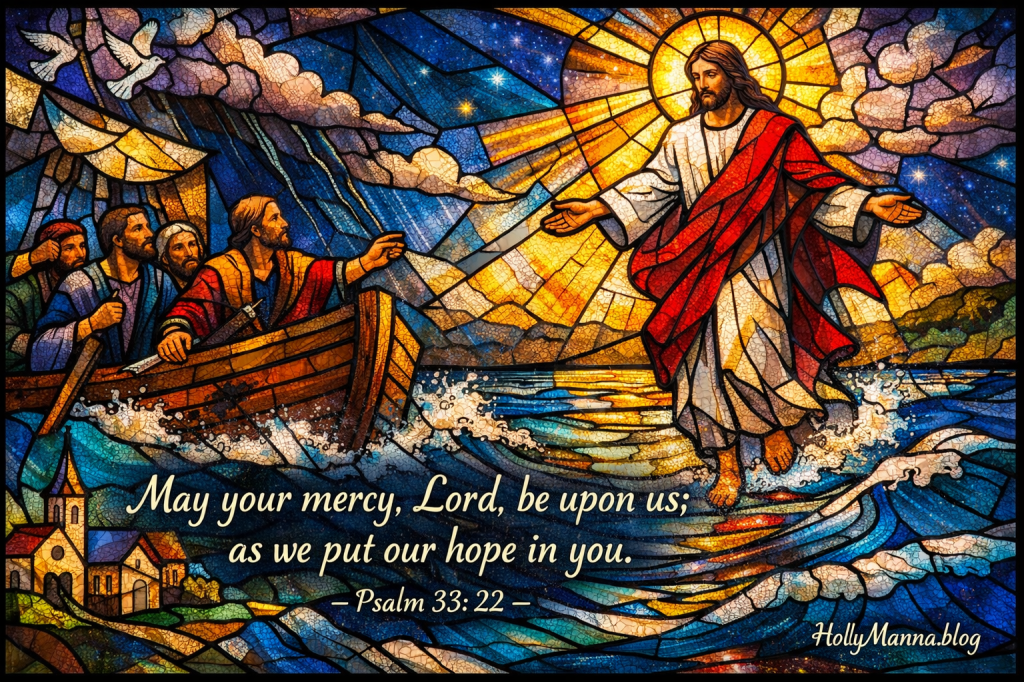
Verse 22. “May your mercy, Lord, be upon us; as we put our hope in you.”
The psalm ends not with self-congratulation, but with petition. The faithful ask for mercy because they know that hope rests not in their own strength, but in God. This is the proper posture of the Christian heart. After praise, after remembrance, after confession of God’s justice and providence, the soul still bows and asks. Hope is not presumption. It is the steady act of entrusting everything to the Lord. This closing verse gathers the whole psalm into prayer. It also gathers the whole day’s readings into one line. The Church in Acts hopes in God as she orders her life. The disciples in John are brought safely through fear by the presence of Christ. And the Church today still prays, with humility and confidence, that the mercy of the Lord would rest upon her.
Teachings
This psalm teaches one of the most important truths in the spiritual life: trust in God is not passive. It is a lived response to who God has revealed Himself to be. The Lord is upright, trustworthy, just, and merciful. Because this is true, the faithful can rejoice, worship, hope, and endure. The Catechism speaks beautifully about divine providence when it says, “Creation has its own goodness and proper perfection, but it did not spring forth complete from the hands of the Creator. The universe was created ‘in a state of journeying’ toward an ultimate perfection yet to be attained, to which God has destined it. We call ‘divine providence’ the dispositions by which God guides his creation toward this perfection.” CCC 302 That teaching fits this psalm perfectly. The Lord sees, guides, sustains, and governs. Nothing in today’s readings makes sense apart from that truth.
The next lines in The Catechism deepen the point even further: “The witness of Scripture is unanimous that the solicitude of divine providence is concrete and immediate; God cares for all, from the least things to the great events of the world and its history.” CCC 303 That sentence could almost serve as a summary of today’s readings. God cares about widows being neglected in Jerusalem. God cares about frightened disciples on rough water. God cares about the hidden hunger of the human heart. Divine providence is not a vague religious concept. It is the personal and fatherly care of God at work in real life.
St. Augustine, reflecting on the psalms, often returned to the truth that praise forms the soul rightly because it teaches man to delight in God above passing things. That matters here. The psalm begins with joy and ends with hope because praise is already a kind of spiritual warfare. It resists despair, self-sufficiency, and forgetfulness. It reminds the soul that God remains God whether the season is abundant or lean, peaceful or stormy.
There is also a Eucharistic echo worth noticing. The psalm speaks of the Lord keeping His people alive through famine. The Church, especially in Easter light, hears that promise with deeper resonance. Christ not only governs history. He feeds His people. He sustains them with grace, with His word, and in the fullness of Catholic life, with His own Body and Blood. What Israel sang in shadow, the Church receives in fulfillment.
Reflection
This psalm is a gift for anyone carrying pressure, uncertainty, or quiet anxiety. It teaches the heart how to breathe again. It says that praise is fitting, that God’s word is upright, that His eye is upon His people, and that mercy surrounds those who hope in Him. That is not sentimental religion. That is solid ground.
In daily life, this means choosing to remember God’s character before being ruled by changing circumstances. It means making room for actual gratitude, not just vague appreciation. It means trusting that the Lord sees the things others miss. It means believing that divine providence reaches into the ordinary mess of work, family, parish life, disappointment, and longing. It also means praying for the grace to love both justice and mercy, since the psalm shows that both belong to God.
What has been shaping the heart more lately, fear or praise? Is hope resting in God’s mercy, or in human control? When life feels uncertain, does the soul remember that the Lord’s eye is still upon His people? What would change if this day were lived with deeper confidence in divine providence?
The Church places this psalm between the first reading and the Gospel for a reason. Before entering the stormy waters with the disciples, the faithful are taught to sing. Before hearing Christ say, “It is I. Do not be afraid,” the soul is reminded that the Lord’s works are trustworthy and that His mercy rests upon those who hope in Him. That is how the Church learns to walk through this world. She sings first, because she knows who is watching over her.
Holy Gospel – John 6:16-21
When the Lord Comes Through the Dark and Stands Above the Waves
The Holy Gospel places the disciples in a scene that feels painfully familiar to the human heart. Evening falls, the light is gone, the sea turns rough, and Jesus seems absent. This passage comes in the sixth chapter of The Gospel of John, immediately after the multiplication of the loaves, when Christ has already revealed Himself as the one who feeds His people in the wilderness. Now He reveals something more. He is not only the giver of bread. He is Lord over the deep. In the biblical world, the sea often symbolized danger, chaos, and the limits of human strength. A boat crossing dark water was never a casual image. It carried a sense of vulnerability, exposure, and dependence on God. That is why this Gospel fits today’s theme so perfectly. In the first reading, the risen Lord brings order to His Church amid tension and need. In the psalm, the faithful are taught to trust the Lord whose eye is upon them. Here in the Gospel, Christ comes to His disciples in the midst of fear and shows that no storm, no darkness, and no distance can keep Him from those He has chosen.
John 6:16-21 – New American Bible (Revised Edition)
16 When it was evening, his disciples went down to the sea, 17 embarked in a boat, and went across the sea to Capernaum. It had already grown dark, and Jesus had not yet come to them. 18 The sea was stirred up because a strong wind was blowing. 19 When they had rowed about three or four miles, they saw Jesus walking on the sea and coming near the boat, and they began to be afraid. 20 But he said to them, “It is I. Do not be afraid.” 21 They wanted to take him into the boat, but the boat immediately arrived at the shore to which they were heading.
Detailed Exegesis
Verse 16. “When it was evening, his disciples went down to the sea,”
John begins with evening, and that detail matters. In The Gospel of John, darkness often carries more than a description of time. It suggests uncertainty, fear, and the experience of not yet seeing clearly. The disciples go down to the sea as night approaches, and the scene begins to take on spiritual weight. This is not yet a moment of peace or clarity. It is the setting for a revelation that will come only after the disciples have entered darkness. For the Christian life, that is often how the Lord works. He does not always prevent the dark hour. Sometimes He reveals Himself within it.
Verse 17. “embarked in a boat, and went across the sea to Capernaum. It had already grown dark, and Jesus had not yet come to them.”
The boat is headed toward Capernaum, a familiar place in the public ministry of Jesus, yet the journey becomes something more than travel. The line “Jesus had not yet come to them” carries a strong emotional weight. The disciples are moving forward, but they feel His absence. Many saints and Fathers saw in the boat an image of the Church and in the sea an image of the troubles of this world. That reading fits beautifully here. The Church crosses history in a fragile vessel, often under pressure, and there are moments when Christ seems delayed. Yet the verse does not say He abandoned them. It says He had not yet come. There is a difference, and it means everything.
Verse 18. “The sea was stirred up because a strong wind was blowing.”
Now the external storm reflects the interior storm. The sea is stirred up, and the disciples are no longer dealing only with darkness, but with force, resistance, and danger. In Scripture, wind and sea often highlight human helplessness before creation and before the power of God. The disciples are experienced enough to know this is serious. John does not dramatize the moment with many words, which somehow makes it feel even more vivid. The danger is simply there. Catholic tradition has long read such moments as mirrors of the spiritual life. Trials arise, peace is disturbed, and the soul discovers how little control it really has. The storm is not imaginary, and faith does not require pretending otherwise.
Verse 19. “When they had rowed about three or four miles, they saw Jesus walking on the sea and coming near the boat, and they began to be afraid.”
The disciples have labored hard and made only limited progress. They are far enough from shore to feel exposed and far enough into the struggle to feel worn down. Then comes the miracle. Jesus is not merely near the sea or standing on the shore. He is walking on it. In the Old Testament, the Lord alone has mastery over the waters. Job 9:8 speaks of God who “treads upon the crests of the sea.” Psalm 77 speaks of the Lord’s way through the sea and His path through mighty waters. John presents Jesus in exactly that divine light. This is not only power over nature. This is a revelation of identity.
And yet the disciples are afraid. That detail is deeply human. Sometimes the presence of God frightens before it consoles because divine holiness is unlike anything the heart can manage on its own terms. St. John Chrysostom saw the realism of this moment and noted how fear had been building in the disciples from every side. The darkness, the wind, the distance, and now the sight of Jesus walking upon the sea all combine to overwhelm them. Grace has come near, but the heart must still learn how to receive it.
Verse 20. “But he said to them, ‘It is I. Do not be afraid.’”
This is the heart of the Gospel. The Lord does not begin by explaining the storm or reproaching their weakness. He speaks His presence. “It is I. Do not be afraid.” The Greek expression carries the force of “I am,” which gives the line a depth far beyond ordinary reassurance. Jesus is not simply identifying Himself. He is speaking in a way that echoes the divine name and reveals His authority. This is why the verse has always held such weight in Catholic tradition. The answer to fear is not first a change in circumstances. It is the presence of Christ.
The Catechism teaches, “To believe in Jesus Christ and in the One who sent him for our salvation is necessary for obtaining that salvation.” CCC 161 In this scene, belief becomes intensely personal. The disciples must trust the one who comes to them in a way that overturns ordinary categories. They are not saved by mastering the sea, but by recognizing the Lord.
St. Augustine beautifully reflected on the Lord’s words by showing that Christ comes to His disciples precisely where their fear is greatest. The One who seemed absent was never powerless. The One who seemed delayed was already Lord over what threatened them. That insight still reaches straight into Christian life now.
Verse 21. “They wanted to take him into the boat, but the boat immediately arrived at the shore to which they were heading.”
The response of the disciples is important. They want to receive Him into the boat. Fear gives way to welcome. This is always the turning point of grace. Christ speaks, and the heart that was trembling begins to open. Then comes the sudden arrival at shore. John presents it with almost holy simplicity. Once Jesus is received, the destination is reached. The Church has often read this line spiritually. Life is a crossing, the world is unstable, and Christ is the one who brings His people safely to their true end.
This does not mean that every earthly trial disappears instantly. The point is deeper than that. The presence of Christ changes the meaning of the journey itself. The soul that receives Him is no longer lost at sea. The Church that receives Him is never abandoned. The shore is not reached by human strength alone, but by communion with the Lord who reigns over wind, wave, time, and fear.
Teachings
This Gospel reveals the divinity of Christ with quiet power. Jesus does what the Scriptures say belongs to God alone. He walks upon the sea, comes through chaos untouched, and speaks a word that stills fear. The Church confesses that Jesus is not merely a holy messenger or moral teacher. He is true God and true man. The Catechism says, “By attributing to Jesus the divine title ‘Lord,’ the first confessions of the Church’s faith affirm from the beginning that the power, honor, and glory due to God the Father are due also to Jesus, because ‘he was in the form of God,’ and the Father manifested the sovereignty of Jesus by raising him from the dead and exalting him into his glory.” CCC 449 That truth shines through this whole scene.
This Gospel also speaks to the Church’s understanding of faith and trust. The Catechism teaches, “Hope is the theological virtue by which we desire the kingdom of heaven and eternal life as our happiness, placing our trust in Christ’s promises and relying not on our own strength, but on the help of the grace of the Holy Spirit.” CCC 1817 That is exactly what the disciples must learn on the water. Their safety will not come from greater rowing power or better control of the elements. It will come from Christ Himself.
There is also a rich patristic tradition that sees the boat as an image of the Church. The world is unstable, history can feel violent, and the faithful are often tempted to panic when Christ seems distant. But this Gospel reminds the Church that the Lord is never truly absent from His own. St. John Chrysostom preached on this passage with striking tenderness, showing that Christ allowed the disciples to struggle so that His coming would be more deeply known as salvation. He did not send comfort from afar. He came Himself.
The line “It is I” carries special weight in the Catholic reading of John. Throughout this Gospel, Jesus speaks in ways that reveal His divine identity. Here, the phrase is not a casual greeting. It stands inside a moment of divine action. The Lord who treads upon the sea and speaks into fear is the same Lord who later says, “I am the bread of life,” and who finally gives Himself for the life of the world. In Easter light, this Gospel becomes even more radiant. The Church hears in it the voice of the risen Christ who still comes to His people in every age, saying again, “It is I. Do not be afraid.”
Reflection
This Gospel reaches into daily life with remarkable force because most souls know what it is like to be in the boat at night. There are seasons when the wind is against everything. Prayer feels dry. The future looks uncertain. The heart keeps rowing, but progress feels painfully slow. This passage does not shame that experience. It enters it. The disciples were not faithless because the storm was real. They were human. The hope of the Gospel is that Christ comes to human weakness without contempt.
In daily life, this means learning to listen for the voice of Christ before surrendering to fear. It means remembering that His apparent delay is not abandonment. It means welcoming Him into the boat through prayer, the sacraments, Scripture, and steady trust when emotions are unsettled. It also means refusing to define reality only by the storm. The waves are real, but they are not ultimate. Christ is.
A soul can live this Gospel concretely by returning to prayer when anxiety rises, by making a reverent act of trust when the future feels unstable, and by resisting the temptation to believe that God is absent simply because life is difficult. This is especially important in Catholic life, where Christ truly continues to come near through His Church, His word, and the sacraments. The same Lord who walked on the sea still comes toward His people.
What storm has been filling the heart with fear lately? Has Christ’s delay been mistaken for His absence? What would it look like to hear His voice more clearly than the wind? Is the soul trying to survive by strength alone, or is it truly receiving the Lord into the boat?
This Gospel does not promise a life without dark water. It promises something better. It promises that Jesus Christ is Lord even there. He comes through the darkness, stands above what terrifies man, and speaks peace into the place where fear thought it had the final word.
When the Lord Is Welcomed, the Church Moves Forward
Today’s readings come together like one living story of the Church and the soul. In Acts 6:1-7, the Lord teaches that His Church must be both prayerful and practical, rooted in the word of God while never neglecting the weak. In Psalm 33, the faithful are taught to rest in the Lord’s justice, mercy, and providence, trusting that His eye remains upon those who hope in Him. In John 6:16-21, Christ comes through darkness and storm to remind His disciples that fear does not have the final word, because He Himself is near. Taken together, these readings reveal a central truth for the Easter season: the risen Jesus does not leave His people to manage life alone. He orders what is disordered, strengthens what is weary, and leads His own safely through what they cannot control.
That message matters just as much now as it did for the first Christians. The Church still faces real needs. Families still carry burdens. Souls still pass through seasons of uncertainty, delay, and fear. Yet today’s readings remind the faithful that the answer is not panic, self-reliance, or discouragement. The answer is deeper fidelity. It is prayer that does not get crowded out. It is charity that becomes concrete. It is trust that remembers the Lord is present even when the wind is strong and the night feels long. The same Christ who guided the apostles, watched over His people, and walked upon the waters still reigns now.
So this day becomes an invitation. Stay close to the Church. Stay close to prayer. Stay close to the Lord who still speaks peace into troubled hearts. Let charity become real in daily life. Let trust grow stronger than fear. Let the voice of Christ be heard above the noise of the storm. Where is the Lord asking for deeper trust today? What neglected corner of life needs to be placed back under His care? What would change if this day were lived with the calm confidence that Jesus Christ is already near?
The faithful do not walk into the day alone. The risen Lord goes before them, remains with them, and brings them where they are meant to go. That is reason enough to hope, to serve, and to begin again with courage.
Engage with Us!
Readers are invited to share their reflections in the comments below. What stood out most in today’s readings? What challenged the heart, brought peace, or stirred a deeper desire to trust God more fully?
- In Acts 6:1-7, what does the care shown for the neglected widows reveal about the heart of the Church? Where might God be calling for greater charity, attentiveness, and responsibility in daily life?
- In Psalm 33:1-2, 4-5, 18-19, 22, which part of the psalm speaks most deeply right now? Is the heart truly living with confidence that the Lord’s eye is upon those who hope in His mercy?
- In John 6:16-21, what storm, fear, or uncertainty most needs to hear Christ say, “It is I. Do not be afraid”? What would it look like to welcome Him more fully into the boat?
May today’s readings lead every heart to pray more faithfully, trust more deeply, and love more generously. Let this day be lived with courage, with mercy, and with the kind of steady faith that keeps its eyes on Jesus and does everything with the love He has taught.
Sacred Heart of Jesus, we trust in You!
Immaculate Heart of Mary, pray for us!
Saint Michael the Archangel, defend us in battle!
Follow us on YouTube, Instagram and Facebook for more insights and reflections on living a faith-filled life.

 Holy Manna!
Leave a comment