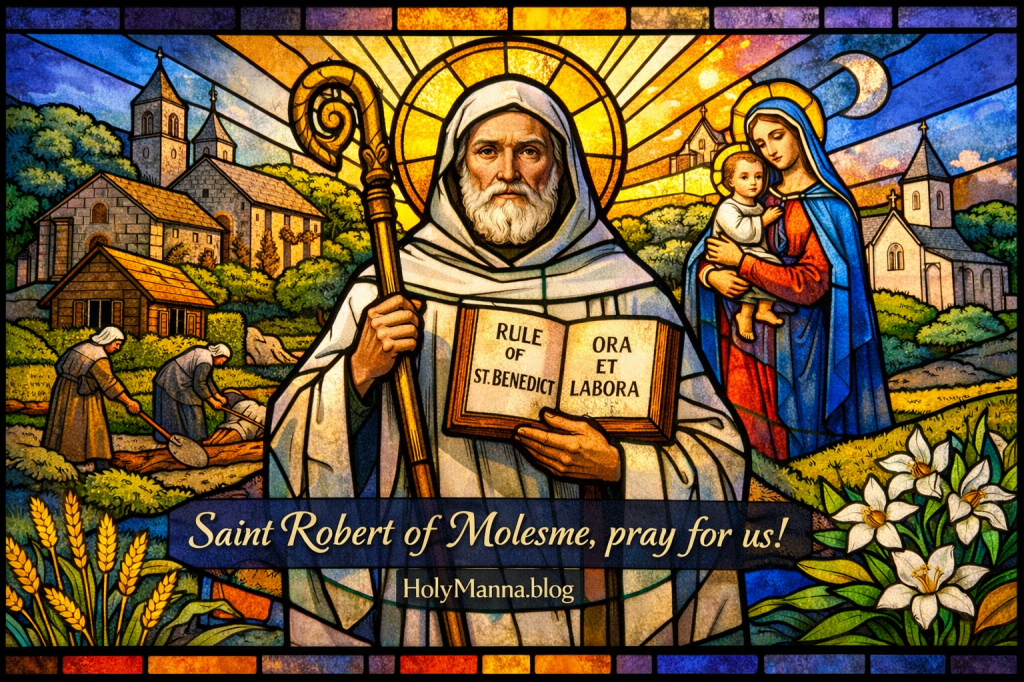
The Monk Who Refused to Settle for Less
Saint Robert of Molesme stands as one of those saints whose name may not be as instantly familiar as Saint Francis or Saint Benedict, yet whose impact on the Church runs deep. He was a Benedictine abbot, a reformer, the founder of Molesme, and the first abbot of Cîteaux, the monastery that became the cradle of the Cistercian Order. He is revered because he loved God enough to resist spiritual comfort when comfort began to weaken holiness.
What makes Saint Robert so important in Christian tradition is not that he built a public reputation through spectacular preaching tours or dramatic martyrdom. It is that he quietly helped renew monastic life at a time when many communities had grown prosperous and less disciplined. He wanted monks to live the Rule of Saint Benedict seriously, not as an idea to admire, but as a way of life shaped by prayer, poverty, work, obedience, and devotion to God. His life reminds the Church that reform usually begins when one soul becomes unwilling to make peace with lukewarmness.
He is most known for helping give the Church the Cistercian reform. That legacy would go on to shape Catholic spirituality, liturgical life, theology, and monastic culture throughout Europe. In that sense, Saint Robert was not simply a founder of monasteries. He was a man who helped clear a path back to radical fidelity.
A Noble Beginning and a Deeper Call
Saint Robert was born around 1028 or 1029 in Champagne, France, to a noble Christian family. His parents are traditionally named Thierry and Ermengarde. From the outside, his life could have followed the usual path of a nobleman, but God had marked him for something different. While still very young, around fifteen years old, he entered the monastery of Montier-la-Celle near Troyes.
That decision was not a conversion in the dramatic sense that appears in the lives of some saints. Robert was raised within the Christian world. His deeper conversion came through the monastic call itself. As he grew in prayer, fasting, and discipline, his faith did not remain merely inherited. It became personal, sacrificial, and serious. He rose to become prior, and later he was chosen abbot of Saint-Michel de Tonnerre. Even there, though, Robert’s desire for authentic reform brought difficulty. He was not a man who could be satisfied with outward religion when the heart of the life had weakened.
After his time there, he was connected with Saint-Ayoul and later with a small group of hermits in the forest of Collan who wanted him to guide them. This part of his life shows what people already recognized in him. They saw not just administrative ability, but holiness, clarity, and a love for the demanding beauty of a life fully given to God. That path eventually led him to found Molesme in 1075.
Saint Robert is most remembered for this burning desire to recover the original seriousness of Benedictine life. He wanted a monastery where prayer, manual labor, poverty, humility, and common life were not softened by comfort. That longing would define the rest of his life.
Poverty, Prayer, and the Work of Renewal
The early years of Molesme were marked by striking poverty. The monks lived simply, built rough shelters, worked with their hands, and embraced a life of austerity. This was not misery for its own sake. It was a deliberate attempt to strip away distractions so that God could once again be the center. That is one reason Saint Robert still matters. He did not believe holiness could be sustained by half measures.
His importance for the Church comes from this witness. He understood that communities do not drift into holiness by accident. They must choose it. He also understood that religious life is meant to point beyond the world, not mirror its comforts. In that sense, he anticipated what The Catechism teaches about the consecrated life, that the evangelical counsels are meant to reveal the life of Christ more clearly and draw the faithful toward charity, CCC 915.
When speaking about miracles during his lifetime, it is important to be honest. Saint Robert is not chiefly remembered in Catholic tradition as a wonderworker in the way some saints are. The strongest historical memory of him centers on reform, holiness, and spiritual influence rather than a clearly documented series of public miracles. Early monastic accounts do preserve signs of providence surrounding his communities, especially during times of hunger and hardship, when the brothers endured extreme poverty and yet survived. Those moments were remembered as the Lord’s care for a house seeking fidelity.
There is also the remarkable fact that Saint Bruno of Cologne, who would later found the Carthusians, spent time under Robert’s direction at Molesme. That alone says a great deal about the spiritual authority Robert carried. Sometimes the most powerful sign of grace in a saint’s life is not a public miracle, but the way his fidelity forms other saints.
The best known line associated with Robert’s reform is not a verified personal quote from his own hand, but the ideal preserved by the early Cistercian tradition, which described the goal of the founders as “to adhere more closely and more perfectly to the Rule of the blessed Benedict.” That sentence captures his life with unusual precision. It explains why he should be remembered and why he should be imitated. He chose not what was easiest, but what would lead more completely to God.
The Pain of Obedience and the Trial of Reform
Saint Robert did not face persecution from pagan rulers or die by execution, but he did endure real suffering for the sake of fidelity. In many ways, his hardships came from within the house of faith itself. Molesme grew successful. Wealth arrived. Comfort increased. Vocations multiplied. On the surface, that might sound like a blessing without complication. In reality, it became a spiritual danger.
As the monastery prospered, discipline weakened. Robert tried to restore the original fervor, but resistance grew. This is one of the hardest lessons in his life. Not everyone welcomes reform, even when reform is holy. There are times when the greatest opposition comes not from enemies of the Church, but from those who have grown used to a more convenient version of discipleship.
In 1098, with ecclesiastical approval, Robert left Molesme with twenty-one monks and founded Cîteaux. This was the beginning of something immense. Yet even here the cross followed him. The monks of Molesme later appealed to Pope Urban II, claiming that their monastery needed Robert back. In obedience to the Church, he returned to Molesme and left the new foundation to continue under others, especially Alberic and later Stephen Harding.
This part of his story is deeply moving because it reveals the purity of his heart. Robert was not trying to build a personal empire. He was not attached to being remembered as the man in charge. He obeyed. He returned. He accepted the burden of repairing what had gone wrong. That kind of surrender is its own form of martyrdom. It is often called white martyrdom, the daily offering of self without the shedding of blood.
Saint Robert was not a martyr in the formal sense, but he lived a life of self-denial, disappointment, sacrifice, and perseverance. He endured the sorrow of seeing reform resisted. He endured the pain of leaving the very desert he had longed for. He endured the weight of responsibility without turning bitter. That is one reason his witness still speaks so clearly.
The Saint Whose Legacy Outgrew His Lifetime
Saint Robert died at Molesme on April 17, 1111. His work, however, was only beginning to show its full fruit. The Church later recognized his sanctity, and Pope Honorius III authorized his cult in 1222. His relics were honored, and devotion to him endured even after great historical upheavals. After the destruction connected to the French Revolution, his remains were preserved in the parish church, which helped keep his memory alive.
When it comes to miracles after death, Catholic tradition does preserve accounts of favors and miraculous stories associated with Saint Robert, as often happens with founders whose holiness is deeply revered. Later chapters were even added to his Vita to recount miracle stories after his death. At the same time, honesty matters here. Those later miracle chapters have been judged legendary by a modern editor of the text, which means they cannot be treated as firmly verified historical accounts. They are part of the devotional tradition surrounding him, but they cannot all be confirmed with certainty.
Even so, his impact after death is beyond dispute. The reform he helped begin at Cîteaux spread through Europe and became one of the great monastic movements of the Church. Cistercian monasteries became centers of prayer, learning, liturgical life, contemplation, manual labor, and sacred culture. Through that legacy, Saint Robert helped shape Catholic civilization long after his earthly life ended.
Places tied to his memory include Molesme and Cîteaux, both of which remain deeply important in the history of Western monasticism. His feast has also been observed in different ways over time. He is commemorated in the Roman Martyrology on April 17, and in Benedictine and Cistercian tradition he is also honored alongside Saints Alberic and Stephen Harding on January 26. His cultural impact is especially strong anywhere the Cistercian heritage has flourished, because the spirit of simplicity, discipline, Marian devotion, and contemplative work all bear the imprint of the reform he helped set in motion.
What Saint Robert Still Teaches the Church
Saint Robert of Molesme speaks powerfully to a world that often mistakes comfort for peace and success for holiness. His life asks whether faith has become too easy, too padded, too shaped by convenience. He shows that real renewal begins when someone loves God enough to clear away whatever has grown in the way.
There is a deeply Catholic lesson here. Reform is not rebellion when it is rooted in obedience, humility, and love for the truth. Robert did not seek novelty. He sought fidelity. He did not try to reinvent the faith. He tried to live it more fully. That is a lesson worth hearing today. Every Catholic is tempted at times to settle for a version of discipleship that asks less, costs less, and changes less. Saint Robert stands against that temptation.
His life also teaches that holiness is not always dramatic. Sometimes holiness looks like enduring frustration without giving up. Sometimes it means building patiently, then letting others carry the work forward. Sometimes it means returning to a difficult place because obedience asks it. That quiet faithfulness is precious in the eyes of God.
Readers can apply his example in simple but demanding ways. Prayer can become more intentional. Daily work can be offered more reverently. Comfort can be questioned when it begins to dull spiritual hunger. Devotion to Our Lady can deepen, since Robert’s reforming spirit was closely tied to Marian devotion. Family life, parish life, and personal habits all become holier when they are shaped less by convenience and more by love.
Where has comfort made the spiritual life softer than it should be?
What part of daily life needs more prayer, more discipline, and more trust in God?
What would it look like to obey Christ more completely, even when that obedience costs something?
Saint Robert’s witness fits beautifully with what the Church teaches about the call to holiness. Every Christian is invited to deeper conversion, deeper charity, and deeper fidelity. His life shows that reform begins with the soul that stops making excuses and starts making room for God.
Engage With Us!
Share your thoughts and reflections in the comments below. Saint Robert of Molesme is not the kind of saint who grabs attention through noise, but he is exactly the kind of saint who can change a life through quiet conviction.
- What part of Saint Robert’s life stands out most strongly to you, his poverty, his obedience, or his courage to pursue reform?
- Have there been moments when God seemed to be calling for greater simplicity or seriousness in your spiritual life?
- How can Saint Robert’s example help Catholics resist lukewarmness in the middle of ordinary life?
- What does his return to Molesme in obedience teach about humility and surrender?
- How can prayer, work, and devotion to Our Lady become more united in daily life?
May Saint Robert inspire a stronger love for prayer, a deeper hatred of lukewarmness, and a steadier courage to follow Christ with a whole heart. May every part of life be lived with the love and mercy Jesus taught, so that even ordinary duties become an offering of faith.
Saint Robert of Molesme, pray for us!
Follow us on YouTube, Instagram and Facebook for more insights and reflections on living a faith-filled life.


Leave a Reply