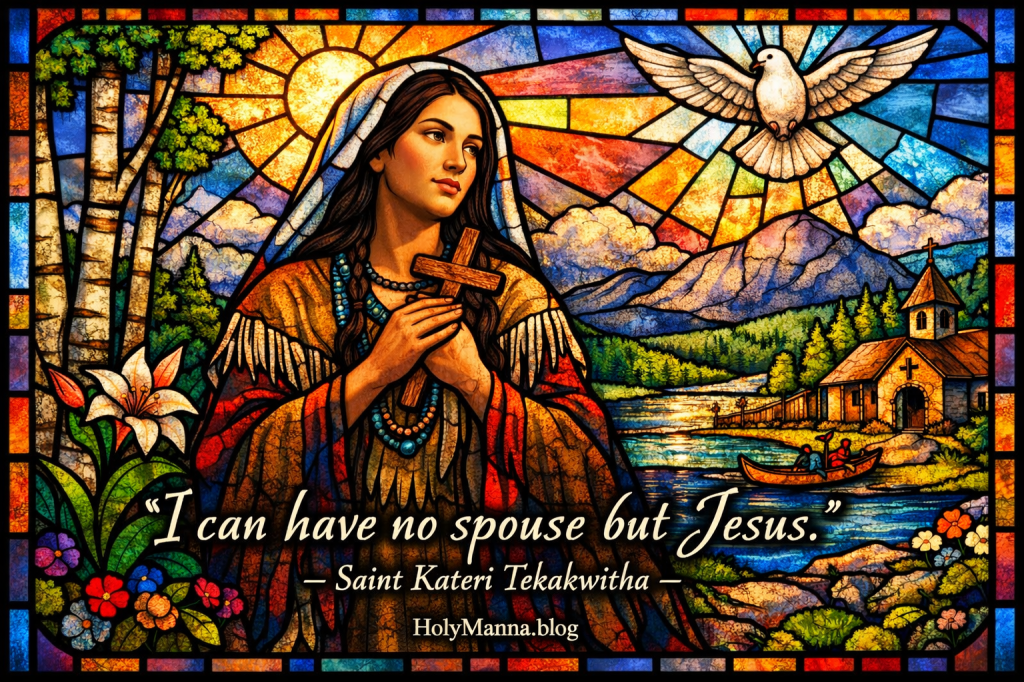
The Lily of the Mohawks
Saint Kateri Tekakwitha is one of the most beautiful examples of hidden holiness in the life of the Church. Known as the Lily of the Mohawks, she is revered as the first Native American woman canonized by the Catholic Church in North America. Her life was not marked by public preaching, political power, or great worldly achievements. It was marked by prayer, suffering, purity, charity, and a love for Jesus that burned quietly and steadily.
That is part of what makes her so unforgettable. Saint Kateri shows that holiness does not have to be loud to be powerful. A soul can belong completely to Christ in silence, in weakness, and in obscurity. The Church honors her because her life reveals what The Catechism teaches so clearly: the saints are men and women who lived heroic fidelity to grace and now shine as examples and intercessors for the faithful on earth, as seen in CCC 828 and CCC 2683.
Kateri is beloved because she stands at the meeting place of suffering and grace. She was a young Mohawk woman who lost almost everything early in life, yet allowed God to transform grief into sanctity. She is remembered for her purity, her deep Eucharistic devotion, her care for the sick and elderly, and her complete surrender to Christ.
Scarred by Suffering, Marked for Grace
Saint Kateri Tekakwitha was born around 1656 in Ossernenon, in present-day New York. Her father was a Mohawk chief, and her mother was an Algonquin Christian who had been taken into the Mohawk community. From her mother, Kateri first learned something about prayer and about the Christian faith. That early influence would matter deeply later, even though much suffering came before her full conversion.
When she was still a small child, a smallpox epidemic swept through her village. Her parents and little brother died, and Kateri herself was left alive but marked. Her face was scarred, and her eyesight was permanently damaged. Because of her poor vision, her name Tekakwitha has often been understood to mean something like one who feels her way or one who bumps into things.
After the destruction and upheaval that affected her people, she eventually lived in Caughnawaga, now Fonda, New York, with relatives. She grew up in a world shaped by Native customs, social expectations, and the tensions created by French contact and missionary activity. She was known as a quiet, modest, hardworking young woman. She became skilled in the ordinary tasks of daily life, including sewing, weaving, and caring for the needs of the household.
Her conversion did not happen in one dramatic moment. It grew slowly. Jesuit missionaries, especially Father Jacques de Lamberville, instructed her in the faith. What had been planted in childhood began to blossom. Kateri desired baptism, even though she knew it could cost her dearly. On Easter Sunday in 1676, she was baptized and given the name Catherine, which became Kateri in her own language.
That baptism changed everything. It did not remove suffering from her life. It gave it meaning. It did not make her path easier. It made her path holy.
She became most known for her radical love of Jesus, her vow of perpetual virginity, her love for the Eucharist, and her willingness to endure misunderstanding rather than betray her conscience. In a world that expected marriage and a more ordinary path, she chose to belong to Christ alone. One of the sayings attributed to her and widely preserved in Catholic tradition is “I can have no spouse but Jesus.”
The Hidden Brilliance of Her Life
Saint Kateri’s life after baptism was marked by striking fidelity. She was not known for dramatic public miracles during her lifetime in the way that some saints were. Catholic sources do not preserve a clear tradition of miraculous healings or spectacular wonders performed by her while she was alive. That matters, because it helps reveal what kind of saint she was. Her greatness was found in the miracle of a soul fully yielded to God.
She eventually left her home village and traveled to the Christian Native mission of Saint Francis Xavier near Montreal, in present-day Kahnawake. There she could live the Catholic faith more freely. She made her First Communion on Christmas Day in 1677, and from there her life became even more deeply rooted in prayer and penance.
She loved the Eucharist with extraordinary devotion. She attended Mass as often as possible, prayed for long periods, practiced penance, and fixed her heart on Christ. When she could not be near the chapel during hunting seasons, she would make a cross from branches in the woods and pray there. That image says so much about who she was. She did not need comfort or recognition. She wanted only to remain close to Jesus.
Her holiness was also practical. She cared for the sick and the elderly. She instructed children in prayer. She served others with tenderness. She was not withdrawn from love. She was consumed by it. Her love of God overflowed into charity for the people around her.
She eventually made a vow of perpetual virginity on March 25, 1679. This was an astonishing choice for a young Native woman in her time and circumstances. It reflected not rebellion, but total consecration. Her heart had already been claimed by Christ.
Another saying associated with her spirituality and preserved in Catholic tradition captures this well: “Who will teach me what is most agreeable to God, that I may do it?” That line sounds simple, but it opens a window into her whole soul. She did not ask how little she could give God. She wanted to know what pleased Him most.
This is why Saint Kateri still matters. She reminds the Church that sanctity is not measured by visibility. It is measured by love.
The Cost of Belonging to Christ
Kateri was not a martyr in the formal sense. She was not executed for the faith. Still, she suffered because of her fidelity to Christ. After her baptism, she endured misunderstanding, social pressure, and opposition. Catholic tradition has often spoken of ridicule, threats, and mistreatment. Some modern Catholic sources also note that certain older accounts may have exaggerated the severity of the persecution, and Mohawk oral memory can present a more nuanced picture. That is worth saying plainly, because truth matters. What remains clear is that Kateri paid a real price for her conversion.
She was pressured in matters of marriage and social expectations. She was viewed with suspicion by some because of her devotion. She had to make painful choices between the life around her and the call of Christ within her heart. This is one reason she remains so relatable. Many people know what it is like to love Christ and still feel out of place in the world around them.
She also bore physical suffering. Her health was never strong. The effects of childhood illness remained with her, and later she suffered from serious bodily weakness, likely including tuberculosis. Her life was brief. She died on April 17, 1680, not yet twenty-four years old.
Yet even near death, her soul was fixed on Jesus. Her last words are traditionally remembered as “Jesos Konoronkwa,” which means “Jesus, I love you.” That is one of the most beautiful deathbed testimonies in the history of the saints. It was not complicated theology. It was the whole Gospel resting on the lips of a dying saint.
Heaven Answered After Her Death
If Saint Kateri was not known for public miracles during her life, Catholic tradition is rich with reports of signs and wonders after her death. The first sign came almost immediately. Witnesses reported that within minutes of her death, the smallpox scars that had marked her face disappeared, and her face became strikingly beautiful. This is one of the most famous events associated with her. Catholic tradition has treasured it as a sign of the purity and glory of the soul God had formed in her. It cannot now be re-examined in the modern scientific sense, but it is a longstanding and central part of her Catholic story.
There are also early accounts that she appeared after death to people who had known her. Catholic tradition preserves reports that she appeared to two Native women and to Father Claude Chauchetière. These stories belong to her early devotional legacy and helped strengthen the conviction that she was already enjoying the glory of Heaven. These apparition accounts are part of her tradition, but they cannot be independently verified in the modern historical sense.
Very early pilgrimages began at her burial place in Kahnawake. Within just a few years, people were already visiting her tomb and praying for her intercession. Reports of favors and healings spread. These included cures that were sudden, lasting, and attributed to her prayers. Many of these older stories belong to devotional tradition and helped build the longstanding reputation for sanctity that surrounded her name. Some of these accounts were important historically, even when not every detail can be verified today with modern standards of documentation.
Her formal path to sainthood also involved miracles. She was declared Venerable by Pope Pius XII in 1943. She was beatified by Pope Saint John Paul II in 1980. Because her cause was ancient, the Church relied heavily on documentary evidence and longstanding reports of favors received through her intercession.
The miracle accepted for her canonization involved Jake Finkbonner, a young boy from the Lummi Nation in Washington state. In 2006, he suffered a severe flesh-eating infection after a simple injury. His condition became grave. People prayed through the intercession of Blessed Kateri Tekakwitha, and after her relic was brought near him, the infection unexpectedly stopped progressing. His recovery was judged miraculous by the Church after careful investigation. This miracle opened the way for her canonization.
Pope Benedict XVI canonized Saint Kateri Tekakwitha on October 21, 2012. With that act, the Church officially held her up for the whole world as a saint and intercessor. Her canonization was not only about one holy young woman from the seventeenth century. It was also a powerful witness that the Gospel truly takes root in every people and culture.
Her memory lives on in shrines, feast day celebrations, Native Catholic communities, and the ongoing spiritual work inspired by her name. In the United States, her memorial is celebrated on July 14. In Canada, she is celebrated on April 17. Her tomb in Kahnawake remains a place of prayer and pilgrimage. Her birthplace region in New York is also deeply connected to her veneration. She has had a lasting cultural impact among Indigenous Catholics and is honored as a sign of fidelity, purity, and holiness rooted in Native identity and Catholic faith.
She is also widely associated in Catholic devotion with Indigenous peoples, those who suffer rejection, those who long for purity, and those seeking to live close to creation while remaining faithful to Christ. This devotional language varies from place to place, but it reflects the real spiritual impact she continues to have.
What Saint Kateri Teaches the Soul Today
Saint Kateri Tekakwitha speaks powerfully to the modern world because so much of modern life is noisy, distracted, and restless. Her life says the opposite. She teaches that silence can be full of God. She teaches that suffering does not cancel a vocation. She teaches that purity is possible. She teaches that love for Jesus is not sentimental weakness, but spiritual strength.
There is something deeply healing about her witness. So many people today feel scarred by the past, misunderstood by others, or torn between the expectations of the world and the call of God. Kateri knew that terrain. She did not become holy because life was easy. She became holy because she let Christ claim every wounded part of her.
Her life also speaks beautifully to what The Catechism says about chastity, holiness, and the universal call to sanctity. The Church teaches in CCC 2348 that all the baptized are called to chastity according to their state in life. It teaches in CCC 2013 that all Christians are called to the fullness of Christian life and to the perfection of charity. Kateri lived those truths in an unusually radiant way.
This saint also helps correct a common mistake. Holiness is not only for the loud, gifted, educated, or influential. Holiness is for the faithful. Holiness is for the obedient. Holiness is for the soul that says yes to Jesus day after day.
What would change if the deepest goal of life became pleasing God rather than pleasing the crowd?
What hidden wound might Jesus want to transform into holiness, just as He did in Saint Kateri’s life?
What would it look like to love the Eucharist with more seriousness, more tenderness, and more hunger?
A practical way to imitate Saint Kateri is to begin with hidden faithfulness. Pray when no one sees. Make time for silence. Receive the sacraments with reverence. Offer bodily suffering to Jesus instead of wasting it. Practice modesty and purity with seriousness. Care for the lonely, the sick, and the forgotten. Stay close to the Cross, and do not assume that an ordinary life cannot become a holy one.
Saint Kateri’s life says that it can.
Engage with Us!
Share your thoughts and reflections in the comments below. Saint Kateri Tekakwitha’s life has a quiet strength that stays with the heart, and it is worth sitting with what her witness stirs up.
- What part of Saint Kateri Tekakwitha’s story speaks most deeply to the heart right now?
- How can greater love for Jesus in the Eucharist shape everyday life this week?
- What does Saint Kateri’s purity and courage teach about living faithfully in a culture that often resists holiness?
- Is there an area of suffering or rejection that could be offered to God instead of resisted?
- How can hidden acts of prayer, charity, and sacrifice become a real path to sanctity at home, at work, and in daily relationships?
Saint Kateri Tekakwitha reminds the Church that the most beautiful lives are often the ones the world barely notices. Stay close to Jesus. Stay faithful in the quiet places. Live with courage, purity, and mercy. Do everything with the love and compassion Christ taught, and trust that no hidden act of faith is ever wasted in the eyes of God.
Saint Kateri Tekakwitha, pray for us!
Follow us on YouTube, Instagram and Facebook for more insights and reflections on living a faith-filled life.

 Holy Manna!
Leave a comment