Friday of the Second Week of Easter – Lectionary: 271
When God Feeds, Nothing Is Lost
Some days in the spiritual life feel painfully small. The strength is limited, the answers are not obvious, and what stands in front of the soul seems larger than what it has to give. Today’s readings step directly into that place and reveal a truth that every Christian needs to hear during Easter: when a life is placed in God’s hands, fear loses its grip, suffering is not wasted, and even the smallest offering can become the beginning of a miracle.
The central theme tying these readings together is confident trust in the victorious power of God. In Acts 5:34-42, the Apostles are beaten and warned into silence, yet they walk away rejoicing because they know the risen Christ cannot be undone by threats or force. In Psalm 27, the heart of the believer clings to the Lord as light, salvation, and refuge, even while waiting in uncertainty. In John 6:1-15, a hungry crowd, a poor boy’s lunch, and the nearness of Passover set the stage for one of the most beloved signs in the Gospel, where Jesus feeds the multitude and hints at the greater gift He will soon give in the Holy Eucharist.
The whole day’s liturgy stands inside the bright horizon of Easter. The Church is still contemplating the fact that Jesus Christ has risen from the dead, and that changes everything. The Apostles are no longer men protecting themselves. They are witnesses. The psalm is no longer just a cry for comfort. It becomes the prayer of a people who know that death itself has been conquered. The feeding of the multitude is no longer merely a story about earthly hunger. It becomes a sign of the abundance of the Messiah, the true Shepherd who satisfies His people not only with bread, but with His very presence.
There is also a rich historical thread running through these readings. The Gospel notes that Passover was near, which matters deeply. Passover was the great remembrance of God’s saving action in the Exodus, when Israel was delivered, fed in the wilderness, and formed as a covenant people. Now Jesus stands before a new multitude in a lonely place and does what only God can do. He feeds them in abundance. The setting quietly tells the reader that a new and greater Exodus is unfolding in Him. Meanwhile, the Apostles in Acts are living out the cost of belonging to that new covenant. They are opposed by the religious authorities, yet the word of God keeps moving forward. What begins in the Gospel as a sign of divine provision becomes, in the life of the early Church, a mission sustained by divine power.
That is what makes these readings so compelling together. They show a God who is not absent in trial, not stingy in generosity, and not weak before the powers of the world. He is the Lord who strengthens His witnesses, steadies the hearts of those who wait for Him, and takes what looks insufficient and turns it into abundance. What does the soul do when it feels outnumbered, underfed, or overwhelmed? Today’s readings answer with one voice: trust the Lord, stay close to Christ, and place everything in His hands.
First Reading – Acts 5:34-42
Tested by Men, Strengthened by God
The scene in this reading unfolds in Jerusalem during the earliest days of the Church, when the Apostles were preaching the Resurrection of Jesus with a boldness that alarmed the religious authorities. The Sanhedrin was the highest Jewish council, made up of leading priests, elders, and teachers of the law. In the eyes of the world, these were the men with authority, influence, and power. The Apostles, by contrast, were fishermen, former tax collectors, and ordinary men from Galilee. Yet Easter had changed them. They had seen the risen Christ, received the Holy Spirit, and could no longer be frightened into silence.
That is what makes this reading so powerful within today’s theme. The question is no longer whether the Gospel can survive human opposition. The question is whether anyone can stop what God Himself has begun. Gamaliel, a respected Pharisee, speaks with prudence, but his warning becomes much more than political advice. His words point toward a truth that runs through salvation history: what is merely human eventually fades, but what is born of God endures. The Apostles leave this encounter bruised but joyful, dishonored but victorious. They have entered into the mystery of Christian witness, where suffering for Christ is not defeat but communion with Him.
Acts 5:34-42 – New American Bible (Revised Edition)
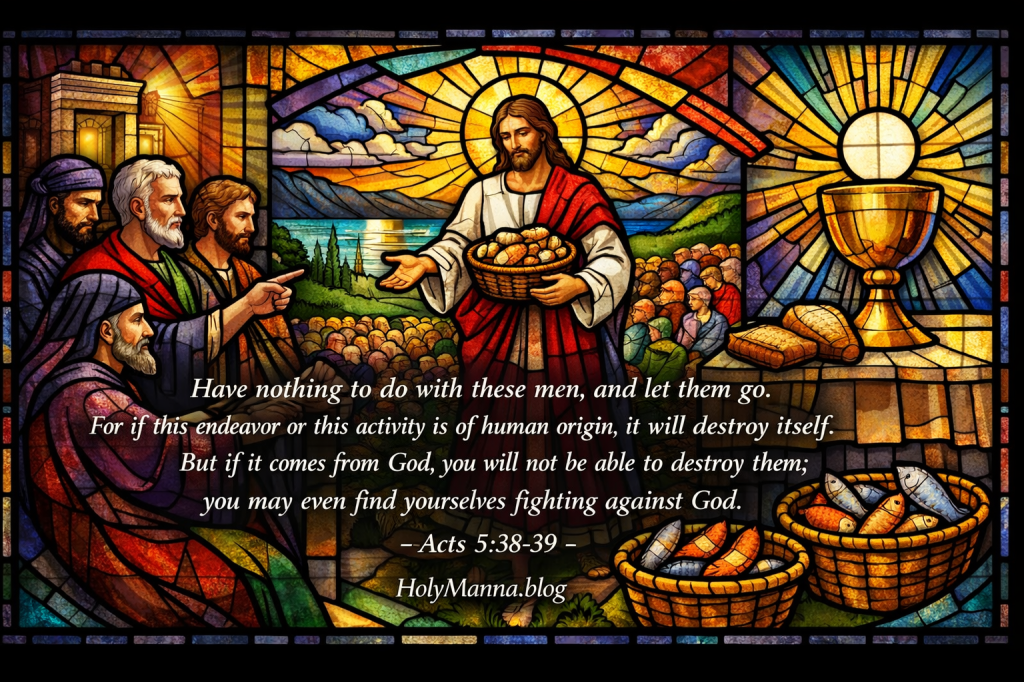
34 But a Pharisee in the Sanhedrin named Gamaliel, a teacher of the law, respected by all the people, stood up, ordered the men to be put outside for a short time, 35 and said to them, “Fellow Israelites, be careful what you are about to do to these men. 36 Some time ago, Theudas appeared, claiming to be someone important, and about four hundred men joined him, but he was killed, and all those who were loyal to him were disbanded and came to nothing. 37 After him came Judas the Galilean at the time of the census. He also drew people after him, but he too perished and all who were loyal to him were scattered. 38 So now I tell you, have nothing to do with these men, and let them go. For if this endeavor or this activity is of human origin, it will destroy itself. 39 But if it comes from God, you will not be able to destroy them; you may even find yourselves fighting against God.” They were persuaded by him. 40 After recalling the apostles, they had them flogged, ordered them to stop speaking in the name of Jesus, and dismissed them. 41 So they left the presence of the Sanhedrin, rejoicing that they had been found worthy to suffer dishonor for the sake of the name. 42 And all day long, both at the temple and in their homes, they did not stop teaching and proclaiming the Messiah, Jesus.
Detailed Exegesis
Verse 34. “But a Pharisee in the Sanhedrin named Gamaliel, a teacher of the law, respected by all the people, stood up, ordered the men to be put outside for a short time.”
Gamaliel enters the story as a figure of weight and credibility. He is not a fringe voice. He is a teacher of the law, respected by the people, and his presence slows the rush toward violence. In the providence of God, even a man who has not yet confessed Christ becomes an instrument of restraint. This moment shows that the Lord can use unexpected people to protect His Church. Gamaliel’s pause also matters spiritually. When passions rise, wisdom steps back before speaking. The enemies of the Apostles are driven by urgency and anger, but Gamaliel introduces sober judgment.
Verse 35. “And said to them, ‘Fellow Israelites, be careful what you are about to do to these men.’”
This is a call to holy caution. Gamaliel warns the council not to act rashly. On one level, he is simply urging political prudence. On a deeper level, his words expose the danger of spiritual blindness. It is possible to be religious, educated, and powerful, yet still resist God. This verse fits today’s theme beautifully because it reminds the reader that the real danger is not merely making a bad decision. The real danger is opposing the work of God while imagining that one is defending religion.
Verse 36. “Some time ago, Theudas appeared, claiming to be someone important, and about four hundred men joined him, but he was killed, and all those who were loyal to him were disbanded and came to nothing.”
Gamaliel points to false movements of the past. Theudas had gathered followers, but once he died, the movement collapsed. History had already shown that merely human ambition burns brightly for a moment and then disappears. This is a sober reminder that charisma, numbers, and excitement do not prove divine origin. The Church has always known that not every movement claiming spiritual authority comes from God. A work must be tested by truth, holiness, perseverance, and fidelity to God’s revelation.
Verse 37. “After him came Judas the Galilean at the time of the census. He also drew people after him, but he too perished and all who were loyal to him were scattered.”
A second example confirms the first. Human rebellion can attract a crowd, but without God it cannot endure. Gamaliel is reasoning from history, but Luke is inviting the Christian reader to compare these failed leaders with Jesus. Christ was killed, yet His followers were not scattered in despair forever. They were gathered anew by His Resurrection. That difference changes everything. The Apostles are not carrying forward the memory of a dead revolutionary. They are bearing witness to the living Lord.
Verse 38. “So now I tell you, have nothing to do with these men, and let them go. For if this endeavor or this activity is of human origin, it will destroy itself.”
This is one of the great lines in the Acts of the Apostles. Gamaliel proposes a test of endurance. If the Apostles are building something merely human, it will collapse on its own. The Church has lived under this truth from the beginning. Kingdoms rise and fall. Empires persecute and disappear. Ideologies explode and then burn out. But the Gospel remains because it does not come from man. This verse invites the soul to trust the providence of God. The Church does not need to panic every time it is opposed. What is false will fall. What is true will remain.
Verse 39. “But if it comes from God, you will not be able to destroy them; you may even find yourselves fighting against God.” They were persuaded by him.
Here the reading reaches its dramatic center. Gamaliel unknowingly speaks one of the deepest truths in all of salvation history. No one can overthrow the work of God. Men may resist it, mock it, wound its servants, or try to bury it, but they cannot destroy it. This is pure Easter logic. The enemies of Christ thought they had silenced Him on Good Friday, yet the tomb was empty on Easter morning. The Apostles now share in that same pattern. To oppose them is to risk opposing the God who raised Jesus from the dead. The council is persuaded, but not converted. Their hearts are restrained, not yet transformed.
Verse 40. “After recalling the apostles, they had them flogged, ordered them to stop speaking in the name of Jesus, and dismissed them.”
Even after being persuaded, the Sanhedrin still lashes out. They compromise between caution and hostility. The Apostles are spared death but not suffering. This is often how the world behaves toward the truth. It may not always kill the witness, but it will often try to shame, punish, or silence him. The command to stop speaking in the name of Jesus is especially revealing. The name of Jesus is what they fear, because His name carries authority, healing, and salvation. In Catholic faith, the holy name of Jesus is not a mere label. It is bound up with His person and power.
Verse 41. “So they left the presence of the Sanhedrin, rejoicing that they had been found worthy to suffer dishonor for the sake of the name.”
This verse is one of the most beautiful descriptions of apostolic joy in the New Testament. The Apostles do not leave humiliated. They leave rejoicing. Not because pain is pleasant, and not because humiliation is easy, but because suffering for Christ is a participation in His own life. They now understand that dishonor in the eyes of the world can be honor in the eyes of Heaven. The Catechism teaches, “Martyrdom is the supreme witness given to the truth of the faith: it means bearing witness even unto death.” CCC 2473. The Apostles are not yet martyred here, but they are already walking the road of martyrdom in spirit. They have learned that fidelity to Christ matters more than comfort.
Verse 42. “And all day long, both at the temple and in their homes, they did not stop teaching and proclaiming the Messiah, Jesus.”
The reading ends with triumphant perseverance. The Apostles do not retreat underground in fear. They continue publicly in the temple and privately in homes. This shows the total reach of Christian witness. The Gospel belongs in worship, in daily life, in public truth, and in personal conversation. Their persistence also reveals that grace has accomplished something extraordinary. These are the same men who once fled in fear during the Passion. Now they cannot be silenced. Easter has remade them.
Teachings
This reading teaches that the work of God is tested, purified, and often opposed, but never defeated. It also teaches that Christian courage is not natural bravado. It is a fruit of union with the risen Christ. The Apostles do not rely on their own toughness. They rely on the Lord who has already conquered death.
The Catechism speaks directly to the kind of witness seen here: “The duty of Christians to take part in the life of the Church impels them to act as witnesses of the Gospel and of the obligations that flow from it. This witness is a transmission of the faith in words and deeds. Witness is an act of justice that establishes the truth or makes it known.” CCC 2472. That is exactly what the Apostles are doing. They are not merely sharing opinions. They are bearing witness to a fact, namely that Jesus is the Messiah and that He has risen.
The joy of suffering in this passage also echoes the words of Christ in the Beatitudes: “Blessed are they who are persecuted for the sake of righteousness, for theirs is the Kingdom of Heaven.” Mt 5:10. The Apostles are beginning to live the Beatitudes not as beautiful sayings, but as hard reality. Saint John Chrysostom marveled at this transformation in the Apostles, seeing in their joy under persecution a clear sign of divine grace. Men do not naturally rejoice after being flogged. That joy is the fingerprint of the Holy Spirit.
Saint Augustine also helps illuminate this reading by constantly returning to the distinction between the city of man and the City of God. Human powers boast, threaten, and pass away. God’s kingdom grows often in hiddenness, weakness, and suffering, yet it outlasts every enemy. Gamaliel’s warning, whether he fully understood it or not, fits that Augustinian insight. What is merely man-made dissolves. What is from God endures because God Himself sustains it.
There is also a historical beauty in the figure of Gamaliel. Tradition remembers him as a respected Jewish teacher, and Acts later identifies Paul as having been educated under him. Even here, before the Gospel has fully broken open the heart of Saul of Tarsus, the narrative quietly places a teacher of Paul in the middle of the Church’s early suffering. It is one of those moments in Scripture where providence seems to move beneath the surface, preparing future chapters long before anyone can see them.
Reflection
This reading speaks powerfully to any Christian who feels pressure to soften the truth, hide discipleship, or remain quiet about Jesus. The Apostles were not reckless men looking for conflict. They were men who had become convinced that Christ was worth everything. Once that conviction takes hold, silence becomes impossible.
The world still tries to shame believers into compromise. Sometimes the pressure is open hostility. Sometimes it is social embarrassment. Sometimes it is the slow suggestion that faith should remain private and never disturb the public square. This reading cuts through all of that. If Christ is risen, then His name cannot be treated as a side note. The Apostles remind the Church that fidelity matters more than reputation.
There is also a lesson here about how to endure suffering. The Apostles do not waste their wounds. They carry them with joy because they understand that suffering united to Christ becomes fruitful. That does not mean Christians should chase pain or pretend hardship is easy. It means they should not let suffering turn them inward, bitter, or faithless. The wounds of life can either harden the heart or deepen communion with Jesus.
A good daily step from this reading is to ask whether discipleship has become too cautious. Has fear of other people’s opinions shaped speech more than love for Christ has? Has obedience grown timid where the Gospel calls for courage? Another step is to offer ordinary humiliations to the Lord. Not every dishonor is persecution, but even small embarrassments, misunderstandings, and rejections can become an offering when united to Jesus.
Where has the fear of man become stronger than the fear of God? What would it look like to speak the name of Jesus with more peace and conviction in daily life? When suffering comes, is it being treated as meaningless pain, or is it being placed in the hands of Christ so that it can become a witness?
The Apostles leave the Sanhedrin wounded, but more alive than before. That is the strange beauty of the Christian life. The world can strike the body, mock the believer, and try to silence the truth, but it cannot conquer a soul that belongs to the risen Jesus. What comes from God cannot be stopped.
Responsorial Psalm – Psalm 27:1, 4, 13-14
The Soul That Waits in the Light
This psalm enters today’s liturgy like a steady hand placed on a trembling heart. After hearing about the Apostles walking away from persecution with joy, the Church now gives the faithful the prayer that makes such courage possible. Psalm 27 is traditionally attributed to David, a man who knew danger, betrayal, battle, and long seasons of waiting on the Lord. That matters because this psalm is not the song of someone who has never suffered. It is the song of someone who has seen fear up close and still learned to say that God is greater.
In the religious life of Israel, the temple was not just a sacred building. It was the place of God’s dwelling, the sign of His covenant presence among His people. So when the psalmist longs to dwell in the Lord’s house and gaze on His beauty, he is expressing something deeper than admiration for worship. He is expressing the hunger of the soul for communion with God. That fits perfectly into today’s theme. In the First Reading, the Apostles endure suffering because they know they belong to God. In the Gospel, Jesus feeds the crowd with abundance that points toward the Holy Eucharist. Here in the psalm, the heart learns the interior posture needed for both witness and trust. It learns to seek the Lord, to wait for Him, and to believe that His goodness is stronger than fear.
Psalm 27:1, 4, 13-14 – New American Bible (Revised Edition)
Trust in God
1 Of David.
The Lord is my light and my salvation;
whom should I fear?
The Lord is my life’s refuge;
of whom should I be afraid?4 One thing I ask of the Lord;
this I seek:
To dwell in the Lord’s house
all the days of my life,
To gaze on the Lord’s beauty,
to visit his temple.13 I believe I shall see the Lord’s goodness
in the land of the living.
14 Wait for the Lord, take courage;
be stouthearted, wait for the Lord!
Detailed Exegesis
Verse 1. “The Lord is my light and my salvation; whom should I fear? The Lord is my life’s refuge; of whom should I be afraid?”
This opening line strikes with confidence, but it is not shallow confidence. The psalmist does not say that danger is imaginary. He says that the Lord is greater than danger. To call the Lord “light” is to confess that God drives back darkness, confusion, and spiritual blindness. To call Him “salvation” is to acknowledge that deliverance does not finally come from armies, wealth, influence, or personal strength. It comes from the Lord. To call Him “refuge” is to say that the soul has a place to stand when everything else feels unstable.
In the light of Easter, this verse becomes even more radiant. Christ is the light no darkness can overcome. The risen Lord is the salvation that death itself could not defeat. That is why the Apostles in Acts 5 can endure public shame without collapsing into fear. Their refuge is no longer reputation or comfort. Their refuge is the Lord. The Church has always prayed this verse in moments of persecution, illness, uncertainty, and grief because it teaches the soul to interpret life from God outward, not from fear inward.
Verse 4. “One thing I ask of the Lord; this I seek: To dwell in the Lord’s house all the days of my life, To gaze on the Lord’s beauty, to visit his temple.”
This verse reveals the heart of the psalm. After speaking of fear, refuge, and salvation, the soul goes deeper and names its one true desire. It does not ask first for victory over enemies, an easier life, or immediate relief. It asks for communion with God. That is the secret of the saints. They may ask for many things in prayer, but beneath every other petition lies one greater longing: to remain near the Lord.
The language of dwelling in the Lord’s house and gazing on His beauty is deeply significant. In the Old Covenant, the temple represented the holy dwelling of God among His people. In the life of the Church, this longing reaches its fulfillment in Christ, who is the true temple, and in the liturgy, where Heaven touches earth. The psalm is not teaching a vague spirituality. It is teaching ordered desire. The heart becomes strong when it wants the highest thing most. A soul scattered among lesser desires becomes anxious and weak. A soul fixed on God becomes simple, clear, and alive.
This verse also carries a Eucharistic echo for Christian ears. To dwell in the Lord’s house and gaze on His beauty is not merely poetic language. It becomes concrete in the sacramental life of the Church, especially in the Mass and in adoration, where the faithful come before the real presence of Christ. The psalm teaches the soul to hunger not only for help from God, but for God Himself.
Verse 13. “I believe I shall see the Lord’s goodness in the land of the living.”
This is one of the most hope-filled lines in the Psalter. The psalmist makes a confession of faith in the middle of uncertainty. He does not say that he already sees everything clearly. He says that he believes. Faith speaks before the full answer arrives. That is why this verse is so fitting during Easter. The Church reads it now with resurrection light. The “land of the living” is not merely a better season on earth, though God often does show His goodness even here. It also opens onto the deeper Christian hope of eternal life.
This verse guards the soul from despair. There are moments when darkness seems to have the louder voice. There are seasons when prayers appear unanswered and grief hangs over daily life like a cloud. But the faithful soul says, with David, that God’s goodness will still be seen. Not because life is easy, but because God is faithful. Hope is not wishful thinking. It is confidence in the character and promises of the Lord.
Verse 14. “Wait for the Lord, take courage; be stouthearted, wait for the Lord!”
The psalm ends not with a quick solution, but with an exhortation to wait. That is important. Scripture often treats waiting not as wasted time, but as a place of purification and strengthening. The repetition of the command to wait shows that holy waiting is difficult. The heart must be told again and again to remain steady. But this waiting is not passive resignation. It is courageous endurance. It is the refusal to give up on God before God has finished His work.
The command to be stouthearted means more than trying to feel brave. It means letting the heart be strengthened by trust in the Lord. This is exactly what the Apostles are doing in today’s First Reading. They are not forcing themselves into cheerfulness. They have become strong by belonging to Christ. The psalm therefore becomes a school of perseverance. It teaches the soul how to remain upright while the answer is still on the way.
Teachings
This psalm teaches that fear is overcome not by denial, but by trust in the presence of God. It teaches that the deepest desire of the human heart is not merely safety, but communion with the Lord. It teaches that hope can speak even before deliverance appears. And it teaches that waiting, in the biblical sense, is an act of courage.
The Catechism speaks directly to the hope that fills this psalm: “Hope is the theological virtue by which we desire the kingdom of heaven and eternal life as our happiness, placing our trust in Christ’s promises and relying not on our own strength, but on the help of the grace of the Holy Spirit.” CCC 1817 This is the spiritual engine of Psalm 27. The psalmist is not relying on his own emotional strength. He is placing his trust in the Lord and learning to desire life with God above every lesser security.
The psalm also reaches toward contemplation, that loving gaze upon the beauty of God. The Catechism describes the heart of contemplation with remarkable clarity: “Contemplation is a gaze of faith, fixed on Jesus. ‘I look at him and he looks at me’: this is what a certain peasant of Ars in time of prayer said to his holy curé. This focus on Jesus is a renunciation of self.” CCC 2715 That line helps illuminate verse 4. To gaze on the Lord’s beauty is not an escape from real life. It is the beginning of seeing all of life rightly.
Saint Augustine read the longing of the psalms as the cry of the whole Church on pilgrimage toward God. His spiritual instinct fits this passage well. The heart is restless until it rests in the Lord. The psalmist’s “one thing” is not narrowness. It is clarity. It is the discovery that every good desire is finally ordered toward God. Saint Thomas Aquinas, in his teaching on hope, likewise shows that the Christian soul can aim at eternal life with confidence because grace makes possible what would otherwise be beyond human reach. That is the hidden strength beneath verse 13. The faithful do not hope in vague optimism. They hope in a supernatural promise.
There is also a beautiful connection between this psalm and the lived history of the Church. Christians in persecution, monks in the silence of the desert, the sick in hospital beds, and the dying at the hour of death have all prayed Psalm 27. The Church has returned to these words again and again because they do not flatter the reader. They steady the reader. They remind the faithful that courage is not loud, and hope is not naïve. Both are born from nearness to God.
Reflection
This psalm speaks with unusual tenderness to anxious hearts. There are many ways fear enters daily life. Fear of the future. Fear of loss. Fear of humiliation. Fear of suffering. Fear that prayers are taking too long to be answered. Psalm 27 does not shame the fearful soul. It teaches that soul where to turn. The answer is not to become emotionally invincible. The answer is to let the Lord become light, salvation, and refuge.
A practical way to live this psalm is to examine what has become the heart’s functional refuge. Is peace being sought in control, distraction, approval, money, or constant reassurance from other people? Those things cannot hold the weight of the soul. They were never meant to. The psalm invites the heart back to its proper center. The Lord alone is strong enough to be a refuge.
Another step is to recover the holy desire described in verse 4. Many spiritual battles become harder because the heart has become cluttered with too many competing loves. The psalm gently asks the soul to simplify. To seek the Lord’s house, to gaze on His beauty, and to remain near Him through prayer and the sacraments is not a luxury for the especially devout. It is how the heart is reordered and strengthened.
The final lesson is about waiting. Waiting can feel like abandonment when it is not united to faith. But this psalm shows that waiting can become a place of deep transformation. The Lord often strengthens the heart before He changes the circumstances. That does not always feel dramatic, but it is one of His most merciful works.
What has been feared lately that needs to be brought honestly before the Lord? Has the heart been seeking God Himself, or only relief from discomfort? What would it look like to wait for the Lord with courage instead of resentment?
The psalm leaves the soul standing still before God, but not empty-handed. It leaves it with light for the darkness, beauty for the restless heart, hope for the road ahead, and courage enough to wait one more day.
Absolutely. Here is the corrected Holy Gospel section with no web links.
Holy Gospel – John 6:1-15
When the Lord Receives the Little, He Reveals the Overflowing Heart of God
The Gospel for today opens on the far side of the Sea of Galilee, with a restless crowd, a mountain, and the quiet approach of Passover. That detail matters. Saint John is not simply telling the story of a meal in the countryside. He is placing this sign in the shadow of Israel’s great feast of deliverance, when God fed His people in the wilderness and formed them into a covenant people. The Church has long read this passage as far more than a miracle of material provision. It is the beginning of the Bread of Life discourse, the only multiplication of the loaves recorded in all four Gospels, and a sign that points toward the Eucharist, where Christ gives not merely bread from His hand, but His very Self.
This Gospel also fits perfectly into today’s theme. In the First Reading, the Apostles show that what comes from God cannot be stopped. In the Psalm, the heart learns to wait for the Lord with courage. Here in John 6, the Lord takes what appears painfully insufficient and turns it into abundance. Jesus is not trapped by scarcity, public pressure, or human expectations. He is the true Shepherd, the new Moses, and the divine host of a greater feast. Even the crowd’s attempt to make Him king cannot force Him into a smaller mission than the one the Father has given Him.
John 6:1-15 – New American Bible (Revised Edition)
Multiplication of the Loaves. 1 After this, Jesus went across the Sea of Galilee [of Tiberias]. 2 A large crowd followed him, because they saw the signs he was performing on the sick. 3 Jesus went up on the mountain, and there he sat down with his disciples. 4 The Jewish feast of Passover was near. 5 When Jesus raised his eyes and saw that a large crowd was coming to him, he said to Philip, “Where can we buy enough food for them to eat?” 6 He said this to test him, because he himself knew what he was going to do. 7 Philip answered him, “Two hundred days’ wages worth of food would not be enough for each of them to have a little [bit].” 8 One of his disciples, Andrew, the brother of Simon Peter, said to him, 9 “There is a boy here who has five barley loaves and two fish; but what good are these for so many?” 10 Jesus said, “Have the people recline.” Now there was a great deal of grass in that place. So the men reclined, about five thousand in number. 11 Then Jesus took the loaves, gave thanks, and distributed them to those who were reclining, and also as much of the fish as they wanted. 12 When they had had their fill, he said to his disciples, “Gather the fragments left over, so that nothing will be wasted.” 13 So they collected them, and filled twelve wicker baskets with fragments from the five barley loaves that had been more than they could eat. 14 When the people saw the sign he had done, they said, “This is truly the Prophet, the one who is to come into the world.” 15 Since Jesus knew that they were going to come and carry him off to make him king, he withdrew again to the mountain alone.
Detailed Exegesis
Verse 1. “After this, Jesus went across the Sea of Galilee [of Tiberias].”
John begins with movement. Jesus crosses the sea and leads His disciples away from the familiar crowds. The mention of Tiberias reflects a later name for the Sea of Galilee, and the setting carries a quiet sense of transition, as though the Lord is drawing His disciples into a new revelation. In salvation history, waters often mark the beginning of something decisive. Here too, the scene opens toward a new manifestation of who Jesus is.
Verse 2. “A large crowd followed him, because they saw the signs he was performing on the sick.”
The crowd follows because it has seen signs, especially healings. Their movement toward Jesus is real, but their understanding is still incomplete. They are drawn by power and relief, not yet by full faith. This verse exposes a familiar spiritual temptation. It is possible to seek Jesus for what He can do, while still failing to recognize who He truly is.
Verse 3. “Jesus went up on the mountain, and there he sat down with his disciples.”
The mountain is never just scenery in Scripture. It is a place of revelation, prayer, and divine encounter. Jesus sits there like a teacher, gathering His disciples close before the sign unfolds. The setting quietly echoes Moses, yet Jesus is greater than Moses, because He does not merely receive bread from Heaven. He will become the Bread from Heaven.
Verse 4. “The Jewish feast of Passover was near.”
This is one of the most important lines in the passage. Passover recalls the Exodus, the lamb, the deliverance from slavery, and the manna in the desert. By naming Passover, John signals that this sign must be read in the light of sacrifice, covenant, and divine nourishment. The Evangelist’s gaze is already turned toward the Cross and toward the Eucharist, the perpetual memorial of Christ’s saving love.
Verse 5. “When Jesus raised his eyes and saw that a large crowd was coming to him, he said to Philip, ‘Where can we buy enough food for them to eat?’”
Jesus sees the need before anyone else does. He does not ignore the crowd’s hunger. He names it. Yet His question to Philip is not born of uncertainty. It is the beginning of a lesson. The Lord often allows the disciple to face an impossible need, not to crush him, but to teach him that grace begins where human calculation ends.
Verse 6. “He said this to test him, because he himself knew what he was going to do.”
John removes all doubt. Jesus is not improvising. He is testing Philip. In Scripture, a divine test is not cruelty. It is revelation. The test exposes what is in the heart and creates room for deeper faith. Christ already knows the abundance He is about to reveal, but He lets the disciple first feel the poverty of his own resources.
Verse 7. “Philip answered him, ‘Two hundred days’ wages worth of food would not be enough for each of them to have a little [bit].’”
Philip responds with arithmetic. His answer is honest, practical, and hopeless. He sees only the scale of the need. This verse is deeply human. Faced with hunger, responsibility, and limits, the mind naturally reaches for numbers. But grace does not begin in sufficiency. It begins in surrender. Philip’s calculation prepares the reader to see the contrast between human scarcity and divine generosity.
Verse 8. “One of his disciples, Andrew, the brother of Simon Peter, said to him,”
Andrew steps into the scene with a small observation that becomes part of a miracle. He does not solve the problem, but he notices what Philip did not mention. In the life of faith, that matters. Some souls only see impossibility. Others at least place the little they can find before the Lord. Andrew’s role reminds the Church that grace often begins with noticing and offering.
Verse 9. “There is a boy here who has five barley loaves and two fish; but what good are these for so many?”
This is one of the most tender lines in the Gospel. A boy appears with a poor meal, five barley loaves and two fish. Barley was associated with the poor, and the scene also recalls Elisha’s multiplication of barley bread in 2 Kings 4:42-44. The boy’s gesture becomes the beginning of the sign. It is the act of offering, the humble yes that places even small things into God’s hands.
Verse 10. “Jesus said, ‘Have the people recline.’ Now there was a great deal of grass in that place. So the men reclined, about five thousand in number.”
Jesus gives an orderly command. The crowd does not scramble like a mob. It reclines like guests being prepared for a banquet. The mention of abundant grass suggests springtime and reinforces the Passover setting. There is something profoundly pastoral here. The Lord does not merely hand out food. He gathers people, orders them, and feeds them as a shepherd would feed his flock.
Verse 11. “Then Jesus took the loaves, gave thanks, and distributed them to those who were reclining, and also as much of the fish as they wanted.”
This is the heart of the sign. Jesus takes, gives thanks, and distributes. These actions are deeply Eucharistic. The Church has always recognized in this verse the pattern that will appear clearly at the Last Supper. Christ receives what is offered, blesses it, and gives it back in abundance. What is little in human hands becomes more than enough in His.
Verse 12. “When they had had their fill, he said to his disciples, ‘Gather the fragments left over, so that nothing will be wasted.’”
The miracle is not barely enough. Everyone eats to satisfaction. Then Jesus commands that the fragments be gathered. Divine generosity never becomes carelessness. The abundance is real, and so is the reverence. This verse hints at the Church’s Eucharistic instinct. What comes from Christ is not disposable. His gifts are to be received with gratitude and handled with holy care.
Verse 13. “So they collected them, and filled twelve wicker baskets with fragments from the five barley loaves that had been more than they could eat.”
Twelve baskets remain, a number that evokes the twelve tribes of Israel and, for Christian readers, the twelve Apostles. The point is unmistakable. In the hands of Christ, there is more after the giving than there was before it. The Lord’s abundance is never depleted by His generosity. He remains the source even while He pours Himself out.
Verse 14. “When the people saw the sign he had done, they said, ‘This is truly the Prophet, the one who is to come into the world.’”
The crowd begins to recognize something true. Jesus is indeed the promised one, the Prophet like Moses. Yet their understanding remains partial. They see a sign and move quickly toward a political conclusion. Saint John often shows this pattern. People encounter Jesus truly, but not yet fully. They touch the edge of the mystery while still misreading its center.
Verse 15. “Since Jesus knew that they were going to come and carry him off to make him king, he withdrew again to the mountain alone.”
Jesus refuses the crown they want to force upon Him. He will not let the crowd define His kingship in merely earthly terms. His kingdom is real, but it is not built on popular enthusiasm or political pressure. The Lord withdraws because He will be king on the Cross before He is publicly confessed as King in glory.
Teachings
This Gospel teaches that Jesus is not only compassionate toward material need, but also revealing a deeper hunger that only He can satisfy. The miracle is real, but it is also a sign. The Catechism says, “The Eucharist is ‘the source and summit of the Christian life.’” CCC 1324. It also teaches, “The miracles of the multiplication of the loaves, when the Lord says the blessing, breaks and distributes the loaves through his disciples to feed the multitude, prefigure the superabundance of this unique bread of his Eucharist.” CCC 1335. The Church does not read John 6 as a charming story about sharing. She reads it as a doorway into the mystery of sacramental abundance.
This passage also reveals the pattern of Christ’s work in the soul. He receives what is offered, blesses it, breaks it open, and makes it fruitful. Pope Benedict XVI reflected on this Gospel by teaching that the mention of Passover directs the heart toward the Cross and the Eucharist. Pope Francis likewise emphasized the three movements present in the miracle: offering, thanksgiving, and sharing. That insight reaches deeply into Catholic life. At every Mass, bread and wine are offered, but so are the hidden burdens, labors, and prayers of the faithful. Christ receives them, and by grace He returns more than what was placed before Him.
Saint Augustine saw this miracle as a revelation of Christ’s divine identity and of the mysteries hidden within God’s saving plan. He wrote of the Lord’s power to multiply in the very act of breaking. That is a beautiful insight for this Gospel. In human logic, breaking often means loss. In the logic of grace, what is placed in Christ’s hands and broken open in love becomes food for others. That truth shines most fully in the Passion, where the Body of Christ is given for the life of the world.
There is also an important teaching here about kingship. The people want Jesus as a provider on their terms, but He refuses to be reduced to an earthly program. His reign is real, yet it is ordered to salvation, not mere public success. The crowd wants a king who can keep bread in their hands. Christ has come to become Bread in their hands, and that is infinitely greater.
Reflection
This Gospel reaches straight into ordinary life because nearly everyone knows what it feels like to stand before something too big. A family burden. A financial strain. A ministry that feels beyond available strength. A weary heart that looks at its own prayer, charity, or courage and thinks, this is not enough. That is exactly where this Gospel begins to shine. Jesus does not ask for abundance before He acts. He asks for trust. He receives the little that is offered and reveals that divine grace is not measured by human supply.
One practical lesson is to stop despising the small offering. A little time in prayer. A little patience with family. A little act of mercy. A little honesty in confession. A little courage in speaking about Christ. Left alone, these things may seem tiny. Given to Jesus, they become the matter He delights to bless. Another lesson is Eucharistic. The soul should not rush past this Gospel as though it were only about physical hunger. It should let the passage awaken a deeper longing for the altar, because the same Lord who fed the crowd still feeds His people with Himself.
There is also a warning here. The crowd wanted Jesus, but only in a way that matched its own expectations. That temptation remains. It is easy to want a Christ who solves visible problems while leaving the deeper conversion of the heart untouched. But the Lord refuses that smaller role. He comes not merely to improve life on the surface, but to transform it from within.
What small offering has been dismissed lately because it seemed too weak to matter? Is the heart seeking Jesus only for relief, or also for communion? When the Lord gives more than was expected, is that gift received with gratitude and reverence, or treated casually?
This Gospel leaves the reader on the mountain with a simple and unforgettable truth. Nothing entrusted to Christ is too small for grace, and nothing received from Christ should ever be treated as small again.
What God Begins, God Sustains
Today’s readings come together like one clear and steady testimony. The Apostles in Acts 5:34-42 show that the truth of Christ cannot be buried by pressure, threats, or suffering. Psalm 27 teaches the heart how to live inside that truth, with courage, patience, and the quiet confidence that the Lord remains light, salvation, and refuge. Then the Holy Gospel in John 6:1-15 reveals the tenderness and power of Jesus, who sees human hunger, receives what little is offered, and turns it into overflowing abundance.
Taken together, these passages speak to every soul that feels weak, delayed, opposed, or uncertain. They remind the faithful that God is never trapped by human limits. He is not defeated by resistance. He is not discouraged by small beginnings. He is not unable to provide because the offering looks too poor or the situation looks too far gone. What belongs to Him will endure. What is surrendered to Him will be used. What is placed in His hands will never remain small.
There is also a deeper invitation running beneath the surface of all three readings. The Christian life is not simply about surviving trials or receiving help in moments of need. It is about belonging completely to the Lord. The Apostles rejoice because they belong to Jesus. The psalmist waits because he trusts the Lord’s presence more than visible answers. The crowd is fed because Christ Himself steps into their hunger. At the center of it all stands the same call: stay close to God, trust His timing, and let Him do what only He can do.
That is the call to action for today. Bring the little there is. Bring the fear, the fatigue, the unanswered prayer, the fragile hope, and the ordinary duties of the day. Bring the heart back to prayer. Return to the Lord with honesty. Stay close to the sacraments. Refuse to let discouragement speak louder than the promises of God. Christ is still feeding His people. Christ is still strengthening His witnesses. Christ is still proving that grace is greater than scarcity.
What would change if today were lived with the conviction that the Lord truly is enough? What small offering needs to be placed into His hands without delay? Where is He asking for deeper trust, deeper courage, and deeper surrender?
The day’s readings leave the soul with a strong and beautiful hope. The Lord who called the Apostles, the Lord whom the psalmist trusted, and the Lord who fed the multitude is still the same. He still leads. He still provides. He still multiplies. And He is still worthy of everything.
Engage with Us!
Readers are invited to share their reflections in the comments below. What stood out most in today’s readings? What challenged the heart, brought peace, or stirred a deeper desire to trust the Lord more fully?
- In the First Reading from Acts 5:34-42, where is God asking for greater courage in the face of pressure, fear, or opposition? What would it look like to remain faithful to Jesus even when that faithfulness costs something?
- In the Responsorial Psalm, Psalm 27:1, 4, 13-14, what fear needs to be brought honestly before the Lord? How is He inviting the heart to wait for Him with courage instead of giving in to anxiety or discouragement?
- In the Holy Gospel from John 6:1-15, what small offering has seemed too little to matter? How might Jesus be asking that offering to be placed into His hands so He can bless it, multiply it, and use it for good?
May today’s readings inspire a stronger trust in God’s providence, a deeper love for Christ in the Eucharist, and a more steadfast courage in daily life. Let everything be done with the love, mercy, and tenderness that Jesus taught, so that even the smallest acts of faith may become a witness to His grace.
Sacred Heart of Jesus, we trust in You!
Immaculate Heart of Mary, pray for us!
Saint Michael the Archangel, defend us in battle!
Follow us on YouTube, Instagram and Facebook for more insights and reflections on living a faith-filled life.

 Holy Manna!
Leave a comment