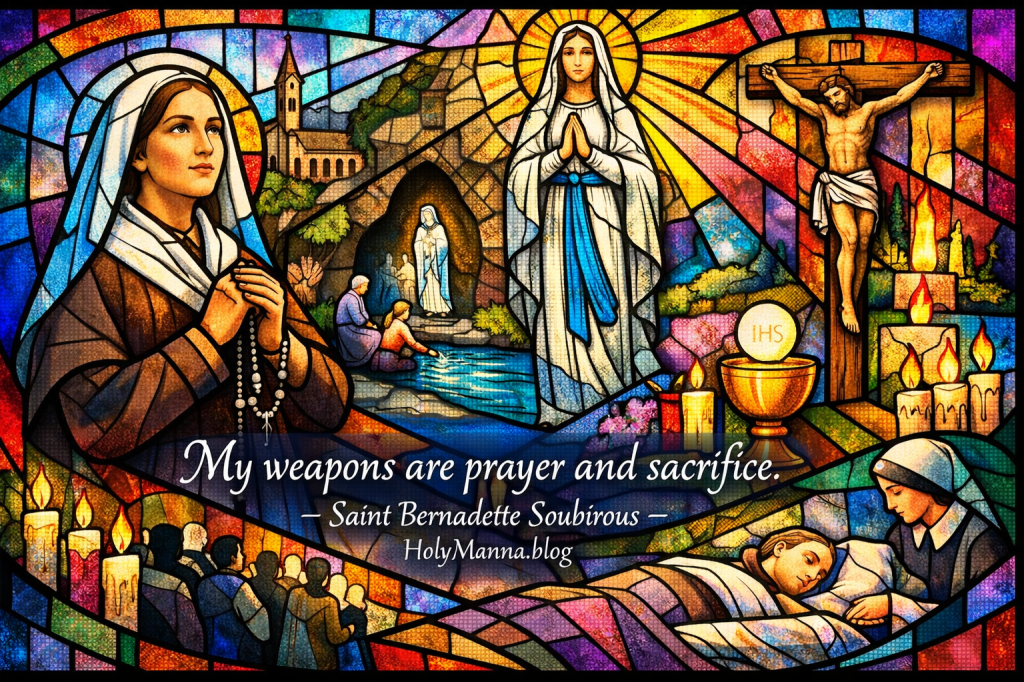
The Little Girl Who Carried a Message Bigger Than Herself
Saint Bernadette Soubirous is one of the most beloved saints of the modern Church, not because she chased greatness, but because she disappeared into God’s will. Born poor, often sick, and largely uneducated, she became the chosen witness of the apparitions of the Blessed Virgin Mary at Lourdes in 1858. Yet the Church has been careful to say that Bernadette was canonized not simply because she saw Our Lady, but because of the way she responded to that grace with humility, honesty, prayer, sacrifice, and love. That is why Catholics revere her. She is the girl who told the truth, endured the noise, refused the spotlight, and spent the rest of her life letting Mary lead souls to Jesus.
From a Catholic perspective, Lourdes belongs to the category of approved private revelation. That matters. The Church teaches in CCC 67 that private revelations do not add to the deposit of faith or complete Christ’s definitive Revelation, but may help the faithful live it more fully in a certain time and place. Bernadette’s life fits that perfectly. Nothing about her draws attention away from Christ or the Gospel. Everything about her pushes the soul back toward prayer, penance, purity, suffering offered in love, and trust in the maternal care of the Blessed Virgin.
From the Boly Mill to the Cachot
Bernadette was born on 7 January 1844 in Lourdes, in the Pyrenees, to François Soubirous and Louise Casterot. She was the eldest child in a family of millers, and her earliest years were marked by real affection and relative stability. Catholic accounts describe a girl who was loved, lively, spontaneous, generous, and strong in character. But those easier years did not last. Economic decline, family debt, illness, and misfortune crushed the household, and the Soubirous family eventually ended up living in the Cachot, a former prison cell. Bernadette also suffered physically, especially from asthma, and because of poverty and circumstance she received very little education as a child.
That background matters because it explains both her weakness and her strength. She was poor, but she was not foolish. She was simple, but not gullible. She was known for being truthful and incapable of deception, and even those who questioned her had to reckon with the clarity and firmness of her testimony. This was not a girl intoxicated by attention. This was a girl who knew hardship early, and that hardship helped form the plain honesty that would one day make her witness so compelling.
When Heaven Spoke at Massabielle
On 11 February 1858, Bernadette went with her sister and a friend to gather wood near Massabielle. There, in the grotto, she saw a Lady in white. Between 11 February and 16 July 1858, she received eighteen apparitions. The Lady invited her to return for a fortnight, called for prayer and penance, asked that people come in procession, requested that a chapel be built, and directed Bernadette to uncover the spring that would become so closely tied to Lourdes. On 25 March, during the sixteenth apparition, the Lady revealed her name: “I am the Immaculate Conception.” Since Pope Pius IX had defined that Marian dogma only four years earlier, and since Bernadette herself did not understand the phrase, this became one of the strongest signs of the credibility of her testimony in the eyes of Church authorities.
One of the most moving details from the tradition is the way Bernadette described the Lady’s manner. The Blessed Virgin addressed her with courtesy and gentleness, and Bernadette herself was struck that the Lady spoke to her with respect. That detail says a great deal. Heaven did not crush this poor child. Heaven stooped to her with tenderness. Bernadette never forgot that.
Bernadette is most known for this witness at Lourdes, but the real marvel is how she bore it. She did not exaggerate. She did not monetize it. She did not confuse herself with the message. When questioned by officials, she famously insisted on precision. One of her best known sayings captures the whole spirit of her mission: “I’m charged with telling you, not with making you believe.” She also resisted attempts to make her into a spiritual celebrity. “I want to remain poor,” she said. When people thrust rosaries at her to bless, she answered, “I don’t wear a stole.” When others tried to turn devotion into commerce, she said, “I’m not a merchant.” This is one reason the Church trusts her. Bernadette never used grace for herself.
The Hidden Saint Behind the Famous Visionary
Many people know the grotto, but fewer know the rest of Bernadette’s story. After the apparitions, life in the family’s poverty and the constant public attention became unbearable. She was admitted to the hospice run by the Sisters of Nevers, and there she began to learn to read and write. It was also there that she received her First Holy Communion. In time, she discerned a call to religious life and chose the Sisters of Charity of Nevers. She left Lourdes in 1866 and entered the convent at Nevers, where she took the name Sister Marie-Bernard.
Here is one of the most surprising facts about her life. She never returned to the grotto. She had seen what she was meant to see, spoken what she was meant to speak, and then accepted obscurity. She even described Nevers with remarkable simplicity: “I came here to hide myself.” In Lourdes she was the visionary. In Nevers she became a sister, a servant, a patient, and finally a saint shaped by suffering.
During her years in Saint Gildard, Bernadette served in humble ways as assistant nurse, infirmary worker, and sacristan, while often being very sick herself. Her life was simple and outwardly ordinary. Yet this hidden period may be the holiest part of the whole story. Her bishop said that her work would be “the work of prayer.” Bernadette embraced that vocation deeply. She wrote to the Pope, “My weapons are prayer and sacrifice.” This is the point where Bernadette stops being merely a famous Catholic figure and becomes a model for every soul that suffers quietly in fidelity.
The Quiet Miracles
Saint Bernadette is not remembered as a miracle worker in the same way as some saints who healed openly with gestures or words, yet her earthly life was surrounded by signs that Catholics have long pondered with reverence. One of the best known is the candle miracle of 7 April 1858. During an apparition, the flame of her candle reportedly passed over her hand without burning her, and a doctor who witnessed it was astonished.
Even more important was the spring uncovered at the grotto after the Lady directed Bernadette to dig in the earth and drink. That muddy beginning led to one of the most famous and fruitful signs in Catholic devotional history. The waters of Lourdes became associated with healing, and the first widely remembered cure linked to the apparitions was that of Catherine Latapie in March 1858. Since then, thousands of cures have been investigated, and many have been officially recognized by the Church as miraculous. Bernadette herself did not claim power. She was simply the witness through whom God opened a place of mercy for countless pilgrims, especially the sick.
There is also a quieter kind of miracle in her life that Catholics should not overlook. She endured humiliation, interrogation, sickness, misunderstanding, and physical pain without losing her faith. That is not the sort of miracle that fills headlines, but it is often the kind that makes saints. Bernadette’s great earthly wonder may be that grace preserved her simplicity even when the world turned her into a sensation.
A Cross Without Martyrdom
Saint Bernadette was not a martyr in the strict sense. She did not die by execution for the faith. But she did live what could honestly be called a hidden martyrdom of suffering. At Nevers she was afflicted by chronic asthma, a painful tumor in her knee, and lung tuberculosis. Long periods in the infirmary became part of her daily life. Yet she did not treat suffering as meaningless. She united it to Christ, offered it for sinners, and kept her eyes on the crucifix. One of the most piercing lines preserved from her life is this: “That is where I find my strength.”
Her sayings from Nevers open a window into her soul. “I want my whole life to be inspired by love.” “I shall always have enough health, but never enough love.” “God speaks in the depths of the person, without the noise of words.” These are not the words of someone living on memories of a mystical past. These are the words of a woman being sanctified in the ordinary, purified by pain, and taught by God in silence. Her prayer is just as beautiful: “O Jesus, give me, I pray, the bread of humility, the bread of obedience, the bread of charity…” That prayer sounds like the interior life of a soul that has learned the Gospel the hard way.
She died on 16 April 1879 at only thirty-five years old. Near the end, the words attributed to her were simple and deeply Eucharistic in spirit: “My Jesus! Oh, how I love him!” and “I am ground like a grain of wheat.” There is no theatrical drama there. Only the language of a soul that had been broken open and offered back to God.
The Echo of Lourdes After Her Death
Bernadette’s impact after death has only grown. Her cause for beatification and canonization began not long after her death, and during that process her body was examined three times, in 1909, 1919, and 1925. Each time, it was found remarkably preserved. In 1925 she was beatified, and her body was placed in a shrine in the chapel at Nevers, where it remains a place of prayer and pilgrimage. She was canonized on 8 December 1933 by Pope Pius XI, fittingly on the feast of the Immaculate Conception.
Catholics should speak carefully here. The preservation of a saint’s body is not, by itself, what makes someone a saint. Holiness does. Still, the Church has long treated Bernadette’s incorrupt body as a striking sign that accompanies her witness. It is one of the most remarkable facts associated with her legacy after death.
The miracles of Lourdes continued long after Bernadette’s death, and in that sense her posthumous impact is immense. The grotto, the spring, the candle processions, the care of the sick, and the constant stream of pilgrims from around the world all stand as part of her legacy. Lourdes remains one of the greatest Marian shrines in the Catholic world. The sanctuary continues to celebrate Saint Bernadette each year, especially on 16 April according to the Roman Martyrology and also on 18 February in connection with the third apparition and the Lady’s promise: “I do not promise to make you happy in this world, but in the other.”
There are also many personal stories told by pilgrims who believe they received favors, healings, or deep conversions through Bernadette’s intercession. Those private accounts belong to the devotional life of the Church and often cannot be independently verified. Still, they show how deeply loved she remains among the faithful. What can be verified is this: her witness still leads souls to confession, Eucharistic devotion, Marian trust, and renewed hope in suffering.
What Saint Bernadette Teaches the Soul Today
Saint Bernadette speaks powerfully to a world that confuses attention with importance. She reminds the Church that the holiest people are often the ones who do not market themselves, do not defend their image, and do not need to be seen. She teaches that humility is not weakness. It is strength under grace. She teaches that suffering can become fruitful when united to Jesus. She teaches that Mary never pulls the soul away from Christ, but always leads it toward Him.
Her life also speaks to anyone who feels poor, sick, overlooked, undereducated, misunderstood, or forgotten. Bernadette was all of those things. Yet heaven found her. More than that, heaven trusted her. What would change if daily life were lived with Bernadette’s honesty? What if suffering were offered instead of wasted? What if prayer and sacrifice became real spiritual weapons again? Her example urges the soul to confession, the Rosary, Eucharistic reverence, patience in sickness, mercy toward sinners, and a deeper trust that God often chooses the little ones to shame the proud.
A practical way to imitate her is very simple. Speak truthfully. Refuse vanity. Pray for sinners. Receive humiliations without bitterness. Stay close to Our Lady. Love the sick and the poor. Keep your eyes on the crucifix. Bernadette did not build a platform. She built a life of surrender. That is why her voice still matters.
Engage with Us!
Share your thoughts and reflections in the comments below. Saint Bernadette’s life has a way of reaching straight into ordinary struggles and reminding the heart that God still works through humility, suffering, and trust.
- What stands out most in Saint Bernadette’s life: her honesty, her humility, her suffering, or her hiddenness? Why?
- How does her example challenge the way success and holiness are usually measured today?
- Is there a suffering in life that needs to be offered to Jesus instead of merely endured?
- What would it look like to make prayer and sacrifice real spiritual weapons this week?
- How can devotion to Our Lady help the soul stay closer to Jesus in daily life?
May Saint Bernadette pray for every soul that feels small, tired, or unseen. May her witness teach hearts to live quietly, love deeply, suffer faithfully, and do everything with the love and mercy Jesus taught us.
Saint Bernadette Soubirous, pray for us!
Follow us on YouTube, Instagram and Facebook for more insights and reflections on living a faith-filled life.


Leave a Reply