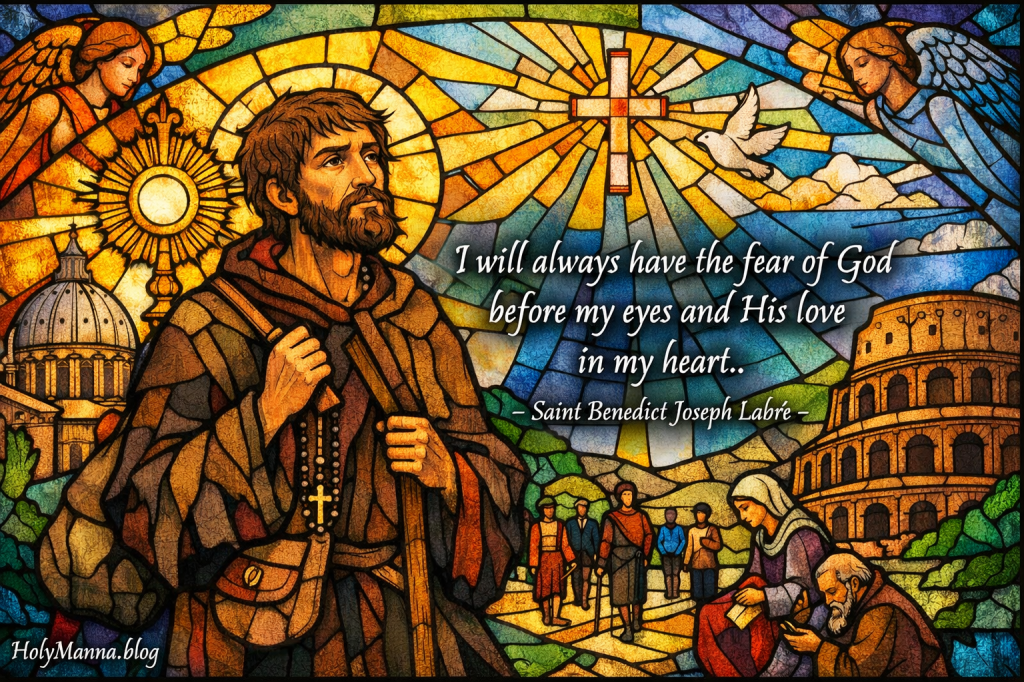
The Beggar Who Carried Heaven Through the Streets
Saint Benedict Joseph Labré is one of those saints who can stop a person in his tracks. He was not a pope, not a bishop, not a founder of a great religious order, and not a famous preacher with books and letters spread across the world. He was a poor pilgrim, a layman, a man who slept in ruins and on doorsteps, and yet the Church remembers him as one of her most luminous witnesses to the love of God.
He is revered because his life shows something the modern world often forgets. A soul can belong so completely to Christ that even outward failure becomes a path to sanctity. Benedict Joseph Labré is remembered as the beggar of Rome, the wanderer of God, and today he is especially known as a patron of the homeless. His holiness was found in radical poverty, Eucharistic devotion, constant pilgrimage, penance, and a deep hidden union with God.
His story matters because it proves that sanctity does not depend on worldly success. It depends on surrender. His whole life seems to whisper the words of Psalm 34: The Lord is close to the brokenhearted. In Benedict’s life, the Church sees a man who had almost nothing, yet possessed the one thing that matters most: God Himself.
The Boy from Amettes Who Longed for God Alone
Benedict Joseph Labré was born on March 26, 1748, in Amettes, France, the eldest of fifteen children. His family was not poor in the desperate sense. They were stable, respectable, and able to give him a good upbringing. From childhood, Benedict stood apart for his seriousness, gentleness, and attraction to prayer. He was not drawn to noise or vanity. He wanted God.
Part of his education was entrusted to his uncle, a parish priest, and during those years his spiritual life deepened. He learned to love prayer, silence, and the things of God. As he grew older, he became convinced that he was called to the religious life. He wanted to enter a monastery and give himself entirely to the Lord.
That desire only grew stronger after a time of suffering touched his family circle. During an epidemic, his priest-uncle ministered heroically to the sick and then died. The witness of priestly sacrifice marked Benedict deeply. He pressed forward with even more determination, seeking entry into several monasteries, including the Carthusians and the Trappists.
But here the story takes an unexpected turn. He was refused more than once. In some places his health was judged too weak. In others, his temperament or physical constitution seemed unsuited to the rigors of the life he longed for. What looked like the destruction of his vocation was actually the beginning of it. Benedict came to see that God was not calling him to serve behind monastery walls. God was asking for everything, just in another way.
He accepted that painful discovery with humility. One of the most touching lines preserved from his life captures that spirit well: “God’s will be done.” That was not resignation. That was trust.
Benedict eventually embraced life as a pilgrim and entered the Third Order of Saint Francis. He would not be a monk enclosed in one abbey. He would become a poor wanderer, carrying Christ in his heart across the roads of Europe.
The Pilgrim Who Made the World His Cloister
For the next years of his life, Benedict traveled from shrine to shrine, often on foot, through France, Italy, Spain, Switzerland, and beyond. He visited places such as Loreto, Assisi, Naples, Bari, Einsiedeln, Compostela, and Paray-le-Monial. He owned almost nothing. Catholic accounts describe him as carrying a crucifix, a rosary, a breviary, the New Testament, and The Imitation of Christ. That small bundle was enough for him, because he wanted no possessions that would slow his soul down.
He fasted heavily, slept in poor shelters or under the open sky, and accepted the humiliations that came with living as a beggar. Yet this was not misery without meaning. Benedict was not simply homeless in the tragic, modern sense. He embraced poverty as penance and as a way of imitating Christ, who Himself had nowhere to lay His head.
In time, Rome became the center of his final years. There he was seen often near the Colosseum, in churches, and especially at Eucharistic devotions. He became known for long hours before the Blessed Sacrament. He prayed the Rosary, recited the breviary, and kept company with the Lord in silence. Rome saw in him a strange and holy figure, dirty and ragged on the outside, yet burning with the life of grace within.
He is most known for exactly this. Benedict Joseph Labré made the streets his monastery and adoration his hidden rule of life. He is remembered not for building something outwardly impressive, but for living poverty, prayer, and dependence on God with startling literalness.
His letters and remembered words reveal the interior spirit that carried him. In one letter, he wrote to his parents, “I beg your pardon for all my acts of disobedience.” In another, he said, “I am very happy in having undertaken my present journey.” Even his renunciations were marked by peace. Another remembered line expresses the direction of his soul: “I will always have the fear of God before my eyes and His love in my heart.”
Those are not dramatic sayings, but perhaps that is the point. Benedict’s sanctity was plain, sincere, and deeply Catholic. He did not perform for the world. He belonged to God.
Hidden Wonders in a Life Without Spectacle
When people hear the lives of saints, they often expect visible miracles during the saint’s earthly life. In the case of Saint Benedict Joseph Labré, Catholic sources are notably restrained. They do not preserve a well-documented catalog of spectacular miracles worked by him while he was alive. That is important to say clearly, because holiness does not need embellishment.
What shines most during his lifetime is not a series of dramatic wonders but the miracle of perseverance itself. He endured rejection, misunderstanding, weakness, hunger, cold, and humiliation without bitterness. He embraced a life that most people would flee. He remained faithful to prayer. He remained devoted to Christ in the Eucharist. He gave away what little came into his hands. He accepted obscurity.
That hidden fidelity is part of why he is so important. Some saints stun the world with public works. Benedict Joseph Labré teaches by silence, poverty, and love. He shows that sanctity is not always loud.
Even so, his life carried a supernatural impression. People in Rome recognized something different about him. Children noticed it. Ordinary workers noticed it. Priests noticed it. He had no title and no office, yet he left behind the scent of holiness.
Rejection, Humiliation, and a Holy Death in Rome
Benedict’s hardships were many. He was not martyred by persecutors, but his life was full of a slower kind of suffering. He knew the pain of rejection when monastery after monastery told him no. He knew what it meant to be hungry, dirty, exhausted, and dismissed by the world. He knew the loneliness of the road. He knew bodily weakness. He knew what it meant to be thought useless.
Yet he carried all this with patience. His life recalls “Blessed are the poor in spirit” from The Gospel of Matthew. He lived those words in a way that feels almost unsettling because it was so total.
His earthly journey ended in Rome on April 16, 1783, which was Holy Wednesday. By then his body had become too weak to continue. He collapsed near the church of Santa Maria ai Monti and was carried to a nearby house, where he received the last rites and died at only thirty-five years old.
The reaction in Rome was immediate and extraordinary. Catholic accounts say that children ran through the streets crying out that the saint was dead. Crowds gathered in great numbers. The poor man who had seemed so small in the eyes of the world was suddenly recognized for what he truly was. Rome had been living beside a saint.
The Saint the City Would Not Forget
If his life was hidden, the aftermath of his death was not. Catholic sources report that miracles began to be attributed to his intercession very quickly. Within only a few months, many cures were reported. One major Catholic reference states that by July 6, 1783, his confessor had recorded 136 certified miraculous cures associated with his intercession.
These miracle reports helped spread his fame rapidly. They also had an unexpected effect on one Protestant minister from Boston, John Thayer. He had approached the events around Benedict’s death with skepticism, but the testimony surrounding the miracles contributed to his conversion to the Catholic faith. That became an important part of early American Catholic history.
Beyond those broadly attested reports, many popular stories of cures, favors, and interventions circulated around his tomb. Not every individual account can now be verified in detail, and it is right to say that plainly. Still, the weight of Catholic tradition is clear. The faithful believed that this poor pilgrim had great power with God, and they sought his intercession with confidence.
His cult grew steadily. He was declared Venerable in 1859, beatified in 1860, and canonized in 1881. His body is venerated in the church of Santa Maria ai Monti in Rome, which remains an important place of memory connected with his final hours and his ongoing intercession.
His birthplace, Amettes, also became a place of pilgrimage. The diocesan sanctuary there keeps his memory alive with liturgical celebrations, novenas, and pilgrim visits. In this way, the man who spent his life walking from shrine to shrine became the reason that others now make pilgrimages of their own.
His cultural impact is also real. He became a lasting Catholic symbol of holy poverty and dependence on God. Even poets took notice. His memory has endured especially in the Church’s care for the poor, and in modern Catholic life he is strongly associated with the homeless and the forgotten. That may be one of the most beautiful parts of his legacy. The saint who had no home on earth has become a heavenly friend to those who feel cast aside.
Learning to See God in Poverty and the Hidden Life
Saint Benedict Joseph Labré has a message that cuts straight into modern life. The world says a life matters when it is productive, admired, influential, and comfortable. Benedict’s life says something else. A life matters when it belongs to God.
His story also offers consolation for anyone who has known disappointment. He wanted one path and received another. He knocked on doors that never opened. He carried weakness that never fully left him. Yet none of that prevented holiness. In fact, God used those very disappointments to shape him into a saint.
That is a lesson worth taking seriously. Sometimes the place of greatest grace is the place where personal plans fall apart. Sometimes holiness begins where ambition ends.
His life invites readers to love the Eucharist more deeply, to detach from needless comforts, to treat the poor with reverence, and to trust God even when the road is unclear. Practical imitation does not mean copying his exact external life. Few are called to sleep under ruins and wander across countries on foot. But everyone can imitate his spirit. Everyone can practice humility. Everyone can pray more faithfully. Everyone can simplify. Everyone can remember that Christ is close to the poor.
What would change if daily life were lived with a little less fear and a little more trust in Providence? What attachments keep the heart from resting fully in God? How often is the poor Christ overlooked in the people right in front of us?
Saint Benedict Joseph Labré reminds the Church that hidden holiness is still holiness. He reminds ordinary Catholics that God can make something radiant out of what the world calls failure. He reminds restless hearts that peace is not found in possessing more, but in surrendering more.
Engage with Us!
Readers are invited to share their thoughts and reflections in the comments below. Saint Benedict Joseph Labré has a way of challenging comfortable assumptions, so this is a beautiful saint to sit with slowly and prayerfully.
- What part of Saint Benedict Joseph Labré’s life speaks most strongly to the heart right now?
- Does his example of poverty and trust challenge any habits of comfort, control, or anxiety?
- How can greater love for the Eucharist become part of everyday life this week?
- Who are the poor, lonely, or forgotten people nearby who may need prayer, kindness, or practical help?
- What disappointment in life might God be using as the beginning of a deeper vocation to holiness?
May Saint Benedict Joseph Labré intercede for every wandering heart, every discouraged soul, and every person who feels unseen. May his witness help more souls live with faith, pray with trust, and do everything with the love and mercy Jesus taught us.
Saint Benedict Joseph Labré, pray for us!
Follow us on YouTube, Instagram and Facebook for more insights and reflections on living a faith-filled life.


Leave a Reply