Thursday of the Second Week of Easter – Lectionary: 270
When Heaven Speaks and Earth Must Answer
There are days in the Easter season when the Church seems to place a hand on the shoulder and say, slow down and really look at what the Resurrection means. Today is one of those days. These readings are not only about brave apostles, consoling promises, or lofty theology. They are about the collision between heaven and earth. They show what happens when the risen Christ, who comes from above, enters a world still obsessed with control, fear, and human authority. The central theme tying these readings together is simple and powerful: the one who comes from God calls His people to trust Him, obey Him, and bear witness to Him, even when the world resists.
That thread runs through every passage. In Acts of the Apostles, Peter and the apostles stand before the Sanhedrin, the highest religious authority in Jerusalem, and speak with astonishing boldness: “We must obey God rather than men.” This is not reckless defiance. It is the fruit of Easter faith. The men who once fled in fear now speak as witnesses because they know Jesus is risen, exalted, and reigning. In Psalm 34, that same confidence takes the shape of prayer. The righteous cry out, the brokenhearted are not abandoned, and the Lord remains near in affliction. Then in The Gospel of John, everything is lifted higher still: Jesus is not merely one more teacher within history. He is the one from above, the beloved Son to whom the Father has given all things. The apostles can stand firm because Christ truly is Lord.
There is also an important background to keep in view. These readings come from the early days of the Church, when the apostles were preaching in Jerusalem not long after the Resurrection. The authorities who had condemned Jesus now faced His followers spreading the very name they tried to silence. This gives the First Reading its tension. The Gospel gives the deeper explanation. Jesus is rejected because fallen humanity prefers what is earthly, manageable, and familiar. Yet Easter keeps pressing the truth into the world. The Church, from the beginning, has lived in that tension. She belongs to history, but her life comes from heaven. She speaks to the world, but she does not take her orders from the world.
That is what makes today’s readings so timely. They ask whether life is being shaped from below or from above. They ask whether faith is real enough to obey God when it costs something. They ask whether the heart really believes that Christ has authority over sin, suffering, fear, and death. Before stepping into each reading, it helps to hold this one truth close: the risen Jesus is not a distant religious figure or a comforting idea. He is the Son sent by the Father, full of the Holy Spirit, and He still calls His people to live with courage, trust, and holy clarity. What happens when heaven speaks into an earthly life? Today’s readings invite the soul to answer.
First Reading – Acts 5:27-33
Before earthly power stands the courage that only Easter can give
The scene in today’s First Reading feels tense from the very first line. The apostles are brought before the Sanhedrin, the highest religious council in Jerusalem, the same body tied to the events surrounding the Passion of Christ. This is not a casual hearing. This is a confrontation between the old order trying to preserve its control and the newborn Church refusing to deny what it has seen. The apostles are no longer the frightened men who scattered on Good Friday. They are now witnesses of the Resurrection, filled with the Holy Spirit, speaking in the name of Jesus with a boldness that would have been unthinkable only weeks earlier.
Historically, this moment takes place in the earliest days of the Church, when the preaching of the apostles was spreading rapidly through Jerusalem. Religiously, it is a decisive moment because the leaders of Israel are being forced to reckon with the name of Jesus again. Culturally, public teaching carried authority, and the Sanhedrin believed it had the right to regulate what was being proclaimed among the people. Yet the apostles know something deeper. The risen Christ has entrusted them with a mission that no earthly court can revoke. That is why this reading fits so perfectly into today’s theme. The one who comes from above now reigns, and those who belong to Him must obey God before men, bear witness to the truth, and trust that the Lord will sustain them.
Acts 5:27-33 – New American Bible (Revised Edition)
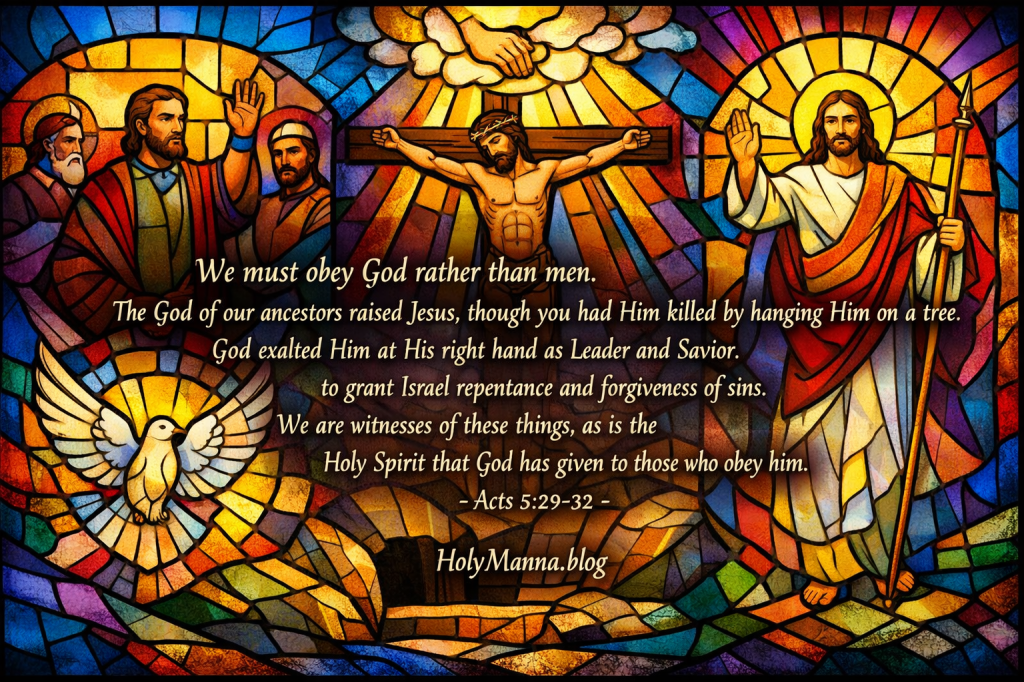
27 When they had brought them in and made them stand before the Sanhedrin, the high priest questioned them, 28 “We gave you strict orders [did we not?] to stop teaching in that name. Yet you have filled Jerusalem with your teaching and want to bring this man’s blood upon us.” 29 But Peter and the apostles said in reply, “We must obey God rather than men. 30 The God of our ancestors raised Jesus, though you had him killed by hanging him on a tree. 31 God exalted him at his right hand as leader and savior to grant Israel repentance and forgiveness of sins. 32 We are witnesses of these things, as is the holy Spirit that God has given to those who obey him.”
33 When they heard this, they became infuriated and wanted to put them to death.
Detailed Exegesis
Verse 27 – “When they had brought them in and made them stand before the Sanhedrin, the high priest questioned them,”
This verse sets the stage with solemnity and pressure. The apostles are not simply being warned. They are being summoned into a formal setting of judgment. The Sanhedrin represented the religious authority of the Jewish people, and standing before it would have been intimidating for anyone. Yet the contrast is striking. Those who appear outwardly weak are the ones carrying divine authority, while those seated in earthly power are resisting the plan of God. This verse reminds the Church that fidelity often places believers before hostile courts, suspicious institutions, or cultural pressure. From the beginning, the Gospel has been tested in public.
Verse 28 – “We gave you strict orders [did we not?] to stop teaching in that name. Yet you have filled Jerusalem with your teaching and want to bring this man’s blood upon us.”
The high priest does not even say the name of Jesus. He calls Him “that name”, which reveals more than he intends. The name of Jesus carries power, and those who reject Him often still feel the force of His presence. The complaint is revealing. The apostles have filled Jerusalem with their teaching. The Gospel is spreading. The leaders also say, “you want to bring this man’s blood upon us.” In one sense they are accusing the apostles of stirring guilt, but in a deeper biblical sense blood cries out for justice. The irony is sharp. The very blood they fear being blamed for is the blood that can cleanse and save. The Church never preaches Christ to shame people for the sake of humiliation. She preaches Christ so that sinners may repent and be forgiven.
Verse 29 – “But Peter and the apostles said in reply, ‘We must obey God rather than men.’”
This is the heart of the reading. Peter speaks not as a political revolutionary but as a witness under divine commission. His obedience is not rooted in stubbornness or pride. It is rooted in truth. God has acted in Jesus Christ, and that act cannot be denied to satisfy human authority. This verse expresses a principle that runs throughout salvation history. When human commands directly oppose the will of God, the disciple must choose God. This is not permission for chaos or arrogance. It is a call to rightly ordered obedience. Human authority is real, but it is never absolute. Only God is Lord of the conscience.
Verse 30 – “The God of our ancestors raised Jesus, though you had him killed by hanging him on a tree.”
Peter speaks with clarity and boldness. He does not soften the truth to make it easier for his listeners. He names both human guilt and divine victory. The phrase “The God of our ancestors” is important because Peter is not preaching a new religion detached from Israel. He is proclaiming the fulfillment of God’s covenant promises. The God of Abraham, Isaac, and Jacob has raised Jesus. The phrase “hanging him on a tree” echoes Deuteronomy 21:23 and highlights the scandal of the Cross. Christ took upon Himself the curse of sin, not because He was guilty, but because He chose to redeem the guilty. Peter proclaims the Passion and Resurrection together, because there is no Easter without Calvary and no Cross without glory.
Verse 31 – “God exalted him at his right hand as leader and savior to grant Israel repentance and forgiveness of sins.”
This verse is rich with royal and salvific meaning. Jesus is not merely alive again. He is exalted at the right hand of the Father. In biblical language, this means that He shares in divine authority and reigns in glory. He is called “leader and savior”, titles that point to His kingship and His mission. Most striking of all, His exaltation is ordered toward mercy. He is raised and glorified to grant repentance and forgiveness of sins. Repentance is not presented as a human achievement alone. It is a gift flowing from the risen Christ. Forgiveness is not self-created peace. It is a grace won by the Savior and offered to His people. This verse reveals the heart of Easter. The risen Lord reigns in order to save.
Verse 32 – “We are witnesses of these things, as is the holy Spirit that God has given to those who obey him.”
The apostles do not present themselves as philosophers spinning ideas. They are witnesses. They speak of what they have seen and heard. Their witness is not isolated, because the Holy Spirit Himself confirms their testimony. The Spirit is not an optional add-on to the Christian life. He is the divine gift given to those who obey God, strengthening the Church to proclaim Christ faithfully. This verse beautifully joins apostolic testimony and the work of the Spirit. Catholic faith is never built on private invention. It stands on the apostolic witness preserved and proclaimed in the Church, animated by the Holy Spirit.
Verse 33 – “When they heard this, they became infuriated and wanted to put them to death.”
Truth does not always produce immediate conversion. Sometimes it produces rage. The leaders are not merely annoyed. They are cut to the heart in the wrong way. Instead of yielding in repentance, they harden themselves in fury. This verse reveals the drama of the human heart. The same Gospel that invites healing can also expose pride so deeply that a person lashes out against it. The apostles are now sharing more fully in the suffering of Christ. The Church learns here that fidelity does not guarantee worldly approval. Sometimes faithfulness to Jesus will provoke rejection precisely because it reveals what people do not want exposed.
Teachings
This reading speaks directly to the Catholic understanding of authority, conscience, witness, repentance, and the kingship of Christ. The apostles do not reject all human authority. They reject the demand to disobey God. That distinction matters. The Catechism of the Catholic Church teaches in CCC 2242: “The citizen is obliged in conscience not to follow the directives of civil authorities when they are contrary to the demands of the moral order, to the fundamental rights of persons or the teachings of the Gospel. Refusing obedience to civil authorities, when their demands are contrary to those of an upright conscience, finds its justification in the distinction between serving God and serving the political community. ‘Render therefore to Caesar the things that are Caesar’s, and to God the things that are God’s.’ ‘We must obey God rather than men.’” That is exactly what Peter embodies here.
The reading also reveals Christ’s exaltation. Jesus is not only risen. He is enthroned. The Church teaches in CCC 663: “Henceforth Christ is seated at the right hand of the Father: ‘By the Father’s right hand we understand the glory and honor of divinity, where he who exists as Son of God before all ages, indeed as God, of one being with the Father, is seated bodily after he became incarnate and his flesh was glorified.’” Peter’s words in this passage are the living proclamation of that truth. The apostles preach Christ not as a memory, but as the reigning Lord.
There is also a deeply sacramental and pastoral truth in verse 31. Christ is exalted to grant Israel repentance and forgiveness of sins. The Church sees in this the heart of her mission. The risen Jesus continues to pour out mercy. The Catechism says in CCC 976: “The Apostle’s Creed associates forgiveness of sins with faith in the Holy Spirit, but also with faith in the Church and in the communion of saints. It was when he gave the Holy Spirit to his apostles that the risen Christ conferred on them his own divine power to forgive sins: ‘Receive the Holy Spirit. If you forgive the sins of any, they are forgiven; if you retain the sins of any, they are retained.’” The forgiveness Peter proclaims in Jerusalem is the same mercy Christ still gives through His Church.
The Fathers of the Church also saw in this passage the transformation of Peter as proof of the Resurrection’s power. The man who once trembled before a servant girl now speaks before the Sanhedrin with clarity and peace. That is what grace does. Easter does not merely inspire. Easter re-creates. Saint John Chrysostom marveled at the apostles’ courage and calm, seeing in them men who no longer acted from natural boldness alone, but from the power of the Holy Spirit. This is one of the great historical signs of the truth of the Resurrection. Men do not endure persecution for a metaphor. They endure it because they know Christ is alive.
Reflection
This reading reaches straight into ordinary life because the conflict it shows did not end in Jerusalem. Every Christian eventually faces moments when comfort pulls one way and obedience to God pulls another. Sometimes the pressure comes through culture. Sometimes it comes through work, family tension, old habits, or fear of looking strange. The temptation is often subtle. It is not always, deny Christ outright. More often it is, stay quiet, soften the truth, avoid the cost, keep the peace. Peter’s words cut through all of that. “We must obey God rather than men.”
That line invites serious examination. Where has human approval become more important than fidelity to Christ? Where has fear made the truth feel negotiable? Where has the name of Jesus been kept hidden to avoid discomfort? This reading does not call for theatrical defiance. It calls for steady courage. It calls for prayer before difficult conversations, honesty in moral decisions, reverence in worship, and a willingness to speak of Christ with clarity and charity.
There are also practical steps hidden in the passage. The first is to ask daily for the courage of the Holy Spirit. Boldness is not manufactured by personality. It is given by God. The second is to stay close to repentance. Peter preaches repentance because the Christian who regularly turns back to God becomes harder to manipulate by fear. The third is to remember that Christ is already exalted. Too much anxiety comes from acting as though everything depends on human victory. It does not. Jesus reigns now. The fourth is to speak the truth without bitterness. The apostles do not insult the Sanhedrin. They testify. That matters. Christian witness should be strong, but it should never become cruel.
This reading is especially consoling for anyone who feels weak. Peter himself had failed publicly. Yet the risen Christ restored him and made him a witness. That means past cowardice does not have to define the future. Grace can turn a fearful heart into a faithful one. What would change if obedience to God became the non-negotiable center of daily life? What conversation, habit, or compromise needs to be brought under the lordship of the risen Christ? What would it look like to speak the name of Jesus with peace instead of hesitation?
The apostles stood before the Sanhedrin, but in a deeper sense they stood before God. That is where every disciple finally stands. And once that truth settles into the soul, earthly pressure starts to lose some of its power. Christ is risen. Christ is exalted. Christ grants repentance and forgiveness. That is why the Church can speak, suffer, and remain faithful. That is why the Christian can too.
Responsorial Psalm – Psalm 34:2, 7, 9, 17-20
When the wounded learn to sing praise
The Responsorial Psalm today does not sound like the voice of someone who has had an easy life. It sounds like the voice of someone who has been pressed, humbled, rescued, and taught to praise God from the middle of real trouble. Psalm 34 is traditionally received as a psalm of thanksgiving, and the biblical tradition also notes its acrostic structure, a poetic form that gives the song a sense of order even while it speaks out of distress. That matters. The psalm does not pretend life is tidy. It shows how grace can teach the heart to bless God in the middle of disorder. That makes it a perfect companion to today’s theme. In the First Reading, the apostles stand before hostile authority with bold trust. In the Gospel, Christ is revealed as the one who comes from above. Here in the psalm, the soul learns what it looks like to live under that heavenly truth: to cry out, to take refuge, and to discover that the Lord is near.
Psalm 34:2, 7, 9, 17-20 – New American Bible (Revised Edition)
2 I will bless the Lord at all times;
his praise shall be always in my mouth.7 This poor one cried out and the Lord heard,
and from all his distress he saved him.9 Taste and see that the Lord is good;
blessed is the stalwart one who takes refuge in him.17 The Lord’s face is against evildoers
to wipe out their memory from the earth.
18 The righteous cry out, the Lord hears
and he rescues them from all their afflictions.
19 The Lord is close to the brokenhearted,
saves those whose spirit is crushed.
20 Many are the troubles of the righteous,
but the Lord delivers him from them all.
Detailed Exegesis
Verse 2 – “I will bless the Lord at all times; his praise shall be always in my mouth.”
This opening line sets the tone for the whole psalm. Praise is not postponed until every problem is solved. Praise becomes the atmosphere of a heart that has learned who God is. That does not mean the psalmist lives in denial. It means he refuses to let suffering become the final interpreter of reality. In the biblical world, to bless the Lord is to acknowledge His goodness, His sovereignty, and His saving action. This verse also prepares the soul for Easter faith. The Christian does not bless God only on bright days. The Christian blesses God because Christ is risen, because grace is real, and because the Lord remains worthy even when life feels heavy. The Catechism teaches that in the Psalms the prayer of God’s people becomes a school of praise, repentance, and trust. CCC 2588.
Verse 7 – “This poor one cried out and the Lord heard, and from all his distress he saved him.”
The poverty in this verse is more than financial poverty. It includes the poverty of the one who knows he cannot save himself. Saint Augustine reads this with striking simplicity: “As poor cry thou, and the Lord hears.” The point is not to act miserable for effect. The point is to become truthful before God. The poor man in the psalm is the man who has stopped pretending he is self-sufficient. He cries out because he knows his need. That is deeply Catholic. Grace always begins where pride ends. The Lord hears the cry of the poor because the poor have made room for Him. This verse also stands close to the apostles in Acts of the Apostles. Their courage does not come from self-confidence. It comes from dependence on God.
Verse 9 – “Taste and see that the Lord is good; blessed is the stalwart one who takes refuge in him.”
This is one of the most beautiful invitations in all the Psalms. It is not merely, think and see. It is, taste and see. The Lord is not only an idea to be examined. He is a goodness to be encountered. In its original sense, the verse calls Israel to personal trust, to discover by lived experience that God is faithful. But the Church has long heard in these words a Eucharistic resonance as well. Saint Augustine, preaching on this psalm, connects “Taste and see that the Lord is good” to the mystery of receiving Christ Himself. That is not a strained Christian reading. It is the natural flowering of the psalm in the light of the New Covenant. The Lord who is good is not only praised from afar. He gives Himself as food for His people. That is why refuge in God is not vague religious comfort. It becomes sacramental, concrete, and deeply personal.
Verse 17 – “The Lord’s face is against evildoers to wipe out their memory from the earth.”
This verse is sobering, and it should be. The mercy of God is real, but so is His opposition to evil. Scripture never speaks as though wickedness were harmless. The face of the Lord, which shines warmly upon the righteous, stands against those who harden themselves in sin. This is not cruelty. It is moral clarity. God is not neutral between good and evil. He is patient, but He is never indifferent. In the context of today’s readings, this verse helps explain the tension in Jerusalem. The apostles preach repentance and forgiveness, but that offer does not erase the seriousness of rejecting God’s work. The same holy God who rescues the humble also judges evil. A healthy spiritual life needs both truths.
Verse 18 – “The righteous cry out, the Lord hears and he rescues them from all their afflictions.”
Here the psalm returns to confidence, but not to naïveté. The righteous still cry out. They still have afflictions. Faith does not remove the need for prayer. It intensifies it. The difference is that the righteous know where to bring their trouble. This is the language of covenant trust. God hears His people. He does not always rescue according to human timing, but He never ceases to hear. Pope Francis, reflecting on this psalm, wrote of the poor man’s cry that “The Psalmist is not alien to suffering.” That line captures the realism of this verse. Biblical prayer is not polished detachment. It is wounded faith that still turns toward God.
Verse 19 – “The Lord is close to the brokenhearted, saves those whose spirit is crushed.”
This may be the tenderest line in the whole psalm. The Lord is not only attentive to the heroic, the strong, or the outwardly composed. He is close to the brokenhearted. That is one of the most consoling truths in Scripture. The brokenhearted person often feels hidden, embarrassed, or spiritually disqualified. Yet this verse says the opposite. Crushed spirits are not forgotten territory. They are places where God draws near. Saint Augustine says that God is high, and so the Christian must be lowly if he wants the Most High to come near. That is the paradox of grace. Humility invites the nearness of God. The heart that knows it is broken is often closer to healing than the heart that is still defending its illusions.
Verse 20 – “Many are the troubles of the righteous, but the Lord delivers him from them all.”
This line refuses every shallow gospel of comfort. The righteous suffer. The saints suffer. The apostles suffer. The Church suffers. There is nothing strange about that. What is strange, and glorious, is that suffering is no longer final. The promise is not that the righteous will never enter affliction. The promise is that affliction will never have ultimate dominion over them. This is where the psalm breathes with Easter hope. Deliverance may come through rescue, endurance, conversion, purification, martyrdom, or final glory, but it does come. The Lord does not lose those who belong to Him. The soul that prays this verse learns to measure life not by immediate relief, but by divine fidelity.
Teachings
The Church reads Psalm 34 not as an isolated devotional poem, but as part of the great school of prayer given by the Holy Spirit. The Catechism says in CCC 2584: “In the Psalms David, inspired by the Holy Spirit, is the first prophet of Jewish and Christian prayer.” That line helps explain why this psalm still feels so alive in Christian worship. The Psalms are not museum pieces. They are Spirit-breathed words placed on the lips of the Church. When today’s liturgy gives this psalm after the apostles’ witness, it teaches the faithful how to answer persecution, uncertainty, and sorrow. The answer is not panic. The answer is praise joined to supplication.
This psalm also stands close to the Gospel’s invitation to believe in the Son who comes from above. Faith is not merely intellectual assent. It is refuge. It is the cry of the poor. It is the turning of the heart toward God as the only true shelter. The Catechism speaks of the Beatitudes and says in CCC 2546: “Blessed are the poor in spirit.” That poverty of spirit is all over today’s psalm. The poor one cries out. The brokenhearted are near to God. The crushed spirit is not despised. In Catholic life, poverty of spirit does not mean weakness without hope. It means radical dependence on grace.
There is also a strong Eucharistic note in the Church’s reading of this psalm. When the psalm says, “Taste and see that the Lord is good,” the Christian ear naturally hears more than metaphor. Saint Augustine explicitly connects this line with receiving the Body and Blood of Christ. The Catechism gives the doctrinal center in CCC 1324: “The Eucharist is ‘the source and summit of the Christian life.’” The goodness of the Lord is not only something remembered. It is something sacramentally given. That is one reason this verse has remained so beloved in Catholic worship. The God who rescues the poor and stays near the brokenhearted does not remain distant. He feeds His people.
The psalm also teaches a right understanding of providence. The Lord hears. The Lord sees. The Lord delivers. That language is not simplistic. It is theological. The Catechism explains in CCC 304: “And so we see the Holy Spirit, the principal author of Sacred Scripture, often attributing actions to God without mentioning any secondary causes. This is not a ‘primitive mode of speech,’ but rather a profound way of recalling God’s primacy and absolute Lordship over history and the world, and so of educating his people to trust in him.” The psalmist does not deny enemies, failures, or suffering. He simply sees all of them under the higher truth that God remains God. Without that conviction, suffering becomes chaos. With it, suffering becomes a place where trust can deepen.
A final historical note helps as well. Saint Augustine comments on this psalm under the numbering Psalm 33, because of the difference between the Hebrew and Greek or Latin traditions of numbering the Psalms. That detail may seem small, but it is a reminder that the Church has prayed and interpreted this psalm across centuries, languages, and liturgical traditions. The cry of the poor, the nearness of God, and the invitation to taste His goodness have formed Christian hearts for a very long time. Today’s liturgy places that same ancient prayer in the mouth of the Church once again.
Reflection
This psalm lands hard in ordinary life because it speaks to people who are trying to stay faithful while carrying more than they expected. It is for the person who is tired of pretending to be stronger than he is. It is for the person who knows what it feels like to be anxious, disappointed, ashamed, or spiritually worn thin. It is for the disciple who wants to obey God like the apostles, but also knows how easy it is to become discouraged. The psalm offers a path. First, bless the Lord at all times. That means building a life where gratitude is practiced before emotions fully cooperate. Second, cry out as poor. That means dropping the performance and speaking honestly to God in prayer. Third, take refuge in Him concretely, above all in the sacramental life of the Church, where the Lord lets His people truly taste His goodness.
There is also a needed correction here for modern habits of heart. Many people are comfortable discussing faith in theory, but much less comfortable becoming poor before God. Yet this psalm insists that rescue begins where false self-sufficiency ends. The heart that always needs to appear composed usually struggles to cry out. The heart that never admits its wounds rarely experiences the tenderness of verse 19. The psalm is not inviting emotional drama. It is inviting honesty. Where has prayer become too polished to be real? Where has pride kept the soul from crying out like the poor man in the psalm? Where is the Lord already trying to meet a broken heart that still feels the need to hide?
This reading also gives practical direction for the day ahead. When discouragement rises, bless the Lord aloud instead of letting the mind spiral. When fear presses in, pray simply and directly rather than waiting for perfect words. When the heart feels crushed, resist the lie that God is distant. He is especially near there. And when the soul begins to hunger for something deeper than distraction, return to the Eucharistic life of the Church, because that is where the promise to taste and see becomes radiant and real. The righteous still have many troubles. The psalm says so plainly. But it also says, just as plainly, that the Lord delivers. That is the kind of truth that can carry a soul through a very long night and keep praise alive until morning.
Holy Gospel – John 3:31-36
The voice from heaven leaves no room for half-belief
Today’s Gospel lifts the heart above the noise of earthly arguments and places it before the majesty of Christ. The setting belongs to the early part of The Gospel of John, in the stretch of revelation that follows Jesus’ conversation with Nicodemus and the witness connected with John the Baptist. The atmosphere is full of transition. The old order is giving way to the new. Israel has received prophets, teachers, signs, covenants, and promises, but now the one who comes from above has arrived. That changes everything. Jesus is not merely a holy man speaking about divine things from a distance. He is the Son sent by the Father, the one who has seen and heard the mysteries of heaven and speaks with absolute authority.
That is why this Gospel fits so powerfully into today’s theme. In the First Reading, the apostles stand before the Sanhedrin and refuse to betray the truth. In the Responsorial Psalm, the poor cry out and find refuge in the Lord. Here in the Gospel, the deeper reason for both of those responses is made clear. The apostles can obey God rather than men because Jesus truly is above all. The brokenhearted can trust because the Father has given everything into the hands of the Son. Easter faith is not built on inspiration alone. It is built on the identity of Christ. If Jesus is from above, then His words are not one opinion among many. If the Father has entrusted all things to Him, then belief in Him is not optional decoration for life. It is the line between life and death.
John 3:31-36 – New American Bible (Revised Edition)
31 The one who comes from above is above all. The one who is of the earth is earthly and speaks of earthly things. But the one who comes from heaven [is above all]. 32 He testifies to what he has seen and heard, but no one accepts his testimony. 33 Whoever does accept his testimony certifies that God is trustworthy. 34 For the one whom God sent speaks the words of God. He does not ration his gift of the Spirit. 35 The Father loves the Son and has given everything over to him. 36 Whoever believes in the Son has eternal life, but whoever disobeys the Son will not see life, but the wrath of God remains upon him.
Detailed Exegesis
Verse 31 – “The one who comes from above is above all. The one who is of the earth is earthly and speaks of earthly things. But the one who comes from heaven is above all.”
This verse opens with a radical contrast. There is the one who comes from above, and there is the one who is of the earth. In the immediate context, this contrast distinguishes Jesus from every merely human witness, even a great witness like John the Baptist. John is holy, chosen, and sent, but he is still a man. Jesus is more. He comes from heaven. Saint Augustine reflects on this contrast to show that every creature, no matter how noble, remains earthly by nature, while Christ alone speaks as the one who belongs to heaven by right. This verse guards the soul from reducing Jesus to the level of a wise teacher, moral reformer, or gifted prophet. He is above all because He is the eternal Son who has entered history.
Verse 32 – “He testifies to what he has seen and heard, but no one accepts his testimony.”
Jesus does not speculate about God. He testifies to what He has seen and heard. That is the language of divine intimacy. He knows the Father not by deduction but by eternal communion. Yet the tragedy appears immediately. “No one accepts his testimony.” This does not mean literally no human being believes, because the next verse will speak of those who do. It means that fallen humanity, left to itself, resists heavenly truth. Saint John often uses this kind of stark language to reveal the drama of belief and unbelief. The world does not reject Christ because His light is dim, but because His light is too clear for hearts attached to darkness. The problem is not weakness in the testimony. The problem is hardness in the hearer.
Verse 33 – “Whoever does accept his testimony certifies that God is trustworthy.”
This verse shows what faith really is. To accept the testimony of Jesus is to set one’s seal on the truthfulness of God. Faith is not a private mood or a passing religious preference. Faith is an act by which the soul declares that God tells the truth. That is why disbelief is so serious. It is not merely intellectual hesitation. It is resistance to the God who speaks. In Catholic theology, faith is personal and ecclesial, inward and outward. It is a surrender of mind and heart to God’s self-revelation. The believer does not simply admire Jesus. The believer entrusts himself to Him.
Verse 34 – “For the one whom God sent speaks the words of God. He does not ration his gift of the Spirit.”
This verse deepens everything. Jesus speaks the words of God because He is the one sent by God. In Scripture, being “sent” is never a small idea. It implies mission, authority, and divine purpose. But the verse goes further still. “He does not ration his gift of the Spirit.” The Church has long understood this as referring to the fullness of the Spirit given to the Son. Others receive grace according to measure. Christ possesses the fullness. This is why His words are life-giving, why His mission is perfect, and why His testimony is utterly trustworthy. The prophets spoke by the Spirit. Jesus speaks as the one on whom the Spirit rests in fullness. The Church hears here an echo of the whole mystery of the Incarnation. The Son is not visited by divine truth from outside. He is its bearer in person.
Verse 35 – “The Father loves the Son and has given everything over to him.”
Here the Gospel opens the inner life of divine love. The Father loves the Son, and in that love all things are entrusted to Him. This is not the handing over of power from one rival to another. It is the revelation of divine communion and divine order. The Father gives, the Son receives, and in that eternal exchange the world is saved. This verse is one of the reasons the Church speaks so strongly about the kingship and lordship of Christ. All things have been placed in His hands. That includes judgment, mercy, history, salvation, and the destiny of every human heart. This verse also explains why the apostles in Acts of the Apostles speak with such conviction. They are not following a defeated teacher. They are serving the Son to whom the Father has given all things.
Verse 36 – “Whoever believes in the Son has eternal life, but whoever disobeys the Son will not see life, but the wrath of God remains upon him.”
The Gospel ends with both promise and warning. The promise is stunningly immediate: “Whoever believes in the Son has eternal life.” Not merely will have, but has. Eternal life begins now in communion with Christ. Yet the warning is equally serious. The opposite of belief here is described not only as unbelief, but as disobedience. That matters. In biblical thought, to refuse the Son is not merely to fail an exam in doctrine. It is to refuse the obedience of faith. The phrase about the wrath of God does not mean that God becomes irrationally angry like a fallen man. It means that outside communion with the Son, man remains under the judgment that sin already deserves. Christ does not come to trap man under wrath. He comes to rescue him from it. But the rescue must be received.
Teachings
This Gospel stands at the heart of Catholic teaching on the identity of Christ. The Church does not proclaim Jesus as one messenger among many. She proclaims Him as the eternal Son made flesh, the one from above. The Catechism teaches in CCC 444: “The Gospels report that at two solemn moments, the baptism and transfiguration of Christ, the voice of the Father designates Jesus his ‘beloved Son’. Jesus calls himself the ‘only Son of God’, and by this title affirms his eternal pre-existence. He asks for faith in ‘the name of the only Son of God’. In the centurion’s exclamation before the crucified Christ, ‘Truly this man was the Son of God’, that Christian confession is already heard. Only in the Paschal Mystery can the believer give the title ‘Son of God’ its full meaning.” That teaching fits today’s Gospel exactly. Jesus is above all because He is the Son, and Easter reveals that sonship in glory.
The verse about the Spirit also opens onto the mystery of Christ’s mission. The Catechism says in CCC 536: “The Holy Spirit comes upon Jesus at his baptism, and the voice of the Father from heaven declares him to be his beloved Son. Jesus’ baptism is the acceptance and inauguration of his mission as God’s suffering Servant. He allows himself to be numbered among sinners; he is already ‘the Lamb of God, who takes away the sin of the world’. Already he is anticipating the ‘baptism’ of his bloody death. Already he is coming to ‘fulfill all righteousness’, that is, he is submitting himself entirely to his Father’s will: out of love he consents to this baptism of death for the remission of our sins. The Father’s voice responds to the Son’s acceptance, proclaiming his entire delight in his Son. The Spirit whom Jesus possessed in fullness from his conception comes to ‘rest on him’.” Today’s Gospel gives the theological meaning behind that truth. Christ does not receive the Spirit in fragments. He possesses the fullness needed for the salvation of the world.
The promise of eternal life also belongs to the very center of the faith. The Catechism teaches in CCC 460: “The Word became flesh to make us ‘partakers of the divine nature’: ‘For this is why the Word became man, and the Son of God became the Son of man: so that man, by entering into communion with the Word and thus receiving divine sonship, might become a son of God.’ ‘For the Son of God became man so that we might become God.’ ‘The only-begotten Son of God, wanting to make us sharers in his divinity, assumed our nature, so that he, made man, might make men gods.’” Eternal life is not merely endless duration. It is participation in the life of God through communion with the Son.
The Fathers of the Church returned often to this passage because it safeguards both Christ’s divinity and man’s need for obedient faith. Saint Augustine saw in these verses a needed humbling of human pride. Earthly men speak earthly things unless they are taught by grace, but Christ speaks as the one who knows the Father from within. Saint John Chrysostom also drew attention to the severity and mercy held together here. The Gospel promises life, but it refuses to flatter unbelief. That balance remained important in the life of the Church, especially during the great Christological controversies. In moments like the Arian crisis, passages such as this one helped the Church defend the truth that the Son is not a creature beneath God, but truly shares the divine life of the Father. This is not abstract theology. If Christ is not truly from above, then He cannot truly bring man to heaven. But because He is the Son, His promise of eternal life is sure.
Reflection
This Gospel presses the heart to make a decision. It does not really allow for a casual Christianity. Jesus is either from above or He is not. His words are either the words of God or they are not. The Father has either given all things to the Son or He has not. Saint John writes in a way that strips away the fog. And that is a gift, because much of modern life is built on keeping ultimate things vague. People will often speak warmly about spirituality, admiration for Jesus, or belief in goodness, but the Gospel will not let the soul stop there. It insists on the person of Christ. Everything turns on Him.
That has practical consequences for daily life. If Jesus is from above, then His teaching cannot be negotiated to fit comfort, culture, or mood. If the Father has entrusted all things to Him, then the soul must learn to submit every area of life to His lordship. That includes private thoughts, moral decisions, wounds, ambitions, relationships, and fears. The question is not whether Jesus has authority. The question is whether that authority is being welcomed. Where has Jesus been treated as helpful, but not absolute? Where has belief remained intellectual without becoming obedient? Where has the heart been tempted to listen more closely to earthly voices than to the voice of the Son from heaven?
This Gospel also offers immense consolation. The one who calls for faith is the same one filled with the Spirit without measure. The one who demands belief is the one loved perfectly by the Father. The one who warns about judgment is the one who came to save. That means surrender to Christ is not slavery. It is the entrance into life. Eternal life begins now wherever the soul yields to the Son in trust. That begins in simple ways. It begins by listening more carefully to the Gospel than to the noise of the age. It begins by approaching prayer not as a chore, but as a meeting with the one from above. It begins by receiving the sacraments with reverence, especially when the heart feels dry. It begins by obeying even when complete understanding has not yet arrived.
There is a final tenderness hidden in the severity of verse 36. The Gospel warns because God wants life for His people. The warning is not given to crush hope. It is given to awaken it. Christ is too good to leave souls in illusion. He tells the truth because He loves. That is why this passage belongs so beautifully in Easter. The risen Lord now stands before the world not only as the crucified one who suffered, but as the Son to whom the Father has given everything. To believe in Him is to step already into life. To resist Him is to remain in darkness that He came to dispel. What would change if the truth that Jesus is above all became the governing truth of each day? What part of life still needs to come under the obedience of faith? What fear might finally loosen its grip if the soul truly believed that all things have been placed in the hands of Christ?
This Gospel does not leave the soul in the middle. It lifts the eyes upward. The Son has come from above. He speaks the words of God. He gives eternal life. The only fitting answer is faith that listens, faith that obeys, and faith that rests in Him.
Lift Your Eyes and Follow the Risen Lord
Today’s readings come together like one clear call from heaven. In Acts of the Apostles, the apostles stand before powerful men and refuse to compromise, because they know Jesus is risen and reigning. In Psalm 34, the soul learns how to live in that truth, not with panic, but with praise, trust, and the honest cry of the poor before God. In The Gospel of John, the deepest reason for both readings is revealed: Jesus Christ is the one who comes from above, the beloved Son to whom the Father has entrusted all things. Because of that, His words are not suggestions. They are life. His call is not optional. It is the path to eternal life.
That is the great message of the day. Easter is not only the memory of an empty tomb. Easter is the beginning of a new way of living. The Christian is called to obey God rather than men, to trust the Lord in affliction, and to believe in the Son with a faith that is real enough to shape daily life. These readings do not ask for a vague spirituality or a sentimental affection for Jesus. They ask for surrender. They ask for courage. They ask for the kind of faith that speaks, prays, repents, and perseveres because Christ truly is Lord.
There is also deep comfort here. The same Lord who commands obedience is the Lord who grants repentance and forgiveness. The same God who judges evil is close to the brokenhearted. The same Son who is above all is the one who came down to save. Nothing in today’s readings suggests that the Christian life will be easy, but every line of them promises that it will be anchored in something stronger than fear. The apostles were opposed, yet they stood firm. The righteous were afflicted, yet they were heard. The world resisted Christ, yet He remained the Son from above, full of the Spirit and full of truth.
That is the invitation now. Stay close to the risen Jesus. Speak His name without shame. Bring every wound, fear, sin, and unanswered question into His presence. Let prayer become more honest. Let obedience become more immediate. Let trust become more concrete. Return to Him in Scripture. Return to Him in repentance. Return to Him in the sacramental life of the Church. What would change if this day were lived with the steady conviction that Jesus Christ is above all? What would become possible if the soul stopped negotiating with fear and began resting in the authority of the risen Lord?
Today is a good day to begin again with clarity. The world still pulls the heart downward, but Christ still calls it upward. The voice from heaven still speaks. The poor still cry out. The Church still bears witness. So let the heart answer with faith. Let the life answer with obedience. Let the soul answer with hope. Christ is risen, Christ is reigning, and Christ is worthy of everything.
Engage with Us!
Share your reflections in the comments below. What stood out most in today’s readings? What challenged the heart, brought comfort, or stirred a deeper desire to trust the Lord more fully? This is a beautiful place to slow down, listen again, and encourage one another in faith.
- In Acts 5:27-33, where is the Lord calling for greater courage and obedience? Are there areas of life where human approval has become more important than faithfulness to God? What would it look like to speak the truth of Christ with both conviction and charity?
- In Psalm 34:2, 7, 9, 17-20, what part of life most needs to cry out honestly to God? How has the Lord shown His closeness in moments of weakness, sorrow, or discouragement? What does it mean right now to truly “taste and see” that the Lord is good?
- In John 3:31-36, what changes when Jesus is seen not as one voice among many, but as the Son who comes from above? Is belief in Him shaping daily choices, priorities, and relationships? What part of life still needs to be surrendered more fully to His authority and love?
Stay close to the risen Jesus this week. Live with courage, pray with honesty, and trust that the Lord is near. May every thought, word, and action be shaped by the love and mercy Jesus taught, so that daily life becomes a quiet witness to His truth, His compassion, and His saving grace.
Sacred Heart of Jesus, we trust in You!
Immaculate Heart of Mary, pray for us!
Saint Michael the Archangel, defend us in battle!
Follow us on YouTube, Instagram and Facebook for more insights and reflections on living a faith-filled life.


Leave a Reply