The Saint Who Turned Doctrine into a Living Flame
A Teacher Raised Up for a Confused Age
Saint César de Bus is one of those saints whose holiness feels especially needed today. He was not known first for royal power, dramatic martyrdom, or astonishing visions. He was known for something the Church can never live without: teaching the faith clearly, faithfully, and lovingly. In an age marked by confusion, religious division, and weak formation, God raised up a man who helped ordinary Catholics understand what the Church believes and why it matters.
That is why Saint César de Bus is remembered with such gratitude in Catholic tradition. He became the founder of the Fathers of Christian Doctrine, and his life was poured out for catechesis, for the handing on of the faith, especially to children, the poor, and those who had never been well instructed. In a very real way, he lived what The Catechism teaches, that the whole aim of catechesis is to lead people into communion with Jesus Christ, as taught in CCC 426.
Saint César matters because he reminds the Church that doctrine is not dry. Doctrine is not cold. Doctrine is the truth about the living God, and when it is taught with love, it becomes a path to salvation.
From Vanity to Grace
César de Bus was born on February 3, 1544, in Cavaillon in Provence, France. He came from a large family of Italian origin and was the seventh of thirteen children. His family was socially established, and his early life gave him access to education, culture, and a certain worldly refinement.
As a young man, though, his life did not yet reflect the holiness for which he would later be known. He served in the king’s army during the wars against the Huguenots. He also spent time in courtly society, and older Catholic accounts remember him as a man drawn for a time to ambition, pleasures, poetry, and artistic pursuits. There was talent in him, but it had not yet been entirely given to God.
Then grace intervened.
His conversion did not happen in a single shallow emotional moment. It unfolded through providential encounters and sincere conviction. Catholic tradition remembers the influence of Antoinette Réveillade, Louis Guyot, and the Jesuit Father Pierre Péquet in helping bring him back to the Lord. One of the most striking moments preserved in his story is the rebuke he heard interiorly from Christ: “Are you going to crucify me again?” Another moment came when he heard nuns chanting in the night and was pierced with sorrow over his sins. He saw the contrast between a life offered to God and a life wasted on vanity.
That is one of the most beautiful parts of his story. Saint César was not holy because he never strayed. He was holy because, when grace touched him, he let God take back the whole of his life.
A Heart Captivated by Christian Doctrine
After his conversion, César de Bus gave himself seriously to prayer, study, and penance. He resumed his studies, was ordained a priest in 1582, and began to live with deep intentionality. He spent time in prayer and study at the hermitage of Saint Jacques near Cavaillon, immersing himself in Sacred Scripture and in the teaching of the Church shaped so strongly by the Council of Trent.
What he became most known for was his mission to teach Christian doctrine. This was not a side project. It became the center of his life. He saw that many Catholics had been sacramentalized without being truly formed. They knew fragments but not the fullness. They had heard things but had not been taught how the faith fits together. Saint César understood that if souls were going to remain faithful, they had to know the truth.
So he began teaching with unusual energy and creativity. He used simple language. He used dialogue. He used repetition. He used music, sacred drama, poetry, and visual tools, even painted catechetical charts prepared by his own hand. He gave little rewards such as rosaries, holy images, and crosses to encourage learning. He did not teach as though doctrine belonged only to scholars. He taught as though heaven itself depended on it, because in a real sense it did.
His spirituality and his mission fit together beautifully. He wanted truth to become life. That is why one of the sayings preserved in his tradition is so powerful: “Everything in us must catechize; our lifestyle must be so in conformity with the truths taught that it is a living catechism.” That line says almost everything about him. He did not want Catholic truth merely recited. He wanted it embodied.
The Miracle of His Life’s Work
When people think of saints and miracles, they often imagine healings, visions, or astonishing wonders. In the case of Saint César de Bus, Catholic sources do not preserve a strong body of verified miracle stories performed publicly during his lifetime in the way that exists for some other saints. That does not diminish his sanctity. In fact, it helps reveal the kind of wonder God worked through him.
The great visible miracle of his life was the transformation of sinners through sound catechesis. He helped bring souls back to confession, to the sacraments, and to a living grasp of the faith. He did not simply speak beautifully. He formed consciences. He repaired ignorance. He strengthened Catholic families. He taught children, the poor, and the spiritually neglected in a way they could understand.
His mission eventually took lasting form. On September 29, 1592, in L’Isle-sur-la-Sorgue, a small community gathered around him, and from that beginning came the Congregation of the Fathers of Christian Doctrine. Their mission was to teach the faith and form souls in the truth of Christ. This became Saint César’s enduring contribution to the Church.
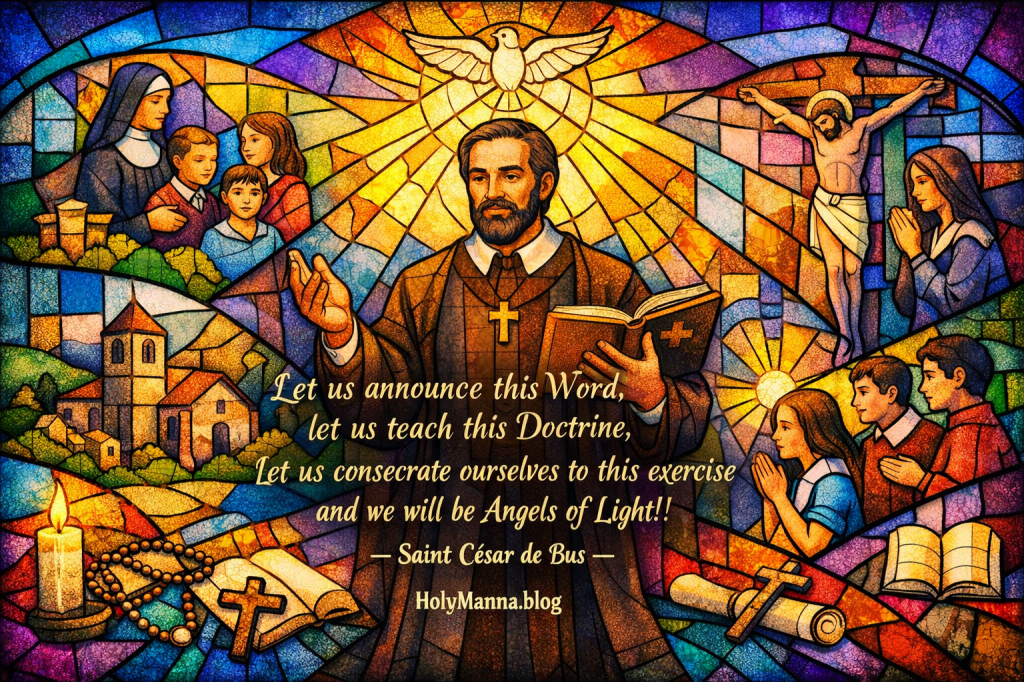
Another saying from his tradition captures the fire that drove him: “Let us announce this Word, let us teach this Doctrine, let us consecrate ourselves to this exercise and we will be Angels of Light!” That is not the language of a man treating catechesis like a classroom duty. That is the language of a priest who believed that teaching the truth was part of spiritual warfare.
Trials Without the Crown of Martyrdom
Saint César de Bus was not a martyr in the strict sense. He did not die by execution for the faith. Still, his life was marked by suffering, perseverance, and quiet endurance. In many ways, his hardships fit the pattern of countless confessors of the faith whose holiness was proved not in a single dramatic death, but in long fidelity.
He faced physical and moral trials. Some early companions left him. Human disappointment weighed on him. The labor of building and sustaining a new community was not simple. Most painfully, he suffered progressive blindness, which became total near the end of his life. For a man so committed to teaching, reading, writing, and forming others, this was a heavy cross.
Yet he did not abandon his mission. He endured. He continued to offer himself to God. This is one reason his life is so relatable. Many Catholics are not asked to die in an arena. They are asked to remain faithful through discouragement, weakness, misunderstanding, and slow suffering. Saint César shows how to do that with courage.
He died in Avignon on April 15, 1607, which that year was Easter Sunday. There is something deeply fitting in that. The man who had spent his life handing on the truth of the risen Christ died on the day the Church rejoices in the Resurrection.
Wonders, Healings, and the Growth of His Legacy
After his death, devotion to Saint César de Bus grew quickly. People reportedly said, “A saint has died,” and his reputation for holiness spread. One of the most notable early stories connected to his death is the report that when his body was examined after more than a year in a damp burial place, it was found intact. This was treated as a sign in the history of his cause, though it is not usually listed as a separately decreed miracle.
The Church’s formal recognition of miracles through his intercession came later. For his beatification, two healings were recognized: the healing of Pasquale Savino, who suffered acute pulmonary syndrome with cardio-respiratory failure, and the healing of Maria Bianco, who suffered a rapidly developing thyroid cancer. These were accepted in the progress of his cause.
For his canonization, the recognized miracle involved the healing of a young woman from Salerno in 2016 who was suffering from severe bacterial meningitis in the context of a grave cerebral condition. Prayers were offered, relics and prayer cards were circulated, vigils were held, and her recovery was judged miraculous in the process that led to his canonization.
There are also broader stories of favors received through his intercession at his tomb and through devotion to him over the centuries. These stories are part of his living cult and reputation for sanctity, though not every individual account can be historically verified. Since they cannot all be verified individually, they should be received with reverence and prudence.
His cause for canonization had a long and difficult path. It moved forward, then faced delays, including complications in the history of his religious family and the upheavals of the French Revolution. Still, the Church did not forget him. Pope Pius VII recognized his heroic virtues in 1821. Pope Paul VI beatified him in 1975. Pope Francis canonized him on May 15, 2022.
His impact after death has not been merely devotional. It has been deeply ecclesial. His congregation continued his work across nations, and his spirit still shapes catechists, priests, schools, youth formation, and Catholic teaching ministries. His feast is celebrated on April 15, and his legacy remains especially meaningful wherever Catholics are serious about handing on the faith to the next generation.
Why the Church Still Needs Saint César
Saint César de Bus feels especially timely because the modern world suffers from many of the same wounds he confronted. There is confusion about truth. There is weak formation. There are Catholics who know religious language without really knowing the faith. There are families trying to raise children in a culture that has forgotten how to speak clearly about God.
Saint César offers a remedy that is both simple and demanding. Teach the truth. Live the truth. Love the souls in front of you. Start with the basics, but do not stay shallow. Bring doctrine down to earth without watering it down. Let the faith be seen not only in speech, but in conduct.
His life also carries a challenge for Catholic parents. One saying preserved in his tradition puts it plainly: “Parents should instruct their children more by example than by words, because example is more effective than words.” That fits beautifully with the Church’s teaching in CCC 2223, which reminds parents of their serious responsibility in the formation of their children.
There is something refreshing about a saint who was not remembered first for spectacle, but for fidelity. He reminds the Church that teaching the faith is not secondary work. It is an act of charity. It is a work of mercy. It is one of the ways Christ continues to gather His people and keep them close to Himself.
Learning to Become a Living Catechism
The witness of Saint César de Bus invites a very practical examination of conscience. How seriously is the faith being learned? How faithfully is it being handed on? How much of daily life actually reflects what the Church teaches?
His example suggests a few very concrete paths. Catholics can recommit to learning the faith, not in a hurried or merely academic way, but as disciples. Families can take catechesis seriously at home, with prayer, Scripture, and honest conversation. Teachers and parish leaders can remember that clarity is an act of love. Every Catholic can ask whether life itself is becoming a witness to truth.
Saint César also reminds believers not to despair over a wasted past. His own life began with worldliness and drift, yet grace made him into a founder and a saint. That should encourage every soul who feels late in responding to God. The Lord still writes beautiful stories with surrendered lives.
What would change if Christian doctrine were treated not as information, but as a way of life? How much stronger would Catholic homes become if truth were taught with both conviction and tenderness? What part of the faith needs to be learned more deeply and lived more honestly right now?
Engage With Us!
Share your thoughts and reflections in the comments below. Saint César de Bus is a powerful reminder that knowing the faith and living it belong together, and it would be beautiful to hear how his witness speaks to the heart.
- What stands out most in Saint César de Bus’s journey from worldliness to holiness?
- How can Catholic families become stronger places of catechesis and example?
- What part of the faith feels most important to learn more deeply at this stage of life?
- How can Saint César’s love for clear teaching inspire better witness at home, at work, or in parish life?
- What does it mean personally to become, in his words, a “living catechism”?
May Saint César de Bus intercede for every soul trying to know Christ more deeply and live the faith more faithfully. May his example teach hearts to love truth, cherish the Church, and do everything with the love and mercy Jesus taught us.
Saint César de Bus, pray for us!
Follow us on YouTube, Instagram and Facebook for more insights and reflections on living a faith-filled life.


Leave a Reply