The Quiet Saint of Saint Peter’s
Saint Abbondio is one of those saints who reminds the Church that holiness does not always arrive with public fame, dramatic preaching, or a long written legacy. Sometimes holiness is hidden near the altar, carried out through humble service, reverence, and obedience. Celebrated on April 15, Saint Abbondio is remembered in Roman Catholic tradition as a holy cleric attached to Saint Peter’s Basilica in Rome, a man whose life was marked by fidelity in the house of God and whose memory was preserved because heaven chose to make known what the world might otherwise have overlooked.
He is revered because he shows that sanctity can flourish in ordinary duties. He did not become famous for founding an order, writing theological masterpieces, or ruling a diocese. Instead, he became known for his humility, his service, and the grace of God working through him. In a world that chases recognition, Saint Abbondio stands as a calm and powerful witness that God sees the hidden soul. That alone makes him deeply significant for Christians today.
A Life Mostly Hidden from History
The historical record about Saint Abbondio’s early life is very limited. Catholic tradition does not preserve clear details about his birthplace, his parents, or the circumstances of his childhood. There is no detailed account of a dramatic conversion, nor is there a full narrative biography like the ones attached to some of the better-known saints. What the Church does preserve is enough to show what mattered most. Saint Abbondio lived in Rome and served at Saint Peter’s Basilica as a mansionario or sacristan, a role tied to the care and service of that sacred place.
That silence around his beginnings is not a weakness in his story. In many ways, it is part of the point. His sanctity was not built on worldly importance or on a carefully preserved public image. He seems to have been a man who belonged entirely to the service of God, and that hidden life became the soil in which holiness grew. What he is most known for is not status, but faithful service in the Church and the miraculous healing associated with him.
The main source for his life in Catholic tradition is The Dialogues of Saint Gregory the Great. That matters because Saint Gregory did not preserve Abbondio’s memory as a curiosity. He preserved it because he recognized in him genuine sanctity. Saint Abbondio is remembered as a man of great humility, and that humility is the thread that runs through everything known about him.
The Grace That Shone Through His Service
Saint Abbondio’s importance comes from the way his life reveals the beauty of hidden holiness. He served Saint Peter’s Basilica with reverence and fidelity, and the Church remembered him precisely because of that quiet faithfulness. He shows that the smallest duties, when carried out with love for Christ, are never small in the eyes of God.
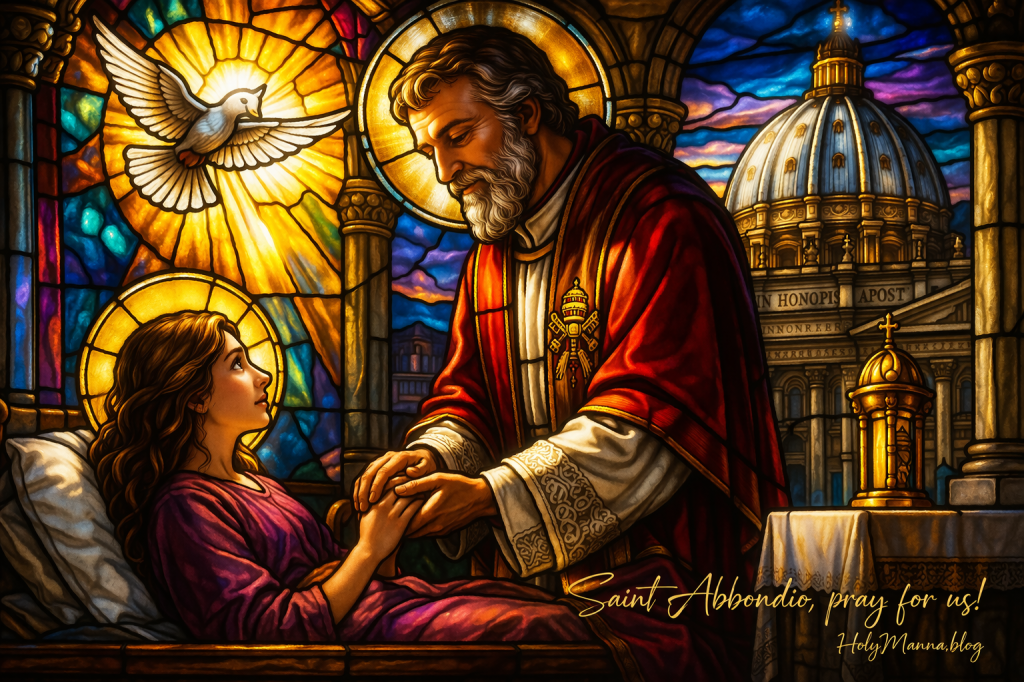
The most famous event associated with his life is the healing of a paralyzed girl. According to the Catholic tradition preserved through Saint Gregory the Great, the girl had long prayed to Saint Peter for relief from her suffering. In a vision, Saint Peter directed her to seek out Abbondio. She found him at the basilica and explained what had happened. His response was simple and full of trust: “If it is he who sends you, then rise up.” He took her by the hand, lifted her up, and she was healed.
This miracle is striking not only because of the healing itself, but because of what it says about Abbondio. Saint Peter, prince of the Apostles, is shown directing a suffering soul not to a famous public figure, but to a humble servant of the basilica. That is deeply Catholic. God delights in exalting the humble. He often hides His greatest works in places the world barely notices.
Saint Abbondio should be remembered because he teaches a truth that Christians easily forget. Holiness is not reserved for those in the spotlight. Holiness belongs to those who love God where He has placed them. A sacristan who serves faithfully, a parent who prays in secret, a worker who acts with integrity, a soul who quietly obeys Christ in daily life all of these can become great saints.
Trials, Limits, and the Silence of a Saint
Unlike many saints of the early Church, Saint Abbondio is not chiefly remembered as a martyr. Catholic tradition does not preserve an account of imprisonment, torture, exile, or violent execution in his case. There is also no verified story of a dramatic persecution or miraculous escape from death attached to him. That does not make his witness less meaningful. In fact, it makes it more relatable for many Christians.
His hardship seems to have been the hidden one that so many holy souls endure. He lived without earthly acclaim. He served in obscurity. He carried out sacred duties without fanfare. He lived the kind of life the world would pass over quickly, but the Church did not. The Church remembered because grace had transformed his ordinary service into extraordinary holiness.
There is something deeply consoling in that. Not every saint is called to shed blood in martyrdom. Some are called to the white martyrdom of daily fidelity, the offering of self in quiet service, the patient endurance of a life that appears small in the eyes of others. Saint Abbondio stands in that tradition. He shows that perseverance in hidden duty can itself be a heroic witness.
Memory, Veneration, and the Legacy of a Hidden Saint
After his death, Saint Abbondio’s legacy endured not through a large popular cult, but through the liturgical memory of the Church, especially in connection with Saint Peter’s Basilica. His feast remained associated with Rome, and the clergy connected to Saint Peter’s kept his remembrance alive. That quiet continuity says a great deal. He was not forgotten because the Church recognized in him a real friend of God.
There are no widely verified posthumous miracle stories comparable in number to those attached to some major saints. The tradition surrounding him is sparse. The healing of the paralyzed girl during his lifetime remains the central miracle associated with his name. Some devotional retellings and local memories may speak more broadly of his holiness and intercession, but there is no large body of clearly verified miracle accounts after death that has come down through Catholic tradition.
There are also no famous relic traditions, grand international pilgrimages, or widespread national festivals firmly attached to him in the way one sees with saints of larger public devotion. If later local stories existed beyond the main account, they are not securely preserved or verified in the surviving Catholic record. That should be stated plainly. Nothing needs to be exaggerated to make Saint Abbondio worth loving. His greatness is already clear.
His cultural impact is more subtle and more Roman. He belongs to that beautiful line of saints whose legacy is liturgical, spiritual, and exemplary. He reminds the faithful that the sanctuary is holy ground, that service to the Church matters, and that God’s grace often rests upon those who labor quietly for His glory. In that sense, his witness still speaks powerfully to Catholics today.
What Saint Abbondio Teaches the Soul
Saint Abbondio’s life invites Christians to examine what kind of greatness they are seeking. The world urges people to be seen, praised, followed, and admired. The saints teach something different. They teach that the real question is whether a soul is faithful to Christ. Saint Abbondio appears in history almost like a candle burning in a quiet chapel. He does not overwhelm by noise. He draws the heart by peace.
His story encourages believers to take small acts seriously. Cleaning the church, serving reverently at Mass, praying faithfully when nobody notices, carrying out daily obligations with love, and remaining humble when no one applauds are all paths to sanctity. The Catechism teaches that every Christian is called to holiness, and Saint Abbondio is a simple, convincing example of that truth lived out.
His miracle also teaches trust in divine providence. He did not act with self-importance. He acted with obedience. He believed that if Saint Peter had sent the girl, then God would do the rest. That is a lesson worth keeping close. Christians do not save by their own power. They cooperate with grace. They act in faith. They leave room for God to work.
Is there a hidden duty in life that has been treated as too small to matter? Saint Abbondio would gently say otherwise. Is there a temptation to measure worth by visibility, success, or recognition? His life answers with a quiet rebuke. Is there a need to trust that God sees the sacrifices others overlook? Saint Abbondio’s memory says yes, absolutely yes.
Engage With Us!
Share thoughts and reflections in the comments below. Saint Abbondio may be a quiet saint, but his witness can speak very loudly to the heart. There is something deeply moving about a man remembered not for worldly greatness, but for holiness in service.
- What part of Saint Abbondio’s hidden life speaks most strongly to the heart?
- Has there been a tendency to think that ordinary duties are too small to matter to God?
- How can greater reverence, humility, and fidelity be brought into daily responsibilities this week?
- What does the healing of the paralyzed girl reveal about God’s love for the humble and forgotten?
- In what ways can Saint Abbondio’s example help Catholics serve the Church more faithfully today?
May Saint Abbondio inspire every soul to seek holiness in humble places, to serve Christ with reverence and love, and to live each day with the mercy, faithfulness, and quiet charity that Jesus taught.
Saint Abbondio, pray for us!
Follow us on YouTube, Instagram and Facebook for more insights and reflections on living a faith-filled life.


Leave a Reply