Wednesday of the Second Week of Easter – Lectionary: 269
When Heaven Opens the Locked Door
There are days in the Easter season when the Church seems to place a lamp in the middle of the soul and ask whether it is truly ready to live in the light. Today is one of those days. The readings are bound together by one clear and beautiful theme: God does not leave his people trapped in darkness, fear, or death, but draws them into the light of Christ and sends them out to live that new life boldly. In Acts 5:17-26, the apostles are locked in prison by jealous leaders, yet the Lord opens the doors and sends them back out to proclaim “everything about this life.” In Psalm 34, the poor man cries out and discovers that the Lord hears, delivers, and surrounds his faithful with saving care. Then in John 3:16-21, the deepest reason for all of it is revealed: “God so loved the world that he gave his only Son”, not to condemn the world, but to save it.
This is the atmosphere of the early Church during Easter. The apostles are preaching in Jerusalem, the same city where Christ was condemned, crucified, and raised. The religious authorities are anxious, the crowds are watching, and the newborn Church is learning that resurrection faith will always meet resistance from those who prefer control, silence, or darkness. At the same time, the Gospel of John lifts the reader above the conflict and into the heart of God himself. The mission of the apostles only makes sense in light of the Father’s love. The courage of the Church only makes sense in light of the risen Christ. The call to step into the light only makes sense because salvation is being offered, not withheld.
Taken together, these readings prepare the heart for a serious but hopeful meditation. They remind the faithful that Easter is not only about what happened to Jesus, but about what now happens to everyone who believes in him. Prison doors open. Fear loses its authority. Truth steps into the light. The soul that has tasted the goodness of the Lord cannot stay hidden forever. What does it mean to let Christ bring every corner of life into his light? That is the question quietly waiting beneath today’s readings, and it is the question that leads the reader deeper into each passage.
First Reading – Acts 5:17-26
Locked Doors, Open Heaven
The first reading unfolds in Jerusalem, in the tense and radiant days after Pentecost, when the apostles are no longer hiding behind closed doors but preaching openly in the very city where Christ was crucified and rose again. The men opposing them are not random critics. The high priest and the Sadducees represent powerful religious authority, and the Sadducees in particular denied the resurrection of the dead. That matters here. The apostles are not simply announcing a moral message or a new religious opinion. They are proclaiming that Jesus, whom the authorities condemned, is alive. That message shakes the foundations of everything the Sadducees want to preserve.
This is why the reading fits so perfectly within today’s theme. The Lord does not leave his people trapped in fear, darkness, or confinement. He brings them into the light and sends them back into mission. The apostles are arrested, but heaven is not blocked by prison walls. Their release is not just a rescue story. It is a mission story. God opens the doors so that the Gospel may keep moving, and he sends the apostles back to the temple to proclaim “everything about this life.” That phrase carries the heart of Easter. Christ is risen, and now a new life has begun, a life of grace, truth, courage, and witness.
Acts 5:17-26 – New American Bible (Revised Edition)
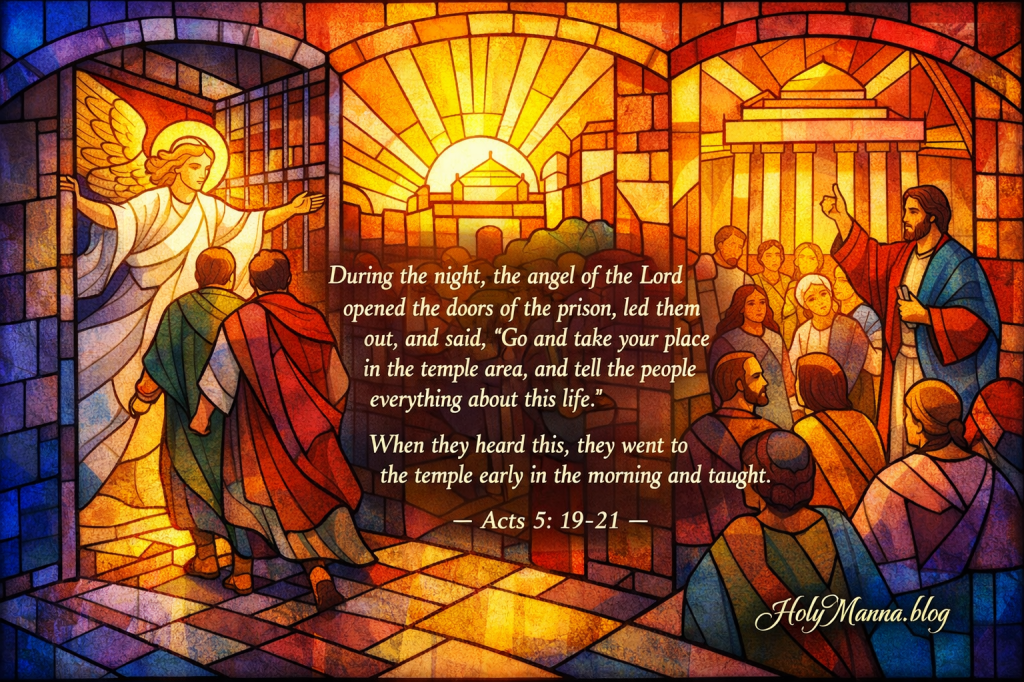
17 Then the high priest rose up and all his companions, that is, the party of the Sadducees, and, filled with jealousy, 18 laid hands upon the apostles and put them in the public jail. 19 But during the night, the angel of the Lord opened the doors of the prison, led them out, and said, 20 “Go and take your place in the temple area, and tell the people everything about this life.” 21 When they heard this, they went to the temple early in the morning and taught. When the high priest and his companions arrived, they convened the Sanhedrin, the full senate of the Israelites, and sent to the jail to have them brought in. 22 But the court officers who went did not find them in the prison, so they came back and reported, 23 “We found the jail securely locked and the guards stationed outside the doors, but when we opened them, we found no one inside.” 24 When they heard this report, the captain of the temple guard and the chief priests were at a loss about them, as to what this would come to. 25 Then someone came in and reported to them, “The men whom you put in prison are in the temple area and are teaching the people.” 26 Then the captain and the court officers went and brought them in, but without force, because they were afraid of being stoned by the people.
Detailed Exegesis
Verse 17 – “Then the high priest rose up and all his companions, that is, the party of the Sadducees, and, filled with jealousy,”
The reading begins not with prayer or peace, but with jealousy. That detail matters. The opposition to the apostles is not presented first as an intellectual disagreement, but as a spiritual disorder in the heart. Jealousy appears when truth bears fruit and proud men resent what they cannot control. The Sadducees are especially threatened because apostolic preaching about the Resurrection directly contradicts their theological position. In the biblical world, jealousy often reveals a deeper refusal to surrender to God’s work.
Verse 18 – “laid hands upon the apostles and put them in the public jail.”
The authorities move from interior resentment to outward force. The apostles are treated like public troublemakers because the Gospel is no longer private. Their preaching is visibly affecting the people. The public jail also signals humiliation. The leaders want to shame the apostles and warn the crowds. Yet throughout The Acts of the Apostles, human attempts to stop the Gospel only become occasions for God to show his power more clearly.
Verse 19 – “But during the night, the angel of the Lord opened the doors of the prison, led them out, and said,”
This verse shifts the whole scene. Human power closes doors, but heaven opens them. The intervention of the angel reminds the reader that the Church is never left alone in her trials. God is not distant from the struggle of his people. He acts, often quietly and decisively, in the middle of the night, which in Scripture often symbolizes fear, testing, and hidden suffering. The release is not merely miraculous. It is theological. The same God who raised Christ from the tomb is still breaking open places of confinement.
Verse 20 – “Go and take your place in the temple area, and tell the people everything about this life.”
The angel does not say, “Run away and stay safe.” He sends them back to the center of public religious life. The temple is not only a location. It is the symbolic heart of Israel’s worship. God is showing that the apostolic message belongs there, because Christ fulfills everything the temple pointed toward. The phrase “this life” is especially rich. It means the new life of the risen Christ, the life of grace, the life of the Holy Spirit, the life that begins in faith and Baptism and opens toward eternal life. The apostles are told to preach not fragments, but the fullness of the Gospel.
Verse 21 – “When they heard this, they went to the temple early in the morning and taught. When the high priest and his companions arrived, they convened the Sanhedrin, the full senate of the Israelites, and sent to the jail to have them brought in.”
The apostles obey immediately. That is one of the most beautiful features of this passage. Their miracle is matched by their obedience. They do not delay, argue, or calculate. They go at once, and they go early. Meanwhile, the Sanhedrin gathers in formal seriousness, as though it still controls the situation. The contrast is almost dramatic. Earthly authority organizes its procedures while heaven has already moved the story forward. The apostles are already teaching while the council is still preparing to question them.
Verse 22 – “But the court officers who went did not find them in the prison, so they came back and reported,”
This verse heightens the tension and underlines the public nature of the miracle. The officers expect a routine task, but they become witnesses to something they cannot explain. The reading does not rush past this moment. It lingers, because God’s action is meant to confront unbelief. The authorities who thought they had contained the apostles now face a reality their power cannot manage.
Verse 23 – “We found the jail securely locked and the guards stationed outside the doors, but when we opened them, we found no one inside.”
The locked doors and standing guards are not incidental details. They establish that the apostles did not escape through human cleverness. The prison remained externally secure, yet empty. This mirrors the logic of Easter itself. The tomb was real, the stone was real, the guards were real, and yet Christ rose. In the same way, the Church’s freedom cannot be reduced to human strategy. God acts beyond the limits of visible control. The detail also exposes the fragility of merely external religion. A locked structure is not enough when God chooses to act.
Verse 24 – “When they heard this report, the captain of the temple guard and the chief priests were at a loss about them, as to what this would come to.”
The authorities are unsettled because the event threatens their sense of order. They are not moved yet to repentance, but they are confused. This is often how divine action first breaks into hardened hearts. It disturbs false certainty. They are forced to ask what this may become because the Gospel is already growing beyond containment. Human institutions can resist grace, but they cannot finally master it.
Verse 25 – “Then someone came in and reported to them, ‘The men whom you put in prison are in the temple area and are teaching the people.’”
This is almost holy irony. The men who were supposed to be silenced are now back in the very place where their message carries the greatest public weight. The apostles are not merely free. They are visibly faithful. Their return to teaching shows that their courage is rooted in conviction, not in temperament. They have seen the risen Lord. They know that obedience to God is greater than fear of men.
Verse 26 – “Then the captain and the court officers went and brought them in, but without force, because they were afraid of being stoned by the people.”
The reading closes with a striking reversal. The officers who once acted confidently must now proceed carefully. Public sympathy has shifted toward the apostles. The people have seen enough to recognize that something holy is happening. The authorities still possess official power, but their moral confidence is weakening. This verse also shows how God can protect his servants through the very people who receive the Gospel. The apostles remain vulnerable, but not abandoned.
Teachings
This reading reveals that the Church is born not from human security but from the risen power of Christ. The apostles are not building a movement by charisma or strategy. They are continuing the mission of Jesus in the power of the Holy Spirit. The Catechism teaches in CCC 765, “The Lord Jesus inaugurated his Church by preaching the Good News, that is, the coming of the Reign of God, promised over the ages in the scriptures.” What appears in this reading is that same reign now advancing through the apostles. The prison cannot stop it. Jealousy cannot silence it. Official resistance cannot bury it.
The passage also shows that witness is essential to Christian life. The apostles are not set free for comfort. They are set free for proclamation. The Catechism says in CCC 425, “The transmission of the Christian faith consists primarily in proclaiming Jesus Christ in order to lead others to faith in him.” That is exactly what is happening in the temple precincts. The apostles are not simply defending themselves. They are leading others to faith in the risen Lord.
The courage of the apostles also reflects the Church’s teaching on public witness. The Catechism teaches in CCC 1816, “The disciple of Christ must not only keep the faith and live on it, but also profess it, confidently bear witness to it, and spread it.” This reading gives that truth a human face. Faith that remains silent under pressure is not yet mature in the apostolic sense. The apostles show what happens when men know that Christ is alive and that eternal life matters more than earthly approval.
The angel’s role in this reading also fits beautifully with Catholic teaching on divine providence and angelic care. The Catechism says in CCC 336, “From its beginning until death, human life is surrounded by their watchful care and intercession.” The appearance of the angel does not distract from Christ. It serves Christ’s mission. In Catholic tradition, angels are never decorative figures. They are messengers and servants of God’s saving plan.
Saint John Chrysostom, preaching on this passage, notes that God allowed the imprisonment so that the miracle and the apostles’ boldness would be more clearly seen. The point is deeply important. God does not always prevent trial, but he often uses trial to reveal the truth more plainly. The apostles are not strong because they avoid suffering. They are strong because grace has made them steadfast inside it.
There is also a historical edge to this reading that should not be missed. The Sadducees denied the resurrection, accepted only the written Torah in a narrow way, and were closely connected to temple leadership. The apostles, by contrast, are proclaiming Jesus risen from the dead and teaching in the temple itself. This is not an accidental clash. It is a direct conflict between a closed religious system and the living fulfillment of God’s promises. The old order, when hardened by pride, resists the very Messiah it was meant to receive.
This passage also foreshadows the Church’s long history of persecution and perseverance. Long before Christian martyrs filled the Roman arenas, the pattern was already established in Jerusalem. Arrest, witness, miracle, public testimony, and further opposition all appear here in seed form. The Catechism expresses this spirit in CCC 2473: “Martyrdom is the supreme witness given to the truth of the faith: it means bearing witness even unto death.” The apostles in this reading have not yet shed their blood, but they are already walking the road of that witness.
Reflection
There is something deeply reassuring in this reading for ordinary Catholic life. Most believers will never be thrown into a public jail for preaching Christ, but many know what it feels like to be hemmed in by fear, social pressure, discouragement, temptation, or the quiet intimidation of a hostile culture. This reading says plainly that the Lord is not helpless in front of locked doors. He knows how to free a soul, and he knows how to send it back into the very place where witness is needed.
The apostles also teach that Christian courage is usually simpler than people imagine. It begins with obedience. The angel says go, and they go. They return to the temple early in the morning. Holiness often looks like that. It looks like getting up and praying when prayer feels dry. It looks like speaking the truth charitably when silence would be easier. It looks like going to Mass faithfully, going to Confession honestly, and refusing to let shame or fear define the soul’s future.
This reading invites some very concrete steps. A Catholic can begin by asking the Lord to reveal the “prison” that has quietly become normal. It may be resentment, impurity, cowardice, addiction to approval, spiritual laziness, or a habit of hiding faith in public. Then comes the second step, which is not merely asking for relief, but asking for mission. The apostles were freed to speak. The question is not only, “Lord, get this burden away from me.” The deeper question is, “Lord, once you free this heart, where are you sending it?”
It is also worth noticing that the apostles were told to preach “everything about this life.” Not part of it. Not the safe parts. Not the parts that draw applause. That matters in daily life. Catholic faith cannot be reduced to private comfort or vague inspiration. It is a whole way of living. It touches speech, purity, family life, work, conscience, forgiveness, and public witness. What part of the Gospel has been treated like something optional instead of something life-giving? Where has fear made faith smaller than it is meant to be? What locked door in the heart needs to be placed before the risen Christ today?
The beauty of the reading is that it does not end in despair or even in conflict. It ends with the apostles still standing, still speaking, still obeying. That is the real victory in the passage. The miracle is not just that the doors opened. The greater miracle is that their hearts remained open too. That is the grace worth asking for today. Lord, open what fear has closed, strengthen what suffering has weakened, and make this life in Christ too bright to hide.
Responsorial Psalm – Psalm 34:2-9
The Song of the Rescued Soul
The responsorial psalm today sounds like the voice of someone who has passed through fear and come out praising. That is exactly why the Church places Psalm 34 beside the story of the apostles being freed from prison and the Gospel proclamation that God sent his Son to save the world. This psalm belongs to the biblical tradition of thanksgiving, a prayer offered after deliverance, when the heart looks back and sees that God was present even in the distress. Its superscription connects it to David during a time of danger, when he escaped the hands of a hostile king. In that light, the psalm is not romantic poetry. It is testimony born from pressure, vulnerability, and rescue.
That context makes the psalm especially fitting for Easter. The apostles have just been imprisoned and then delivered by the Lord. The Church answers not with panic, but with praise. The poor cry out, the Lord hears, and the angel of the Lord surrounds those who fear him. Then the psalm reaches its most beloved line: “Taste and see that the Lord is good.” For Catholic ears, that verse has always carried a deep Eucharistic beauty. The God who rescues is not distant. He draws near enough to be tasted, adored, and received. Today’s psalm fits the day’s theme perfectly. The Lord brings his people out of fear and into the light of trust, praise, and living communion with him.
Psalm 34:2-9 – New American Bible (Revised Edition)
2 I will bless the Lord at all times;
his praise shall be always in my mouth.
3 My soul will glory in the Lord;
let the poor hear and be glad.
4 Magnify the Lord with me;
and let us exalt his name together.5 I sought the Lord, and he answered me,
delivered me from all my fears.
6 Look to him and be radiant,
and your faces may not blush for shame.
7 This poor one cried out and the Lord heard,
and from all his distress he saved him.
8 The angel of the Lord encamps
around those who fear him, and he saves them.
9 Taste and see that the Lord is good;
blessed is the stalwart one who takes refuge in him.
Detailed Exegesis
Verse 2 – “I will bless the Lord at all times; his praise shall be always in my mouth.”
This verse opens with a decision, not a feeling. The psalmist does not say that praise will come only when life is easy. He says that he will bless the Lord at all times. That is one of the clearest marks of biblical faith. True praise is not built on comfort, but on confidence in God’s goodness. In Catholic life, this verse teaches that worship is not merely a reaction to blessings already understood. It is an act of trust offered even when the road is not fully clear.
Verse 3 – “My soul will glory in the Lord; let the poor hear and be glad.”
The psalmist does not boast in himself. He glories in the Lord. That is an important distinction. The soul finds its dignity not by inflating itself, but by rejoicing in God. The mention of the poor is equally important. In Scripture, the poor are often those who know their need and lean upon God. This verse widens praise from something personal into something communal. The soul that has tasted God’s mercy begins to strengthen others by its witness.
Verse 4 – “Magnify the Lord with me; and let us exalt his name together.”
Praise now becomes an invitation. The psalmist calls others into worship. This is the movement of the Church. The one who has encountered God does not remain isolated. He gathers others into thanksgiving. In the liturgy, this is exactly what happens. The people of God do not merely think private holy thoughts. They lift up the Lord together. This verse also fits beautifully with the apostles in Acts 5. Once God has acted, silence is no longer appropriate. Praise seeks company.
Verse 5 – “I sought the Lord, and he answered me, delivered me from all my fears.”
The verse does not say that every danger vanished instantly. It says that the Lord delivered the psalmist from fear. That is a deeper salvation than mere circumstantial relief. Fear can imprison the soul long before chains ever touch the body. The psalm teaches that when the heart turns toward God, something interior changes. Fear loses its mastery. This fits today’s first reading perfectly. The apostles do not become fearless because the world becomes safe. They become bold because the Lord has answered them.
Verse 6 – “Look to him and be radiant, and your faces may not blush for shame.”
This is one of the most tender lines in the psalm. The face turned toward God becomes radiant. Shame no longer rules the soul that lives in his presence. In the Bible, the face often reveals the inner condition of the heart. A downcast face can reflect guilt, fear, or humiliation. A radiant face reflects trust and restored dignity. This verse quietly anticipates the Gospel theme of light. Those who turn toward the Lord do not remain buried in darkness. They begin to shine with borrowed light.
Verse 7 – “This poor one cried out and the Lord heard, and from all his distress he saved him.”
The psalm becomes very personal here. The poor one is not an abstract figure. He is the worshiper himself, standing before God in need. This is the language of humility. Salvation begins when the soul stops pretending to be self-sufficient. The Lord hears the cry of the poor because the poor know they need saving. In Catholic spirituality, this verse echoes the whole logic of grace. God is not won over by pride, but received through humility.
Verse 8 – “The angel of the Lord encamps around those who fear him, and he saves them.”
This verse beautifully joins today’s psalm to today’s first reading. In Acts 5, an angel of the Lord literally frees the apostles from prison. Here, the psalm proclaims that God’s heavenly protection surrounds those who fear him. To fear the Lord in biblical language does not mean servile terror. It means reverence, obedience, and a heart that knows God is holy. The image of the angel encamping around the faithful suggests a military protection, as though heaven itself keeps watch over the believer.
Verse 9 – “Taste and see that the Lord is good; blessed is the stalwart one who takes refuge in him.”
This verse brings the psalm to a kind of summit. Faith is not presented only as an idea to be accepted. It is an invitation to experience the goodness of God. The language of tasting is strikingly intimate. The Lord is not merely discussed. He is encountered. In Catholic tradition, this verse has naturally been heard in relation to the Eucharist, where the goodness of the Lord is not only believed, but sacramentally received. The final phrase also matters. The blessed one is the one who takes refuge in him. Holiness begins with trusting the right shelter.
Teachings
This psalm teaches that praise is one of the most basic responses of the redeemed heart. The Catechism speaks beautifully about this in CCC 2639: “Praise is the form of prayer which recognizes most immediately that God is God. It lauds God for his own sake and gives him glory, quite beyond what he does, but simply because HE IS.” That line goes right to the center of Psalm 34. The psalmist praises God not only because he has been rescued, but because the rescue has revealed who God is.
The psalm also reflects the Church’s teaching on confidence in divine help and the ministry of angels. The Catechism states in CCC 336: “From its beginning until death, human life is surrounded by their watchful care and intercession. Beside each believer stands an angel as protector and shepherd leading him to life.” Today’s reading makes that truth feel wonderfully concrete. The same God who surrounded David, and who sent his angel to free the apostles, still governs his people with providence and care.
The line “Taste and see that the Lord is good” has long nourished Catholic Eucharistic devotion. The Church teaches in CCC 1324: “The Eucharist is ‘the source and summit of the Christian life.’” That teaching shines here because the Christian does not only remember that God is good. The Christian is fed by that goodness. The Lord gives himself as food, and so the psalm’s language of taste finds a sacramental depth that reaches its fulfillment in the Mass.
Saint Augustine, reflecting on this psalm, draws out its challenge and beauty. He writes, “Bless the Lord at all times, whether in prosperity or in adversity. For when thou blessest the Lord in prosperity, thou dost take heed that in adversity thou faint not.” That is classic Augustine. Praise is not decorative. It trains the heart to remain faithful when hardship comes. The psalmist’s language becomes a school of endurance.
Saint John Paul II also reflected on this psalm and highlighted its movement from anguish to joy. He taught that the faithful are invited to join the prayer of the poor and to discover that God’s answer restores dignity and peace. That matters today because the psalm is not about triumphalism. It is about rescue. The one singing is not self-made. He is saved.
Historically, this psalm has remained close to the Church’s life of persecution, deliverance, and worship. It has been prayed by monks in choir, by martyrs in danger, by penitents seeking mercy, and by Eucharistic believers kneeling in adoration. That long Catholic memory matters. Psalm 34 is not only an ancient text. It is a living prayer of the Church, still teaching souls how to trust, how to adore, and how to praise.
Reflection
This psalm speaks gently but directly to daily life because most people know what fear feels like. Fear over health, family, money, reputation, the future, old wounds, hidden sin, and unanswered questions can slowly tighten around the heart. Psalm 34 does not deny any of that. It simply refuses to let fear have the final word. It teaches the soul to seek the Lord, to cry out honestly, and to believe that God hears.
There is also a practical lesson here about praise. Many people wait to praise God until life feels settled. The psalm invites something stronger and truer. Praise can begin now. A Catholic can bless the Lord in the morning before the day is clear, in the middle of stress instead of after it, and in the presence of suffering without pretending that suffering is pleasant. Praise reorders the heart. It reminds the soul that God remains good even when life is heavy.
The line about radiance and shame is especially important. A great number of people carry shame quietly. Some carry shame over past sins. Some carry shame over weakness, failure, or wounds they cannot seem to outgrow. The psalm does not say to stare endlessly at the shame. It says, “Look to him and be radiant.” That is a deeply healing direction. The soul is changed not by circling around itself, but by turning toward the Lord with honesty and trust.
Then comes that verse the Church never tires of praying: “Taste and see that the Lord is good.” This is an invitation to deeper Eucharistic faith. It is a call to go to Mass attentively, to receive the Lord worthily, to kneel before him in adoration, and to remember that Christian life is not sustained by vague inspiration. It is sustained by communion with Christ himself.
A few simple steps flow naturally from this psalm. Begin by naming one fear before God each day instead of hiding it behind distraction. Spend a few moments offering praise before asking for anything else. Pray slowly with Psalm 34 before Mass or after Communion. Let the soul practice refuge in God rather than refuge in noise, control, or self-reliance. What fear has been treated as permanent when the Lord is ready to meet it? What would change if praise became a daily habit instead of an occasional reaction? How might the heart become more radiant by turning more steadily toward Christ in prayer and in the Eucharist?
This psalm leaves the reader with a beautiful image of Christian life. The poor cry out. The Lord hears. Heaven stands guard. The soul tastes divine goodness and learns to bless the Lord at all times. That is not sentimental religion. That is the steady joy of a life learning, little by little, to take refuge in God.
Holy Gospel – John 3:16-21
Loved Into the Light
The Holy Gospel today opens the heart of Easter with some of the most beloved words in all of Scripture, but it helps to remember where these words appear. They come from Jesus’ nighttime conversation with Nicodemus, a Pharisee and a leader among the Jews. Nicodemus comes in the dark, both literally and spiritually. He is drawn to Jesus, but he does not yet see clearly. That setting matters. In The Gospel of John, darkness is never just the absence of sunlight. It often points to confusion, fear, unbelief, and the uneasy place where the human heart resists surrender. Into that darkness, Jesus speaks of new birth, heavenly things, the lifting up of the Son, and now, in today’s passage, the love of the Father that sends the Son to save the world.
This Gospel stands beautifully within today’s theme. In the first reading, prison doors are opened so the apostles may proclaim “everything about this life.” In the psalm, the poor cry out and discover that the Lord hears and saves. Here in John 3:16-21, the deepest reason for all that rescue is revealed. God acts because he loves. He sends the Son not to destroy sinners, but to save them. He shines light not to humiliate, but to heal. The whole Easter mystery is gathered here. The Cross is not a tragic interruption. It is the measure of divine love. The Resurrection is not a happy ending added later. It is the triumph of that love over sin and death. This Gospel invites the reader to see that salvation is offered freely, but it must be received honestly. The light has come, and every soul must decide whether to step toward it.
John 3:16-21 – New American Bible (Revised Edition)
16 For God so loved the world that he gave his only Son, so that everyone who believes in him might not perish but might have eternal life. 17 For God did not send his Son into the world to condemn the world, but that the world might be saved through him. 18 Whoever believes in him will not be condemned, but whoever does not believe has already been condemned, because he has not believed in the name of the only Son of God. 19 And this is the verdict, that the light came into the world, but people preferred darkness to light, because their works were evil. 20 For everyone who does wicked things hates the light and does not come toward the light, so that his works might not be exposed. 21 But whoever lives the truth comes to the light, so that his works may be clearly seen as done in God.
Detailed Exegesis
Verse 16 – “For God so loved the world that he gave his only Son, so that everyone who believes in him might not perish but might have eternal life.”
This verse is one of the clearest windows into the heart of God. The movement begins with the Father. Salvation does not start with man climbing upward, but with God giving downward. The word “world” here does not mean a morally pure humanity waiting patiently for rescue. In John’s Gospel, the world often means humanity in its fallen condition, marked by resistance, blindness, and sin. That is what makes the verse so astonishing. God loves not only the lovable, but the fallen world itself. He gives his only Son, not as a symbol, but as a real saving gift. Belief in John is not mere intellectual agreement. It means entrusting the whole self to Christ. Eternal life is not only future duration. It is participation even now in the life of God.
Verse 17 – “For God did not send his Son into the world to condemn the world, but that the world might be saved through him.”
This verse corrects one of the oldest distortions about God, the idea that he delights first in punishment. Jesus reveals something very different. The mission of the Son is fundamentally salvific. He comes as Savior. He comes as physician. He comes as redeemer. This does not cancel judgment, but it places judgment in the proper order. God’s first movement toward the sinner is mercy. The Cross itself proves that the Father is not indifferent to evil, but neither is he content simply to condemn. He acts to rescue. In Catholic teaching, grace always comes first. The sinner is pursued by divine love before he is ever capable of returning that love fully.
Verse 18 – “Whoever believes in him will not be condemned, but whoever does not believe has already been condemned, because he has not believed in the name of the only Son of God.”
This verse sounds severe, but it is actually very clarifying. Condemnation here is not presented as an arbitrary act. It is the tragic result of refusing the one source of salvation. If a man rejects the physician, he remains sick. If a soul refuses the light, it stays in darkness. To “believe in the name” of the Son means more than using the name of Jesus reverently. In biblical thought, the name expresses the person, authority, and mission of the one named. So refusal to believe is not simply hesitation. It is refusal of the person and saving work of Christ. The verse is sobering because it honors human freedom. Love is offered, but not imposed.
Verse 19 – “And this is the verdict, that the light came into the world, but people preferred darkness to light, because their works were evil.”
Now the Gospel goes deeper into the human heart. The problem is not that the light failed to arrive. The problem is that many prefer darkness. Sin is not only weakness. It can become attachment. People may choose darkness because darkness seems to protect pride, secrecy, or self-rule. In John’s Gospel, Christ himself is the light. To reject the light is to reject truth made present in a person. This verse also explains why the apostles in Acts face hostility. The presence of divine truth always exposes what is false. Some rejoice in that exposure. Others resent it.
Verse 20 – “For everyone who does wicked things hates the light and does not come toward the light, so that his works might not be exposed.”
This verse describes the fearful logic of sin. Sin wants cover. It does not want to be seen clearly. That is why secrecy often strengthens it. The sinner may speak of freedom, but he often avoids the light because he knows the light will name things truthfully. This is one reason why repentance feels hard. It is not only morally demanding. It is humbling. Yet exposure by Christ is never meant as cruelty. He reveals in order to heal. In Catholic life, this verse points toward examination of conscience, repentance, and sacramental confession, where hidden things are brought before grace.
Verse 21 – “But whoever lives the truth comes to the light, so that his works may be clearly seen as done in God.”
The Gospel ends with hope. The one who “lives the truth” does not merely think true thoughts. He acts in accordance with truth. He lets truth shape his life. He comes to the light willingly because he desires God more than self-protection. This does not mean he arrives sinless. It means he arrives honest. His works are then seen as “done in God,” which means grace is the source of whatever is truly good in him. This verse is deeply Catholic because it unites moral living and divine grace. The believer is called to cooperate with God, not to replace him. Holiness is not self-construction. It is life lived in the light of grace.
Teachings
This Gospel stands near the center of Catholic faith because it reveals both who God is and how he saves. The Catechism teaches in CCC 458, “The Word became flesh so that thus we might know God’s love: ‘In this the love of God was made manifest among us, that God sent his only Son into the world, so that we might live through him.’ ‘For God so loved the world that he gave his only Son, that whoever believes in him should not perish but have eternal life.’” That teaching fits this passage perfectly. The Incarnation is not simply God visiting earth. It is God revealing love in the flesh of the Son.
The saving purpose of Christ’s coming is also taught with beautiful clarity in The Catechism. In CCC 1846, it says, “The Gospel is the revelation in Jesus Christ of God’s mercy to sinners. The angel announced to Joseph: ‘You shall call his name Jesus, for he will save his people from their sins.’ The same is true of the Eucharist, the sacrament of redemption: ‘This is my blood of the covenant, which is poured out for many for the forgiveness of sins.’” The Gospel today is exactly that revelation of mercy. The Son is sent not first to accuse, but to save.
At the same time, the Church never empties this passage of its seriousness. The Catechism says in CCC 679, “Christ is Lord of eternal life. Full right to pass definitive judgment on the works and hearts of men belongs to him as redeemer of the world. He ‘acquired’ this right by his cross. The Father has given ‘all judgment to the Son.’ Yet the Son did not come to judge, but to save and to give the life he has in himself.” That line holds together both sides of today’s Gospel. Christ truly judges, but his mission is fundamentally the mission of salvation. Judgment falls upon those who reject the saving light.
Saint Augustine comments on this passage with his usual penetrating realism. Speaking about John 3:17, he says, “What is this then? Is there no judgment after because ‘God sent not his Son into the world to judge the world’? Judgment there will be, but in the end of the world: because it was not for that purpose that he came the first time. He came first to set free, afterwards to judge.” Augustine helps the reader see that the first coming of Christ is marked by mercy. The time of grace is real. The invitation to conversion is real. That is why this Gospel carries both tenderness and urgency.
Augustine also gives a memorable image for verse 17 when he compares Christ to a physician. The physician comes to heal the sick. If the sick man refuses the cure, he destroys himself, not because the physician desired his death, but because he rejected the remedy. That image has remained powerful in Catholic preaching because it preserves both mercy and responsibility.
The contrast between light and darkness also runs through the whole Christian tradition. Saint John Paul II often spoke of conscience, truth, and the danger of living in moral shadows. The Gospel today shows why that theme matters. Light is not the enemy of the human person. Light is the place where true dignity is restored. A soul does not become whole by hiding its wounds from God. It becomes whole by opening them to grace.
Historically, this Gospel has been cherished by the Church not only for private devotion but for missionary proclamation. It has stood at the center of countless homilies, catechetical teachings, and Eucharistic reflections because it answers the most important question of all: why did God act? The answer is not vague benevolence. It is costly love. The Father gives the Son. The Son is lifted up. The world is offered salvation. That is the logic beneath the whole Christian life.
Reflection
This Gospel reaches into daily life with almost uncomfortable honesty because it names both the beauty of God and the evasions of the human heart. Everyone wants to be loved. Very few are prepared to be known completely while being loved. Yet that is exactly what Jesus offers. He comes with mercy, but he also comes with light. He does not flatter the darkness. He exposes it so that he can heal what is broken.
That matters in ordinary life more than many people realize. It is easy to say that God is love while keeping certain corners of life closed off. It is easy to admire John 3:16 while avoiding John 3:19-21. Yet the Gospel keeps them together. The same God who loves the world also brings truth into it. The same Christ who saves also exposes what is false. Real Christian comfort never comes from hiding. It comes from stepping into the light and discovering that mercy is waiting there.
A few practical steps flow from this reading. The first is to stop treating conviction as rejection. When conscience is stirred, that is often grace at work. The second is to practice honest prayer, especially in the places where shame or self-justification usually take over. The third is to return regularly to Confession, where darkness is named plainly and placed beneath the mercy of Christ. The fourth is to choose truth in small daily ways, because souls are trained either for light or for hiding by the habits they repeat.
This Gospel also invites deeper trust in the Father’s heart. Many Catholics know intellectually that God is loving, but live as though he is mostly disappointed and barely patient. Today’s passage corrects that fear. The Father gave the Son. He did not send him to condemn the world, but to save it. That does not make sin less serious. It makes mercy more astonishing.
The final question of the Gospel is simple, but it reaches everywhere. Will the soul come to the light. Not later, not when everything looks respectable, not after self-repair is complete, but now. What hidden pattern of life has been protected from Christ’s light? Where has shame been stronger than trust in mercy? What would change if God’s love were received not as a distant idea, but as the deepest truth about the Cross, the Resurrection, and the soul’s future?
This is the beauty of today’s Gospel. The light has already come. The love of the Father has already been revealed. The Son has already been given. The question is no longer whether God desires to save. The question is whether the heart will step out of the dark and let itself be loved into the light.
Step Out Into the Light
Today’s readings tell one beautiful story from three different angles. In Acts 5:17-26, the apostles are thrown into prison, but the Lord opens the doors and sends them back out to preach “everything about this life.” In Psalm 34:2-9, the rescued soul responds the only fitting way, with trust, praise, and that unforgettable invitation to “taste and see that the Lord is good.” Then in John 3:16-21, the deepest truth behind both readings is revealed: “God so loved the world that he gave his only Son” so that the world might be saved through him. Taken together, the message is clear. God does not leave his people in darkness. He enters the darkness, breaks its hold, and calls souls into the light of Christ.
There is a steady challenge running through the whole day as well. The apostles could have chosen safety, but they chose obedience. The psalmist could have stayed buried in fear, but he chose praise. The Gospel makes it even more personal. The light has come, but each soul must decide whether to step toward it. That is where these readings move from ancient history into daily life. The prison may look different now. It may be fear, secrecy, shame, compromise, distraction, or spiritual laziness. Yet the risen Lord still opens locked places. He still calls his people out. He still offers mercy before condemnation, truth before illusion, and life before despair.
The invitation for today is simple and serious. Come into the light. Let prayer be honest. Let praise become a daily habit. Let the heart stop hiding what Christ already sees and wants to heal. Return to the sacraments with confidence. Stay close to the Eucharist. Read the Word of God not as a distant text, but as the living voice of the Lord speaking into the real struggles of ordinary life. What door is Christ trying to open today? What fear needs to be placed before him? What would change if his love were trusted more completely?
This is a good day to begin again. Not dramatically, but sincerely. Ask the Lord for a braver faith, a cleaner heart, and a steadier trust. Ask for the grace to live in the truth and to walk in the light. The same God who freed the apostles, heard the cry of the poor, and gave his only Son for the salvation of the world has not changed. He is still drawing souls out of darkness and into life. The right response is to follow him there.
Engage with Us!
Readers are warmly invited to share their reflections in the comments below. These readings speak with unusual clarity about fear, freedom, mercy, and light, and sometimes the most fruitful insights come from hearing how the Word of God has touched another soul’s daily life. Today’s passages are rich with invitation, challenge, and hope, so take a moment to sit with them and consider where the Lord may be speaking most personally.
- In the First Reading, what stands out most about the apostles returning to preach after being freed from prison? What “locked door” in life may the Lord be asking to open through grace, courage, and obedience?
- In the Responsorial Psalm, which line speaks most deeply to the heart today: “I sought the Lord,” “This poor one cried out,” or “Taste and see that the Lord is good”? How can praise, trust, and deeper Eucharistic faith become a more intentional part of daily life?
- In the Holy Gospel, what does it mean personally to step out of darkness and come into the light of Christ? Where is Jesus inviting greater honesty, repentance, and trust in the saving love of the Father?
May today’s readings encourage a life lived boldly in the light, humbly in the truth, and faithfully in the love of Christ. Keep walking with confidence, stay close to the sacraments, and do everything with the love and mercy Jesus taught us.
Sacred Heart of Jesus, we trust in You!
Immaculate Heart of Mary, pray for us!
Saint Michael the Archangel, defend us in battle!
Follow us on YouTube, Instagram and Facebook for more insights and reflections on living a faith-filled life.


Leave a Reply