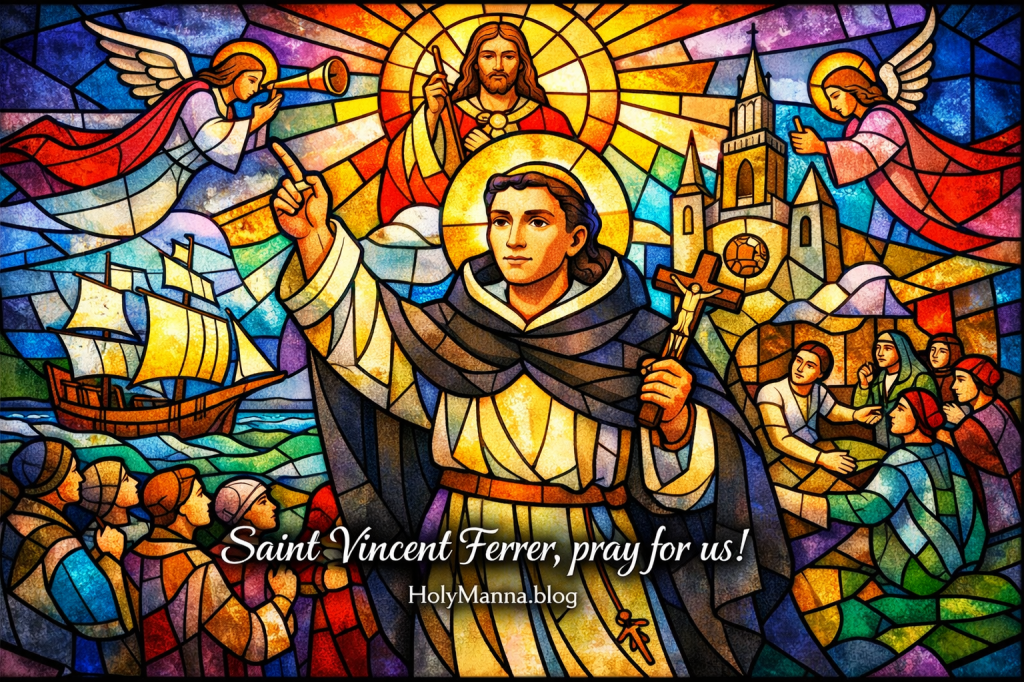
The Priest Who Shook Europe Awake
Saint Vincent Ferrer stands in Catholic memory as one of the great preachers of repentance the Church has ever known. He was a Dominican friar, theologian, missionary, and miracle-working saint whose voice carried across kingdoms and whose words called countless souls back to confession, prayer, and a serious love for Jesus Christ. In an age marked by confusion, division, and moral decay, he became a burning lamp for the Church.
He is especially revered for preaching conversion with urgency. He spoke often about judgment, eternity, heaven, hell, mercy, and the need to turn back to God before it was too late. That may sound severe to modern ears, but his message was never empty fear. It was a deeply Catholic call to salvation. He wanted souls to wake up, repent, receive grace, and live in friendship with God.
Saint Vincent is also remembered for his role during the Western Schism, one of the most painful crises in Church history, when rival claimants to the papacy divided Christendom. He lived in the middle of that storm and eventually worked for the peace and unity of the Church. He was not just a preacher with a loud voice. He was a man formed by prayer, study, penance, and obedience, and his life became a witness that true reform begins with holiness.
A Child of Valencia, Formed for God
Vincent was born in Valencia, in the Kingdom of Aragon, in 1350 according to the most widely accepted Catholic tradition, though some older accounts give a slightly different year. He was born into a noble and devout Christian family. His father was William Ferrer, and his mother was Constantia Miguel. Catholic tradition remembers the household as generous to the poor and serious about the faith, which mattered deeply in shaping the boy who would later preach to all of Europe.
From a young age, Vincent showed unusual intelligence, seriousness, and devotion. He did not stumble into holiness by accident. He was formed by Catholic life, disciplined study, and the example of a believing family. One of his brothers, Boniface Ferrer, also embraced a deeply religious life and later became a Carthusian.
As a young man, Vincent entered the Dominican Order in 1367. That choice tells a great deal about him. The Dominicans were the Order of Preachers, founded to defend truth, preach sound doctrine, and save souls through study and proclamation. Vincent fit that mission perfectly. He studied in Barcelona and Toulouse, then went on to teach philosophy and theology. He quickly gained a reputation for intellectual brilliance, but he did not treat learning as a path to pride. Catholic tradition preserves one of his best-known sayings: “Study less to make yourself learned than to become a saint.”
That line says almost everything about him. Vincent believed that theology was not supposed to make a man clever for its own sake. It was supposed to make him holy. He also reportedly said, “Consult God more than your books.” That did not mean books were useless. It meant scholarship had to kneel before prayer.
What was Saint Vincent most known for? He was known above all as a preacher of penance and conversion. He traveled from place to place calling people away from sin and back to Christ. He preached with such force that entire towns were said to change their way of life after hearing him. He became famous not because he entertained crowds, but because he unsettled consciences and led people toward grace.
A Preacher of Fire, Mercy, and Miracles
The turning point of Vincent’s life came during a grave illness while he was in Avignon. Catholic tradition says that during this sickness he experienced a vision of Christ, accompanied by Saint Dominic and Saint Francis. In that vision, he was healed and sent out to preach repentance with renewed power. This story is deeply rooted in Catholic tradition and has long been part of the way the Church remembers his mission.
After that, Vincent entered the great apostolic phase of his life. For roughly twenty years, he traveled through Spain, France, Italy, Switzerland, and other parts of Western Europe preaching to enormous crowds. He often had to preach outdoors because churches could not hold the people. He spoke with passion about sin, death, judgment, mercy, and the need to prepare for eternity. Because of this, he came to be called by some the Angel of the Judgment.
One of the most remarkable traditions connected to his preaching is that people of many different languages could understand him even though he ordinarily preached in his own tongue. Catholic tradition has often seen this as a kind of gift of tongues, a sign that God wanted his message to reach far beyond natural limits. This cannot be independently verified in every reported case, but it has long been part of his Catholic memory.
Many miracles were also attributed to him during his lifetime. One early story says that during a time of famine in Barcelona, he foretold that ships loaded with grain would arrive, and the prophecy came true. Another tradition says he multiplied food for those in need. Many accounts tell of healings of the sick, the crippled, and the possessed through his prayers. He was also credited with bringing hardened sinners to repentance, which in many ways was the deepest miracle of all.
One of the most dramatic miracle stories associated with him is the account that he raised a murdered man at Salamanca so that the man could identify his killer. This story is often repeated in Catholic tradition, but it cannot be independently verified with certainty. Still, it has remained part of the saint’s legendary memory because it reflects the way generations of Catholics saw Vincent as a vessel of divine power.
His life mattered because he showed what a priest on fire with the Gospel looks like. He did not soften the truth, but he did not preach as a cold judge either. He preached like a man who believed that every soul mattered, that hell was real, that grace was available, and that Jesus Christ truly saves. That is why he should be remembered. That is also why he should be imitated. The Church always needs saints who are willing to speak the truth with courage and charity.
Trials in a Divided Church
Saint Vincent did not live in peaceful times. He lived through the Western Schism, when multiple claimants to the papacy divided the Church and scandalized Christendom. This was not a small political argument. It was a deep wound in the visible unity of the Church, and it caused confusion among clergy and laity alike.
For a time, Vincent supported the Avignon claimant Benedict XIII, believing him to be the rightful pope. He even served him in important roles. This part of Vincent’s life is important because it shows that saints are not machines. They live in history, make difficult judgments, and sometimes walk through great complexity before seeing the right path clearly.
What makes Vincent’s story so powerful is that he later withdrew his support from Benedict XIII when it became clear that stubbornness was prolonging division and harming the peace of the Church. He chose the good of ecclesial unity over personal attachment. That took humility, courage, and a conscience formed by God.
He also endured the hardships of endless travel, exhausting preaching, fasting, penance, and the physical toll of old age. He was not a martyr in the strict sense because he was not killed for the faith, but he lived a life of severe sacrifice. In many ways, he embraced a kind of white martyrdom, pouring himself out for souls until his strength was nearly gone.
There is also an older report that he was once denounced over a sermon statement concerning Judas. The details are obscure and the story is not always repeated in modern retellings, but it shows that even a great preacher could face suspicion and misunderstanding. He carried on anyway. He kept preaching. He kept serving. He kept warning people that eternity was not a game.
Wonders, Relics, and a Living Legacy
Saint Vincent died in Vannes, in Brittany, on April 5, 1419. Catholic tradition says that before his death he indicated he had returned there not to continue preaching, but to find his grave. Even in death, there was a sense that his mission had been guided by Providence.
After his death, reports of miracles spread quickly. Catholic tradition says that miracles were associated with the water used to wash his body and with contact with his relics, habit, and other objects linked to him. Many healings and favors were reported by the faithful. These stories helped fuel devotion to him throughout Europe. Some of these reports belong to the devotional tradition surrounding the saint and cannot all be independently verified one by one, but they have been handed down in Catholic memory for centuries.
His relics became objects of deep veneration, especially in Vannes Cathedral, where devotion to him remained strong. Over the centuries, his relics were protected, moved, hidden at times for safety, and solemnly honored again. Pilgrimage to places connected with Saint Vincent became part of his posthumous legacy.
He was canonized in the fifteenth century, and his cult spread widely. His impact was not limited to private devotion. He left a deep mark on Catholic preaching, Dominican spirituality, and popular religion. In Valencia, his hometown, his memory remains especially alive. He is one of the great beloved saints of the region, and his feast is celebrated with processions, Masses, floral offerings, and the famous milacres, dramatic representations of miracles attributed to him, often performed by children. This cultural tradition shows how thoroughly he entered into the life of Catholic people.
His national and cultural impact is especially strong in Spain, above all in Valencia, but his spiritual reach extends much farther. He is remembered as a saint of renewal, a preacher for troubled times, and a model for priests and laity alike. Even today, his life speaks with surprising force in a world that often avoids talking about sin, judgment, and conversion.
Among the miracle stories after death, some are tied to healings through his intercession, others to favors granted near his relics, and others to the powerful continuation of his reputation as a wonderworker. Not every individual story can be fully verified. Still, the persistence of devotion across centuries says something important. The faithful did not remember him merely as an impressive speaker. They remembered him as a holy man through whom God continued to act.
The Voice That Still Calls Souls Home
Saint Vincent Ferrer still has a lot to teach modern Catholics. His life reminds the Church that mercy and repentance belong together. Real love warns. Real charity tells the truth. Real preaching does not flatter people in their sins. It invites them to freedom.
That matters now more than ever. A culture that avoids judgment often loses the meaning of mercy. Yet the Church teaches that conversion is not a one-time event. The Catechism teaches that Christ’s call to conversion continues to resound in the lives of the baptized, and that the Church herself follows “the path of penance and renewal” in this world, as taught in CCC 1428. Saint Vincent lived that reality. He believed no one was beyond grace, but he also believed no one should delay returning to God.
His life also teaches that holiness requires both truth and prayer. He studied deeply, but he never let study replace dependence on God. That is why his sayings still land with force. “Study less to make yourself learned than to become a saint.” “Consult God more than your books.” Those are not anti-intellectual lines. They are Catholic lines. They place wisdom under the lordship of grace.
For ordinary Catholics, the application is practical and direct. Take sin seriously. Go to confession regularly. Pray with greater attention. Do not assume there will always be more time later. Speak the truth with charity. Love the Church even when her members fail. Stay close to Jesus in the sacraments. Let concern for souls become real, not abstract.
What would change if eternity became more real in daily life? What sins have been minimized because repentance feels uncomfortable? What would it look like to love others enough to desire their salvation, not just their approval? These are the kinds of questions Saint Vincent presses into the heart.
His witness also encourages perseverance when the Church seems wounded or confused. He lived through scandal, division, and uncertainty, yet he did not walk away. He chose fidelity. He kept preaching Christ. He kept calling souls home. That is a lesson worth holding onto.
Engage with Us!
Share your thoughts and reflections in the comments below. Saint Vincent Ferrer’s life has a way of waking up the soul, and it would be beautiful to hear what stood out most and what challenged the heart the most.
- What part of Saint Vincent Ferrer’s life speaks most strongly to the heart right now?
- How does his preaching on repentance challenge the way sin, mercy, and conversion are usually viewed?
- What practical step can be taken this week to live with greater seriousness about prayer, confession, and holiness?
- How can Saint Vincent’s courage during a time of Church crisis help Catholics remain faithful in difficult times today?
Saint Vincent Ferrer shows that holiness is never outdated. Truth still matters. Repentance still matters. Mercy still matters. Live the faith with courage, stay close to Christ, and do everything with the love and mercy Jesus taught us.
Saint Vincent Ferrer, pray for us!
Follow us on YouTube, Instagram and Facebook for more insights and reflections on living a faith-filled life.


Leave a comment