A Flame That Would Not Bow
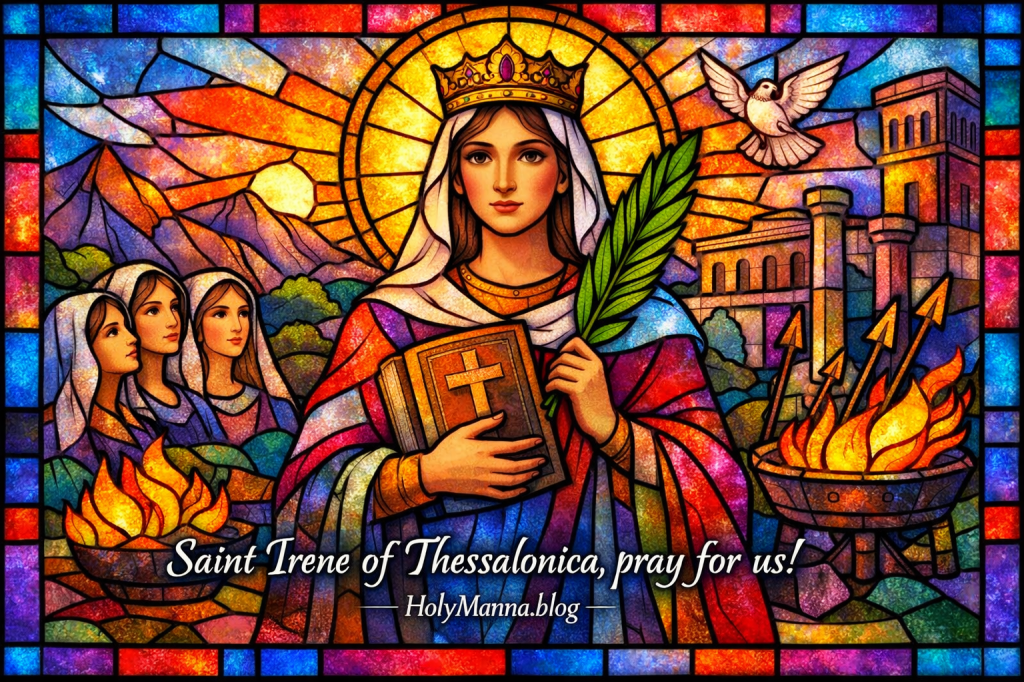
Saint Irene of Thessalonica is remembered in the Roman Catholic tradition as a virgin martyr of the early Church, closely linked with her sisters Saint Agape and Saint Chionia. She is revered because she stood firm during the persecution of Diocletian and refused to surrender either her faith or the sacred books of the Christians. In a time when even possessing the Scriptures could lead to death, Saint Irene chose fidelity over fear. That is why her witness still feels so powerful. She was not honored because she held earthly power, wrote great theological works, or lived a long public life. She is honored because she loved Christ enough to lose everything rather than offend Him. The Church’s understanding of martyrdom gives the key to her whole life, because The Catechism teaches in CCC 2473 that martyrdom is the supreme witness to the truth of the faith.
Roots Hidden in Trial and Grace
The ancient record preserves Saint Irene’s martyrdom far more clearly than the details of her childhood. The old Catholic account in Butler says that Irene and her sisters lived at Thessalonica and that their parents were still pagans when the sisters suffered martyrdom. Some later Catholic retellings connect the sisters with Aquileia, but the strongest early evidence centers their story in Thessalonica itself. What matters most is that these young women were formed deeply enough in Christian truth to resist the pressure of an empire. Their story comes down through ancient martyr acts that Butler says were drawn from the court registers of Thessalonica, and Catholic teaching on the Acts of the Martyrs explains why that matters. In the Catholic tradition, these are not treated like loose legends with no anchor at all, but as records rooted in the trial and death of the martyrs, even if later editors handed them on for devotion.
Saint Irene does not seem to have a dramatic conversion story in the way some saints do. No great turning point survives in the record. Instead, her life reveals a quieter and perhaps even more demanding kind of holiness. She appears as a young woman whose faith had already sunk deep into the soul. She and her sisters treasured the holy books, refused food sacrificed to idols, and chose obedience to God over survival. What Saint Irene is most known for is simple and unforgettable. She defended the faith, loved the Scriptures, preserved her chastity, and accepted martyrdom rather than betray Christ.
The Girl Who Guarded the Word of God
When Diocletian’s edict forbade Christians to keep the sacred Scriptures, Irene and her sisters hid those holy books. That detail is one of the most striking features of her witness. Many martyrs died for refusing pagan sacrifice, but Saint Irene is especially remembered for loving the Word of God so much that she risked death to protect it. When she was questioned, the ancient acts preserve one of the few sayings securely attached to her name. Asked why she had not obeyed the emperor’s command, she answered, “For fear of offending God.” That one sentence reveals the whole shape of her soul. She did not think first about comfort, public shame, or death. She thought first about God.
The record also preserves another beautiful line. After the sisters returned from hiding, Irene said they were in great sorrow because they could no longer read the sacred books “night and day” as they had been accustomed to do. There is something deeply moving in that image. Saint Irene was not only willing to die for Scripture. She also loved to live with Scripture. She was nourished by it. She missed it. She longed for it. That makes her witness especially powerful for Catholics today, because it shows that the Bible was never meant to sit unopened in the home. It was meant to be loved, prayed, guarded, and obeyed.
Providence in the Mountains and Purity in the Fire
The Catholic record does not present Saint Irene as a saint known for a wide public ministry of miracle-working during her earthly life. There are no large cycles of healings or dramatic wonders performed by her in the way later saints are sometimes remembered. What the tradition does preserve are providential signs surrounding her witness. When the persecution intensified, Irene and her sisters fled to the mountains. Asked where they hid, Irene answered that they lived in the open air, from one mountain to another. When the judge asked who gave them bread, she replied, “God, who gives food to all flesh.” That is not a theatrical miracle story, but it is still a beautiful testimony to divine care in hardship.
The most dramatic sign attached to her life came later, after her sisters had already been condemned. Irene was sent to a brothel in an attempt to break her spiritually and publicly humiliate her. Yet the ancient Catholic account says that God protected her and that no man dared violate her. That moment became one of the defining parts of her story. Saint Irene’s enemies could chain her body, but they could not conquer her soul. Her purity remained intact, not because the world respected it, but because God watched over His servant in the midst of cruelty. That is why the Church remembers her not merely as a victim of persecution, but as a conqueror through grace.
The Cost of Refusing to Offend God
Saint Irene endured the same brutal world that consumed many of the early martyrs. The Roman authorities wanted conformity. Christians were expected to obey imperial religion, eat sacrificial food, and surrender the books of the faith. Irene refused. The trial account also shows that she was not suffering alone. Other Christians were caught up in the same proceedings, including Agatho, Casia, Philippa, and Eutychia. This reminds the heart that persecution was not an abstract event in a textbook. It was a pressure placed on real believers, one by one, family by family.
After the brothel ordeal, Irene was brought before the governor again. When pressed once more, she answered, “Not in rashness, but in piety towards God.” That line matters because holy courage can look like foolishness to the world. The governor saw obstinacy. Irene saw worship. The Roman Martyrology and Butler both preserve the tradition that she was finally put to death by fire. Some older Catholic witnesses also include the detail that she was pierced by an arrow before being consumed by fire, which is one reason some sacred art shows her with arrows. The firmer Roman Catholic core is that she died as a martyr under the governor Dulcetius after refusing to betray the sacred writings and the faith of Christ.
Her martyrdom has a special significance because it joins several forms of witness into one offering. She was a martyr for Christ, a martyr for purity, and a martyr for the sacred books. She chose the Lord over survival, chastity over humiliation, and truth over compromise. That is why her story remains so piercing. The early Church did not remember her because she escaped suffering. The early Church remembered her because grace made her faithful in the middle of suffering.
What Followed After Her Death
Saint Irene does not appear in Roman Catholic tradition with a long catalog of verified posthumous miracles. The sources are much more focused on her martyrdom itself than on a later cycle of healings or apparitions. So it is better to be honest here than to decorate her story with claims the Catholic record does not clearly preserve. Her greatest miracle, in a sense, is the witness she left behind. The Church kept her name. The Church preserved her trial. The Church prayed with her memory. The Church never let her testimony disappear.
There are, however, important signs of her lasting veneration. Her relics are honored in the reliquary chapel of the Basilica of the Sacred Heart at Notre Dame. She is also honored as the patron saint of the Roman Catholic Diocese of Santorini, where her celebration is marked on May 5. That means her legacy did not stay buried in late antiquity. It entered the living devotional life of the Church. Her story also reached Christian culture through literature. Catholic sources note that the martyrdom of Agape, Chionia, and Irene became the subject of a tenth century Latin drama by Hrotsvitha of Gandersheim, one of the earliest known female playwrights in Christian history. Even centuries later, the courage of these sisters was still strong enough to inspire art, memory, and prayer.
Learning to Love God Without Compromise
Saint Irene has a word for the modern Catholic soul. She lived in a world that demanded compromise and punished conviction. That sounds uncomfortably familiar. The pressure may look different now, but the temptation is much the same. Stay quiet. Blend in. Do not take the faith too seriously. Do not let the Word of God shape too much of life. Saint Irene answers all of that with her witness. She loved God enough to obey Him when obedience was costly.
Her life invites a serious examination of conscience. How much love is there for the Scriptures? Are the words of Christ read only occasionally, or are they treasured “night and day” in the heart? When pressure comes, is the first instinct to protect reputation, comfort, and convenience, or to avoid offending God? Saint Irene teaches that holiness is not made of dramatic feelings. It is made of steadfast decisions. Read the Word of God. Guard purity. Refuse the small compromises that train the soul to surrender later. Stay close to the sacraments. Pray with courage. Let conscience be formed by Christ and His Church, not by the noise of the age.
This saint also offers hope. A young woman in a hostile empire remained faithful, and grace did not fail her. That same grace has not disappeared. Christ is still Lord. The truth is still worth suffering for. The Word of God is still living and active. Saints like Irene remind the Church that no age is too dark for holiness.
Engage With Us!
Readers are invited to share their thoughts and reflections in the comments below. Saint Irene’s witness is simple, strong, and deeply needed, and it would be a blessing to hear how her story speaks to the heart.
- What stands out most in Saint Irene’s love for the holy Scriptures?
- Has there ever been a moment when avoiding offense against God cost something real?
- What would it look like to love the Word of God more intentionally “night and day” in daily life?
- How can Saint Irene’s courage help strengthen purity, conviction, and perseverance in the middle of modern pressures?
- Which part of her witness feels most challenging right now: love of Scripture, moral courage, or trust under suffering?
May Saint Irene of Thessalonica inspire a life of steady faith, clean conscience, and courageous love. May everything be done with the love and mercy Jesus taught us, and may His truth be cherished more than comfort, more than fear, and more than life itself.
Saint Irene of Thessalonica, pray for us!
Follow us on YouTube, Instagram and Facebook for more insights and reflections on living a faith-filled life.


Leave a comment