The Resurrection of the Lord – The Mass of Easter Day – Lectionary: 42
Dawn Broke Open the World
There are mornings that feel like every other morning, and then there is Easter morning, the day when God overturned the oldest enemy and opened history from the inside. The readings for The Resurrection of the Lord all gather around one radiant truth: Jesus Christ is truly risen, and because He is risen, everything has changed. What began in sorrow, sealed stone, and shattered hopes becomes the Church’s song of victory, her mission to the nations, and the pattern for every Christian life.
This is why the liturgy places side by side the preaching of Peter in Acts of the Apostles, the triumphant cry of Psalm 118, the call of Saint Paul in Colossians or First Corinthians, and the Resurrection witness of The Gospel of John, The Gospel of Matthew, or The Gospel of Luke. Each reading approaches Easter from a different angle, but all of them point to the same center. The crucified Jesus is not a memory, not a symbol, and not a noble teacher whose influence somehow lives on. He is the living Lord, raised by the Father, victorious over sin and death, and still drawing His people to Himself. The Church does not merely remember Easter. She proclaims it as the turning point of the world.
There is rich background behind this great feast. Easter rises from the ancient Passover, when the Lord delivered Israel from slavery and brought His people through death into life. That is why Saint Paul can call Christ the true Paschal Lamb in First Corinthians 5:7. What Israel celebrated in figure, Christ fulfills in reality. The blood once placed on doorposts now finds its fullness in the blood of the Lamb of God. The passage through the Red Sea becomes the deeper passage through Baptism. The old feast becomes the new and eternal victory of Christ. This is also why the empty tomb matters so much. In the Jewish world of the first century, burial, mourning, and honor for the dead carried deep religious weight. A sealed tomb meant finality. Easter shatters that finality forever.
A beautiful thread also runs through all the readings: witness. Peter stands and testifies that the apostles ate and drank with the risen Christ. The psalmist declares, “I shall not die but live, and declare the deeds of the Lord.” Saint Paul insists that those raised with Christ must live differently. Mary Magdalene, Peter, John, the holy women, and the disciples on the road to Emmaus all become living signs that an encounter with the risen Jesus always leads somewhere. Easter does not leave people standing still. It sends them running, proclaiming, worshiping, and returning to the others with burning hearts.
The central theme, then, is not simply that Jesus rose, but that His Resurrection creates a new people and a new way of living. The stone rejected has become the cornerstone. The old leaven must be cast out. Hearts once trapped in grief must be lifted upward. Eyes once clouded by fear must learn to recognize the Lord. This is the joy and challenge of Easter Day. Christ is risen, and now those who belong to Him must learn to live as people of the Resurrection. What in the heart still clings to the tomb when the Lord is already calling His people into the light?
First Reading – Acts 10:34, 37-43
When Peter Opens the Door and Easter Breaks Into the Nations
This first reading places the reader inside one of the great turning points in the life of the early Church. Peter is speaking in the house of Cornelius, a Gentile and a God-fearer, in Caesarea. Saint Luke treats this moment with unusual weight because it shows the Gospel crossing a boundary that many first century Jews would have found shocking. Peter had been prepared by a vision to understand that he must no longer call unclean those whom God is calling. Then, standing in a Gentile home, he gives a compact proclamation of the Gospel, what the Church often calls the kerygma: Jesus’ public ministry, His death, His Resurrection, His appearances to chosen witnesses, His authority as judge, and the forgiveness of sins offered in His name. This moment is central to Saint Luke’s vision of salvation going out to the nations under the guidance of the Holy Spirit.
That is why this reading fits Easter Day so beautifully. Easter is not merely the happy ending to the Passion. Easter is the public proclamation that the crucified Jesus is alive and now reigns as Lord of all. Peter is not sharing a private religious experience. He is bearing apostolic witness. He is telling the world that what God promised to Israel has now burst open for every nation. The Resurrection is already creating the Church as a missionary people, and this reading lets the reader hear that mission in its early, fiery form.
Acts 10:34, 37-43 – New American Bible (Revised Edition)
34 Then Peter proceeded to speak and said, “In truth, I see that God shows no partiality.
37 what has happened all over Judea, beginning in Galilee after the baptism that John preached, 38 how God anointed Jesus of Nazareth with the holy Spirit and power. He went about doing good and healing all those oppressed by the devil, for God was with him. 39 We are witnesses of all that he did both in the country of the Jews and [in] Jerusalem. They put him to death by hanging him on a tree. 40 This man God raised [on] the third day and granted that he be visible, 41 not to all the people, but to us, the witnesses chosen by God in advance, who ate and drank with him after he rose from the dead. 42 He commissioned us to preach to the people and testify that he is the one appointed by God as judge of the living and the dead.[c] 43 To him all the prophets bear witness, that everyone who believes in him will receive forgiveness of sins through his name.”
Detailed Exegesis
Verse 34 – “In truth, I see that God shows no partiality.”
Peter begins with a confession of conversion. He is not changing God’s plan, but finally understanding it more fully. Israel’s election was never meant to be a closed circle of privilege. It was the beginning of a saving plan for the whole world. Peter is learning that the holiness of God is not narrow, tribal, or jealous in a human way. The Resurrection of Christ reveals the wideness of God’s mercy. Easter opens the door that sin and fear had kept shut.
Verse 37 – “what has happened all over Judea, beginning in Galilee after the baptism that John preached,”
Peter roots the Gospel in history. Christianity does not begin in myth, private intuition, or vague spiritual symbolism. It begins in events that happened in a real land, among real people, in a real sequence. John the Baptist stands at the threshold, calling Israel to repentance and preparing the way for the Messiah. Peter’s point is that the story of Jesus did not appear out of nowhere. It unfolded publicly, beginning in Galilee, and therefore it can be proclaimed with confidence. Easter faith is not detached from history. It is history fulfilled by God.
Verse 38 – “how God anointed Jesus of Nazareth with the holy Spirit and power. He went about doing good and healing all those oppressed by the devil, for God was with him.”
Peter gives a summary of the Lord’s earthly ministry that is both simple and profound. Jesus is the anointed one, the true Christ, filled with the Holy Spirit and divine power. This verse echoes the messianic promise fulfilled in Christ, the One anointed to bring good news and liberation. Peter also describes the ministry of Jesus as a campaign against the oppression of the devil. This is essential. The miracles of Christ were not random displays of power. They were signs that the kingdom of God had entered history to overthrow the tyranny of sin, death, and Satan. Easter does not cancel that mission. Easter confirms it. The One who healed others has now conquered death itself.
Verse 39 – “We are witnesses of all that he did both in the country of the Jews and [in] Jerusalem. They put him to death by hanging him on a tree.”
The apostles are not passing along rumors. They are witnesses. Saint Luke emphasizes that apostolic testimony includes both the ministry of Jesus and His death and Resurrection. Peter speaks of the Cross with sober clarity. Jesus was killed, and His death was not an accident or a misunderstanding. Yet Peter’s phrase, “hanging him on a tree”, also carries the bitter scandal of the Cross. The Holy One was treated as cursed, shamed, and cast out. But that shame becomes the place where redemption is accomplished. The Church never preaches Easter without the Cross, because the risen Lord is the crucified Lord.
Verse 40 – “This man God raised [on] the third day and granted that he be visible,”
This is the blazing center of the reading. The Father raised Jesus on the third day. Peter does not say that the disciples kept His memory alive. He says God raised Him. The Catechism teaches that the Resurrection is a real event, historically attested by the disciples who encountered the risen Christ, while also surpassing history because Christ’s humanity enters the glory of God. The third day matters because it shows the Father’s vindication of the Son before corruption takes hold. The Crucified One is declared victorious. Easter is the Father’s answer to Good Friday.
Verse 41 – “not to all the people, but to us, the witnesses chosen by God in advance, who ate and drank with him after he rose from the dead.”
The Resurrection appearances were not stage-managed spectacles for curiosity. They were gifts given to witnesses chosen by God. Saint Luke presents salvation as being carried forward through divinely chosen representatives, and Peter now names himself among them. The detail that they ate and drank with the risen Lord matters enormously. It shows continuity. Jesus is not a ghost, not a symbol, not a merely interior experience. He is truly risen. The Catechism insists that the disciples really encountered the risen Christ. The Church’s Easter faith is therefore apostolic and bodily. The same Jesus who was crucified now lives.
Verse 42 – “He commissioned us to preach to the people and testify that he is the one appointed by God as judge of the living and the dead.”
The witness of Easter is never meant to remain private. The risen Lord commissions His apostles to preach and testify. This is the birth of mission flowing directly from the Resurrection. Peter also declares that Jesus is judge of the living and the dead. That is not a threat thrown into the sermon to frighten people. It is a declaration of Christ’s universal authority. The Catechism teaches, “Christ died and lived again, that he might be Lord both of the dead and of the living.” CCC 668. The One who judges history is the same One who carried the wounds of history in His own body. This gives both sobriety and hope to Christian preaching.
Verse 43 – “To him all the prophets bear witness, that everyone who believes in him will receive forgiveness of sins through his name.”
Peter ends where every true Easter proclamation must end: with mercy. The prophets pointed toward Christ, and now in Him forgiveness is offered to all who believe. This is not cheap pardon. It is forgiveness purchased by the blood of the Cross and vindicated by the Resurrection. The Catechism teaches, “Our Lord tied the forgiveness of sins to faith and Baptism.” CCC 977. It also teaches, “Christ sent his apostles so that ‘repentance and forgiveness of sins should be preached in his name to all nations.’” CCC 1122. Peter is doing exactly that in the house of Cornelius. Easter is not only the victory of Christ. It is the opening of pardon to the sinner.
Teachings
This reading is one of the clearest windows into the Church’s earliest preaching. Peter does not offer an abstract theology lesson. He proclaims the saving acts of God in Christ. That pattern still shapes Catholic preaching today. The Church announces what Jesus did, what the Father accomplished in raising Him, and what that means for the life of the world. Peter’s speech is a decisive moment in the opening of the Church to the Gentiles. Easter is already missionary in this reading. It is already catholic in the deepest sense of that word, universal.
The first great teaching here is apostolic witness. Christianity is not built on self-invented spirituality. It stands on testimony entrusted to men chosen by Christ and sent in His name. The Catechism says that faith in the Resurrection has as its object “an event which as historically attested to by the disciples, who really encountered the Risen One.” CCC 656. Peter’s sermon breathes that certainty. He speaks as one who saw, heard, ate, drank, and was sent. That is why the Church treasures apostolic succession, apostolic preaching, and apostolic faith. Easter is handed on, not reinvented.
The second great teaching is the lordship of Christ. Peter says Jesus is judge of the living and the dead. This means that the risen Christ is not only Savior in a sentimental sense. He is the Lord to whom every conscience and every age must answer. Yet the one who judges is also the one who was crucified for sinners. The Gospel is therefore both urgent and merciful. It calls for repentance, but it does so with pierced hands extended in mercy.
The third great teaching is forgiveness through the name of Jesus. This is deeply sacramental. The Catechism teaches, “Baptism is the first and chief sacrament of forgiveness of sins because it unites us with Christ, who died for our sins and rose for our justification.” CCC 977. In the verses immediately following this reading, the Holy Spirit falls upon Cornelius and his household, and they are baptized. The pattern is unmistakable: apostolic preaching, faith, the gift of the Spirit, sacramental incorporation. Easter is not just a doctrine to admire. It is a mystery into which souls are brought.
The saints never let the Church forget that Easter must become a way of life. Saint Augustine beautifully says, “The resurrection of the Lord is our hope.” That short sentence fits this reading perfectly. Peter’s sermon is not bare information. It is hope announced to a waiting household and, through them, to the nations.
Reflection
This reading speaks with special force to a world tempted by cynicism, tribalism, and private religion. Peter walks into a house that many would have considered outside the boundary, and he announces that the risen Jesus is Lord there too. That is a needed Easter correction. The human heart is quick to sort people into worthy and unworthy, near and far, clean and unclean. Peter had to be converted out of that instinct, and Christians still do. A soul that has really met the risen Christ cannot cling to pride, contempt, or spiritual elitism.
This reading also reminds the believer that Christianity is something to be proclaimed, not merely felt. Peter says, in effect, this happened, this was seen, this was entrusted, and now this must be preached. There is a healthy challenge here for daily life. A Catholic cannot keep Easter buried under politeness, fear, or embarrassment. A good place to begin is very simple. Speak the name of Jesus with reverence. Read the Scriptures with the expectation that God has acted in history. Go to Confession and receive the forgiveness Peter proclaims. Come to Mass ready to stand with the witnesses, not as a spectator but as one who belongs to the risen Lord.
There is also a deeply personal consolation here. Peter ends with forgiveness. Not performance. Not self-salvation. Not endless shame. Forgiveness. Easter means that no one has to stay locked inside yesterday’s sin. Christ is risen, and His risen life presses toward the sinner with mercy.
Where has the heart quietly assumed that God’s mercy stops at certain people, or at certain sins?
What would change if Easter were received not as a nice idea, but as the living truth that Jesus Christ is Lord and judge of all?
How is the risen Christ calling the soul to become a witness, not in grand speeches, but in honesty, repentance, courage, and hope?
Responsorial Psalm – Psalm 118:1-2, 16-17, 22-24
The Church Sings at the Empty Tomb
The responsorial psalm for Easter Day is not a quiet meditation from the edge of sorrow. It is a victory chant. Psalm 118 belongs to the great Hallel psalms, the collection of psalms sung in Jewish festal worship, especially around Passover. That matters deeply on Easter. The Church hears this psalm through the light of Christ’s Passion, Death, and Resurrection because Jesus Himself likely prayed these psalms during the Passover meal before going out to the Mount of Olives. What Israel sang in gratitude for deliverance now reaches its fullest meaning in the Resurrection of Christ. The God who saved His people from slavery has now shattered the deeper slavery of sin and death.
That is why this psalm fits today’s theme so perfectly. The first reading proclaims the Resurrection through apostolic witness. The Gospel reveals the empty tomb. The psalm gives the Church her song in response. It teaches the faithful how to stand before Easter with gratitude, awe, and holy confidence. The rejected stone has become the cornerstone. The one who seemed defeated now lives forever. The day that looked like the triumph of darkness has become the day of the Lord’s glory. Easter is not only something to explain. Easter is something to sing.
Psalm 118:1-2, 16-17, 22-24 – New American Bible (Revised Edition)
Hymn of Thanksgiving
1 Give thanks to the Lord, for he is good,
his mercy endures forever.
2 Let Israel say:
his mercy endures forever.16 the Lord’s right hand is raised;
the Lord’s right hand works valiantly.”
17 I shall not die but live
and declare the deeds of the Lord.22 The stone the builders rejected
has become the cornerstone.
23 By the Lord has this been done;
it is wonderful in our eyes.
24 This is the day the Lord has made;
let us rejoice in it and be glad.
Detailed Exegesis
Verse 1 – “Give thanks to the Lord, for he is good, his mercy endures forever.”
The psalm begins where true worship always begins: not with man, but with God. Thanksgiving is the first note because Easter is first and foremost God’s work. The Resurrection is not something the disciples achieved through courage or optimism. It is the Father’s mighty act. The word translated as mercy carries the rich sense of covenant love, steadfast love, faithful love that does not fail. On Easter morning, the Church realizes that this mercy has endured through betrayal, scourging, crucifixion, burial, and now shines in triumph. Even death could not exhaust the goodness of God.
Verse 2 – “Let Israel say: his mercy endures forever.”
This verse calls the whole people of God into a shared confession. Salvation is never merely private. Israel is summoned to remember together what the Lord has done. On Easter Day, the Church takes this line upon her lips as the new Israel, the people gathered in Christ. The Resurrection creates a people who remember, proclaim, and celebrate the works of God together. This is why Easter is liturgical. The Church does not keep Resurrection faith hidden in the heart alone. She sings it publicly, joyfully, and as one body.
Verse 16 – “The Lord’s right hand is raised; the Lord’s right hand works valiantly.”
In biblical language, the right hand of the Lord symbolizes God’s saving power, kingship, and victory. This is not a human hand raised in fragile celebration. It is the power of God acting in history. For Easter, this verse takes on a blazing significance. The Father’s power has raised the Son from the dead. What seemed like defeat on Calvary is revealed as victory through divine strength. The Church hears in this line the triumph of God over every force that opposes life, truth, and holiness.
Verse 17 – “I shall not die but live and declare the deeds of the Lord.”
This verse sounds almost like Easter morning spoken in advance. In its original setting, it is the cry of one delivered from deadly danger and restored to praise God among the living. In the full light of Christ, the Church hears more. Christ passed through death and lives forever. He is the true one who can say these words in their deepest sense. But the verse also becomes the song of every baptized Christian. United to Christ, the believer is no longer destined for meaningless death. The Christian is called to live in such a way that the deeds of the Lord are proclaimed not only with words, but with the shape of one’s whole life.
Verse 22 – “The stone the builders rejected has become the cornerstone.”
This is one of the most important verses in the whole psalter for understanding Jesus Christ. In its original context, the image speaks of what men cast aside and God exalts. In the New Testament, Jesus applies this verse to Himself, and Saint Peter later proclaims it openly. The leaders rejected Him. The world judged Him unworthy. The Cross looked like a final rejection. Yet the Father made Him the cornerstone, the foundation of a new temple, a new people, and a new creation. Easter reveals that God builds His kingdom precisely where human pride thought it had buried the truth.
Verse 23 – “By the Lord has this been done; it is wonderful in our eyes.”
This verse protects the believer from reducing Easter to human explanation. The Resurrection is not the disciples recovering emotionally from trauma. It is not a poetic way of saying that Jesus’ message lives on. “By the Lord has this been done.” Easter is divine action. It is wonderful precisely because it is God’s work. Wonder is the right response. The Church does not stand before the empty tomb as if solving a puzzle. She stands there in adoration.
Verse 24 – “This is the day the Lord has made; let us rejoice in it and be glad.”
This is the Church’s great Easter cry. The day is not merely a twenty four hour span on the calendar. It is the day of salvation, the day of victory, the day of new creation. The Fathers of the Church loved this verse because they saw in it the day of Christ’s Resurrection, the day that begins a new world. Easter joy is therefore not shallow excitement. It is the gladness that comes when God has done what no man could do. Sin has been defeated. Death has been broken. The Lord has made a day that no darkness can erase.
Teachings
This psalm teaches the soul how to pray Easter. It begins in thanksgiving, rises into confidence, and ends in joy. That movement is deeply Catholic. The Church never treats doctrine and worship as rivals. What the Church believes about the Resurrection becomes what she sings, celebrates, and lives. That is why Psalm 118 belongs so naturally to Easter liturgy. It is the prayer of a people who know that salvation comes from the Lord and that His mercy outlasts every human failure.
One of the clearest teachings here is that praise belongs to God simply because He is God. The Catechism teaches, “Praise is the form of prayer which recognizes most immediately that God is God. It lauds God for his own sake and gives him glory, quite beyond what he does, but simply because HE IS.” CCC 2639. That line fits the opening of this psalm beautifully. Easter gratitude certainly rejoices in what God has done, but it also lifts the heart higher. The Church praises the Lord not only for gifts received, but because His goodness is eternal.
This psalm also opens directly into the mystery of the Resurrection. The Catechism teaches, “The Paschal mystery has two aspects: by his death Christ liberates us from sin; by his Resurrection, he opens for us the way to a new life.” CCC 654. That is exactly the rhythm of this psalm. The one threatened by death now lives. The rejected stone now stands as cornerstone. The day once shadowed by suffering has become a day of rejoicing. Easter is not merely rescue from something negative. It is entrance into new life.
The Church also hears in this psalm the promise of the Christian’s own future. The Catechism teaches, “Finally, Christ’s Resurrection and the risen Christ himself are the principle and source of our future resurrection.” CCC 655. So when the psalm says, “I shall not die but live,” the Church dares to sing it not only as Christ’s victory, but as the hope of those united to Him. This does not remove the reality of bodily death in the present age. It transforms its meaning. Death no longer has the last word over those who belong to the risen Lord.
The verse about the rejected stone carries a powerful Christological meaning. Jesus Himself used this verse to reveal that His rejection would not be the end of the story. Saint Peter later preached the same truth boldly to the leaders of Israel. The Fathers, especially Saint Augustine, loved to see in this stone the mystery of Christ humbled and then exalted. The builders rejected Him because they judged according to worldly wisdom. God chose Him as the cornerstone because divine wisdom overturns human pride. Easter is the Father’s answer to the world’s verdict on His Son.
Historically, this psalm has been woven deeply into Christian worship because it captures the Church’s Easter instinct so well. The liturgy does not merely state that Christ is risen. It answers that truth with thanksgiving, praise, wonder, and joy. In that sense, Psalm 118 is not background music to Easter. It is one of the Church’s clearest Easter voices.
Reflection
There is something deeply healing about the way this psalm speaks. It does not pretend suffering never happened. It does not speak as though rejection, fear, and danger were imaginary. It sings from the far side of deliverance. That is why it reaches so naturally into ordinary life. Many hearts know what it feels like to carry disappointment, to feel cast aside, to watch plans collapse, or to wonder whether darkness has won. Easter does not mock those wounds. It transforms them. The rejected stone becomes the cornerstone. The one near death now lives to praise. The day of grief becomes the day of the Lord.
This psalm also challenges the way many people live. Modern life trains the soul to complain quickly, to forget blessings, and to treat gratitude as a passing mood. But the psalm begins with thanksgiving because gratitude is one of the clearest signs that the heart is awake to God. A practical way to live this psalm is to begin the day by thanking the Lord before asking Him for anything. Another way is to speak openly about His mercy when life becomes heavy, instead of speaking only about burdens and frustrations. Easter joy grows where gratitude is practiced.
The line about the rejected stone also deserves to stay close to the heart. Christ knows what it is to be rejected. He knows what it is to be misunderstood, dismissed, and condemned. That means no Christian suffers those wounds alone. More than that, it means God can build something holy precisely out of what seemed like loss. This does not mean every pain is pleasant. It means no pain is wasted when placed in the hands of the risen Lord.
The final verse calls for a choice. “This is the day the Lord has made; let us rejoice in it and be glad.” Christian joy is not fake positivity. It is a deliberate act of faith in the God who raised Jesus from the dead. It is a refusal to let darkness narrate the whole story.
Has gratitude become a daily habit, or only an occasional feeling when circumstances are easy?
Where has the heart felt rejected, and how might the risen Christ be turning that wound into a place of strength and grace?
What would it look like to truly live this day as the day the Lord has made?
Second Reading (Option 1) – Colossians 3:1-4
Raised With Christ, Hidden in Glory
Saint Paul’s words to the Colossians sound like Easter morning spoken directly into the soul. He is writing to Christians in a city shaped by competing ideas, spiritual confusion, and the pull of ordinary earthly concerns. In that world, Paul does not tell them to invent a new philosophy or chase some secret religious technique. He reminds them of what already happened to them in Christ. Through Baptism, they have died with Him and been raised with Him. That is the heart of this reading, and that is why it belongs so naturally on Easter Day. The Resurrection is not only something that happened to Jesus. It is the new life into which Christians have already been drawn.
This reading fits today’s theme because Easter is not merely proof of Christ’s power. It is the beginning of a transformed way of living. The empty tomb is not just good news for the future. It changes the present. Paul speaks to baptized Christians who still live on earth, still struggle, still work, still suffer, but whose true life is now hidden with Christ in God. Easter teaches the Church to lift her eyes upward, not in escape from the world, but in order to live in the world with a new heart.
Colossians 3:1-4 – New American Bible (Revised Edition)
Mystical Death and Resurrection. 1 If then you were raised with Christ, seek what is above, where Christ is seated at the right hand of God. 2 Think of what is above, not of what is on earth. 3 For you have died, and your life is hidden with Christ in God. 4 When Christ your life appears, then you too will appear with him in glory.
Detailed Exegesis
Verse 1 – “If then you were raised with Christ, seek what is above, where Christ is seated at the right hand of God.”
Paul begins with a fact, not a suggestion. He does not say, “Try to rise.” He says, “you were raised with Christ.” This points directly to Baptism, where the Christian is united to Christ’s death and Resurrection. Paul then draws out the consequence. The baptized soul must seek what is above. This does not mean despising creation, family life, work, or daily responsibilities. It means that the Christian’s desires, values, and loyalties must now be ordered toward Christ, who reigns in glory. Easter lifts the direction of the heart.
Verse 2 – “Think of what is above, not of what is on earth.”
Paul presses deeper. The resurrection life is not only about outward behavior. It reaches the mind, the imagination, and the inner habits of thought. A Christian cannot live as though passing pleasures, anxieties, rivalries, and worldly approval are the highest things. To think of what is above means to measure life by eternal truth. It means allowing Christ’s victory to shape how one interprets success, suffering, temptation, and hope. Easter changes not just what a believer does, but how a believer sees.
Verse 3 – “For you have died, and your life is hidden with Christ in God.”
This is one of the most beautiful and mysterious lines in Saint Paul. The Christian has died, meaning the old life ruled by sin has been judged and broken in Christ. Yet the new life is hidden. That matters. Resurrection life is real now, but it is not yet fully visible. Grace often works quietly. Holiness is often hidden. A faithful Catholic may look ordinary in the eyes of the world, but his deepest life is already bound to Christ in the life of God. This verse gives great comfort to anyone who feels unseen, unnoticed, or spiritually weak. What is hidden in God is not lost. It is being kept.
Verse 4 – “When Christ your life appears, then you too will appear with him in glory.”
Paul ends by drawing the reader forward to the final unveiling. Christ is not simply part of life. He is the Christian’s life. When He appears in glory, those who belong to Him will share in that glory. Easter therefore stretches from the empty tomb to the last day. The Resurrection is both present grace and future promise. The Christian lives between these two horizons: already raised with Christ, not yet fully revealed with Christ. That tension is not a contradiction. It is the shape of hope.
Teachings
This reading is one of the clearest expressions of the Church’s teaching that Easter must become a lived reality in the baptized. The Catechism teaches, “The Paschal mystery has two aspects: by his death Christ liberates us from sin; by his Resurrection, he opens for us the way to a new life.” CCC 654. Saint Paul is speaking precisely about that new life. He is not offering poetic encouragement. He is describing the real spiritual condition of the Christian after being united to Christ.
The Church also sees Baptism shining through this whole passage. The Catechism teaches, “This sacrament is called Baptism, after the central rite by which it is carried out: to baptize means to ‘plunge’ or ‘immerse’; the ‘plunge’ into the water symbolizes the catechumen’s burial into Christ’s death, from which he rises up by resurrection with him, as ‘a new creature.’” CCC 1214. That is exactly the background of Paul’s words. The believer has died and risen with Christ. Easter is not external to the Christian. It has entered the soul sacramentally.
This reading also carries the Church’s teaching on hope and glory. The Catechism teaches, “Finally, Christ’s Resurrection and the risen Christ himself are the principle and source of our future resurrection.” CCC 655. Paul’s final verse rests on that promise. The hidden life of grace now will one day be revealed in glory. This is why Catholics can live with patience in a world that often misunderstands holiness. The truest things are not always the loudest things.
Saint John Chrysostom captured the strength of Easter hope with blazing confidence when he preached, “Let no one fear death, for the Savior’s death has set us free.” That line fits this reading well. The Christian’s life is hidden with Christ not because death still rules, but because death has already been broken from within by the risen Lord.
Reflection
This reading speaks straight into modern restlessness. It is easy to live with a baptized body and an earthbound heart. It is easy to spend days thinking only about deadlines, money, image, conflict, comfort, and distraction. Saint Paul does not shame ordinary life, but he does refuse to let ordinary life become ultimate. Easter asks whether the heart is actually seeking what is above or whether it has quietly settled for smaller things.
A practical way to live this reading is to begin the day by deliberately lifting the mind to Christ. That can be as simple as a morning offering, a few minutes with Scripture, or a conscious act of thanksgiving before the rush begins. Another way is to examine what fills the mind most often. If anger, envy, lust, fear, or vanity dominate the inner conversation, then Paul’s words are calling for real repentance. The mind must be trained toward heaven because the heart tends to drift downward when left unattended.
This reading also gives deep encouragement to anyone trying to live faithfully in hidden ways. Much of Christian life is unseen. Quiet fidelity in marriage, honest work, resisting temptation, caring for children, forgiving an injury, going to Confession, remaining faithful in prayer during dry seasons, all of this can feel hidden. Saint Paul says that hiddenness is not failure. A life hidden with Christ in God is a life being prepared for glory.
What fills the mind most often, the things of Christ or the things that keep the soul restless and divided?
Does daily life reflect the truth that the Christian has already died and risen with Christ?
What hidden act of fidelity might the risen Lord be asking for today?
Second Reading (Option 2) – 1 Corinthians 5:6-8
Clearing Out the Old Leaven for the Feast of the Risen Lamb
If the alternate second reading is proclaimed, the Church hears Easter through the language of Passover. Saint Paul is writing to the Corinthians, a community gifted but troubled, energetic but morally compromised. He warns them that sin cannot be treated lightly, because what seems small can spread through the whole body like leaven through dough. Then he turns to the great image at the center of the passage: Christ is the true Paschal Lamb. The old Passover has reached its fulfillment in Him.
This reading fits Easter Day with remarkable force. The Resurrection is not only the declaration that Christ lives. It is the beginning of a new feast, a new people, and a new way of life. In the Jewish Passover, leaven was removed from the house as part of the sacred preparation. Paul takes that familiar practice and gives it a sharp Christian meaning. If Christ the Paschal Lamb has been sacrificed, then those who belong to Him must cast out the old leaven of sin. Easter joy is not careless. It is purified.
1 Corinthians 5:6-8 – New American Bible (Revised Edition)
6 Your boasting is not appropriate. Do you not know that a little yeast leavens all the dough? 7 Clear out the old yeast, so that you may become a fresh batch of dough, inasmuch as you are unleavened. For our paschal lamb, Christ, has been sacrificed. 8 Therefore, let us celebrate the feast, not with the old yeast, the yeast of malice and wickedness, but with the unleavened bread of sincerity and truth.
Detailed Exegesis
Verse 6 – “Your boasting is not appropriate. Do you not know that a little yeast leavens all the dough?”
Paul begins with correction. The Corinthians were in danger of treating serious moral disorder as something tolerable, perhaps even something that displayed their supposed maturity. Paul will have none of it. He uses the image of leaven to show how sin spreads. What looks small can reshape everything. This is true in a soul, in a family, and in the Church. Easter does not teach believers to ignore corruption because grace is abundant. Easter teaches believers to take holiness seriously because Christ has truly won them for Himself.
Verse 7 – “Clear out the old yeast, so that you may become a fresh batch of dough, inasmuch as you are unleavened. For our paschal lamb, Christ, has been sacrificed.”
Here Paul joins moral exhortation to sacrificial theology. The old leaven must be removed because the Christian people belong to a new Passover. Christ is the true Paschal Lamb. In the Exodus, the lamb’s blood marked the people for deliverance. Now Christ’s sacrifice brings the deeper deliverance from sin and death. Paul is telling the Corinthians that they cannot celebrate belonging to Christ while making peace with what Christ died to destroy. The Resurrection does not make conversion optional. It makes conversion urgent and hopeful.
Verse 8 – “Therefore, let us celebrate the feast, not with the old yeast, the yeast of malice and wickedness, but with the unleavened bread of sincerity and truth.”
Paul ends with a summons to celebration, but it is a morally serious celebration. Christians are meant to keep the feast, yet not with the corrupt leaven of the old life. Malice and wickedness belong to the former way of being. Sincerity and truth belong to the new. This verse is deeply fitting for Easter because it joins joy and purity. The Church does not celebrate the risen Christ with hypocrisy. She celebrates Him by becoming what grace has made her to be.
Teachings
This reading stands right in the heart of the Church’s Paschal faith. The Catechism teaches, “The Paschal mystery of Christ’s cross and Resurrection stands at the center of the Good News that the apostles, and the Church following them, are to proclaim to the world.” CCC 571. Saint Paul’s words to the Corinthians make that mystery concrete. Christ is not only a teacher or example. He is the Paschal Lamb whose sacrifice redefines the feast of God’s people.
The passage also speaks to the moral consequences of redemption. The Church does not separate worship from holiness. The Catechism teaches, “By Baptism into his death, Christ liberates us from sin and raises us up to new life.” CCC 977. If that is true, then the old leaven has to go. A Christian cannot cling to malice, dishonesty, impurity, or resentment as though Easter changed nothing. The Resurrection is not a decorative truth placed on top of an unchanged life. It is the power of a new beginning.
There is also a Eucharistic depth here. The Passover language naturally draws the mind toward the sacrifice of Christ made present in the Mass. The Church celebrates not a dead memory, but the living Paschal mystery. The feast continues because the Lamb who was slain now lives. That is why Easter is both joyful and reverent. The Christian comes to the altar not to congratulate himself, but to receive the grace of the risen Lord and be made sincere and true.
Saint Bede captured the spirit of this passage beautifully when he wrote, “We too are commanded to keep the pasch spiritually, by casting out the old leaven of malice and wickedness and living in the unleavened bread of sincerity and truth.” That is the heart of Paul’s message. Easter is not only announced. It must be lived.
Reflection
This reading is wonderfully direct. It refuses the comfortable illusion that small compromises do not matter. A little leaven leavens the whole dough. That truth can feel sharp, but it is actually merciful. Sin grows when it is excused, hidden, renamed, or laughed off. Easter calls the Christian to honesty. What old leaven has been allowed to remain in the house of the heart? Resentment, bitterness, lust, envy, gossip, self-righteousness, dishonesty, and spiritual laziness all spread if left unchallenged.
The good news is that Paul does not call the Church to grim self-repair. He points first to Christ, the Paschal Lamb. The command to clear out the old leaven is grounded in what Jesus has already done. That changes everything. A Christian fights sin not from panic, but from belonging. The Lamb has already been sacrificed. The victory has already been won. That is why repentance on Easter is not gloomy. It is full of hope.
A practical way to live this reading is to make a serious examination of conscience in the light of the Resurrection. Not a vague feeling of regret, but a clear look at what still belongs to the old life. Then bring that old leaven to Confession, prayer, and concrete amendment. Replace malice with blessing. Replace falsehood with honesty. Replace compromise with deliberate acts of integrity. The feast is meant to be celebrated with sincerity and truth.
What old leaven has been quietly tolerated because it seemed small or manageable?
Does Easter joy in daily life lead to deeper sincerity, or only to temporary emotion?
What would it mean to celebrate the risen Christ today with truth in the heart, truth on the lips, and truth in the choices that are made?
Holy Gospel (Option 1) – John 20:1-9
While It Was Still Dark, the Light Had Already Won
Saint John’s Easter Gospel begins in silence, uncertainty, and grief. There is no trumpet blast in the tomb, no description of the exact moment of the Resurrection, and no dramatic explanation given to Mary Magdalene at the start. Instead, the reader is brought into the scene slowly, almost reverently. It is early. It is still dark. A woman comes to mourn. A stone has been moved. Two disciples run. Linen cloths lie where a body should have been. Then, in the midst of that quiet confusion, faith begins to awaken.
This Gospel carries the mark of Saint John’s deeply theological way of telling a story. He never wastes a detail. The darkness matters. The first day of the week matters. The tomb matters. The linen cloths matter. Peter matters. The beloved disciple matters. Historically, this reading unfolds within the world of first century Jewish burial customs, where a body would be wrapped in burial cloths and laid in a tomb cut from rock. Religiously, it also stands at the turning point of salvation history. The first day of the week is not just a date on the calendar. It signals a new creation. The old world, scarred by sin and death, is giving way to the new world born from the risen Christ. That is why this Gospel fits today’s theme so perfectly. Easter is the dawn of the new creation, and faith in the risen Lord begins even before everything is fully understood.
John 20:1-9 – New American Bible (Revised Edition)
The Empty Tomb. 1 On the first day of the week, Mary of Magdala came to the tomb early in the morning, while it was still dark, and saw the stone removed from the tomb. 2 So she ran and went to Simon Peter and to the other disciple whom Jesus loved, and told them, “They have taken the Lord from the tomb, and we don’t know where they put him.” 3 So Peter and the other disciple went out and came to the tomb. 4 They both ran, but the other disciple ran faster than Peter and arrived at the tomb first; 5 he bent down and saw the burial cloths there, but did not go in. 6 When Simon Peter arrived after him, he went into the tomb and saw the burial cloths there, 7 and the cloth that had covered his head, not with the burial cloths but rolled up in a separate place. 8 Then the other disciple also went in, the one who had arrived at the tomb first, and he saw and believed. 9 For they did not yet understand the scripture that he had to rise from the dead.
Detailed Exegesis
Verse 1 – “On the first day of the week, Mary of Magdala came to the tomb early in the morning, while it was still dark, and saw the stone removed from the tomb.”
John begins with Mary Magdalene, a woman of deep love and loyalty. She comes not as someone expecting Resurrection, but as someone honoring the dead. Her presence is already a quiet witness to faithfulness. The detail that it was still dark is more than a time reference. In John’s Gospel, darkness often carries spiritual weight. The world still looks dark. Grief still feels real. The disciples still do not understand. Yet even while it is dark to human eyes, Christ has already risen. The stone being removed is the first visible sign that death has been broken open.
Verse 2 – “So she ran and went to Simon Peter and to the other disciple whom Jesus loved, and told them, ‘They have taken the Lord from the tomb, and we do not know where they put him.’”
Mary’s first interpretation is not Resurrection, but removal. That is important. The empty tomb did not force immediate understanding. Faith often begins in bewilderment. John also introduces Peter and the beloved disciple in a way that highlights their roles in the Church. Peter is the chief of the apostles. The beloved disciple is the one marked by intimacy and contemplative love. Mary runs to them because Easter is never meant to be processed in isolation. The first instinct of the faithful is to go to the apostolic community.
Verse 3 – “So Peter and the other disciple went out and came to the tomb.”
This simple verse is full of movement. The two disciples do not remain frozen in fear or debate. They go. Easter stirs the soul to seek. John lets the action speak. Love, confusion, and urgency are all moving together here. The Resurrection will always have this effect. It draws people out of passivity. Even before understanding is complete, the heart begins to move toward Christ.
Verse 4 – “They both ran, but the other disciple ran faster than Peter and arrived at the tomb first.”
John includes the race with startling realism. It feels like memory, like something so vivid it stayed in the mind for years. The beloved disciple arrives first, perhaps suggesting the swiftness of love. Love often outruns calculation. Yet arriving first is not the same as taking the lead. John is careful. The beloved disciple reaches the tomb first, but he does not immediately enter. The scene preserves both the ardor of love and the order of the apostolic witness.
Verse 5 – “He bent down and saw the burial cloths there, but did not go in.”
The beloved disciple sees, but he waits. The burial cloths are the first clue that something more than theft has happened. Grave robbers do not usually unwrap a body and leave the cloths behind in an orderly way. John slows the scene here so that the reader notices what the disciples noticed. The empty tomb is not chaos. It bears signs of divine action. The beloved disciple’s restraint also shows reverence. He does not rush past Peter, even though he arrived first.
Verse 6 – “When Simon Peter arrived after him, he went into the tomb and saw the burial cloths there,”
Peter enters first. That detail matters. John does not diminish Peter even while highlighting the beloved disciple. Peter acts with the boldness that often marks his character. He steps into the mystery. The Church has always seen something fitting here: Peter, the one given a unique pastoral office among the apostles, is the first to enter and examine the signs within the tomb. He sees what death has left behind, but he does not yet arrive at the conclusion John will soon express.
Verse 7 – “and the cloth that had covered his head, not with the burial cloths but rolled up in a separate place.”
This verse is one of the most quietly powerful in the whole account. John points to a detail that would have struck the eye. The cloth was not thrown aside in disorder. It was separate. Deliberate. Ordered. This is not the aftermath of panic or theft. The tomb bears a strange calm. The signs suggest not that someone took the Lord away, but that the Lord has passed through death in sovereign freedom. Everything about the scene tells the careful reader that Jesus did not merely resume earthly life. Something new has happened.
Verse 8 – “Then the other disciple also went in, the one who had arrived at the tomb first, and he saw and believed.”
This is one of the most beautiful moments in all of Easter Scripture. The beloved disciple sees and believes. John does not say he understood everything. He says he believed. Faith here comes before full comprehension. The empty tomb, the ordered cloths, the memory of Jesus’ words, and the grace of God all come together in a moment of dawning faith. This is deeply consoling. The Christian life often advances this way. The soul may not grasp every mystery clearly, yet grace grants real faith.
Verse 9 – “For they did not yet understand the scripture that he had to rise from the dead.”
John ends with humility. Even now, understanding is incomplete. The disciples believe before they fully understand how the Scriptures point to the necessity of the Resurrection. This verse protects the reader from a shallow view of faith. Faith is not the same as having every answer immediately arranged. The disciples are already being drawn into truth, but their minds will need to be opened more fully. Easter faith is both gift and journey. It begins in encounter and matures through the light of Scripture and the life of the Church.
Teachings
This Gospel teaches that the Resurrection is both historical and mysterious. John gives concrete details because the event truly happened in time and space. Mary went to a real tomb. Peter and the beloved disciple ran to a real place. They saw real burial cloths. Yet the event itself also surpasses ordinary human categories. Jesus is not simply revived. He is risen into a glorified life. The Church has always guarded both truths. The Resurrection is not a symbol created by the disciples, and it is not merely a return to ordinary earthly existence.
The Catechism teaches that the empty tomb is an essential sign for faith and that the beloved disciple’s belief began through what he saw in the condition of the tomb. The Church also teaches that the Resurrection is not like the raising of Lazarus, who returned to ordinary life and would die again. Christ rose into a new mode of life, never to die again. That is why the burial cloths matter so much in this Gospel. They point to a victory over death that is deeper than resuscitation.
This Gospel also teaches something vital about faith itself. John shows that faith can begin before total understanding. The beloved disciple believed, even though the full meaning of Scripture had not yet unfolded to him. That is very Catholic. The life of faith is not irrational, but neither is it reduced to intellectual mastery. God often grants enough light for the next step before giving the whole horizon. The heart believes, and then, little by little, the Scriptures open, the Church teaches, and understanding deepens.
There is also a beautiful ecclesial teaching in the presence of Mary Magdalene, Peter, and the beloved disciple. Easter faith is personal, but it is never private in the modern sense. Mary runs to Peter and the other disciple. Peter enters the tomb. The beloved disciple believes. Already the shape of the Church is visible. Love, witness, apostolic authority, and contemplation all meet around the risen Lord. The Resurrection gathers people into communion.
Saint Gregory the Great saw in the beloved disciple a model of loving faith, the kind of faith made swift by intimacy with Christ. Saint Augustine likewise reflected on the difference between seeing outwardly and believing inwardly. Both insights fit this Gospel well. Many people can look at the same evidence, but grace opens the eyes of the heart. John saw more than cloths in a tomb. He saw signs that the Lord had conquered death.
This Gospel also speaks with quiet force to the Church’s Sunday worship. John begins on the first day of the week because Easter has made that day forever new. Christians gather on Sunday not merely out of convenience or habit, but because the first day has become the Lord’s Day, the day of the Resurrection, the day of new creation. Every Sunday carries the echo of this morning.
Reflection
There is something deeply human in this Gospel. Mary loves Jesus, but she does not yet understand. Peter runs, but he does not yet grasp the whole mystery. John sees and believes, but even he does not yet understand everything written in Scripture. That should bring real comfort. Many souls know what it feels like to love Christ and still feel confused. Many know what it is to keep walking in darkness while grace is already at work underneath the surface. Easter does not begin with the disciples having everything figured out. It begins with Christ already risen and drawing them, step by step, into faith.
This Gospel invites the reader to notice how God often works. He does not always overwhelm the soul with instant clarity. Sometimes He gives signs. Sometimes He stirs the heart to run toward Him. Sometimes He plants a quiet certainty before full explanation arrives. That is not weakness. That is how love often grows. The believer learns to trust the Lord even while still waiting for fuller light.
A practical way to live this Gospel is to imitate the movement of its characters. Like Mary Magdalene, remain faithful in love even when the heart feels dark. Like Peter, go into the place of mystery instead of standing at a distance. Like the beloved disciple, let love become attentive enough to notice the signs of grace. Read the Scriptures carefully. Go to Mass on Sunday with the awareness that this is the day of the risen Lord. Bring confusion honestly to prayer instead of hiding it behind religious performance.
This Gospel also asks whether there are places in life where Christ is still being searched for among the dead. Many people keep looking for lasting life in old sins, old wounds, dead ambitions, empty pleasures, and familiar patterns that cannot save. The empty tomb quietly announces that life is no longer there. Christ is risen, and the soul must learn to look upward.
Where does life still feel dark, even though the risen Christ may already be at work there?
Is the heart willing to run toward the Lord, even without having every answer yet in place?
What signs of grace have been present all along, waiting to be noticed with the eyes of faith?
Holy Gospel (Option 2) – Matthew 28:1-10
Fearful Yet Overjoyed at the Dawn of the New Creation
Saint Matthew tells the Resurrection with the kind of holy intensity that makes the heart feel the ground shake. This Gospel begins just after the Sabbath, at the edge of dawn, when Mary Magdalene and the other Mary come to the tomb. They are not coming as women expecting triumph. They are coming as women still marked by grief, love, and devotion. In the world of first century Judaism, the Sabbath had just ended, and the first day of the week was beginning. That detail matters, because Easter is not just another morning after a tragedy. It is the first morning of the new creation. The old order, ruled by sin and death, has been broken open by the power of God.
Matthew also writes with a strong sense of fulfillment. He wants the reader to see that the Resurrection is not an isolated wonder floating above history. It is the vindication of everything Jesus said, everything the prophets anticipated, and everything the Passion seemed to deny. The guards, the sealed tomb, the earthquake, the angel, the women, and then the appearance of Jesus Himself all show that Easter is both divine victory and the beginning of mission. This Gospel fits today’s theme perfectly because it reveals that the risen Christ turns fear into witness, sorrow into worship, and the empty tomb into the place where the Church begins to run with the news.
Matthew 28:1-10 – New American Bible (Revised Edition)
The Resurrection of Jesus. 1 After the sabbath, as the first day of the week was dawning, Mary Magdalene and the other Mary came to see the tomb. 2 And behold, there was a great earthquake; for an angel of the Lord descended from heaven, approached, rolled back the stone, and sat upon it. 3 His appearance was like lightning and his clothing was white as snow. 4 The guards were shaken with fear of him and became like dead men. 5 Then the angel said to the women in reply, “Do not be afraid! I know that you are seeking Jesus the crucified. 6 He is not here, for he has been raised just as he said. Come and see the place where he lay. 7 Then go quickly and tell his disciples, ‘He has been raised from the dead, and he is going before you to Galilee; there you will see him.’ Behold, I have told you.” 8 Then they went away quickly from the tomb, fearful yet overjoyed, and ran to announce this to his disciples. 9 And behold, Jesus met them on their way and greeted them. They approached, embraced his feet, and did him homage. 10 Then Jesus said to them, “Do not be afraid. Go tell my brothers to go to Galilee, and there they will see me.”
Detailed Exegesis
Verse 1 – “After the sabbath, as the first day of the week was dawning, Mary Magdalene and the other Mary came to see the tomb.”
Matthew begins with women who remained faithful through the darkness of the Passion. While many fled, these women stayed near the suffering Christ and now come to the tomb with devotion. The dawning of the first day is rich with meaning. It is not simply a time marker. It signals a new beginning. Just as creation began with God calling light out of darkness, so the Resurrection begins the new creation in Christ. The women come to a tomb, but God is about to reveal that death no longer holds the last word.
Verse 2 – “And behold, there was a great earthquake; for an angel of the Lord descended from heaven, approached, rolled back the stone, and sat upon it.”
The earthquake signals divine action. In Scripture, earthquakes often accompany moments when God reveals His power. The earth itself seems to respond to the victory of the Creator. The angel rolls back the stone not because Jesus needs help getting out, but so that the witnesses may see that the tomb is empty. The angel sitting upon the stone is a striking image of triumph. What men sealed, God has opened. What seemed final has been overturned. The stone that symbolized death’s claim has become a kind of footstool beneath heaven’s messenger.
Verse 3 – “His appearance was like lightning and his clothing was white as snow.”
Matthew uses language of heavenly radiance. Lightning and dazzling white garments point to the purity, authority, and glory of God. This is not an ordinary messenger with ordinary news. Heaven has broken into the world to announce that Jesus, the crucified one, is alive. The brightness of the angel also stands in contrast to the darkness of the tomb. Easter is the victory of divine light over the realm of death.
Verse 4 – “The guards were shaken with fear of him and became like dead men.”
This verse carries a sharp irony. The guards, placed there to secure the tomb, become like dead men, while the one they were meant to contain has risen in glory. Human power is exposed as helpless before the work of God. Matthew does not include this detail merely for drama. He is showing that the authorities of this world cannot imprison the Son of God. The Resurrection is not just a personal comfort for the disciples. It is the public defeat of every earthly claim that imagined it could silence Christ forever.
Verse 5 – “Then the angel said to the women in reply, ‘Do not be afraid! I know that you are seeking Jesus the crucified.’”
The first words spoken to the women are words the Church never stops needing to hear: “Do not be afraid!” Fear has haunted the Passion. Fear scattered the apostles. Fear darkens the human heart when death seems stronger than hope. The angel addresses the women with tenderness, and he names Jesus as “the crucified.” That matters deeply. The risen one is not someone other than the crucified Jesus. The same Lord who was pierced and buried is now alive. Easter never erases Good Friday. It glorifies the one who passed through it.
Verse 6 – “He is not here, for he has been raised just as he said. Come and see the place where he lay.”
This is the center of the proclamation. Jesus has been raised, just as He said. The Resurrection confirms the truthfulness of Christ’s own words. He was not mistaken, and He was not defeated. The angel then invites the women to look. Christianity is not built on wishful thinking. The empty place where the Lord lay matters. The Church’s faith is rooted in a real event. The tomb is empty because Jesus is risen.
Verse 7 – “Then go quickly and tell his disciples, ‘He has been raised from the dead, and he is going before you to Galilee; there you will see him.’ Behold, I have told you.”
The women are not allowed to remain at the tomb as passive observers. They are sent. Easter immediately becomes mission. Galilee is also important. It is the place where much of Jesus’ ministry began, where the disciples were first called, and where the Gospel will soon open outward toward the nations. The Resurrection gathers the disciples again and sends them back into the world. The angel’s words show that Easter is never only about personal consolation. It is about proclamation.
Verse 8 – “Then they went away quickly from the tomb, fearful yet overjoyed, and ran to announce this to his disciples.”
This is one of the most beautiful descriptions of the spiritual life in the whole Resurrection narrative. The women are “fearful yet overjoyed.” Their hearts are stretched by the greatness of what God has done. Holy fear and holy joy are not enemies here. Fear is becoming reverence, and sorrow is becoming hope. They run, because Easter stirs movement. A soul touched by the Resurrection does not remain still for long.
Verse 9 – “And behold, Jesus met them on their way and greeted them. They approached, embraced his feet, and did him homage.”
Jesus meets them on the way. That is a beautiful detail. As they obey the message and carry the news, the Lord Himself comes near. Their response is intensely physical and deeply reverent. They embrace His feet and worship Him. This confirms the bodily reality of the Resurrection. Jesus is not a ghost, not a memory, and not a merely interior experience. He is truly risen. It also reveals the proper response to Easter: encounter leading to adoration. The first Easter morning is not complete until the risen Christ is worshiped.
Verse 10 – “Then Jesus said to them, ‘Do not be afraid. Go tell my brothers to go to Galilee, and there they will see me.’”
Jesus repeats the command not to fear. Heaven has spoken it, and now the risen Lord Himself speaks it. That repetition matters because fear does not leave easily. Christ addresses the disciples as “my brothers,” which is full of tenderness after their failure and flight. The Resurrection does not begin with reproach. It begins with restored communion and renewed mission. The disciples are gathered again not because they were flawless, but because Christ is merciful. Easter is the triumph of both truth and mercy.
Teachings
This Gospel teaches that the Resurrection is a real event in history and at the same time a mystery of divine power that surpasses ordinary human categories. The women come to a real tomb. The guards are real. The stone is real. The angel speaks into real fear and real grief. Yet everything in the scene also proclaims that God has acted in a way beyond human expectation. The Catechism teaches, “The Resurrection of Jesus is the crowning truth of our faith in Christ, a faith believed and lived as the central truth by the first Christian community.” CCC 638. Matthew’s account bears exactly that kind of centrality. The Resurrection is not one teaching among many. It is the blazing center of the Gospel.
This Gospel also teaches that the risen Jesus is the crucified Jesus. The angel does not say, “You are seeking someone else now.” He says, “Jesus the crucified.” That protects the Church from separating Easter from the Cross. The Catechism teaches, “The Paschal mystery has two aspects: by his death Christ liberates us from sin; by his Resurrection, he opens for us the way to a new life.” CCC 654. The Resurrection is therefore not a reversal that cancels Calvary. It is the Father’s vindication of the Son who freely offered Himself in love.
The women in Matthew’s Gospel also reveal something precious about the way God acts. In a world where female testimony was often undervalued, God chooses holy women as the first recipients of the Resurrection message and the first messengers to the disciples. This does not erase the apostolic office given to the Twelve, but it does show the tenderness and freedom of divine wisdom. God delights to overturn human expectations. The humble become witnesses to the mighty works of the Lord.
The repeated command “Do not be afraid” teaches something essential about Easter. Fear had become one of the great powers ruling the disciples. Fear of suffering, fear of death, fear of failure, fear of what comes next. But the Resurrection speaks directly into that prison. Saint John Chrysostom preached with unforgettable boldness, “Let no one fear death, for the Savior’s death has set us free.” That is the heartbeat of this Gospel. Fear has not disappeared from human experience, but it no longer gets to reign.
This Gospel also shows that worship and mission belong together. The women worship Jesus, and then they are sent. They do not choose one or the other. This is deeply Catholic. The soul that truly meets the risen Christ falls at His feet in adoration and then rises to carry His message. Contemplation and mission are not rivals. On Easter morning they walk together.
Finally, Matthew’s mention of Galilee is filled with hope. The place where the disciples were first called becomes the place where they will be regathered. The Resurrection does not merely rescue the past. It renews the call. Even after failure, the disciples are summoned again. This is the mercy of Easter. Christ does not abandon His own. He restores them and sends them forward.
Reflection
This Gospel reaches into ordinary life with surprising tenderness. Many souls know what it is to live somewhere between fear and joy. They love Christ, but they still carry anxieties, wounds, and unanswered questions. That is exactly where the women in this Gospel stand. They do not arrive at the tomb with perfect composure and flawless understanding. They arrive with love, grief, trembling, and then astonishment. Yet it is precisely there that heaven speaks to them. Easter does not wait for people to become emotionally polished. It meets them in the trembling.
There is a deeply practical lesson here. Stay near Christ even in grief. The women came to the tomb because they loved Him. That fidelity placed them at the threshold of the greatest news in history. In daily life, this means remaining faithful in prayer, Mass, and repentance even when the heart feels tired or confused. Grace often meets the soul on the road of simple faithfulness.
This Gospel also shows that fear is not conquered by pretending it does not exist. Fear is conquered by hearing the voice of heaven and the voice of Jesus. “Do not be afraid” is not shallow encouragement. It is grounded in the fact that Christ is risen. The One who conquered death now speaks peace into the life of His people. That means fear about the future, fear about suffering, fear about failure, and fear about what obedience may cost can all be brought into the light of Easter.
There is also a needed challenge here. The women were told to go and tell. Easter creates witnesses. A Catholic cannot stay forever at the empty tomb admiring the mystery from a distance. The news must be carried into the home, the parish, the workplace, the friendships, and the hidden corners of the heart. Sometimes that witness looks dramatic. More often it looks like steady courage, truthfulness, visible hope, and a life that actually reflects belief in the risen Christ.
The scene of the women embracing Jesus’ feet also deserves to linger in the imagination. The Christian faith is not an idea floating in the mind. It is encounter with the living Lord. That is why adoration matters. That is why Sunday Mass matters. That is why prayer must become real and personal. Jesus is not merely the subject of Easter. He is the living Christ who still meets His people on the way.
Where has fear been quietly ruling the heart instead of the voice of the risen Christ?
Is daily fidelity placing the soul where it can actually receive the Lord’s Easter grace?
How is the risen Jesus asking for both worship and witness in ordinary life today?
Holy Gospel (Option 3) – Luke 24:13-35
When the Stranger on the Road Became the Lord at the Table
This Gospel unfolds like one of the most tender stories in all of Easter. It does not begin at the empty tomb with angels and astonishment, but on a dusty road with two disappointed disciples walking away from Jerusalem. That setting matters. Jerusalem was the holy city, the place of Passover, sacrifice, covenant memory, and now the place where Jesus had been crucified. In the minds of these disciples, Jerusalem had become the place where hope seemed to die. So they leave it carrying sorrow, confusion, and the ache of shattered expectation.
Saint Luke tells the story with a deeply human touch. These disciples are not villains. They are wounded believers. They had hoped Jesus would redeem Israel, but they did not yet understand that He would do so through suffering, death, and Resurrection. Their journey to Emmaus also reflects the culture of the time. Travelers walked together, discussed recent events, welcomed strangers, and shared meals with reverence. In that ordinary pattern of walking, speaking, and eating, the risen Lord reveals Himself. That is why this Gospel fits today’s Easter theme so beautifully. The risen Christ is alive, and He comes near not only in triumph, but in the confusion of His disciples. He opens the Scriptures, breaks the bread, and turns discouraged hearts into burning witnesses.
Luke 24:13-35 – New American Bible (Revised Edition)
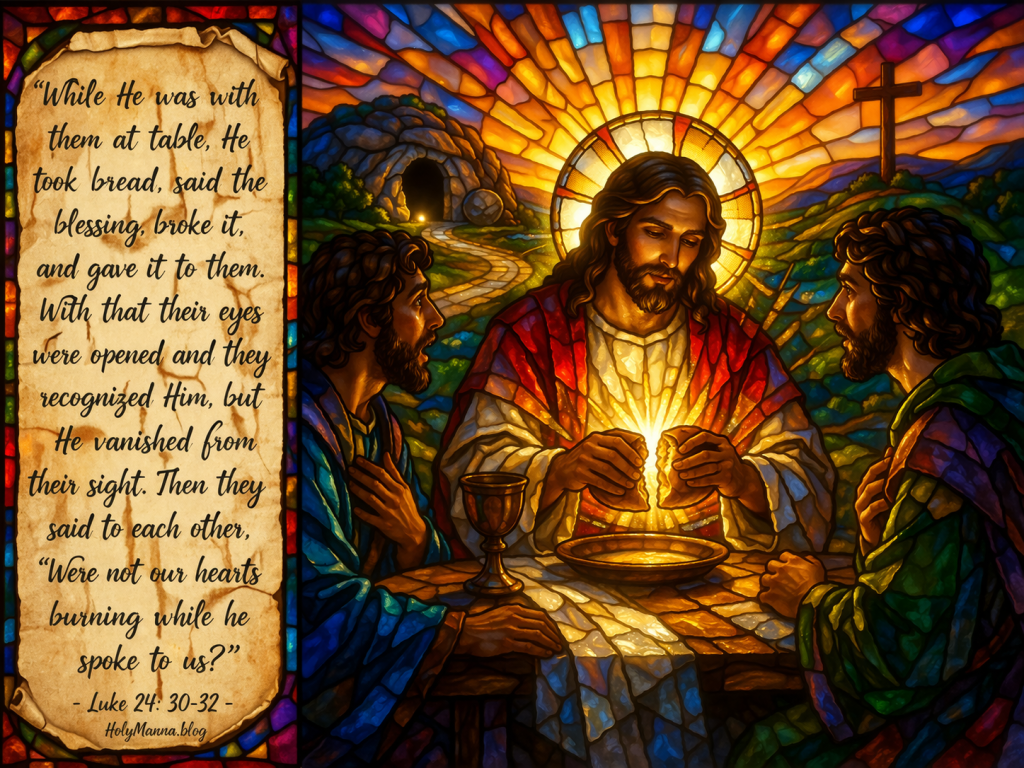
13 Now that very day two of them were going to a village seven miles from Jerusalem called Emmaus, 14 and they were conversing about all the things that had occurred. 15 And it happened that while they were conversing and debating, Jesus himself drew near and walked with them, 16 but their eyes were prevented from recognizing him. 17 He asked them, “What are you discussing as you walk along?” They stopped, looking downcast. 18 One of them, named Cleopas, said to him in reply, “Are you the only visitor to Jerusalem who does not know of the things that have taken place there in these days?” 19 And he replied to them, “What sort of things?” They said to him, “The things that happened to Jesus the Nazarene, who was a prophet mighty in deed and word before God and all the people, 20 how our chief priests and rulers both handed him over to a sentence of death and crucified him. 21 But we were hoping that he would be the one to redeem Israel; and besides all this, it is now the third day since this took place. 22 Some women from our group, however, have astounded us: they were at the tomb early in the morning 23 and did not find his body; they came back and reported that they had indeed seen a vision of angels who announced that he was alive. 24 Then some of those with us went to the tomb and found things just as the women had described, but him they did not see.” 25 And he said to them, “Oh, how foolish you are! How slow of heart to believe all that the prophets spoke! 26 Was it not necessary that the Messiah should suffer these things and enter into his glory?” 27 Then beginning with Moses and all the prophets, he interpreted to them what referred to him in all the scriptures. 28 As they approached the village to which they were going, he gave the impression that he was going on farther. 29 But they urged him, “Stay with us, for it is nearly evening and the day is almost over.” So he went in to stay with them. 30 And it happened that, while he was with them at table, he took bread, said the blessing, broke it, and gave it to them. 31 With that their eyes were opened and they recognized him, but he vanished from their sight. 32 Then they said to each other, “Were not our hearts burning [within us] while he spoke to us on the way and opened the scriptures to us?” 33 So they set out at once and returned to Jerusalem where they found gathered together the eleven and those with them 34 who were saying, “The Lord has truly been raised and has appeared to Simon!” 35 Then the two recounted what had taken place on the way and how he was made known to them in the breaking of the bread.
Detailed Exegesis
Verse 13 – “Now that very day two of them were going to a village seven miles from Jerusalem called Emmaus,”
Luke begins by saying “that very day,” tying this story directly to Easter Sunday. The Resurrection has already happened, even though these disciples do not yet grasp it. Their movement away from Jerusalem suggests disappointment and retreat. Emmaus becomes the road of the discouraged believer, the road taken when hope feels fragile and the heart does not yet know what God is doing.
Verse 14 – “and they were conversing about all the things that had occurred.”
They speak about the Passion, the death of Jesus, and the strange reports beginning to circulate. This is important because faith does not erase the need to wrestle honestly with events. The disciples are not numb. They are trying to make sense of what has happened. Luke shows that grace often meets people in the middle of sincere struggle.
Verse 15 – “And it happened that while they were conversing and debating, Jesus himself drew near and walked with them.”
This is one of the most beautiful lines in Scripture. While they are discussing, debating, and trying to understand, Jesus Himself comes near. The risen Lord does not wait until they are composed, certain, or worthy. He meets them in their confusion. Easter means that Christ is alive enough to enter the ordinary roads of human sorrow.
Verse 16 – “but their eyes were prevented from recognizing him.”
Their inability to recognize Jesus is not mere absentmindedness. Luke suggests a deeper mystery. God permits a hiddenness here so that the disciples may be led gradually into fuller faith. This reflects the Christian life. The Lord is often nearer than the soul realizes, yet recognition comes in His time and through His chosen means.
Verse 17 – “He asked them, ‘What are you discussing as you walk along?’ They stopped, looking downcast.”
Jesus asks a question, not because He lacks knowledge, but because He wants them to speak their hearts. The Gospel notes that they stopped, looking downcast. Luke lets the sadness settle in the scene. Before the risen Lord heals their understanding, He allows their grief to be voiced. Christ does not crush wounded hearts. He draws them out gently.
Verse 18 – “One of them, named Cleopas, said to him in reply, ‘Are you the only visitor to Jerusalem who does not know of the things that have taken place there in these days?’”
Cleopas speaks with a mix of frustration and astonishment. The irony is rich. He asks whether Jesus is the only one who does not know, when in fact Jesus alone understands the full meaning of what has taken place. Luke often uses irony to reveal how limited human sight can be when divine truth is still hidden.
Verse 19 – “And he replied to them, ‘What sort of things?’ They said to him, ‘The things that happened to Jesus the Nazarene, who was a prophet mighty in deed and word before God and all the people,’”
Jesus invites them to tell the story as they currently understand it. They describe Him as a prophet mighty in deed and word, which is true, but still incomplete. They have not yet fully grasped that He is the Messiah, the Son of God, and the risen Lord. This verse reveals how a person can speak reverently of Jesus and still not yet know Him fully.
Verse 20 – “how our chief priests and rulers both handed him over to a sentence of death and crucified him.”
The disciples recount the Passion with painful clarity. Jesus was not simply opposed. He was condemned and crucified. Luke lets the scandal of the Cross remain visible. Easter does not erase the horror of Calvary. The risen Lord is the crucified Lord, and the disciples must come to see that the Cross was not the collapse of God’s plan, but its mysterious fulfillment.
Verse 21 – “But we were hoping that he would be the one to redeem Israel; and besides all this, it is now the third day since this took place.”
This verse opens the wound. “We were hoping.” Few phrases capture disappointment more honestly. Their expectation of redemption was real, but it was too narrow. They had hoped for a certain kind of deliverance, perhaps political or visibly triumphant. Jesus had come to redeem Israel and the world, but through suffering love. The mention of the third day is especially poignant, because the clue is already there, though they do not yet understand it.
Verse 22 – “Some women from our group, however, have astounded us: they were at the tomb early in the morning”
The women’s witness has already begun to unsettle the disciples. Luke gives them due importance. Their testimony does not fit neatly into ordinary expectations, and so it leaves the disciples astonished rather than convinced. Grace has already entered the story, but the heart still struggles to receive it.
Verse 23 – “and did not find his body; they came back and reported that they had indeed seen a vision of angels who announced that he was alive.”
The disciples repeat the report accurately, yet still from a distance. The empty tomb and angelic message are present, but they have not yet become personal faith. This is a sobering reminder that hearing about the Resurrection is not the same as recognizing the risen Christ.
Verse 24 – “Then some of those with us went to the tomb and found things just as the women had described, but him they did not see.”
The evidence is accumulating, yet the disciples remain spiritually stalled. The tomb is empty, and the women’s report has been partially confirmed. Still, they remain on the road away from Jerusalem. Luke shows that facts alone do not heal the heart. The soul also needs its understanding opened by Christ.
Verse 25 – “And he said to them, ‘Oh, how foolish you are! How slow of heart to believe all that the prophets spoke!’”
Jesus now speaks with loving firmness. His correction is not cruel. It is medicinal. Their problem is not lack of intelligence, but slowness of heart. They know pieces of the story, but they have not believed the Scriptures in their fullness. The risen Lord diagnoses the root of their confusion: they have not yet accepted God’s way of saving through suffering.
Verse 26 – “Was it not necessary that the Messiah should suffer these things and enter into his glory?”
This verse stands at the center of Christian understanding. The Cross was not an accident. It was necessary in the sense of divine wisdom and saving purpose. Christ enters glory through suffering, not around it. Easter can only be understood rightly when joined to Good Friday. Glory comes through the wounds, not apart from them.
Verse 27 – “Then beginning with Moses and all the prophets, he interpreted to them what referred to him in all the scriptures.”
This is one of the great moments in all of salvation history. The risen Jesus opens the Scriptures and shows that all of them point toward Him. Moses, the prophets, the patterns of sacrifice, covenant, suffering, kingship, and promise all find their fulfillment in Christ. The disciples are being taught to read the whole Bible through the Paschal Mystery.
Verse 28 – “As they approached the village to which they were going, he gave the impression that he was going on farther.”
Jesus acts in a way that invites desire. He does not force Himself upon them. He allows space for hospitality and longing. The spiritual life often works this way. Christ comes near, but He also invites the heart to ask for more.
Verse 29 – “But they urged him, ‘Stay with us, for it is nearly evening and the day is almost over.’ So he went in to stay with them.”
This is one of the most beloved lines in the Easter Gospels. “Stay with us.” Their hearts have already begun to recognize something beautiful in this stranger’s presence. Hospitality becomes the threshold of revelation. In the Christian tradition, this verse has long been a prayer of the soul asking the Lord to remain near in darkness, weakness, and the approach of night.
Verse 30 – “And it happened that, while he was with them at table, he took bread, said the blessing, broke it, and gave it to them.”
Luke’s language here is unmistakably Eucharistic. The fourfold action of taking, blessing, breaking, and giving recalls the Last Supper and the Church’s liturgical life. The risen Christ who opened the Scriptures now reveals Himself in the breaking of the bread. This is not accidental detail. Luke is showing the Church where the Lord continues to be known.
Verse 31 – “With that their eyes were opened and they recognized him, but he vanished from their sight.”
Recognition finally comes at the table. Their eyes are opened, language that echoes divine grace and interior awakening. Jesus vanishes from their sight, not because He is absent, but because the mode of His presence has changed. They have been taught how to know Him now: in the Scriptures opened and in the bread broken.
Verse 32 – “Then they said to each other, ‘Were not our hearts burning within us while he spoke to us on the way and opened the scriptures to us?’”
Only after recognition do the disciples fully name what was happening within them. Their hearts had been burning. The Word of God, rightly opened by Christ, ignites the soul. This verse beautifully captures the interior effect of divine revelation. True encounter with Christ is not cold information. It sets the heart on fire.
Verse 33 – “So they set out at once and returned to Jerusalem where they found gathered together the eleven and those with them”
Everything changes at once. The same road that carried them away in discouragement now becomes the road back in urgency. Encounter with the risen Christ turns retreat into return. They go back to Jerusalem, back to the apostolic community, back to the place where the Church is being gathered.
Verse 34 – “who were saying, ‘The Lord has truly been raised and has appeared to Simon!’”
The community already has its own Easter proclamation. The Resurrection is not a private discovery belonging only to these two disciples. It is being confirmed within the apostolic circle. The appearance to Simon Peter is mentioned briefly but importantly, reinforcing Peter’s role within the Easter witness of the Church.
Verse 35 – “Then the two recounted what had taken place on the way and how he was made known to them in the breaking of the bread.”
The story ends with testimony. The disciples recount both the road and the table, both the Word and the breaking of the bread. That pairing is essential. The risen Christ opened their minds through Scripture and opened their eyes in the breaking of the bread. This is not just their private memory. It becomes part of the Church’s living proclamation.
Teachings
This Gospel is one of the Church’s clearest windows into how the risen Christ continues to form His people. The road to Emmaus shows that Easter is not simply an announcement that Jesus is alive. It reveals how the living Christ encounters the discouraged heart, interprets the Scriptures, and makes Himself known in the breaking of the bread. The Church has always recognized in this story a profound image of the Mass.
The Catechism teaches, “It is Christ himself who speaks when the holy Scriptures are read in the Church.” CCC 1088. That truth shines through Emmaus. The disciples are not merely receiving a Bible lesson. They are hearing the risen Christ open the Scriptures. The Word of God becomes living, personal, and burning because Christ Himself is its fulfillment and its true interpreter.
The Eucharistic dimension is just as central. The Catechism teaches, “The liturgy of the Word and liturgy of the Eucharist together form ‘one single act of worship.’” CCC 1346. Emmaus reflects exactly that movement. First Christ opens the Scriptures on the road. Then He is recognized in the breaking of the bread at table. The Church has long seen in this pattern the shape of her own worship. The same risen Lord still teaches, feeds, and reveals Himself.
This Gospel also teaches that the Resurrection does not cancel suffering, but reinterprets it. Jesus says it was necessary that the Messiah should suffer and so enter into glory. The Catechism teaches, “The Paschal mystery has two aspects: by his death Christ liberates us from sin; by his Resurrection, he opens for us the way to a new life.” CCC 654. Emmaus shows both aspects woven together. The disciples had tried to separate glory from suffering, but Christ joins them forever in the mystery of redemption.
There is also a beautiful lesson here about faith and understanding. The disciples do not recognize Jesus immediately. Their eyes are opened gradually through His Word and through the breaking of the bread. This is often how grace works in real life. Saint Augustine, reflecting on this Gospel, saw in it a mercy from Christ: He was hidden for a time so that He might be recognized more deeply. The Lord leads the soul by stages, not because He is distant, but because He is patient.
Finally, Emmaus is a Gospel of ecclesial return. Once the disciples recognize Christ, they do not stay in private spiritual satisfaction. They return at once to Jerusalem and to the gathered disciples. That is profoundly Catholic. Encounter with the risen Christ always leads back into communion with His Church.
Reflection
This Gospel feels close to ordinary life because so many people know the road to Emmaus. It is the road walked after disappointment, after prayer seems unanswered, after hope feels bruised, after God’s plan no longer looks like what was expected. These disciples were not mocking Jesus. They were grieving Him. They loved Him enough to be crushed by what they thought had happened. That is what makes this story so consoling. Christ comes precisely to disciples like that.
There is deep comfort in the way Jesus handles them. He does not begin by scolding their sadness. He walks with them. He listens. He asks questions. Then He teaches. That alone can reshape the spiritual life. The believer does not need to hide confusion from Christ. The better path is to bring it onto the road and let Him meet it there.
This Gospel also offers a very practical pattern for daily life. Stay near the Scriptures even when the heart feels slow. Ask the Lord to remain near in the evening hours of life, in fatigue, in temptation, in discouragement, and in uncertainty. Come to Mass with the awareness that the risen Christ still opens the Word and is still made known in the breaking of the bread. A Catholic who neglects Scripture and the Eucharist should not be surprised if the heart grows cold. Emmaus shows where fire returns.
There is also a needed challenge here. Many Christians want resurrection joy without allowing Christ to reinterpret suffering. The disciples wanted redemption without the Cross. Modern hearts often want the same. But Jesus insists that glory comes through suffering offered in love. This does not make pain easy, but it does make it meaningful when united to Him.
The final movement of the Gospel is especially important. The disciples rise and return at once. Real encounter leads to witness. Once Christ has been recognized, the soul cannot remain forever turned inward. It must go back to the Church, back to communion, back to testimony, back to the life of mission.
What disappointment has quietly put the soul on the road away from Jerusalem?
Has the heart been allowing Christ to open the Scriptures, or has it been trying to interpret life without Him?
How might the risen Lord be inviting deeper recognition of His presence in the Eucharist, in the Word, and in the daily roads where He still draws near?
Step Out of the Tomb and Live the Feast
Easter Sunday gathers every reading into one radiant truth: Jesus Christ is truly risen, and because He is risen, nothing has to remain trapped in darkness. In Acts of the Apostles, Peter stands and proclaims the Resurrection as a real event witnessed by chosen men and offered to the whole world. In Psalm 118, the Church answers with gratitude and wonder, singing “This is the day the Lord has made; let us rejoice in it and be glad.” In Colossians, Saint Paul reminds the baptized that their lives are now hidden with Christ in God. In First Corinthians, he urges the faithful to clear out the old leaven and live as people of the true Passover. Then the Gospels lead the heart into the mystery itself: the empty tomb, the angel’s message, the burning road to Emmaus, the breaking of the bread, and the first trembling steps of resurrection faith.
Taken together, these readings show that Easter is not only something to admire. It is something to enter. The risen Christ is not a memory from long ago. He is the living Lord who forgives sins, opens the Scriptures, feeds His people, and calls them to a new life. He meets the grieving at the tomb, the fearful on the road, the confused in their questions, and the faithful at the table. He turns witnesses into preachers, sorrow into praise, and ordinary disciples into men and women who can no longer live as if death still rules the world.
This is the invitation of Easter. Leave behind the old leaven. Stop returning to the tomb as though hope were buried there. Lift the mind and heart toward Christ. Stay close to the Scriptures. Go faithfully to the altar. Bring sins to His mercy. Speak His name with confidence. Live as someone who actually believes that the stone has been rolled away. The world does not need half-awake Christians who admire the Resurrection from a distance. It needs believers whose lives quietly announce that Jesus is alive.
What part of life still needs to be placed in the light of the risen Christ? What would change if Easter were received not as a passing holy day, but as the beginning of a truly new life?
Today is the day to begin again. Today is the day to rejoice, to repent, to believe, and to follow with a steadier heart. The tomb is empty. Christ is risen. The feast has begun. Now the faithful are called to live like it.
Engage with Us!
Share your reflections in the comments below. Easter is too rich to rush past, and sometimes the Lord opens the heart more deeply when His people slow down, pray, and speak about what they have heard. These readings carry victory, mercy, truth, and invitation. They remind the faithful that the risen Christ still meets His people, still opens the Scriptures, and still calls each soul into a new life.
- In the First Reading from Acts 10:34, 37-43, what stands out most in Peter’s witness to the risen Jesus? How does this reading challenge the heart to trust that forgiveness of sins is truly offered through the name of Christ?
- In the Responsorial Psalm, Psalm 118:1-2, 16-17, 22-24, which line speaks most powerfully today: “I shall not die but live”, “The stone the builders rejected has become the cornerstone”, or “This is the day the Lord has made”? Why does that verse feel especially important right now?
- In the Second Reading, Colossians 3:1-4, what does it mean in daily life to seek what is above and to remember that life is hidden with Christ in God? Where might the Lord be asking for a more heavenly way of thinking?
- In the Second Reading, 1 Corinthians 5:6-8, what old leaven may still need to be cleared out of the heart? How is the risen Christ calling for a more sincere and truthful way of living?
- In the Holy Gospel, John 20:1-9, which part of the empty tomb story speaks most deeply: Mary coming while it was still dark, Peter running to the tomb, or the beloved disciple seeing and believing? What signs of grace might the Lord already be placing before the eyes of faith?
- In the Holy Gospel, Matthew 28:1-10, what speaks most strongly: the angel’s words “Do not be afraid”, the women running with fear and joy, or their worship of the risen Jesus? Where is Christ asking for greater courage and trust?
- In the Holy Gospel, Luke 24:13-35, do the heart and mind relate more to the sadness of the road, the burning of the Scriptures, or the recognition of Jesus in the breaking of the bread? How might the risen Lord be drawing closer in the middle of disappointment or confusion?
Keep walking with Christ this Easter season. Stay close to His Word, stay close to the Eucharist, and do everything with the love, mercy, and faithfulness that Jesus taught. The tomb is empty, the Lord is risen, and a life lived in His grace is never wasted.
Sacred Heart of Jesus, we trust in You!
Immaculate Heart of Mary, pray for us!
Saint Michael the Archangel, defend us in battle!
Follow us on YouTube, Instagram and Facebook for more insights and reflections on living a faith-filled life.


Leave a comment