Easter Morning and the Empty Tomb
Easter Sunday of the Resurrection of the Lord is the heart of the Catholic faith. This is the day the Church stands before the empty tomb and proclaims that Jesus Christ, who truly suffered, truly died, and was truly buried, has truly risen. Everything in Christian life flows from this mystery. The Cross is not erased on Easter. It is revealed in its full glory. The wounds remain, but they shine now with victory. Sin has been defeated. Death has been broken open. Hope is no longer wishful thinking. Hope has a face, and His name is Jesus Christ.
In Catholic tradition, Easter is the greatest of all solemnities, the feast of feasts. It is not simply a beautiful anniversary or a comforting symbol. It is the decisive act of God in history, the fulfillment of the promises made to Israel, and the triumph of the Son over the grave. The Church’s liturgy, preaching, sacraments, and prayer all turn toward this day because the Resurrection is not one doctrine among many. It is the blazing center of the Gospel. As Saint Paul teaches, “If Christ has not been raised, your faith is vain”. Easter is the answer to that question forever.
The Night That Changed the World
The story behind Easter begins in sorrow, silence, and apparent defeat. On Good Friday, Jesus was crucified outside Jerusalem under Pontius Pilate. The One who healed the sick, forgave sinners, raised the dead, and preached the Kingdom was mocked, scourged, nailed to the Cross, and laid in a borrowed tomb. The disciples were shattered. The hopes of many seemed buried with Him. The world, for one awful moment, appeared to have chosen darkness.
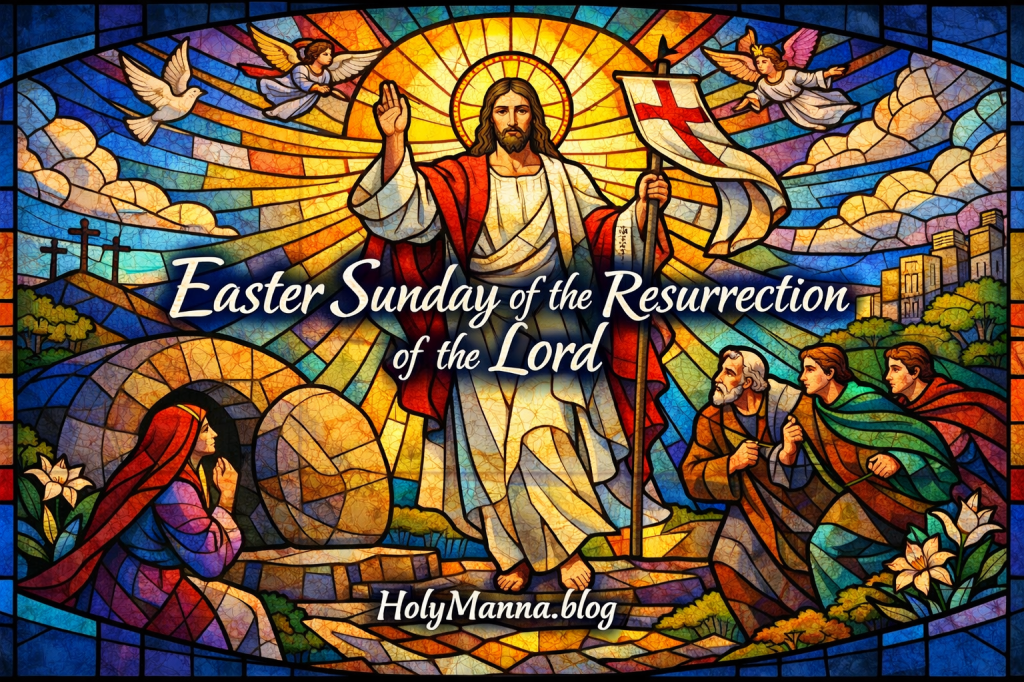
But the silence of Holy Saturday was not empty. The Church has always understood that Christ’s rest in the tomb was part of the saving mystery. Then came the first day of the week. The women went to the tomb carrying spices, still acting in love even while their hearts were broken. They did not go there expecting a miracle. They went there to mourn well. Instead, they found the stone rolled away. The tomb was empty. The angels announced what no human heart would have dared to imagine: “He is not here, for he has been raised just as he said”.
The key figures in this holy drama are not political rulers or military heroes. They are Mary Magdalene, the other holy women, Saint Peter, Saint John, and the disciples who slowly came to understand that the Lord had done exactly what He promised. Jerusalem was the place where this happened, under the shadow of Roman occupation and within the tension of first century Judea. Yet what took place there was bigger than any empire, bigger than any age. The Resurrection was not merely a private consolation for grieving followers. It was the beginning of a new creation.
From the Roman Catholic perspective, Easter also stands in profound continuity with the Passover of Israel. The Christian word Pascha comes from the Passover. Just as Israel passed from slavery to freedom, so humanity now passes from sin and death into grace and life through Christ, the true Paschal Lamb. The old exodus was real, but it pointed toward something even greater. On Easter, the final exodus begins.
The Victory at the Center of the Faith
Theologically, Easter means that Jesus did not simply return to earthly life. Lazarus was raised and would die again. Christ rose in glory, never to die again. His Resurrection is the beginning of the new creation, the revelation of what redeemed humanity is called to become. The Church teaches that the Resurrection is both a real historical event and a mystery that surpasses history. The tomb was truly empty. The Lord truly appeared to His disciples. Yet what happened in Him cannot be reduced to ordinary categories. Death itself was transformed from within.
This is why Easter is so central in Catholic teaching. By His death, Christ freed humanity from sin. By His Resurrection, He opened the way to new life. Easter is therefore bound up with justification, grace, adoption as sons and daughters of God, and the future resurrection of the body. The Resurrection is the Father’s vindication of the Son and the public triumph of divine love over every force that opposes it.
The Church’s liturgy guards this truth with great care. Easter is not detached from the Sacred Triduum. Holy Thursday, Good Friday, and Easter Sunday form one great mystery. The sacrifice of Calvary and the glory of the Resurrection belong together. There is no Easter without the Cross, and the Cross only reveals its full meaning in Easter. That is why the Easter Vigil is so magnificent. The Church begins in darkness, kindles the new fire, lights the Paschal Candle, sings the Easter proclamation, tells the great story of salvation, blesses baptismal water, renews baptismal promises, and then comes to the altar. The whole liturgy says, with signs as well as words, that Christ has led His people from darkness into light.
Catholic teaching has returned to this mystery again and again through the centuries. The Fathers of the Church preached Easter as the victory of the Lamb. Great papal teaching has emphasized that the Risen Christ is not a memory from the past but the living Lord who walks with His Church now. The Church does not celebrate an idea. She worships a living Person. Easter means Jesus is alive now, reigning now, interceding now, and drawing souls now into His divine life.
Where the Church Learns to Rejoice
Devotion surrounding Easter is rich because the mystery itself is rich. The first and greatest devotion is the Church’s sacred liturgy, especially the Easter Vigil and Easter Sunday Mass. Nothing surpasses participation in these mysteries. This is where Catholics hear the saving Word, renew baptismal promises, receive the Eucharist, and enter again into the life won by Christ.
The Paschal Candle holds a special place in this season. Lit at the Vigil from the new fire, it stands as a sign of the Risen Christ, the Light of the World. It remains near the ambo throughout Easter Time and is also used at baptisms and funerals, reminding the faithful that Christian life begins and ends in the light of the Resurrection.
There are also beautiful devotions proper to Eastertide. The Regina Caeli replaces the Angelus, and the Church prays with joy, “For the Lord has truly risen, alleluia”. The Via Lucis, or Way of Light, invites the faithful to meditate on the appearances of the Risen Lord from Easter to Pentecost. Divine Mercy devotion also finds a natural home here, because the wounds of the Risen Christ are not hidden away but shown as fountains of mercy.
Pilgrimage has a special place as well. Rome is especially beloved at Easter because of the public witness of the universal Church gathered around Saint Peter’s Basilica and the Holy Father’s Easter blessing. The Holy Land, above all Jerusalem and the Church of the Holy Sepulchre, remains one of the most powerful places of Christian pilgrimage because it anchors devotion in the actual places of the Passion, burial, and Resurrection. Yet the deepest Catholic instinct is to remember that every faithful parish becomes a kind of Jerusalem on Easter, because the same Paschal Mystery is made present sacramentally wherever the Church gathers in truth.
The Easter season also carries practical spiritual weight. Catholics are reminded of the duty to receive Holy Communion during the Easter season, prepared by confession when needed. This is fitting. Easter is not meant to stay at the level of decoration, music, or sentiment. It calls the faithful to sacramental renewal.
The Joy That Spread Across the World
Easter has shaped Catholic culture across the world in ways both grand and intimate. In many places the celebration begins with the Vigil and continues with processions, bells ringing in full voice, festive meals, floral altars, and homes filled with joy after the austerity of Lent. The Alleluia, silenced during the penitential season, returns like a flood. The whole Church seems to breathe again.
In Rome, Easter is marked with solemn liturgies that reveal the universal dimension of the feast. In the Holy Land, the sacred geography itself deepens the mystery. In countries throughout Europe and Latin America, Easter traditions often preserve processions, candles, special foods, and community gatherings that unite family life with liturgical life. In the Philippines, parts of Spain, Poland, Italy, Mexico, and many other places, Easter morning is celebrated with a sense of victory that is both communal and deeply personal.
Catholic hymnody also bears the mark of this feast. Ancient chants like the Exsultet and the Easter Sequence sing the Church’s faith in language both poetic and theological. The liturgy itself becomes culture, shaping memory, song, and celebration across generations. Even where external customs differ, the core remains the same. The tomb is empty. Christ is risen. The Church rejoices.
Yet Catholic tradition always keeps the order clear. The feast is not about customs first. It is about Christ first. Every cultural expression reaches its fullest meaning when it serves the liturgy and helps souls enter more deeply into the mystery.
Living Like the Tomb Is Empty
Easter is not only a feast to admire. It is a truth to live. The lesson of Easter is not that pain is imaginary or that the Christian life is easy. The Risen Christ still bears His wounds. The lesson is that suffering does not have the final word when it is united to Him. Sin does not have the final word when it is confessed and surrendered. Death does not have the final word for those who belong to Christ.
That is why Easter speaks so strongly to ordinary life. It teaches perseverance when prayer feels dry. It teaches trust when the future is unclear. It teaches mercy when bitterness feels easier. It teaches courage when faith is costly. The Resurrection tells the faithful that God is always at work, even in silence, even in waiting, even in what looks hopeless.
A Catholic life shaped by Easter begins with the sacraments. It returns to confession with honesty. It receives the Eucharist with reverence. It prays with hope. It forgives because it has been forgiven. It loves because divine love has already conquered the grave. Easter also teaches believers to stop living like practical atheists who say Christ is risen with their lips but live as though anxiety, status, pleasure, or resentment still reign.
What tomb has been mistaken for the end when Christ may be preparing a resurrection? What fear still acts as though Jesus has not conquered death? What relationship, wound, or sin needs to be brought into the light of the Risen Lord? These are Easter questions. They are not meant to produce guilt. They are meant to open the heart.
The Resurrection calls every Christian to become a witness. Mary Magdalene did not keep the news to herself. Peter and John did not keep the empty tomb private. The Church herself exists because people who encountered the Risen Christ could not stay silent. Easter therefore asks the faithful to bring hope into homes, workplaces, friendships, marriages, and parishes. The world does not need vague optimism. It needs Christian hope rooted in a real victory.
The Feast That Holds Everything Together
Easter Sunday of the Resurrection of the Lord is the feast that holds the whole Catholic faith together. Creation, covenant, sacrifice, redemption, grace, baptism, Eucharist, mercy, hope, mission, and eternal life all meet here. Without Easter, the Gospel becomes a tragic memory. With Easter, everything changes.
This is why the Church never tires of proclaiming the same good news. Christ is risen. He is truly risen. That proclamation is not repetitive because the heart always needs to hear it again. Every age tries in its own way to convince the soul that darkness is stronger, that holiness is futile, that death is final, or that sin is too deep to heal. Easter stands over against every one of those lies with the calm authority of the empty tomb.
The Church does not celebrate Easter because Christians are naturally cheerful people. The Church celebrates Easter because Jesus Christ has destroyed death by death and opened heaven to the faithful. That is why this feast remains the wellspring of Catholic joy. It is not shallow. It has passed through Calvary. It is not naïve. It has seen the tomb. It is not sentimental. It is victorious.
Engage with Us!
Readers are warmly invited to share their thoughts and reflections in the comments below. Easter is too rich a mystery to keep at a distance, and often the most beautiful insights come from seeing how the Lord has worked in ordinary lives with extraordinary mercy.
- What part of the Easter story speaks most deeply to the heart right now: the empty tomb, the faithfulness of the holy women, the running of Peter and John, or the appearances of the Risen Christ?
- How has the Lord brought new life out of a season of sorrow, confusion, or waiting?
- What does it mean in daily life to truly live as someone who believes Christ is risen?
- How can the joy of Easter shape prayer, family life, work, and the way others are treated this week?
- What area of life most needs the mercy, hope, and light of the Risen Jesus right now?
May this holy feast draw every heart more deeply into the life of Christ. May Easter joy not remain only in church buildings or family celebrations, but take root in daily life. Live with faith. Speak with charity. Forgive with mercy. Love generously. Do everything with the love and mercy Jesus taught us.
Jesus Christ, Our God and Our Lord, have mercy on us!
Follow us on YouTube, Instagram and Facebook for more insights and reflections on living a faith-filled life.


Leave a comment