The Mothers Who Would Not Bend
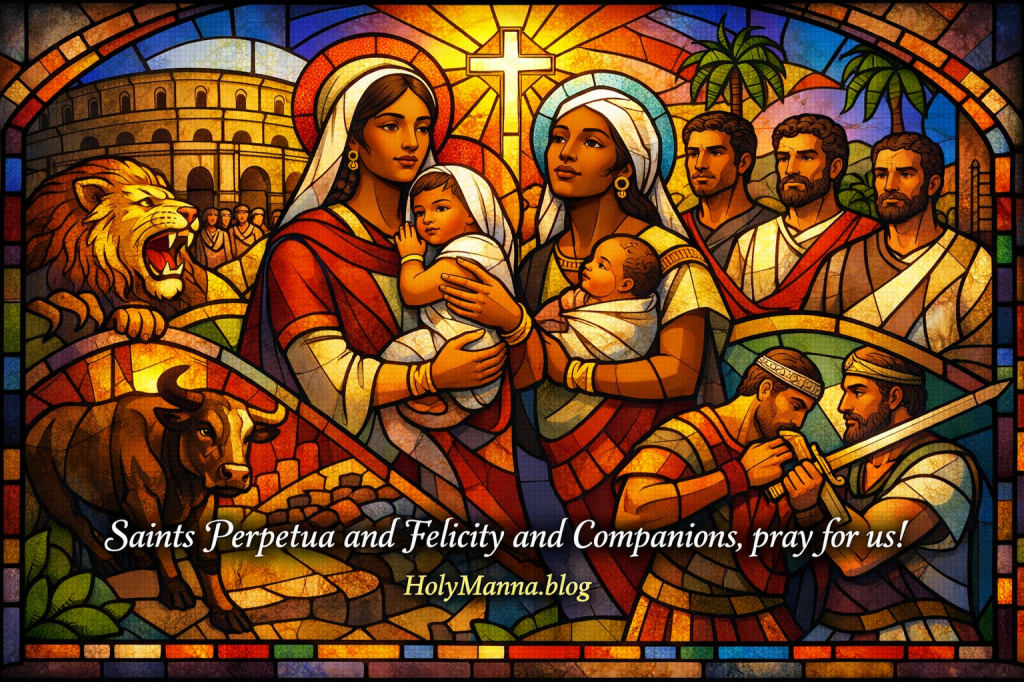
In the early third century, in the loud and proud Roman city of Carthage, two women stood side by side and quietly changed Christian history. Saint Perpetua was young, noble, educated, and nursing a baby. Saint Felicity was enslaved, poor, and very pregnant. Everything about their lives said they should never have been in the same story, much less in the same prison cell. Yet the Church remembers them together because grace does that. Grace makes strangers into sisters, and it makes ordinary people astonishingly brave.
Saints Perpetua and Felicity are revered as martyrs, but they are also cherished for something rare: the Church has an ancient account of their suffering that preserves Perpetua’s own words, recorded during her imprisonment. Their witness is not a distant legend. It feels close enough to hear their breathing, close enough to feel the pressure of a father’s pleading, close enough to watch a trembling executioner hesitate.
Their feast is celebrated in the Roman Catholic Church, and their names are famously included in the Church’s most ancient Eucharistic prayer. That matters because it means their blood is not only remembered in books. Their witness is echoed at the altar, where Christ’s sacrifice is made present and His victory is proclaimed.
A Noble Daughter and an Enslaved Mother Find the Same Lord
Perpetua lived in Carthage and came from a well-to-do family. The details that survive paint her as a woman with real responsibilities, not a sheltered girl playing at religion. She had a father who loved her fiercely, a household that depended on her choices, and an infant who needed her body, not just her affection. Felicity lived under the harsh reality of slavery, and the ancient account does not romanticize it. She was pregnant, vulnerable, and at the mercy of Roman power and Roman entertainment.
What brought them together was not politics or personality. It was Christ. Both were catechumens, meaning they were preparing for Baptism and being formed in the faith. They were not “born into it” in any comfortable way. They were choosing it, and that choice had a price. The group also included companions who shared their preparation and their arrest. The names remembered with them are Saints Revocatus, Saturninus, Secundulus, and their instructor, Saint Saturus. Secundulus did not live to face the beasts because he died in prison, a quiet martyrdom that still counted as a complete offering.
A surprising and important detail is that the catechumens were baptized after the arrest. Their enemies thought prison would weaken their resolve, but the Church remembers prison as the place where they were sealed to Christ. That is deeply Catholic. Baptism is not a spiritual accessory. It is a new identity, a real belonging, and a covenant that can demand everything. CCC 1213.
Perpetua became known not only for dying bravely, but for speaking with a clarity that still cuts through excuses. When pressured to deny the faith, she did not hide behind complicated arguments. She spoke like someone who knew that truth has a name.
“I cannot call myself by any other name than what I am, a Christian.”
That sentence is simple, but it is not childish. It is the voice of someone who has been claimed by Christ and refuses to lie about it.
Visions in a Cell
It is tempting to think sainthood is mostly about dramatic moments, but the most striking part of Perpetua and Felicity’s story is the steady interior strength that carries them day after day. Prison was not a monastery. It was crowded, hot, dark, and humiliating. It was the kind of suffering that grinds down the soul, especially when fear and uncertainty stretch on.
Perpetua’s account includes visions that the Church has long treated as part of her spiritual witness. These are not “party tricks.” In a Catholic lens, authentic private revelations never replace the Gospel, but they can strengthen a person for the task God has permitted. CCC 67. Perpetua’s visions focus again and again on spiritual reality, on the fact that martyrdom is not merely a public execution. It is a battle of faith in which Christ’s victory is shared with His friends.
One of the most moving moments is the way Perpetua’s heart is repeatedly pulled in two directions. Her baby needs her. Her father begs her. Her society threatens her. And yet her conscience, formed by the truth of Christ, will not break. The Church teaches that martyrdom is the supreme witness to the truth of the faith. CCC 2473. That witness is not only made at the last second in the arena. It begins in the cell, when a mother chooses to live and speak as a disciple even while her heart aches.
Felicity’s “miracle” is the kind that sounds almost too human to call miraculous. She feared that pregnancy would separate her from her companions because Roman custom delayed the execution of pregnant women. She wanted to suffer with the others, not because she loved pain, but because she loved Christ and wanted to complete the same witness. She prayed, and she went into labor. She gave birth shortly before the games, and the child was received and cared for by Christians. That is not only providence. That is the Church acting like the Church, receiving the vulnerable as family. CCC 1655.
The ancient story also preserves Felicity’s reply when someone mocked her labor pains, basically saying, “If this hurts, how will you handle the beasts?” Her answer is famous for a reason.
“Now it is I that suffer what I suffer, but then there will be another in me, because I also am about to suffer for Him.”
That is a theology of union with Christ spoken in the language of a woman who has lived in a body that gets used and dismissed. It is Catholic to the core. Christian suffering is never worship of pain. It is participation in the love of Christ, who suffers to save. CCC 618.
A Father’s Tears, a Crowd’s Hunger, and the Dignity of the Saints
Perpetua’s hardships were not only Roman chains. They were family grief. Her father appears in the story as a man tormented by the fear of losing his daughter and losing face. His pleading is the kind that would break most people. He appeals to her love, to her duty, to her baby, and to his own heartbreak. That part of the story matters because it shows something Catholic and very real: holiness does not require a lack of human feeling. The saints are not stone. They are faithful.
When judgment came, the Roman world treated these Christians as entertainment. The arena was meant to humiliate them, costume them, and turn their deaths into a pagan celebration of power. The account remembers that they resisted that humiliation. They refused to be dressed up as characters in a false religion. They wanted to die as Christians, not as props.
In the amphitheater, the companions were scourged and exposed to beasts. Perpetua and Felicity were sent against a wild cow, a cruel choice meant to mock their womanhood and motherhood. The story’s details are painful, but the reason they are remembered is not gore. It is dignity.
Perpetua, after being tossed, is described as gathering her torn clothing and fixing herself with a modesty that looks almost shocking in that setting. She ties up her hair because loose hair signaled mourning, and she would not appear as someone defeated. The point is not vanity. The point is interior freedom. Martyrs do not die as victims of chaos. They die as witnesses of Christ.
In a final moment, Perpetua encourages the faithful and does what Christians have done for centuries before facing death. She clings to communion. She urges love. She refuses to let suffering become a scandal that drives others away from Christ.
“Stand fast in the faith, and love one another. Do not let our sufferings be a stumbling block to you.”
Then comes one of the most startling details: the executioner trembles, and Perpetua guides the blade to her throat. That is not suicide. It is the opposite. It is a refusal to let fear have the final word. It is the calm, deliberate offering of a life that belongs to Jesus.
A Memory That Would Not Die
Some saints are remembered mainly through later legends, but Perpetua and Felicity are remembered through an early witness that spread quickly through the Church. Their story was read aloud among Christians, treasured as a testimony, and treated with reverence. At the same time, holy leaders also cautioned the faithful to keep the right order of authority, because even the most moving martyr story is not Scripture. Catholics love the saints, but Catholics worship God, and God’s Word remains the measure. CCC 102.
The greatest “miracle” after their death is how widely their witness took root. Their veneration spread, their burial place became a place of remembrance, and churches were dedicated in their honor. Their names entered the Church’s liturgical memory so deeply that they are included in the Roman Canon of the Mass, meaning their witness is invoked in the Church’s most solemn prayer at the Eucharist. That is an enormous cultural and spiritual impact. It means the Church keeps saying their names in the context of Christ’s sacrifice, as if to say, “This is what grace can do in a human life.”
Through the centuries, Christians have also reported favors, help, and healings through the intercession of Saints Perpetua and Felicity, especially among mothers and pregnant women who see their own fears reflected in these martyrs’ courage. Many of these personal testimonies cannot be verified historically in a strict documentary way, but they fit a deeply Catholic instinct: the saints are alive in Christ, and they pray for the Church. CCC 956. When a mother whispers a prayer to Felicity in the middle of a difficult pregnancy, that prayer is not reaching into a dead past. It is reaching into the living communion of the Church.
Their story also carries a quiet cultural revolution that still matters. Rome tried to divide people by class, citizenship, and power. Perpetua and Felicity stand as a Catholic contradiction. In Christ, a noblewoman and an enslaved woman share the same Baptism, the same confession, and the same crown.
The Courage of a Christian Name
Perpetua and Felicity are not only for people who love ancient history. Their story is painfully modern because it exposes the same old pressure with a new coat of paint. The world still begs Christians to rename themselves. It still says, “Be spiritual, but do not be Christian. Be good, but do not be Catholic. Keep faith private, but do not let it reshape your choices.”
Perpetua’s answer is a gift to any believer who feels squeezed by family expectations, social trends, or the fear of being judged. Christian identity is not a costume that gets taken off when it becomes inconvenient. It is a reality sealed by Baptism. CCC 1272. The modern disciple may not face a Roman beast, but the disciple will face something else, like ridicule, isolation, career consequences, or the slow temptation to compromise.
Felicity’s witness speaks powerfully to anyone who feels trapped in circumstances they did not choose. She was enslaved, pregnant, and condemned, yet she was free where it mattered most. She belonged to Christ. Her courage challenges the comfortable lie that freedom is mostly about control. In the Catholic view, real freedom is the ability to choose the good, even when suffering is present. CCC 1731.
This story also invites a very practical kind of examination. Courage is not only for dramatic moments. It shows up in small fidelities. It shows up when a person chooses Sunday Mass again, confession again, prayer again, chastity again, honesty again, and forgiveness again. It shows up when a person refuses to call evil “normal” just to keep the peace.
How often does fear try to rename a disciple into something safer than “Catholic”?
Where is Christ inviting a firmer, calmer confession that does not argue, but simply tells the truth?
What would change if identity in Christ became the loudest voice in the heart, not the loudest voice on the internet?
Engage With Us!
Share thoughts and reflections in the comments below. This story has a way of stirring the heart, especially for anyone carrying family tension, anxiety, or the quiet fear of standing out for the faith.
- What part of Saints Perpetua and Felicity’s story felt most personal or challenging today?
- Where does pressure to compromise show up most often, in family, work, friendships, or private habits?
- What does it look like to say, with Perpetua, “I cannot call myself by any other name than what I am, a Christian” in everyday life, without being rude or dramatic?
- How does Felicity’s confidence in suffering with Christ reshape the way pain, anxiety, or inconvenience is viewed?
- What concrete step can be taken this week to “stand fast in the faith” through prayer, confession, Mass, or an act of mercy?
May this witness strengthen the heart to live a life of faith with steadiness, courage, and joy. Let every choice, especially the hidden ones, be done with the love and mercy Jesus taught, so that even ordinary days become a quiet confession that Christ is Lord.
Saints Perpetua and Felicity and Companions, pray for us!
Follow us on YouTube, Instagram and Facebook for more insights and reflections on living a faith-filled life.


Leave a Reply