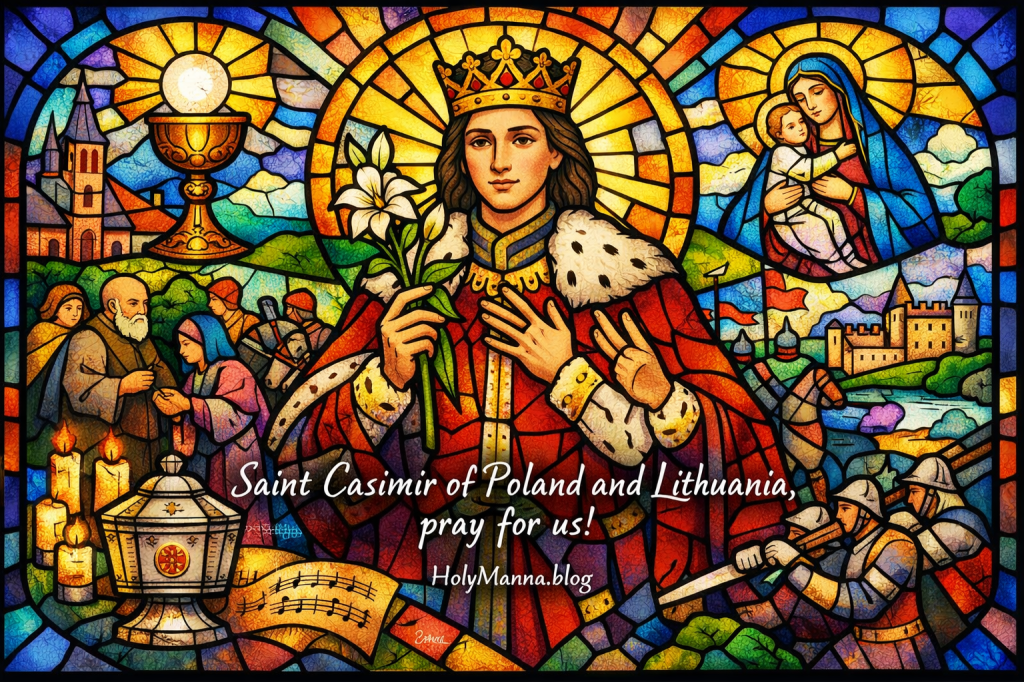
The Prince Who Chose a Different Crown
Saint Casimir is one of those saints who quietly shatters the excuses people make for not taking holiness seriously. He was not a monk hidden in the mountains. He was a prince raised in the noise of a royal court, trained for politics, and surrounded by power, comfort, and temptation. Yet he became known for something far rarer than influence. He became known for purity, prayer, mercy, and a love for the poor that made his royal life look almost upside down.
The Church remembers him because he lived what The Catechism teaches about true greatness. Holiness is not reserved for one “type” of person. It is the universal call of every Christian life, in every state of life, in every culture, and in every century, as CCC 2013 teaches. Casimir shows what it looks like when a young man takes that call seriously and refuses to let privilege soften his soul.
A Boy Prince Learning the Weight of a Soul
Casimir was born in Kraków in 1458, into the royal family of Poland and Lithuania. He grew up in a household where politics mattered, alliances mattered, and dynasties mattered. He was educated carefully, trained to think clearly, govern wisely, and represent his people. Even in his youth, he was pulled into the brutal chessboard of European power.
One of the surprising moments in his story came early. As a teenager, he became involved in a failed political attempt connected to the Hungarian throne. It was a sharp lesson. Sometimes what looks like a “great opportunity” is actually a doorway into compromise, pride, and bloodshed. In the years that followed, Casimir’s life shows a young man becoming more interior, more prayerful, and more resistant to the usual intoxicating ambitions of princes.
His conversion was not the kind that comes from a sudden dramatic sin and turnaround. It was the slower, stronger kind, the steady deepening of faith that shapes habits, choices, friendships, and desires. He began to live like a man who knew that Christ was not a private hobby. Christ was King, and everything else had to fall into line.
The Hidden Fire of a Public Life
Casimir eventually held real responsibility. While his father was away, he helped administer the kingdom with a reputation for prudence and justice. That detail matters because it shows his holiness was not just personal piety. It shaped leadership. It shaped judgment. It shaped the way he treated people who could do nothing for him.
He is especially remembered for chastity. Casimir resisted the pressure to marry for dynastic advantage, choosing a life of celibacy. That choice was not an escape from responsibility. It was a sacrifice offered for love of God. In a culture that treated royal marriage like a political tool, his refusal became a quiet protest, the kind that says a human person is not a bargaining chip.
This is where the Catholic vision of chastity becomes concrete. Chastity is not merely avoiding sin. It is the integration of the whole person in love, ordered toward truth and self-gift, as CCC 2337 teaches. Casimir’s chastity was not sterile. It overflowed into charity, humility, and a life marked by compassion.
His devotion to the Blessed Virgin Mary is also central to his story. Tradition associates him strongly with Marian prayer and praise, including a long-standing connection to the hymn “Omni die dic Mariae,” though authorship is not certain. What is clear is that he lived the kind of Marian devotion The Catechism describes, devotion that never competes with Christ, but leads the heart more deeply to him, as CCC 971 teaches.
A Life That Looked Ordinary from the Outside
Saint Casimir is not most famous for showy wonders performed during life. His miracle, in many ways, was the daily battle for holiness won through prayer and penance. Catholic tradition remembers him spending long hours in prayer, sometimes even kneeling outside churches when doors were locked, as if he would rather freeze in the night than go back to comfort without first giving God his due.
That is justice in the deepest sense. The Catechism defines justice as giving God and neighbor what is due to them, in CCC 1807. Casimir gave God time, reverence, worship, and trust. He gave the poor what the world tries to deny them, dignity, generosity, and personal attention.
His love for the Eucharist is also part of his remembered holiness. The Eucharist is “the source and summit of the Christian life,” as CCC 1324 teaches, and saints tend to orbit around that reality. Casimir’s prayer and purity were not random virtues. They were the fruit of a life oriented toward Christ.
The Cross That Came Without Martyrdom
Casimir was not killed for the faith, but he still carried a cross. Sometimes the hardest martyrdom is the slow one, the daily refusal to be owned by the world.
He faced the pressure of the court, the expectation to play the royal game, and the constant temptation to use power the way power is usually used. He also faced physical suffering. His health deteriorated, and he endured a serious illness that ended his life at only twenty-five years old.
His death is part of his witness because it shows how quickly earthly plans vanish. Royalty did not save him. Youth did not save him. Influence did not save him. Only Christ saves. That truth is not depressing. It is clarifying. It is the kind of truth that turns a young man into a saint.
The Saint Who Did Not Stay in the Grave
After Casimir’s death, devotion grew around his tomb, especially in Vilnius, where his relics were venerated in the cathedral. Many healings and favors were attributed to prayer through his intercession. In Catholic life, this is not superstition. It is the family of God acting like a family. The saints are alive in Christ, and they pray with us and for us, as CCC 956 explains.
Several miracle traditions surround Saint Casimir. There is a long-standing story that he aided his people in a time of military danger, appearing in a way that encouraged defenders and led to victory. This story is part of Catholic memory around him, but details vary by retelling, and the specific narrative cannot be verified with certainty.
Another famous tradition involves an image of Saint Casimir associated with Vilnius, sometimes called the “three-handed” depiction, where a second hand appears as if it returned after an attempted repainting. This story has been told for generations as a devotional wonder, but it cannot be verified with certainty.
What is more solid, historically speaking, is that devotion to him became intense and widespread. His relics were honored, his chapel became a place of pilgrimage, and his name spread far beyond one city. He became a patron especially beloved in Poland and Lithuania, and his feast is celebrated on March 4.
His cultural impact is also striking. In Lithuania, celebrations near his feast grew into a major public tradition in Vilnius, often connected to processions and a lively fair that blends faith, craftsmanship, and national memory. Even when a culture becomes less religious, saints like Casimir remain like deep roots under the soil. They keep calling a people back to what is true.
His legacy also traveled with the Catholic diaspora. Churches, schools, and Catholic communities carried his name to new lands, honoring him as a model for youth and for anyone trying to stay faithful in a world full of distractions.
What Saint Casimir Teaches a Modern Heart
Saint Casimir is a powerful friend for anyone trying to live a clean life in a dirty culture, and a faithful life in a cynical age. His story proves that purity is possible, not because a person is strong, but because grace is real. His life also proves that charity is not sentimental. It is costly. It is personal. It is inconvenient. It is exactly what Christ commands when he says, “Whatever you did for one of these least brothers of mine, you did for me” Mt 25:40.
Casimir also speaks to anyone who feels trapped by public pressure. He lived inside a system that could have shaped him into a polished hypocrite. Instead, he became a man of interior freedom. That is the kind of freedom worth begging God for, the freedom to say yes to Christ even when the crowd expects compromise.
For daily life, his example can be lived in very practical ways. A person can choose a disciplined prayer routine and treat it as non-negotiable. A person can practice custody of the eyes and imagination, asking for purity not only in actions but in desires, as CCC 2520 calls believers to interior purity. A person can give alms in a way that actually costs something, because the poor are not a political issue for Catholics. They are a face of Christ, and the works of mercy are part of Christian life, as CCC 2447 teaches.
Most of all, Saint Casimir shows that holiness is not about having a dramatic story. It is about having a surrendered heart.
Engage With Us!
Share your thoughts and reflections in the comments below. What part of Saint Casimir’s life felt most challenging, and what part felt most hopeful?
- Where does modern life pressure the heart to compromise, even in small ways?
- What would change if prayer was treated like a daily appointment with God instead of a leftover option?
- What is one concrete way to practice charity this week that actually costs time, comfort, or money?
- How can devotion to Mary lead more directly to love for Jesus in the Eucharist?
- What would it look like to pursue chastity as freedom and strength, not as deprivation, in line with CCC 2337?
Keep walking forward with faith. Keep choosing what is clean, what is true, and what is generous. Do everything with the love and mercy Jesus taught, and trust that the saints are not distant legends. They are older brothers in the family of God, cheering on every sincere step toward holiness.
Saint Casimir of Poland and Lithuania, pray for us!
Follow us on YouTube, Instagram and Facebook for more insights and reflections on living a faith-filled life.


Leave a comment