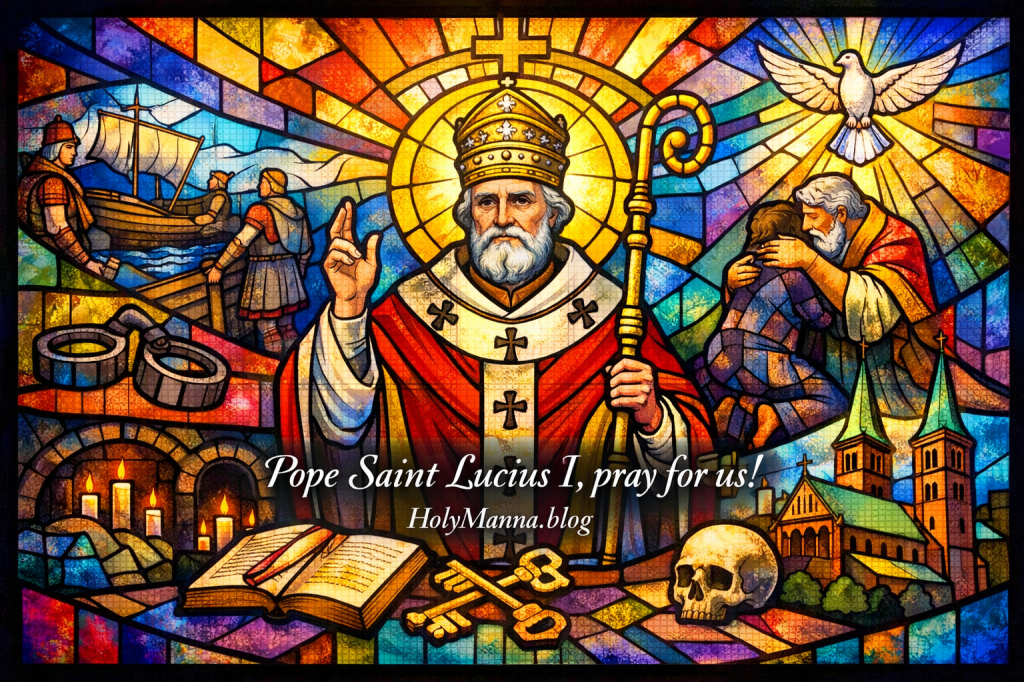
A Pope in Exile Who Kept the Door of Mercy Open
There are saints who leave behind libraries of writing, and there are saints who leave behind something quieter but just as powerful. Pope Saint Lucius I is remembered not because he ruled for decades, but because he held the Church steady when fear, division, and shame were all pulling it apart. His pontificate was short, but it landed right in the middle of real chaos: persecution from the Roman state on the outside, and a painful fight inside the Church over whether fallen Christians could ever come back home.
Lucius is revered because he lived what the Church still teaches today, that holiness does not mean pretending sin is small, and mercy does not mean pretending sin is not real. In Catholic life, mercy is Jesus actually lifting people up and restoring them through repentance and grace, especially through the Sacrament of Reconciliation. That is the kind of shepherd Lucius was, and that is why the Church remembers him.
The Man History Barely Names
One of the humbling things about Pope Saint Lucius I is how little is firmly known about his early life. The ancient Church preserved what mattered most, his fidelity as bishop and confessor, more than personal details. Later tradition says he was Roman and even gives a father’s name, but the earliest and strongest records focus on what he did once he carried the weight of the Church of Rome.
That lack of detail can actually teach something. Not every saint is remembered for a dramatic backstory. Some are remembered because, when it was their turn to carry the cross, they did not drop it. Lucius stepped into the papacy after Pope Saint Cornelius, in a moment when the Church was bruised and vulnerable. The conversion story that matters here is not a single moment from his youth that can be retold with confidence. It is the conversion of a shepherd who chose courage over comfort and mercy over pride.
The Mercy That He Refused to Lock Away
Lucius became Bishop of Rome in the third century, when following Jesus could still cost a person everything. His greatest “work” was not a building project or a political treaty. His work was holding the line on two truths at once: the Church must stay united, and sinners who truly repent must not be treated as if the Gospel has no room for them.
This mattered because of a fierce controversy known as the Novatian schism. A rigorist group insisted that Christians who had denied the faith under persecution, often called the lapsed, should not be restored to communion. In other words, they treated certain sins as a permanent exile. Lucius stood with the Catholic understanding that repentance is real and mercy is real. The Church can call sin what it is, and still welcome the sinner home through conversion, penance, and sacramental reconciliation. This is the heartbeat of what Jesus does after the Resurrection when He breathes the Holy Spirit on the apostles and gives authority to forgive sins in His name, as seen in Jn 20:22-23. This is also the Church living out the ministry of reconciliation described in 2 Cor 5:18.
Lucius did not leave behind confirmed writings that can be quoted as his own, but the Church does preserve a famous witness about him from Saint Cyprian of Carthage. Cyprian praised Lucius with words that still feel like a bright torch in a dark tunnel. He spoke of Lucius’ return to his flock and called him “the twofold glory of confessor and bishop”. Those words matter because they show how the early Church saw him. Lucius was not only a pope with authority. He was a man who had suffered for Christ and did not become bitter.
As for miracles during his lifetime, there are no securely documented healing miracles attached to Lucius the way later saints often have. The “miracle” remembered most clearly is his providential return from exile, which the Church later described as something that happened by God’s protection. It was not presented as a flashy supernatural spectacle. It was the kind of miracle that looks like God quietly opening a door that no one expected to open.
Exile, Pressure, and the Strength to Return
Lucius did not have the luxury of a calm reign. Soon after becoming pope, he was exiled. That is not a small footnote. Exile in that world meant separation, vulnerability, and the constant possibility that the next step would be imprisonment or death. When he was permitted to return to Rome, the Church saw it as God’s providence, almost like the Lord sending a shepherd back into the sheepfold when the wolves were still nearby.
Later legends tried to make his ending even more dramatic by saying he was executed, even beheaded. Catholic tradition has repeated that claim in some places, but careful historical memory inside the Church also recognizes that it cannot be firmly proven. What can be said with confidence is that he suffered for the faith and was honored as a confessor. In the early Church, even when the word “martyr” was sometimes used more broadly, the core idea remained the same: Lucius was a witness, a man who stayed faithful under pressure.
That is why his story still speaks. Not every saint’s suffering ends in a public execution. Some saints are crucified in quieter ways, through fear, uncertainty, exile, and responsibility. Lucius endured that kind of suffering and returned to strengthen the Church.
Relics, Memory, and a Saint Who Traveled Far
After his death in early March of 254, Lucius was buried in the Catacombs of Saint Callistus, in the area connected with the popes. One striking detail survived in his tomb inscription. A fragment preserves his name written in Greek as “LOUKIS”, a reminder that early Roman Christianity still breathed both Latin and Greek.
Centuries later, his relics were translated into churches within Rome, which was a common practice as the Church sought to honor saints and protect sacred remains. The details of exactly which pope moved which relics are complex in the historical record, but the Catholic memory is clear on the larger point. The Church continued to venerate Lucius as a saint and to keep his witness close.
One surprising thread of devotion reaches far beyond Rome, into northern Europe. A tradition developed that a skull relic of Saint Lucius I was brought to Roskilde, and he became associated with patronage there. It is an unusual legacy for a third-century Roman pope, and it shows how devotion to the saints has often crossed borders and centuries. Modern discussions have raised serious questions about whether that skull can truly be verified as his, and so this relic attribution cannot be confirmed with certainty. Still, the story remains part of his posthumous footprint, even if it cannot be verified.
In a Catholic perspective, relics are never meant to be magic objects. They are meant to point hearts toward the reality that holiness is lived in the body, that the saints are real people, and that the Church is one family across time. The communion of saints is not an idea meant for stained-glass windows only. It is the Church’s living reality, as taught in CCC 956.
Lucius’ deeper impact after death is not mainly about relics. It is about the spiritual pattern he defended. He helped the Church keep the balance between truth and mercy, which is still the Catholic way. The Church is holy, but she is also always calling sinners to conversion, as taught in CCC 827. The Church is not ashamed to say sin destroys, and the Church is not afraid to say grace restores, especially through confession and reconciliation, as taught in CCC 1422 and CCC 1468.
The Saint Who Welcomes the Repentant
Pope Saint Lucius I offers a simple but challenging lesson. Mercy is not a vague kindness. Mercy is a decision to let Christ heal what sin has broken. His life pushes back against two temptations that keep showing up in every age. One temptation is despair, the lie that a person’s worst failure has the final word. The other temptation is hardness, the lie that being “serious” about holiness means refusing to forgive.
Lucius teaches a better way. The Church does not pretend sin is harmless. The Church insists on repentance because repentance is the door to freedom. At the same time, the Church does not treat repentant sinners as permanent outsiders. That is not the Gospel. That is not the Heart of Christ.
In daily life, this can be very practical. It means taking confession seriously and going regularly, not as a routine, but as a real encounter with Jesus’ mercy. It means refusing to label people by their worst moment, especially when they are trying to come back. It means guarding the unity of the Church by refusing to enjoy division, gossip, and factional thinking. It also means learning how to receive mercy without excuses, because the humble heart can be healed.
How easy is it to believe that God can forgive others, but difficult to believe He can forgive personal sins?
How often does pride hide behind “standards,” when what the heart really wants is to withhold mercy?
What would change if confession was treated as a real return home, like the father welcoming the prodigal son in Lk 15:11-32?
Engage with Us!
Share thoughts and reflections in the comments below. There is a lot to learn from a saint like Pope Saint Lucius I, especially because his story touches real wounds that people still carry today, shame, fear, regret, and the longing to belong again.
- Where is mercy most needed right now, in personal life, in family life, or in parish life?
- Is there any place where the heart has become harsh toward repentant sinners, even subtly?
- What is one concrete step that can be taken this week to return to the Lord more sincerely, especially through the Sacrament of Reconciliation, as taught in CCC 1422?
- Who is someone that needs encouragement to come back to the Church, and what would a loving invitation look like?
- How can unity be protected in everyday speech, especially when tempted to criticize or divide the Body of Christ?
Keep walking forward in faith. Keep choosing repentance over excuses and mercy over pride. Do everything with the love and mercy Jesus taught, and trust that when the Church opens the door to the repentant, it is Christ Himself welcoming His children home.
Pope Saint Lucius I, pray for us!
Follow us on YouTube, Instagram and Facebook for more insights and reflections on living a faith-filled life.


Leave a comment