Wednesday of the Second Week of Lent – Lectionary: 232
The Kingdom’s Strange Ladder: Downward Into Glory
Some days in Lent feel like a quiet walk with the Lord. Other days feel like walking straight into resistance, misunderstanding, and the kind of pressure that makes a person want to protect reputation at all costs. Today’s readings speak to that moment with surprising clarity, because they reveal a single thread running through the pain of the prophet, the prayer of the suffering righteous, and the teaching of Jesus on the road to Jerusalem. The central theme is this: true greatness in God’s eyes is forged through faithful suffering and humble service, not through status, power, or the approval of the crowd.
In the world Jeremiah lived in, a prophet was not treated like a motivational speaker who drops life advice and leaves the room smiling. A prophet was sent to confront hardened hearts, to call a covenant people back to the living God, and to suffer the consequences when pride refused to bend. Jeremiah stands inside the religious life of Israel, surrounded by priests, wise men, and voices that claim authority, yet he becomes a target because he refuses to soften the truth. The shock is not only that enemies want him silenced, but that he has already interceded for them. His complaint rises from the place every honest believer eventually reaches: “Must good be repaid with evil?” This is the spiritual cost of loving people enough to pray for them, warn them, and still be misunderstood.
That same tension spills into the Responsorial Psalm, Psalm 31, which gives the Church the words to pray when life feels like a net tightening around the soul. This psalm does not pretend that threats are imaginary. It speaks of whispers, plots, and fear, and then makes a choice that becomes the backbone of Christian faith under pressure: “Into your hands I commend my spirit.” Lent keeps placing this kind of prayer on the tongue because the Church wants hearts trained for trust before Holy Week arrives, when Christ Himself will carry that trust all the way to the Cross.
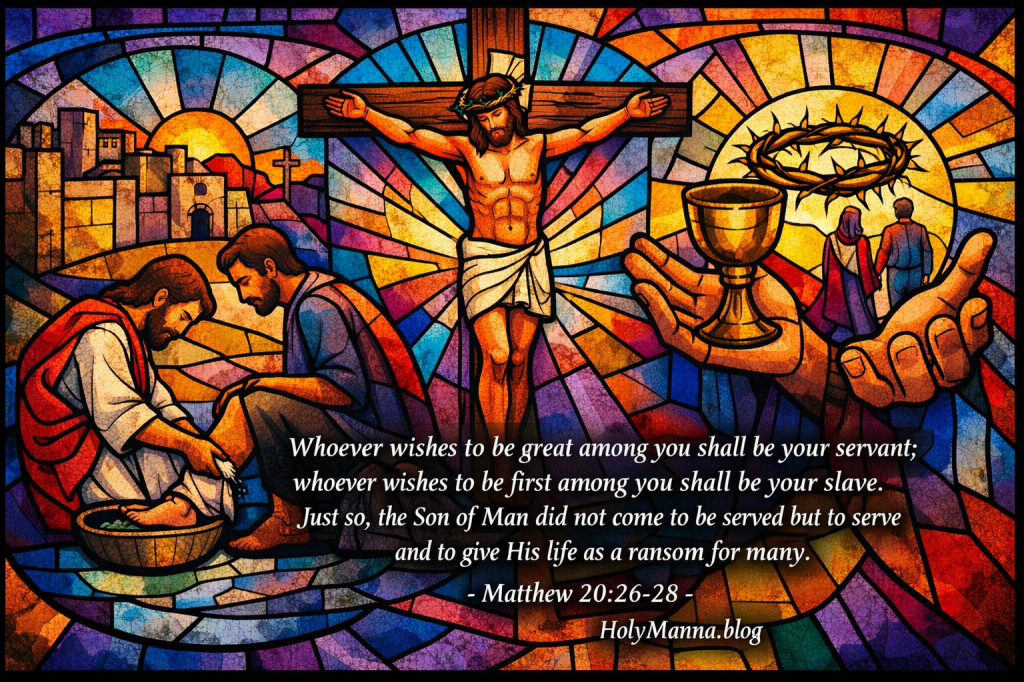
Then The Gospel of Matthew brings everything into focus. Jesus is walking toward Jerusalem with full knowledge that betrayal, mockery, scourging, and crucifixion are ahead. He is not guessing. He is choosing. And right there, with the Cross on the horizon, the disciples are tempted by the old itch for importance, the desire to be placed at the right and left in the kingdom. Jesus does not shame their desire for greatness, but He corrects their definition of it. He teaches that His kingdom is not built on dominance but on self-gift, and He sets Himself as the pattern and the proof: “The Son of Man did not come to be served but to serve and to give his life as a ransom for many.” Lent makes this teaching unavoidable, because it exposes the false ladder people climb in a world obsessed with recognition, and it reveals the true ladder of the saints, a ladder that looks like going lower in love so that God can raise a soul higher in glory.
Where has the heart been tempted to seek respect without sacrifice, or influence without service, or victory without a cross?
First Reading – Jeremiah 18:18-20
When the Faithful Voice Gets a Target Painted on It
Jeremiah is not preaching from the safety of a quiet monastery. He is standing in the middle of Judah’s public religious life, speaking God’s word in a culture that still has priests, still has official teachers, and still has people who assume everything is fine because the religious system is still running. Just before this moment, Jeremiah has been sent to the potter’s house, where God shows him that a nation can be reshaped, restored, or shattered depending on whether it turns back to Him. That kind of message does not simply irritate people, it threatens them. It challenges the comfortable lie that repentance is optional.
So the backlash comes fast, and it is not only political. It is spiritual. The community that should have recognized the prophet instead treats him like a problem to be managed. This reading fits perfectly with today’s theme because it shows what happens when God’s servant chooses love and intercession, and the world answers with suspicion and violence. Jeremiah’s suffering becomes a preview of Christ’s path to Jerusalem, where truth will be condemned and humility will be mocked, yet salvation will be accomplished through faithful endurance.
Jeremiah 18:18-20 – New American Bible (Revised Edition)
Another Prayer for Vengeance. 18 “Come,” they said, “let us devise a plot against Jeremiah, for instruction will not perish from the priests, nor counsel from the wise, nor the word from the prophets. Come, let us destroy him by his own tongue. Let us pay careful attention to his every word.”
19 Pay attention to me, O Lord,
and listen to what my adversaries say.
20 Must good be repaid with evil
that they should dig a pit to take my life?
Remember that I stood before you
to speak on their behalf,
to turn your wrath away from them.
Detailed Exegesis
Verse 18, “Come,” they said, “let us devise a plot against Jeremiah, for instruction will not perish from the priests, nor counsel from the wise, nor the word from the prophets. Come, let us destroy him by his own tongue. Let us pay careful attention to his every word.”
This is the sound of a crowd justifying sin with religious confidence. They claim that getting rid of Jeremiah will not matter because the religious establishment will continue without him. In other words, they treat Jeremiah as disposable, because they believe God’s voice can be replaced by an institution, a title, or a majority opinion. That is a dangerous spiritual blindness. God does give priests, wise counselors, and prophets, but when the heart is hardened, even sacred offices can be used as shields against conversion.
The phrase “destroy him by his own tongue” reveals the method. They want to trap him with words, twist his meaning, and weaponize his speech. This is not only persecution, it is corruption of truth itself. It is the ancient version of taking someone’s words out of context, assigning the worst motives, and turning the public against him. The human heart has not changed much.
Verse 19, “Pay attention to me, O Lord, and listen to what my adversaries say.”
Jeremiah does not run first to self-defense, strategy, or revenge. He runs to God. This is one of the clearest marks of a faithful soul under pressure: the first court of appeal is heaven. Jeremiah is not pretending the accusations are harmless. He is bringing them into the light of God’s judgment, because only God sees perfectly, and only God can defend the innocent without hatred.
This is also a lesson in prayer. The prophet does not perform holiness for the crowd. He speaks honestly to the Lord. The Catechism describes prayer in a way that fits Jeremiah’s posture exactly: “Prayer is the raising of one’s mind and heart to God or the requesting of good things from God.” That is what Jeremiah is doing here. He is lifting his fear, his confusion, and his need for justice into God’s hands.
Verse 20, “Must good be repaid with evil that they should dig a pit to take my life? Remember that I stood before you to speak on their behalf, to turn your wrath away from them.”
This verse is where the story gets personal, and where it starts sounding like the Passion. Jeremiah is not suffering because he harmed them. He is suffering because he loved them. He did not only warn them, he interceded for them. He stood before God on their behalf, pleading for mercy. And now the very people he prayed for want him dead.
The image of “dig a pit” is not accidental. It evokes a hidden trap, a planned ambush, a quiet evil that waits in the dark. Jeremiah’s question, “Must good be repaid with evil?”, is the cry of every righteous person who has tried to do what is right and been treated as if it were wrong. It is also the doorway into the Gospel, because Christ will be the perfect innocent One who intercedes, loves, and is repaid with betrayal, yet still offers mercy.
Teachings
This reading teaches that God’s servants should not be surprised when fidelity brings resistance. Throughout salvation history, prophets are opposed precisely because they call people to conversion. Jeremiah’s suffering is not meaningless drama, it is a sign that truth has weight, and that pride fights hard when it is being challenged.
It also teaches something deeply Catholic about intercession. Jeremiah reminds God that he prayed for the very people who now seek his life. That is not weakness. That is priestly love in prophetic form. Intercession is not a sentimental accessory to faith, it is part of how God trains His people to share in His own mercy. The Catechism gives a definition of intercession that shines light on Jeremiah’s role: “Intercession is a prayer of petition which leads us to pray as Jesus did.” Jeremiah, in a real sense, is already being drawn into the pattern that will be fulfilled in Christ, who intercedes even for His persecutors.
This passage also exposes the sin of destroying with words. The plotters want to destroy Jeremiah by his tongue, and they listen to him like hunters, not like disciples. That matters because the moral life is not only about physical violence. It includes what is done with speech, suspicion, and public accusation. The Catechism gives a clean and direct principle that applies here: “Respect for the reputation of persons forbids every attitude and word likely to cause them unjust injury.” When a community turns watchfulness into condemnation, it stops seeking truth and starts seeking a target.
The Church’s saints often return to this point with a hard kind of wisdom. Saint John Chrysostom repeatedly warns that ambition and envy can turn brothers into rivals, and that the tongue can become a sword when the heart refuses humility. Jeremiah’s enemies are not only angry. They are protecting status, protecting control, protecting the illusion that they can stay the same and still claim God.
Reflection
Jeremiah’s pain is not just ancient history. It is the kind of moment that shows up in everyday life, in families, workplaces, parishes, and friendships. Sometimes a person tries to speak honestly, tries to call a situation back to what is right, tries to pray for someone who is drifting, and suddenly becomes the problem in the room. That is when the soul is tempted to retaliate, to sharpen the tongue, and to pay evil back with evil.
Lent invites a different response, the response Jeremiah models before he ever becomes perfect at it. He brings the matter to God. He tells the truth in prayer. He remembers that he has been an intercessor, not a rival. That is how a believer stays free inside suffering.
A practical step for today is to refuse the instinct to “win” with words. When the urge rises to defend pride, exaggerate, or get the last line, it helps to pause and pray Jeremiah’s honest question in a purified way: “Must good be repaid with evil?” Then it helps to choose one concrete act of intercession for the very person who causes the most tension, because intercession breaks the cycle of hatred.
When has the heart wanted to destroy someone “by the tongue,” even if it was dressed up as righteous anger?
Who needs prayer today, not because they deserve it, but because God is training His people to love like Christ?
What would change if the first reaction to being misunderstood was to bring the whole case to the Lord, instead of bringing it to the crowd?
Responsorial Psalm – Psalm 31:5-6, 14-17
When the Net Tightens, Put the Soul in God’s Hands
There is a reason the Church keeps handing out the psalms during Lent like bread for the road. They are not polite religious poems. They are battle prayers, forged in the real-life tension between faithful hearts and hostile crowds. Psalm 31 belongs to that family of prayers where the righteous are hunted, misunderstood, and pressured, yet they refuse to let fear become their master.
In Israel’s worship, psalms like this gave ordinary believers a voice when enemies felt bigger than strength and when betrayal felt close enough to breathe. In the Church’s prayer, this psalm becomes even more personal, because its words echo into the Passion. The line “Into your hands I commend my spirit” becomes the language of holy surrender, the kind of surrender Jeremiah is reaching for as plots rise against him, and the kind of surrender Jesus will perfect as He walks toward Jerusalem. This fits today’s theme because it teaches what true strength looks like under pressure. It is not dominance, it is trust. It is not a louder voice, it is a deeper refuge.
Psalm 31:5-6, 14-17 – New American Bible (Revised Edition)
5 Free me from the net they have set for me,
for you are my refuge.
6 Into your hands I commend my spirit;
you will redeem me, Lord, God of truth.14 I hear the whispers of the crowd;
terrors are all around me.
They conspire together against me;
they plot to take my life.
15 But I trust in you, Lord;
I say, “You are my God.”
16 My destiny is in your hands;
rescue me from my enemies,
from the hands of my pursuers.
17 Let your face shine on your servant;
save me in your mercy.
Detailed Exegesis
Verse 5, “Free me from the net they have set for me, for you are my refuge.”
The psalmist speaks like someone who knows the threat is real. A net is not a fair fight. A net is hidden, designed to trap without warning. That image matches the kind of persecution Jeremiah faces, and it matches the kind of spiritual pressure believers still face when conversations get twisted and motives get judged. The turning point is the second half of the verse. The soul does not look for refuge in strategy, popularity, or control. The soul says to God, “you are my refuge.” This is the first move of faith, choosing God as shelter before asking God to change the situation.
Verse 6, “Into your hands I commend my spirit; you will redeem me, Lord, God of truth.”
This is the heartbeat of the psalm. The word “commend” is not casual. It is the act of placing something precious into the care of someone trustworthy. The psalmist is not only asking for rescue, he is entrusting the entire inner life to God. The phrase “Lord, God of truth” matters because persecution is often built on lies, half-truths, and slander. The believer anchors in the One who cannot lie. This verse is also a doorway into Christ’s Passion, because Jesus will take this prayer onto His own lips at the Cross, fulfilling it with perfect trust and perfect love.
Verse 14, “I hear the whispers of the crowd; terrors are all around me. They conspire together against me; they plot to take my life.”
The psalm does not pretend that fear is imaginary. It names the pressure. “Whispers” are the sound of reputation being attacked without a fair hearing. “Conspire” is the sound of coordinated injustice. The righteous person is not called to denial, but to honesty before God. This verse also exposes how spiritual warfare often works through social currents. A crowd can become its own kind of storm, especially when fear spreads faster than truth.
Verse 15, “But I trust in you, Lord; I say, ‘You are my God.’”
This verse is a clean pivot. The word “but” is the hinge of conversion in the middle of anxiety. The psalmist does not say the whispers stop. The psalmist says trust gets the final word. Calling God “my God” is covenant language, personal and committed, not vague and distant. It is the believer choosing belonging over panic, and worship over rumination.
Verse 16, “My destiny is in your hands; rescue me from my enemies, from the hands of my pursuers.”
Here the psalm goes deeper than “help with this problem.” It becomes total abandonment to Providence. The word “destiny” points to the whole course of life, not only today’s conflict. The psalmist is not surrendering into passivity. The psalmist still asks for rescue. The difference is that the request is made from a place of trust, not from a place of frantic control. This is what faith looks like when the heart stops trying to be its own savior.
Verse 17, “Let your face shine on your servant; save me in your mercy.”
The image of God’s shining face carries the warmth of blessing and the intimacy of favor. It is the opposite of being cast out, mocked, or treated as disposable. The psalmist calls himself God’s servant, which is not humiliation, it is identity. The final request is not, “Save me because I earned it.” The final request is, “save me in your mercy.” Mercy is the foundation. Mercy is the hope. Mercy is what makes the servant bold enough to pray.
Teachings
This psalm teaches that suffering does not disqualify a believer from God’s love. In fact, suffering often becomes the place where faith is purified, because it forces a choice between clinging to control and clinging to God. The Catechism describes prayer in a way that matches the psalm’s movement from fear to surrender: CCC 2559 says “Prayer is the raising of one’s mind and heart to God or the requesting of good things from God.” The psalm is doing both. It lifts the heart into God’s hands, and it requests deliverance.
This psalm also teaches that trust is not a feeling, it is a decision. The crowd whispers, conspiracies grow, and terrors surround, yet the believer still declares, “You are my God.” That declaration becomes the backbone of Christian discipleship in Lent, especially as the Church walks toward the Passion. When Jesus prays “Father, into your hands I commend my spirit” in The Gospel of Luke, He is not quoting Scripture like a classroom exercise. He is living the psalm to the end, revealing that the true refuge of the righteous is the Father’s heart.
There is also a quiet lesson here about authority in God’s kingdom, because the psalm calls the believer “servant” without shame. The world treats servanthood as weakness, but Scripture treats it as closeness to God. That prepares the heart for the Gospel’s teaching that greatness is found in service, not in being seated above others.
Reflection
This psalm is for the day when someone feels trapped in a situation that cannot be fixed with a clever response. It is for the day when reputation feels fragile, when people whisper, when a relationship turns tense, or when anxiety keeps replaying conversations long after they end. Psalm 31 gives a practical path forward, because it teaches the soul to name the threat honestly and then hand the soul to God anyway.
A good way to live this today is to pray verse 6 slowly, not like a slogan, but like a real transfer of ownership. The mind can offer the same surrender in plain words: “Into your hands I commend my spirit.” Then the heart can name one specific net, one specific fear, and place it there too. Another step is to watch the tongue. When the crowd whispers, the temptation is to whisper back, to control the narrative, to win the social moment. The psalm points to a different victory, the victory of refusing to let fear steer the soul.
What net feels like it is tightening right now, even if no one else can see it?
Where has the heart been trying to control what only God can hold?
What would change if the next anxious moment began with “You are my God” instead of another round of replaying the worst-case scenario?
Holy Gospel – Matthew 20:17-28
The Road to Jerusalem: The Cross in Front, the Ego Behind
Jesus is not wandering toward Jerusalem with uncertainty. He is climbing toward it with purpose, and everyone around Him can feel the tension rising. In the world of first-century Judaism, Jerusalem was not just a city. It was the center of worship, sacrifice, and covenant identity. It was the place where Israel’s story met God’s promises in the Temple, and it was also the place where political and religious power could turn deadly. By this point in The Gospel of Matthew, the conflict has sharpened. The leaders are threatened, the crowds are watching, and Jesus is preparing His disciples for the shock that salvation will come through suffering.
That is why today’s Gospel is so striking. Jesus predicts His Passion with plain clarity, and almost immediately the disciples reveal how easily the human heart drifts toward status even when the Cross is on the horizon. The request for seats of honor is not just a random interruption. It is a mirror held up to every disciple in every age. This reading fits today’s theme because it teaches the true shape of greatness in the kingdom of God. The path to glory runs through humble service, and the throne of Christ is the Cross.
Matthew 20:17-28 – New American Bible (Revised Edition)
17 As Jesus was going up to Jerusalem, he took the twelve [disciples] aside by themselves, and said to them on the way, 18 “Behold, we are going up to Jerusalem, and the Son of Man will be handed over to the chief priests and the scribes, and they will condemn him to death, 19 and hand him over to the Gentiles to be mocked and scourged and crucified, and he will be raised on the third day.”
The Request of James and John. 20 Then the mother of the sons of Zebedee approached him with her sons and did him homage, wishing to ask him for something. 21 He said to her, “What do you wish?” She answered him, “Command that these two sons of mine sit, one at your right and the other at your left, in your kingdom.” 22 Jesus said in reply, “You do not know what you are asking. Can you drink the cup that I am going to drink?” They said to him, “We can.” 23 He replied, “My cup you will indeed drink, but to sit at my right and at my left [, this] is not mine to give but is for those for whom it has been prepared by my Father.” 24 When the ten heard this, they became indignant at the two brothers. 25 But Jesus summoned them and said, “You know that the rulers of the Gentiles lord it over them, and the great ones make their authority over them felt. 26 But it shall not be so among you. Rather, whoever wishes to be great among you shall be your servant; 27 whoever wishes to be first among you shall be your slave. 28 Just so, the Son of Man did not come to be served but to serve and to give his life as a ransom for many.”
Detailed Exegesis
Verse 17, “As Jesus was going up to Jerusalem, he took the twelve [disciples] aside by themselves, and said to them on the way,”
Jesus takes the Twelve aside because what He is about to say cannot be absorbed in the noise of the crowd. Discipleship includes moments of intimacy, where the Lord forms His own with truths that demand more than admiration. The phrase “going up to Jerusalem” also carries a spiritual weight. Pilgrims always “go up” to Jerusalem, not only because of elevation, but because it represents approaching the holy place. Jesus is going up, but the ascent will be the descent into suffering.
Verse 18, “Behold, we are going up to Jerusalem, and the Son of Man will be handed over to the chief priests and the scribes, and they will condemn him to death,”
Jesus identifies Himself as the “Son of Man,” a title that echoes The Book of Daniel and carries both glory and authority, yet here it is paired with betrayal. He will be “handed over,” which is the language of being delivered into hostile hands. The chief priests and scribes represent religious authority, and their condemnation reveals a tragic possibility: religious office can be used to reject the very Messiah it should recognize. Jesus is not a victim of surprise. He speaks with deliberate foreknowledge.
Verse 19, “and hand him over to the Gentiles to be mocked and scourged and crucified, and he will be raised on the third day.”
The handing over continues, moving from Jewish authorities to Gentile power, which points to Rome’s role in crucifixion. Mockery, scourging, and crucifixion form a brutal chain of humiliation and pain. Yet Jesus ends with the resurrection, because the Passion is not the collapse of His mission. It is the way the mission is completed. The “third day” promise is the seed of hope planted before the darkness arrives.
Verse 20, “Then the mother of the sons of Zebedee approached him with her sons and did him homage, wishing to ask him for something.”
This moment feels almost jarring after the Passion prediction, and that is the point. Human hearts can stand next to holy mystery and still chase personal advantage. The mother approaches with “homage,” a gesture of respect, but the intention is a request for honor. The sons are present, which shows that the desire is shared. Ambition can hide behind polite religious language.
Verse 21, “He said to her, ‘What do you wish?’ She answered him, ‘Command that these two sons of mine sit, one at your right and the other at your left, in your kingdom.’”
Jesus invites the request into the open. He does not allow hidden motives to stay hidden. The request is for the highest seats near the king, positions of authority and prestige. In the ancient world, sitting at the right and left meant closeness to power and participation in rule. They imagine the kingdom as a political triumph with spiritual decoration.
Verse 22, “Jesus said in reply, ‘You do not know what you are asking. Can you drink the cup that I am going to drink?’ They said to him, ‘We can.’”
Jesus corrects the misunderstanding with one sentence that still lands like a hammer. They want glory without understanding the cost. The “cup” is the biblical image of suffering and the burden of what God permits for salvation. Jesus invites them to measure their ambition against the Cross. Their answer, “We can,” is confident but immature. It is the voice of people who love Jesus but still do not grasp what His love will demand.
Verse 23, “He replied, ‘My cup you will indeed drink, but to sit at my right and at my left [, this] is not mine to give but is for those for whom it has been prepared by my Father.’”
Jesus affirms that they will share in suffering. This is a prophecy of their future trials, including martyrdom and long witness. Then Jesus points to the Father’s providence. The kingdom is not a system of favors. It is ordered by God’s wisdom, and places of glory are not prizes seized by ambition. They are gifts prepared by the Father’s plan.
Verse 24, “When the ten heard this, they became indignant at the two brothers.”
The indignation of the ten is not pure virtue. It reveals competition in the group. They are angry because the request threatens their own standing. This verse shows how quickly a community can turn tense when status is in play. Even among disciples, pride can create rivalries.
Verse 25, “But Jesus summoned them and said, ‘You know that the rulers of the Gentiles lord it over them, and the great ones make their authority over them felt.’”
Jesus does not ignore the conflict. He summons them like a teacher who loves them too much to let them stay small. He describes the normal pattern of worldly power: domination, control, and authority felt as pressure. The phrase “lord it over them” reveals leadership as self-assertion.
Verse 26, “But it shall not be so among you. Rather, whoever wishes to be great among you shall be your servant;”
This is the great reversal. Jesus does not deny the desire to be great. He redefines greatness. In His kingdom, greatness is measured by service. The servant is not a mascot. The servant is the model. This is not advice for a few holy people. It is the rule for every disciple.
Verse 27, “whoever wishes to be first among you shall be your slave.”
Jesus intensifies the teaching. In the ancient world, “slave” meant the lowest social position, the one who exists for the good of another. Jesus uses the strongest image available to kill the illusion that His kingdom is built on ego. The disciple who wants to be first must choose the lowest place in love.
Verse 28, “Just so, the Son of Man did not come to be served but to serve and to give his life as a ransom for many.”
Jesus ends by placing Himself at the center as the standard. He is not asking disciples to do something He refuses to do. He came to serve, and His service reaches its summit in the gift of His life. The word “ransom” points to deliverance, the freeing of captives at a cost. This verse is a summary of the mission of Christ and the heart of the Gospel.
Teachings
This Gospel teaches that the Cross is not an accident in Christian life. It is the path of love in a fallen world. Jesus predicts His Passion so the disciples will not mistake suffering for defeat. Salvation comes through sacrifice, and the resurrection proves that sacrificial love is stronger than death.
The Church teaches that Christ’s death is redemptive in exactly the way Jesus describes here. The Catechism states: CCC 616 says “It is love ‘to the end’ that confers on Christ’s sacrifice its value as redemption and reparation, as atonement and satisfaction. He knew and loved us all when he offered his life.” This places the Cross in the category of deliberate love, not mere tragedy.
The Church also directly ties redemption to this Gospel’s language. The Catechism states: CCC 617 says “The Council of Trent emphasizes the unique character of Christ’s sacrifice as ‘the source of eternal salvation’ and teaches that ‘his most holy Passion on the wood of the cross merited justification for us.’” The “ransom” is not a metaphor without power. It is the saving act by which Christ opens heaven to sinners.
This Gospel also teaches about authority. Jesus does not abolish leadership, but He purifies it. Authority among Christians must look like service, because it must look like Christ. The Catechism makes this principle practical and direct when it says: CCC 2235 “Those subject to authority should regard those in authority as representatives of God, who has made them stewards of his gifts.” Then it balances that with the demand placed on rulers themselves in the same section of teaching on society, emphasizing that authority must be exercised as service ordered to the common good, not personal domination.
Saint John Chrysostom, preaching on this passage, warns that ambition can poison discipleship even when it wears religious clothing. He notes that the request for honor reveals a heart that still thinks in worldly categories, and he praises Christ’s patience in correcting them without crushing them. Christ does not mock their weakness. He heals it by teaching the Cross and the servant’s path.
Historically, this teaching shaped the Church’s self-understanding from the beginning. The martyrs did not “win” by taking power. They won by faithful witness unto death. The saints built hospitals, cared for the poor, and evangelized nations not through domination, but through service rooted in Christ’s own self-gift. This is why the Church honors humble servants as the true great ones, because they resemble the Lord.
Reflection
This Gospel lands in everyday life in a very direct way, because the desire for recognition does not vanish at baptism. It can live inside family life, parish life, careers, friendships, and even ministry. Sometimes the heart wants the seat of honor, not in a literal chair, but in the form of being noticed, being praised, being consulted, being treated as important. Jesus exposes that desire without humiliation and asks a better question: Can the heart drink the cup? The cup is the quiet suffering of doing the right thing without applause, serving without being seen, forgiving when pride wants revenge, and staying faithful when it costs comfort.
A practical step is to locate one area where leadership has been treated like control. Then the soul can flip it into service. That might mean listening instead of lecturing, helping without advertising it, or choosing to be the first to apologize. Another step is to embrace one hidden act of sacrifice each day of Lent, something that costs time, comfort, or ego. Over time, those small choices train the heart to climb the strange ladder of the kingdom, where going lower in love is the way God raises a soul into true greatness.
Where has the heart been chasing the right and left seats, even if it was disguised as “just being ambitious”?
What would it look like today to choose the servant’s place on purpose, without resentment, because Christ chose it first?
If Jesus asked, “Can you drink the cup that I am going to drink?”, what part of life would immediately try to negotiate a different path?
The Only Greatness That Lasts
Today’s readings sketch one clear path through the noise and confusion of real life, especially when faith becomes costly. Jeremiah shows what it feels like when a person speaks truth, prays for others, and still gets repaid with hostility. The prophet is not shocked that evil exists. He is wounded that goodness can be treated like a threat. Yet even there, he brings the conflict to God and remembers that his role was never to win approval. His role was to be faithful.
Psalm 31 then places words in the mouth of every believer who has felt trapped by fear, misunderstood by a crowd, or pressured by enemies seen and unseen. The psalm does not deny the danger. It names it, and then it makes the strongest move a disciple can make: “Into your hands I commend my spirit.” That is not resignation. That is trust with spine. That is the prayer that keeps the heart from becoming bitter.
Then The Gospel of Matthew reveals the center of everything. Jesus walks toward Jerusalem with eyes wide open, predicting betrayal, suffering, and death, and He still keeps going because love keeps going. When the disciples drift into ambition, Jesus does not simply scold them. He redefines greatness from the ground up. Greatness is not the seat of honor. Greatness is the servant’s place. The King of heaven does not demand to be served. He chooses to serve, and He chooses the Cross as the throne where mercy reigns. “The Son of Man did not come to be served but to serve and to give his life as a ransom for many.”
This is the invitation for today. Let Lent strip away the need to be seen, the need to be right, and the need to dominate. Let God train the heart to be steady under pressure, gentle with the tongue, and generous in hidden sacrifice. When the net tightens, put the soul in God’s hands. When pride rises, choose the servant’s place. When suffering shows up, do not assume God has left. Stay close to Christ on the road to Jerusalem, because the road that looks like loss in the world becomes victory in the kingdom.
What would change this week if the goal was not to climb higher, but to love lower in the way Christ loved? Let today be lived with one concrete act of service that costs something, one sincere prayer for someone difficult, and one decision to entrust reputation and outcomes to the Father. That is how greatness begins in the heart, and that is how Lent becomes real.
Engage with Us!
Share reflections in the comments below, because the Word of God is not meant to stay trapped in the head. It is meant to take root in real life, shape choices, and strengthen hearts for the road. Here are some questions to help bring today’s readings into prayer, conversation, and practical discipleship.
- First Reading, Jeremiah 18:18-20: Where has goodness been repaid with criticism, suspicion, or betrayal, and how is God inviting a response that stays faithful instead of bitter? Who needs intercession today, even if they have been difficult to love? What would it look like to bring that conflict to God before bringing it to the crowd?
- Responsorial Psalm, Psalm 31:5-6, 14-17: What “net” feels like it is tightening right now, whether it is fear, pressure, temptation, or conflict? How can the heart pray “Into your hands I commend my spirit” in a concrete way today, naming one specific anxiety and placing it in God’s care? What changes when trust becomes a decision instead of a mood?
- Holy Gospel, Matthew 20:17-28: Where has the heart been chasing the right and left seats, seeking recognition, control, or the last word? What would it look like today to choose the servant’s place on purpose, without resentment, because Christ chose it first? If Jesus asked, “Can you drink the cup that I am going to drink?”, what part of life would immediately resist, and what small step of sacrificial love could be offered anyway?
Keep walking this Lenten road with steady trust, humble service, and a heart that refuses to repay evil with evil. Live a life of faith, and do everything with the love and mercy Jesus taught, because that is the only greatness that lasts.
Sacred Heart of Jesus, we trust in You!
Immaculate Heart of Mary, pray for us!
Saint Michael the Archangel, defend us in battle!
Follow us on YouTube, Instagram and Facebook for more insights and reflections on living a faith-filled life.


Leave a comment