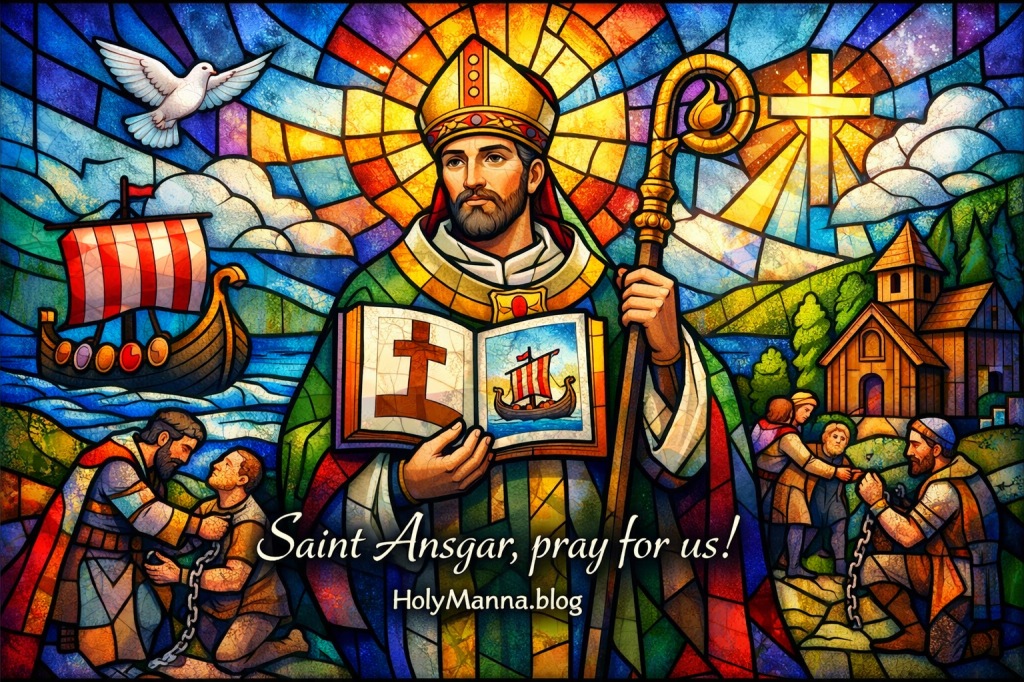
The Apostle of the North
Saint Ansgar, also called Anschar, is remembered as the Apostle of the North because he carried the Gospel into Denmark and Sweden when those lands were still largely pagan and often suspicious of Christianity. He did not walk into a comfortable Christian culture that already shared his assumptions. He stepped into a world shaped by warrior honor, shifting kings, and spiritual darkness, and he did it with the steady patience of a Benedictine monk and the courage of a bishop who believed Christ was worth everything. The Church’s love for Ansgar is not just about where he traveled. It is about how he endured, and how he kept offering his life even when the fruit looked small or fragile.
His story also makes Catholic teaching feel concrete. The Catechism reminds Catholics that the Church is missionary by her very nature, because she is sent to bring Christ to every people and every place (CCC 849). Saint Ansgar lived that mission with a quiet stubbornness that still feels like good medicine for modern Catholics who are tired of compromise and ready for real faith again.
A Benedictine Beginning That Forged a Strong Soul
Saint Ansgar was born in 801 in the Frankish world, in the region of Picardy. After the early loss of his mother, his life was shaped by the Benedictine monastery of Corbie, where prayer, discipline, and Scripture formed him slowly and deeply. That kind of formation matters because missionaries do not survive on personality alone. They survive on a heart anchored in God, trained to obey, and willing to suffer without losing hope.
Catholic tradition also preserves the sense that God was drawing Ansgar early through powerful interior experiences that deepened his hunger for holiness. His biographer and successor, Saint Rimbert, records that Ansgar understood his life as a call to sacrifice, even a call that sounded like martyrdom. The point is not that he chased danger for drama. The point is that he wanted to belong to Christ without conditions, and he learned early that true discipleship is never a negotiation.
One of the most famous sayings associated with him shows what he valued most. When the idea of miracles came up, Ansgar’s desire was not to be impressive. He wanted conversion of heart, and he expressed it with striking simplicity and humility: “Were I worthy of such a favour from my God, I would ask one miracle, that He make of me a good man.” That line sounds like the voice of a man who had stared at his own weakness and decided that holiness is the greatest wonder God can work in a human life.
Into Viking Lands
Ansgar’s missionary path opened when a Danish ruler, newly baptized after a season of exile, returned home and needed support for a fragile Christian presence. Ansgar went with him and began preaching in Denmark, but he did not rely on preaching alone. He founded a school at Schleswig because he understood that the faith must be taught, formed, and handed on if it is going to endure. He wanted local Christians, local leaders, and a real Christian community, not a passing foreign influence.
The mission in Denmark was repeatedly shaken by political instability and resistance, and this is where Ansgar’s sanctity becomes more relatable than romantic. He built and watched things collapse. He gained ground and lost it. He learned to treat setbacks not as proof that God had abandoned the mission, but as part of the Cross that always accompanies the Gospel.
From Denmark he traveled to Sweden, where he was received well enough to preach. Catholic tradition highlights the conversion of a prominent royal counselor named Herigar, who built what is remembered as the first church in Sweden. This detail matters because it shows how God often begins. The Lord claims one faithful heart, and then that single heart becomes a doorway for others. The Church grows like a seed, and the first shoots can look unimpressive until years later when the roots finally hold.
The Kind of Miracles God Loves
Saint Ansgar’s life was filled with the kind of miracles that do not always look like fireworks. He lived the daily miracle of perseverance, the miracle of humility, and the miracle of mercy, and those are often the miracles God uses to change history. He preached, he formed clergy, he strengthened monasteries, and he helped build a stable base for missionary work, including renewing church life and education in places that supported the mission behind the scenes.
He also became known for works of mercy that were unmistakably Catholic in their concreteness. He built hospitals, cared for the poor, and ransomed captives. He did not treat charity as a private hobby. He treated it as proof that the Gospel is real. This lines up with the Church’s teaching that the corporal works of mercy belong to the heart of Christian life, because love of neighbor is not optional, it is commanded by Christ and empowered by grace (CCC 2447). When Catholics hear about Ansgar’s care for the sick and vulnerable, they are hearing an echo of Jesus Himself, who healed and lifted up the suffering, and who still calls His Church to continue that healing mission (CCC 1503).
Catholic sources also connect Ansgar with healings through prayer and anointing, understood in the spiritual and pastoral context of his time. Yet even when healing is mentioned, the deeper point remains the same. Ansgar’s heart was not chasing wonders. He was begging God for holiness, and he wanted to become good in the deepest sense, shaped by Christ from the inside out.
When Hamburg Burned
Ansgar was appointed bishop of Hamburg and entrusted with missionary responsibility for the northern peoples, a sign that the Church wanted a stable base for evangelization in the North. Then disaster struck. Hamburg was attacked and destroyed in a major raid, and Ansgar was left displaced, stripped of stability, and forced to rebuild when it would have been easier to retreat into safer life.
This chapter of his story reveals the hidden martyrdom that some saints live. He longed for martyrdom in the dramatic sense and even grieved that he had not been found worthy of it. Yet his life shows that martyrdom can also be lived as a daily surrender, a steady carrying of the Cross when the world does not applaud and the mission does not look successful. The Catechism calls martyrdom the supreme witness to the truth of the faith, but it also reveals a deeper reality for every Christian, because to follow Christ is to accept the Cross in one form or another (CCC 2472).
Ansgar did not let suffering make him hard. He continued to serve. He continued to organize the mission, to care for souls, and to pour himself out in charity. Over time the Church’s structures in the region were strengthened, including the union of Hamburg with Bremen, which gave the mission more stability. The story is not about ecclesiastical politics. It is about a bishop who stayed faithful to Christ and to the people entrusted to him when everything around him felt unstable.
A Holy Death and a Legacy That Still Speaks
Saint Ansgar died in 865, and Catholic tradition remembers his final days as deeply prayerful and shaped by the liturgy. He died with the kind of trust that every Catholic hopes to have at the end, when distractions fall away and only God remains. One line is especially associated with his final surrender, and it captures the heart of Christian hope: “Into Thy hands, O Lord, I commend my spirit.” In Catholic ears, that prayer sounds like the echo of Christ Himself, and it also sounds like the prayer of a man who spent his life putting everything into God’s hands, including his mission, his sufferings, and the results he could not control.
After his death, devotion to Saint Ansgar continued, and miracles were attributed to his intercession in Catholic tradition. More than that, his life became a missionary blueprint. He did not “finish” the conversion of Scandinavia in his lifetime, but he planted the Gospel with real institutions, real catechesis, and real Christian worship. His name remains tied to Catholic life in the North, and churches and cathedrals dedicated to him continue to bear witness that the Gospel reached those lands not through comfort, but through sacrifice.
Walking the Ansgar Way in Modern Life
Saint Ansgar is a saint for Catholics who feel like the culture is cold. He shows that faithfulness is not the same as visible success, and he proves that the Church can live in hostile territory without losing her identity. His example challenges modern Catholics to stop measuring holiness by comfort and to start measuring it by fidelity.
His humility is just as challenging. That famous desire for the “one miracle” is a spiritual gut check because it confronts the craving to be noticed, applauded, or seen as spiritual. Real sanctity wants something else. It wants to become good by grace, steady in virtue, and faithful in trials. The Catechism teaches that charity is the form of all the virtues, and it is the very life of God poured into the soul (CCC 1822 to CCC 1823). Saint Ansgar’s life makes that teaching feel personal because his charity was not theoretical. It looked like hospitals, ransomed captives, patient preaching, and rebuilding after ruin.
What would change in daily life if faithfulness mattered more than recognition, and mercy mattered more than winning arguments? That question sits at the center of Saint Ansgar’s witness, and it invites every Catholic to live the mission right where God has planted them.
Engage with Us!
Share thoughts and reflections in the comments below, because the saints are not meant to be distant heroes. They are meant to be companions who teach ordinary Catholics how to live with extraordinary faith.
- What part of Saint Ansgar’s story makes perseverance feel more possible right now?
- Where might God be asking for faithfulness, even if visible results are not showing up yet?
- How does Saint Ansgar’s humility challenge the desire to be noticed or praised for doing good?
- What is one practical work of mercy that can be lived this week in a more intentional way?
- Who is one person who might need a patient, steady witness of Catholic faith rather than a debate?
Keep walking forward with faith. Keep choosing prayer, confession, the Eucharist, and real charity. A life rooted in Jesus Christ is never wasted, even when the fruit is hidden. Do everything with the love and mercy Jesus taught us, and trust that God can grow a harvest from even the smallest seed.
Saint Ansgar, pray for us!
Follow us on YouTube, Instagram and Facebook for more insights and reflections on living a faith-filled life.


Leave a comment