Tuesday of the Fourth Week in Ordinary Time – Lectionary: 324
When Grief Knocks and Faith Reaches
There are days when the readings sound like real life, the kind that does not wait for anyone to feel ready. A father sits between the city gates listening for news, and the news breaks him. A desperate woman moves through a crowd hoping no one notices her, and she reaches for Jesus with the last strength she has. A respected synagogue official falls to his knees because his little girl is slipping away, and suddenly every title and reputation means nothing compared to love.
The central theme that ties today together is this: God meets His people at the edge of helplessness, and He asks for faith that comes to Him anyway. In the First Reading, Israel’s story is unfolding in the gritty aftermath of civil war, with King David mourning Absalom, not as a political enemy, but as a son. David’s cry is not polished. It is the sound of a heart that would trade places with the one who is lost. That kind of lament reveals something deeply human, but it also hints at something prophetic, because the wounded love of a father points forward to the greater mystery of God’s love that truly does carry suffering for His children.
The Responsorial Psalm gives the Church the right words for a day like this. Psalm 86 is the prayer of someone who cannot fix the situation, someone “poor and oppressed” who keeps calling on the Lord anyway. This is how Israel learned to live in covenant, not by pretending pain is not real, but by bringing pain into God’s presence and trusting His mercy is stronger than the moment.
Then the Holy Gospel in The Gospel of Mark places that mercy in the flesh. Jesus does not stay at a safe distance from human need. He lets a suffering woman touch His cloak, He speaks peace over her fear, and He tells a grieving father the sentence every trembling heart needs to hear: “Do not be afraid; just have faith.” In a world shaped by honor, ritual boundaries, and public reputation, Jesus is not impressed by appearances and He is not threatened by weakness. He restores dignity, He confronts despair, and He reveals that for the Lord of life even death is not the last word.
This is the doorway into the whole day’s message. Today is about what happens when grief knocks, when fear shouts, and when hope feels thin. It is about the kind of faith that does not have to be loud to be real, because sometimes faith is a touch, sometimes it is a kneel, and sometimes it is simply refusing to walk away from Jesus when the worst news arrives. Where does the heart most need to bring its fear to Christ today, not after things improve, but right now?
First Reading – 2 Samuel 18:9-10, 14, 24-25, 30-19:3
A victory that feels like a funeral
Israel’s story today is not a triumphal march. It is a family tragedy playing out on a national stage. King David has survived a rebellion led by his own son Absalom, and the kingdom is technically “safe,” but the cost is unbearable. In the ancient world, kingship was never just politics. It was covenant responsibility. The Davidic king was meant to shepherd God’s people, protect the unity of Israel, and model reverence for the Lord. When the king’s household collapses into betrayal and violence, the whole nation trembles with it.
This reading fits today’s theme because it shows what helplessness feels like when it is personal. David waits between the gates like a man holding his breath, and when the news finally comes, the king who has faced giants and armies is undone by grief. His cry exposes something every human heart recognizes: love can be real, and still be shattered. That is why this passage prepares the way for the Gospel. It sets the emotional landscape where fear and loss feel final, and it quietly begs for a Savior who can do more than merely mourn.
2 Samuel 18:9-10, 14, 24-25, 30–19:3 – New American Bible (Revised Edition)
Death of Absalom. 18:9 Absalom unexpectedly came up against David’s servants. He was mounted on a mule, and, as the mule passed under the branches of a large oak tree, his hair caught fast in the tree. He hung between heaven and earth while the mule under him kept going. 10 Someone saw this and reported to Joab, “I saw Absalom hanging from an oak tree.”
14 Joab replied, “I will not waste time with you in this way.” And taking three pikes in hand, he thrust for the heart of Absalom. He was still alive in the tree.
24 Now David was sitting between the two gates, and a lookout mounted to the roof of the gate above the city wall, where he looked out and saw a man running all alone. 25 The lookout shouted to inform the king, who said, “If he is alone, he has good news to report.” As he kept coming nearer,
30 The king said, “Step aside and remain in attendance here.” So he stepped aside and remained there. 31 When the Cushite came in, he said, “Let my lord the king receive the good news that this day the Lord has freed you from the power of all who rose up against you.” 32 But the king asked the Cushite, “Is young Absalom all right?” The Cushite replied, “May the enemies of my lord the king and all who rebel against you with evil intent be as that young man!”
19:1 The king was shaken, and went up to the room over the city gate and wept. He said as he wept, “My son Absalom! My son, my son Absalom! If only I had died instead of you, Absalom, my son, my son!”
Joab Reproves David. 2 Joab was told, “The king is weeping and mourning for Absalom,” 3 and that day’s victory was turned into mourning for the whole army when they heard, “The king is grieving for his son.”
Detailed Exegesis
Verse 9 “Absalom unexpectedly came up against David’s servants. He was mounted on a mule, and, as the mule passed under the branches of a large oak tree, his hair caught fast in the tree. He hung between heaven and earth while the mule under him kept going.”
Absalom, the rebel son, does not fall in a heroic duel. He is exposed, suspended, and powerless. The image is almost symbolic: a man trying to grasp a throne ends up trapped, hanging between earth and sky. In the biblical imagination, rebellion against rightful authority is never just a political error. It is a spiritual rupture that eventually leaves a person stranded, because sin always promises control and delivers captivity.
Verse 10 “Someone saw this and reported to Joab, ‘I saw Absalom hanging from an oak tree.’”
The report goes to Joab, David’s military commander, a man shaped by battlefield logic. The tragedy deepens here because David had wanted his son treated gently, yet the situation is now in the hands of someone who values decisive outcomes over a father’s plea. Scripture often shows how quickly violence escalates once hearts stop listening.
Verse 14 “Joab replied, ‘I will not waste time with you in this way.’ And taking three pikes in hand, he thrust for the heart of Absalom. He was still alive in the tree.”
Joab’s words are cold, and his action is final. The text does not romanticize it. It is brutal, and it is a reminder that political rebellion quickly becomes lethal, not only for strangers but for sons. Absalom’s death is not simply the end of a threat. It is the irreversible consequence of a heart that chose ambition over communion. There is a hard spiritual lesson here: a person can win the admiration of crowds and still lose the soul by rejecting the order God establishes.
Verse 24 “Now David was sitting between the two gates, and a lookout mounted to the roof of the gate above the city wall, where he looked out and saw a man running all alone.”
David waits “between the gates,” a detail that feels almost like a pause between worlds. He is not on the battlefield, but he is not at peace. He is suspended in the anxious space where outcomes are decided elsewhere. Many spiritual battles feel exactly like this. The heart is stuck watching the horizon, waiting for the message that will either relieve fear or confirm it.
Verse 25 “The lookout shouted to inform the king, who said, ‘If he is alone, he has good news to report.’ As he kept coming nearer,”
David interprets the scene with hope. A single runner usually means a clear report, and David wants it to be good. Even when the situation is morally tangled, the father’s heart still reaches for the possibility that his child lives. This hope is not naïve. It is love refusing to give up too quickly.
Verse 30 “The king said, ‘Step aside and remain in attendance here.’ So he stepped aside and remained there.”
David manages the messengers with restraint, but the restraint is fragile. Everything is building toward the one question he cannot stop asking. It is possible to hear in David’s voice the tension between being king and being father. One role demands composure. The other demands an answer.
Verse 31 “When the Cushite came in, he said, ‘Let my lord the king receive the good news that this day the Lord has freed you from the power of all who rose up against you.’”
The messenger speaks truth from a political angle. David has been delivered from enemies. The language even attributes victory to the Lord, which is fitting in Israel’s worldview. Yet the “good news” lands like ash in David’s mouth, because the king’s heart is not measuring success by survival alone. He is measuring it by the life of his son.
Verse 32 “But the king asked the Cushite, ‘Is young Absalom all right?’ The Cushite replied, ‘May the enemies of my lord the king and all who rebel against you with evil intent be as that young man!’”
David’s question is the center of the passage. It reveals what matters most. The reply is a diplomatic way of saying Absalom is dead, and it frames Absalom as an enemy who received what enemies receive. That is not a false judgment about Absalom’s rebellion, but it still crashes into David’s love. This is where Scripture shows the difference between justice as a concept and justice as it feels when it touches someone beloved.
Verse 19:1 “The king was shaken, and went up to the room over the city gate and wept. He said as he wept, ‘My son Absalom! My son, my son Absalom! If only I had died instead of you, Absalom, my son, my son!’”
David’s grief is unfiltered. The repetition is what real mourning sounds like. His line, “If only I had died instead of you,” is especially striking because it expresses substitution, the desire to take the place of the guilty and the lost. David cannot actually do it, but the longing itself points forward. It hints at the deeper pattern of salvation history, where a Father’s love will not remain a wish, but will become an act in Jesus Christ.
Verse 19:2 “Joab was told, ‘The king is weeping and mourning for Absalom,’”
The kingdom’s leadership now has to deal with a king who is emotionally collapsing. Joab’s report shows how grief changes the atmosphere of a whole community. In biblical life, the king’s interior world was never private. When the shepherd weeps, the flock feels it.
Verse 19:3 “And that day’s victory was turned into mourning for the whole army when they heard, ‘The king is grieving for his son.’”
The final line lands like a heavy door closing. Victory becomes mourning. Success tastes like sorrow. Scripture is honest: even when the “right side” wins, sin and death still leave wounds. This is why salvation cannot be reduced to political stability or personal achievement. The human heart needs something stronger than victory. It needs redemption.
Teachings
This passage teaches that sin fractures communion at every level, personal, familial, and national. Absalom’s rebellion is not merely a personal failure. It is a rejection of rightful order, and it spreads bloodshed through the kingdom. Yet the reading also teaches that love does not become fake just because the beloved is wrong. David does not excuse Absalom. He mourns him. That is a deeply biblical posture: hatred of evil and love for the person are not the same thing, and God’s people are called to hold the difference.
The Church’s moral tradition insists on human freedom and responsibility, and it is honest about the real damage that follows from evil choices. The Catechism states this with sobering clarity: “God is in no way, directly or indirectly, the cause of moral evil. He permits it, however, because he respects the freedom of his creatures and, mysteriously, knows how to derive good from it.” (CCC 311). David’s story looks exactly like that. God is not the author of betrayal and bloodshed, but God can still weave mercy and purification through the ruins.
At the same time, David’s cry reveals a longing that only Christ can fulfill. The desire to die “instead of” the guilty is a human echo of the Gospel itself. It prepares the heart to recognize what Jesus will later do in full. The Catechism describes the Cross as the unique sacrifice of Christ who truly takes our place: “Jesus atoned for our faults and made satisfaction for our sins to the Father.” (CCC 615). David weeps because he cannot save Absalom from the consequences of his rebellion. Jesus comes as the Son of David who can save rebels by drawing them back through repentance and grace.
This is also why the Church reads David’s life with both reverence and realism. David is a true king and a flawed man, and his family story carries both the beauty of love and the wreckage of sin. The spiritual lesson is not to idolize the hero. It is to look through the hero toward the Lord, because only God can heal what sin breaks.
Reflection
David’s grief is uncomfortable because it feels so familiar. There are people who love a child, a sibling, a spouse, or a friend who has chosen a destructive road, and it hurts in a way that cannot be explained to someone who has never lived it. This reading gives permission to mourn without pretending. It also gives a warning: love cannot be reduced to enabling, and grief cannot become an excuse to abandon responsibility. David’s sorrow is real, but it also shakes the community, and it shows how easily pain can spill outward if it is not brought under God’s mercy.
A wise spiritual response begins with honest prayer. Today’s theme is not about pretending everything is fine. It is about bringing the helpless parts of life into the presence of God and refusing to let despair get the last word. David sits between the gates waiting for news, and many hearts live in that same place, waiting for a diagnosis, a phone call, a child to come home, a marriage to heal, or a soul to return to the sacraments. The story invites a deeper decision: grief can either harden the heart into bitterness, or it can soften the heart into intercession.
The most practical step is to turn sorrow into prayer that does not quit. Pray for the people who have wandered, not as a performance, but as a steady act of love. Ask the Lord to break the cycle of resentment, pride, and revenge that destroys families. Ask for the grace to speak truth without cruelty, and to set boundaries without hatred. Ask for the humility to admit personal sins too, because nobody remains clean by pretending.
Who needs persistent intercession right now, even if their choices have caused real damage?
Where has grief become heavy enough that it is starting to shape the way others experience the home, the workplace, or the parish?
What would it look like to bring that grief to God with the honesty of a father’s tears, while still trusting that the Lord can draw good even from what has been broken?
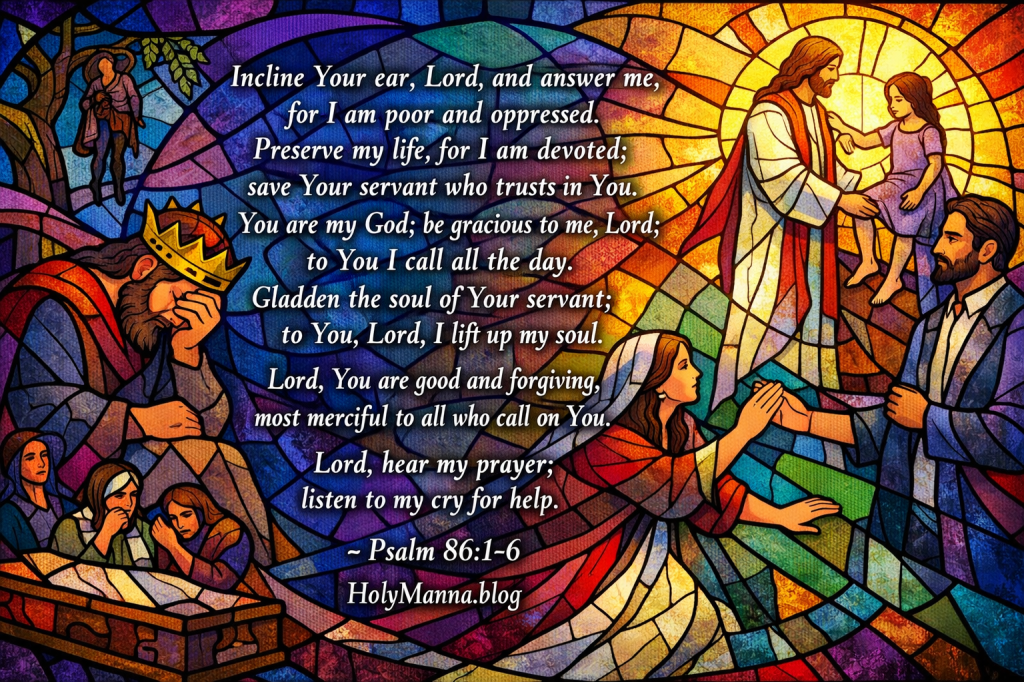
Responsorial Psalm Psalm 86:1-6
A poor man’s prayer that refuses to stop knocking on God’s door.
This psalm carries the voice of King David, but it does not sound like royal confidence. It sounds like a man with nothing left to lean on except the mercy of God. In Israel’s worship, the psalms were not private journaling. They were sung in the life of the people, forming hearts to trust the Lord in distress, in battle, in exile, and in grief. That is why Psalm 86 fits so perfectly beside David’s mourning in the First Reading and the fear-filled urgency in the Holy Gospel. When life feels like it is coming apart, God does not demand eloquence. God invites His children to pray like children, with honesty, persistence, and dependence.
Today’s theme is faith at the edge of helplessness, and this psalm gives the words for that exact moment. It teaches the soul how to stay turned toward God when the news hurts, when the body is weak, and when the heart feels cornered. It also prepares the way for Jesus’ words in The Gospel of Mark, because a heart trained to pray, “Incline your ear, Lord, and answer me,” is a heart ready to hear Christ say, “Do not be afraid; just have faith.”
Psalm 86:1-6 – New American Bible (Revised Edition)
Prayer in Time of Distress
1 A prayer of David.
Incline your ear, Lord, and answer me,
for I am poor and oppressed.
2 Preserve my life, for I am devoted;
save your servant who trusts in you.
You are my God; 3 be gracious to me, Lord;
to you I call all the day.
4 Gladden the soul of your servant;
to you, Lord, I lift up my soul.
5 Lord, you are good and forgiving,
most merciful to all who call on you.
6 Lord, hear my prayer;
listen to my cry for help.
Detailed Exegesis
Verse 1 “Incline your ear, Lord, and answer me, for I am poor and oppressed.”
David begins with humility, not with a résumé. In Scripture, “poor” often means more than lacking money. It means being brought low, stripped of illusions, and forced to depend. This is the posture of authentic prayer, because prayer starts when a person stops pretending to be self-sufficient and finally admits need before God.
Verse 2 “Preserve my life, for I am devoted; save your servant who trusts in you. You are my God.”
David calls himself devoted, but he does not claim perfection. He claims relationship. He is a servant, and the Lord is “my God.” That phrase is covenant language. It is the heart of Israel’s faith, the conviction that God is not distant, and that trust is not vague optimism. Trust is a personal surrender to the living Lord who has bound Himself to His people.
Verse 3 “Be gracious to me, Lord; to you I call all the day.”
This verse is persistence without drama. David does not say he called once and gave up. He says he calls “all the day.” This is how prayer survives hard seasons. It becomes a steady turning back to God, again and again, even when feelings lag behind faith.
Verse 4 “Gladden the soul of your servant; to you, Lord, I lift up my soul.”
David asks for gladness of soul, not just the removal of problems. He wants interior renewal. The phrase “lift up my soul” describes prayer as movement upward, not because life is suddenly easy, but because the heart is being raised toward God. This is a quiet antidote to despair. Despair curls the soul inward. Prayer lifts the soul toward the Lord.
Verse 5 “Lord, you are good and forgiving, most merciful to all who call on you.”
Here the psalm shifts from request to proclamation. David names God’s character as the foundation of his confidence. God is “good,” God is “forgiving,” God is “most merciful.” This is not sentimentality. It is theology. The psalm teaches that prayer rests on who God is, not on how strong a person feels.
Verse 6 “Lord, hear my prayer; listen to my cry for help.”
The psalm ends where it began, with the plea to be heard. That repetition is meaningful. It shows that prayer is not always a straight line from pain to peace. Sometimes prayer is faithful repetition, a child returning to the Father again, and again, and again.
Teachings
Psalm 86 teaches that prayer is first of all a relationship of trust and humility. It is not self-therapy, and it is not a technique to control God. The Church puts it plainly in The Catechism: “Prayer is the raising of one’s mind and heart to God or the requesting of good things from God.” (CCC 2559). That is what David is doing in every verse. He raises his heart, and he asks for what he cannot give himself.
This psalm also teaches the spiritual power of persistent supplication. It is not a lack of faith to keep asking. It is often a sign of faith, because a person who keeps asking has not left the Father’s house. The Catechism describes this kind of prayer: “The first movement of the prayer of petition is asking forgiveness, like the tax collector in the parable: ‘God, be merciful to me, a sinner!’ The prayer of petition is already a turning back toward God.” (CCC 2629). David’s plea for grace and mercy is not a side note. It is the doorway into communion with God.
The tradition of the saints echoes this same realism. St. Augustine famously described the human heart as restless until it rests in God, and the psalms train that restless heart to seek the Lord instead of seeking escape. Prayer, in the Catholic sense, is not denial of distress. It is the decision to bring distress to God’s mercy. That matters today because the liturgy is placing this psalm between two scenes of anguish, David’s mourning and Jairus’ terror. The Church is teaching that the faithful response to helplessness is not panic, and it is not numbness. The faithful response is prayer that clings.
Reflection
This psalm is for the day when the heart is tired of holding it together. It gives permission to say, in plain language, that life feels heavy, and that help is needed. It also challenges the modern instinct to treat prayer like a last resort. David prays like a man who believes the Lord is real, present, and attentive. He does not wait until he has better words. He starts with need.
A practical way to live this psalm is to pray it slowly and personally when distress rises. When worry starts looping, take one line and repeat it until the heart calms enough to breathe. When guilt starts accusing, repeat what the psalm says about God, that He is good and forgiving and most merciful. When grief makes prayer feel impossible, borrow David’s words and let the psalm carry the voice that cannot be found.
Which line from Psalm 86 sounds most like what the heart has been trying to say, but has not known how to express?
Where has prayer become occasional, when David’s example invites a heart that “calls all the day”?
What would change if every fear was answered with a simple habit of lifting the soul to God, not once, but repeatedly, as an act of trust?
Holy Gospel The Gospel of Mark 5:21-43
Two desperate stories collide, and Jesus proves that fear is not the final authority.
St. Mark tells this Gospel like a fast-moving story where urgency keeps getting interrupted. A synagogue official named Jairus comes begging for his dying daughter, and Jesus goes with him. On the way, a suffering woman reaches out in secret and touches Jesus’ cloak. Everything pauses. Then the worst news arrives: the little girl is dead. In a first-century Jewish setting, this scene is packed with meaning. A synagogue official represents public respect and religious order. A woman with chronic hemorrhages represents suffering, isolation, and ritual uncleanness that would have kept her at the margins of worship and community life. One person is “important,” the other is invisible, yet both fall into the same place: helplessness.
This Gospel fits perfectly with today’s theme because it shows what faith looks like when grief and fear are real. David wept for Absalom, and Psalm 86 taught the poor man’s prayer that keeps calling all day long. Now Jesus steps into the middle of human distress and speaks the line the whole day has been building toward: “Do not be afraid; just have faith.” This is not motivational talk. This is the voice of the Lord of life who has authority over sickness, shame, and even death.
Mark 5:21-43 – New American Bible (Revised Edition)
21 When Jesus had crossed again [in the boat] to the other side, a large crowd gathered around him, and he stayed close to the sea. 22 One of the synagogue officials, named Jairus, came forward. Seeing him he fell at his feet 23 and pleaded earnestly with him, saying, “My daughter is at the point of death. Please, come lay your hands on her that she may get well and live.” 24 He went off with him, and a large crowd followed him and pressed upon him.
25 There was a woman afflicted with hemorrhages for twelve years. 26 She had suffered greatly at the hands of many doctors and had spent all that she had. Yet she was not helped but only grew worse. 27 She had heard about Jesus and came up behind him in the crowd and touched his cloak. 28 She said, “If I but touch his clothes, I shall be cured.” 29 Immediately her flow of blood dried up. She felt in her body that she was healed of her affliction. 30 Jesus, aware at once that power had gone out from him, turned around in the crowd and asked, “Who has touched my clothes?” 31 But his disciples said to him, “You see how the crowd is pressing upon you, and yet you ask, ‘Who touched me?’” 32 And he looked around to see who had done it. 33 The woman, realizing what had happened to her, approached in fear and trembling. She fell down before Jesus and told him the whole truth. 34 He said to her, “Daughter, your faith has saved you. Go in peace and be cured of your affliction.”
35 While he was still speaking, people from the synagogue official’s house arrived and said, “Your daughter has died; why trouble the teacher any longer?” 36 Disregarding the message that was reported, Jesus said to the synagogue official, “Do not be afraid; just have faith.” 37 He did not allow anyone to accompany him inside except Peter, James, and John, the brother of James. 38 When they arrived at the house of the synagogue official, he caught sight of a commotion, people weeping and wailing loudly. 39 So he went in and said to them, “Why this commotion and weeping? The child is not dead but asleep.” 40 And they ridiculed him. Then he put them all out. He took along the child’s father and mother and those who were with him and entered the room where the child was. 41 He took the child by the hand and said to her, “Talitha koum,” which means, “Little girl, I say to you, arise!” 42 The girl, a child of twelve, arose immediately and walked around. [At that] they were utterly astounded. 43 He gave strict orders that no one should know this and said that she should be given something to eat.
Detailed Exegesis
Verse 21 “When Jesus had crossed again [in the boat] to the other side, a large crowd gathered around him, and he stayed close to the sea.”
Jesus returns to the “Jewish side” of the lake, and the crowd closes in. St. Mark often shows crowds pressing Jesus, which highlights both His popularity and the deep hunger of a wounded people.
Verse 22 “One of the synagogue officials, named Jairus, came forward. Seeing him he fell at his feet”
Jairus is not casually curious. He is desperate. Falling at Jesus’ feet is a posture of reverence and surrender, especially striking for a respected leader.
Verse 23 “and pleaded earnestly with him, saying, ‘My daughter is at the point of death. Please, come lay your hands on her that she may get well and live.’”
Jairus believes Jesus can heal through touch, which is significant because Jesus’ touch is never merely physical. In the Gospels, touch often signals God’s merciful closeness to human suffering.
Verse 24 “He went off with him, and a large crowd followed him and pressed upon him.”
Jesus responds immediately, and the crowd becomes a kind of moving wall. The pressure of the crowd sets up the contrast between being near Jesus and truly reaching Him in faith.
Verse 25 “There was a woman afflicted with hemorrhages for twelve years.”
Twelve years is not a random detail. It signals long suffering, and it also sets up the parallel with Jairus’ twelve-year-old daughter.
Verse 26 “She had suffered greatly at the hands of many doctors and had spent all that she had. Yet she was not helped but only grew worse.”
This is human misery without varnish. The text acknowledges disappointment, financial ruin, and worsening pain, which makes her act of faith even more courageous.
Verse 27 “She had heard about Jesus and came up behind him in the crowd and touched his cloak.”
She approaches from behind, likely hoping to stay unseen. Her faith is real, but it is timid, and Jesus will draw her into the light without crushing her.
Verse 28 “She said, ‘If I but touch his clothes, I shall be cured.’”
This is a simple act of trust. She believes Jesus is not only powerful, but merciful enough to heal.
Verse 29 “Immediately her flow of blood dried up. She felt in her body that she was healed of her affliction.”
The healing is immediate and bodily. St. Mark emphasizes that grace touches real flesh and real pain, not just ideas.
Verse 30 “Jesus, aware at once that power had gone out from him, turned around in the crowd and asked, ‘Who has touched my clothes?’”
Jesus’ question is not ignorance. It is invitation. He draws the hidden sufferer into a personal encounter, because He does not merely want to fix a condition. He wants to restore a daughter.
Verse 31 “But his disciples said to him, ‘You see how the crowd is pressing upon you, and yet you ask, “Who touched me?”’”
The disciples think in physical terms only. They cannot yet see the difference between accidental contact and intentional faith.
Verse 32 “And he looked around to see who had done it.”
Jesus searches with purpose. This look is mercy that refuses to let fear keep someone hidden forever.
Verse 33 “The woman, realizing what had happened to her, approached in fear and trembling. She fell down before Jesus and told him the whole truth.”
Fear and trembling reveal her vulnerability. She confesses “the whole truth,” which is more than a medical report. It is the unveiling of a life burdened by suffering and shame.
Verse 34 “He said to her, ‘Daughter, your faith has saved you. Go in peace and be cured of your affliction.’”
Jesus calls her “Daughter,” restoring identity and belonging. He links healing to faith and gives peace, which shows that salvation is personal communion with Him, not just symptom relief.
Verse 35 “While he was still speaking, people from the synagogue official’s house arrived and said, ‘Your daughter has died; why trouble the teacher any longer?’”
The interruption becomes heartbreak. Human logic declares the situation finished. The phrase “any longer” is the voice of despair pretending to be practical.
Verse 36 “Disregarding the message that was reported, Jesus said to the synagogue official, ‘Do not be afraid; just have faith.’”
Jesus does not deny the pain. He denies fear the right to rule. Faith here means staying with Jesus even when the worst news arrives.
Verse 37 “He did not allow anyone to accompany him inside except Peter, James, and John, the brother of James.”
Jesus brings witnesses who will later be present at other key moments. This is formation through proximity, teaching them how the Lord confronts death.
Verse 38 “When they arrived at the house of the synagogue official, he caught sight of a commotion, people weeping and wailing loudly.”
The scene is culturally realistic. Public mourning included professional mourners and loud lament, and the chaos underscores how final death seems to everyone there.
Verse 39 “So he went in and said to them, ‘Why this commotion and weeping? The child is not dead but asleep.’”
Jesus speaks with divine authority. Calling death “sleep” is not denial. It is revelation, because what is irreversible to human power is not irreversible to Him.
Verse 40 “And they ridiculed him. Then he put them all out. He took along the child’s father and mother and those who were with him and entered the room where the child was.”
Unbelief mocks. Jesus removes the noise and brings the parents close. The miracle happens in a space of intimacy, not spectacle.
Verse 41 “He took the child by the hand and said to her, ‘Talitha koum,’ which means, ‘Little girl, I say to you, arise!’”
Jesus touches a dead body, something that would normally render a person ritually unclean, and yet He is not defiled. Instead, life flows outward. The Aramaic words preserve the tenderness of the moment.
Verse 42 “The girl, a child of twelve, arose immediately and walked around. [At that] they were utterly astounded.”
Life returns immediately. The detail of walking around confirms the reality of the resurrection, and astonishment is the natural reaction when God breaks into ordinary limits.
Verse 43 “He gave strict orders that no one should know this and said that she should be given something to eat.”
Jesus commands silence, resisting sensationalism and shallow fame. Then He asks for food, grounding the miracle in ordinary care, because God’s power does not float above daily life. It restores daily life.
Teachings
This Gospel proclaims Jesus Christ as true God and true man, not an abstract teacher but the living Lord whose mercy is personal and whose authority is real. His miracles are not party tricks, and they are not mere compassion. They are signs that the Kingdom has arrived and that the power of sin and death is being confronted at the root.
The Church teaches that faith is not simply agreeing with religious ideas. Faith is trustful surrender to God, expressed in obedience and persistence. Jairus models this by continuing to walk with Jesus even after the message of death arrives. The hemorrhaging woman models this by risking exposure and rejection to reach Christ. Both show that faith is often a movement toward Jesus when everything in the flesh wants to retreat.
This Gospel also reveals that Christ’s holiness is contagious in the right direction. Under the old ritual boundaries, impurity spreads. Here, holiness spreads. Jesus is not made unclean by touching suffering and death. Instead, suffering and death are pushed back by His life. This points directly to the sacraments, where Christ continues to touch human weakness through tangible signs. Catholic life is not built on the fantasy that the body does not matter. Catholic life is built on the Incarnation, where God heals, sanctifies, and strengthens through real encounters.
The Fathers loved to emphasize the difference between mere proximity and living faith. Many are pressed against Jesus in the crowd, but only one truly “touches” Him with trust. The Church has repeated this lesson across centuries because it explains a common spiritual trap: being around holy things without actually entrusting the heart to the Lord. External closeness is not the same as interior surrender.
Finally, Jesus’ words, “The child is not dead but asleep,” shine light on Christian hope. The Church does not pretend death is insignificant. The Church weeps, prays, and buries the dead with reverence. Yet the Church also proclaims that death is not sovereign. Christ is sovereign. This Gospel is a preview of the Resurrection, and it trains the heart to believe that Jesus does not only comfort mourners. He also holds the keys of life.
Reflection
This Gospel meets people where they actually live. It meets the parent who is afraid for a child. It meets the person who feels ashamed, exhausted, and unseen. It meets the believer who has prayed, waited, and still received bad news. And it insists that Jesus is not intimidated by any of it.
A practical response begins by noticing how both Jairus and the woman move toward Christ in different ways. Jairus comes publicly, humbled in front of everyone. The woman comes quietly, almost hiding, but still moving forward. Both approaches are received. That should free the heart from thinking there is only one “acceptable” way to come to Jesus. The Lord receives the desperate prayer, the trembling prayer, and the prayer that can barely speak.
This Gospel also invites a serious examination of fear. Jesus does not scold sorrow, but He does challenge fear’s authority. Fear loves to send messages like the one Jairus received: “It is too late, do not bother, stop hoping.” Faith answers by staying near Jesus anyway, especially through prayer, Confession, and the Eucharist, which are not spiritual accessories but real meeting places with the living Christ.
It is also worth noticing that Jesus insists on bringing the woman into the open. That is a gentle warning against hidden spirituality that never becomes honest. Healing deepens when truth is told. Many burdens lose their grip when they are brought into the light before the Lord, especially through confession of sin and honest naming of wounds.
Where has fear been acting like it has the final word, even though Christ says, “Do not be afraid; just have faith”?
Is the heart more like Jairus right now, praying boldly in public, or more like the woman, reaching quietly and hoping not to be seen?
What would change this week if the soul chose one concrete act of faith each day, not as a performance, but as a real touch of trust toward Jesus in prayer and sacramental life?
When the Worst News Arrives, Stay Close to Jesus
Today’s readings move like one story with three scenes, and each scene is honest about how heavy life can feel. In the First Reading, David learns that Absalom is dead, and the king who survived battles is undone by grief. His cries show what love sounds like when it is wounded, and they reveal how sin leaves real consequences in families and communities. Then the Church places Psalm 86 on the lips of the faithful, not as a poetic break, but as the right response to distress. It is the prayer of the poor and oppressed who keep calling on the Lord because mercy is the only solid ground left. Finally, in The Gospel of Mark, Jesus steps into two impossible situations, one public and one hidden, and He shows that faith is not a theory. Faith is coming to Him anyway.
The key message is simple enough to remember and deep enough to change a life. Fear does not get to be the final authority, because Jesus is Lord. The crowd presses in, but one woman truly touches Him with trust and hears “Daughter, your faith has saved you. Go in peace.” A father hears the words that every trembling heart needs, “Do not be afraid; just have faith.” Then death itself is treated like sleep, because Christ speaks life with divine authority, and the little girl rises and walks.
This is the invitation for today. Bring the real burdens to the Lord instead of carrying them alone. Pray with the stubborn persistence of Psalm 86. Refuse to let despair dictate the next step. If faith feels small, let it be small and real, like a trembling hand reaching for Christ. If grief is loud, let prayer be louder. Choose one concrete act today that moves closer to Jesus, a sincere time of prayer, an honest examination of conscience, a return to the sacraments, or a quiet decision to forgive and keep loving without excusing sin.
What would change if the heart stopped treating fear like a master and started treating Jesus like the King He truly is?
Engage with Us!
Readers are invited to share their reflections in the comments below, because God often teaches through the shared witness of His people, especially when the readings touch real grief, real fear, and real hope.
- First Reading, 2 Samuel 18:9-10, 14, 24-25, 30-19:3: Where does David’s mourning reveal the painful cost of sin, and how can that grief be brought to God without letting it harden into bitterness?
- Responsorial Psalm, Psalm 86:1-6: Which line from this psalm sounds most like the heart’s honest prayer right now, and what would it look like to “call all the day” with steady trust instead of occasional panic?
- Holy Gospel, The Gospel of Mark 5:21-43: Where has fear been trying to declare “it is too late,” and what would it mean to hear Jesus say “Do not be afraid; just have faith” and take one concrete step closer to Him this week?
May God give the grace to live a life of faith that does not quit, to pray with perseverance, and to do everything with the love and mercy Jesus taught, so that homes, friendships, and daily work become places where His peace is real and His compassion is visible.
Sacred Heart of Jesus, we trust in You!
Immaculate Heart of Mary, pray for us!
Saint Michael the Archangel, defend us in battle!
Follow us on YouTube, Instagram and Facebook for more insights and reflections on living a faith-filled life.


Leave a comment