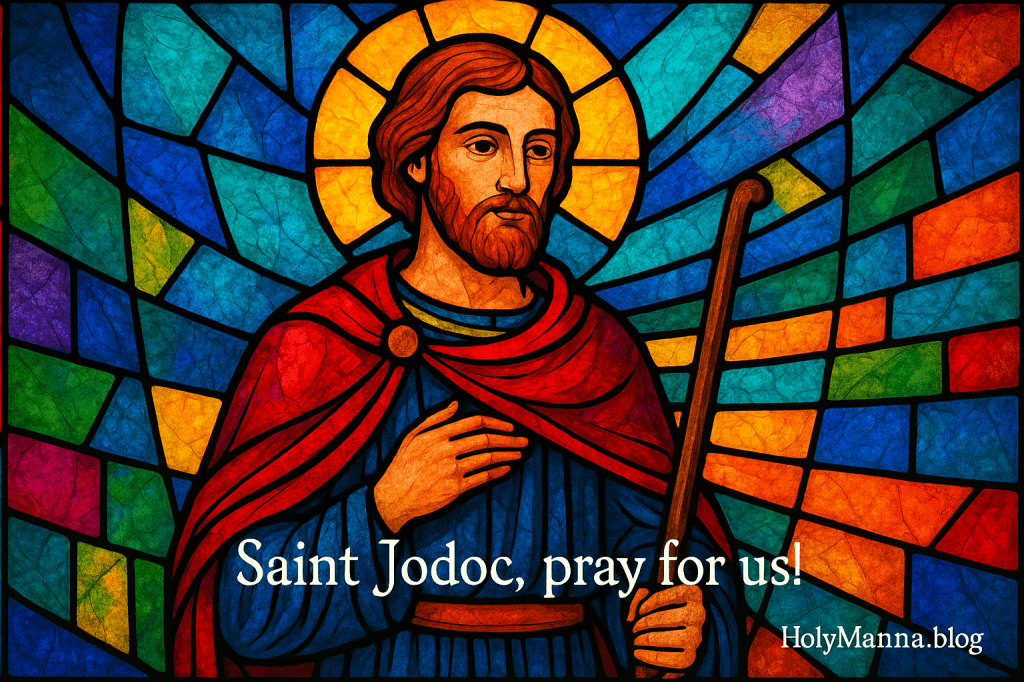
A Pilgrim Prince Who Chose Poverty for Christ
Saint Jodoc, also known as Saint Judoc or Josse, stands out in Christian tradition as a nobleman who laid aside earthly power to pursue holiness with extraordinary humility. Born a Breton prince, he willingly abandoned inheritance and influence to become a pilgrim priest completely dedicated to God. His life of charity, hospitality, and quiet miracles has inspired countless Christians, and his veneration spread widely throughout France, England, Belgium, and Germany during the Middle Ages. He is remembered as a protector of pilgrims, a model of holy renunciation, and a witness to the transforming power of choosing God over worldly ambitions.
A Prince Raised for Power Who Chose Heaven Instead
Saint Jodoc was born around the year 600 in Brittany, the son of King Juthael and the brother of the great Saint Judicael. His early years were shaped by royal expectation and the responsibilities of a noble household. From youth he showed deep reverence for God and a gentle spirit that contrasted with the political struggles of the time.
When Judicael renounced his claim to the throne for a monastic life, the succession naturally fell to Jodoc. Instead of embracing kingship, Jodoc stunned his court by refusing the crown. He desired not a kingdom of earthly rule but a kingdom shaped in the heart by God’s grace. He left Brittany and traveled to northern France, where he was welcomed by the pious Count Haymon of Ponthieu. There he fully embraced a life of prayer and simplicity, eventually becoming a priest dedicated to service and contemplation. His life became a witness that true nobility is found not in status but in holiness.
A Life Marked by Charity, Hidden Miracles, and Holy Hospitality
Saint Jodoc spent many years serving as a spiritual guide in the region of Ponthieu. After receiving ordination, he founded a hermitage near the river Canche, where he lived in poverty, prayer, and manual labor. His humble dwelling became a haven for pilgrims traveling to Rome or Compostela. Countless travelers testified to his kindness, generous hospitality, and prophetic insight.
Some stories speak of small but profound miracles that occurred through his intercession even while he lived. One well-known tradition recounts that the bread he blessed for the hungry never ran out until every person had been fed. Another tells of how the fields near his hermitage produced abundant harvests through his prayers during seasons of famine. Though these miracles were simple, they revealed a heart completely surrendered to God and attentive to the needs of His people. His compassion became a beacon that drew others to deeper conversion and trust.
Trials, Sacrifice, and a Holy Death
While Jodoc did not suffer martyrdom, he lived a life marked by voluntary hardship. Choosing poverty over royalty brought many challenges, including rejection, the loss of worldly security, and the daily sacrifices required by hermitic life. He endured these freely, understanding that the imitation of Christ demands renunciation of anything that hinders the soul’s freedom.
Near the end of his life, Jodoc withdrew even more deeply into solitude. He died around the year 668, known for his holiness and loved by the people he had served. His death was seen not as an ending but as a passage into the fullness of the Kingdom he had sought his entire life.
A Saint Who Continued to Bless Pilgrims from Heaven
After his death, miracles multiplied at his tomb. Pilgrims who visited his relics reported healings of body and soul. The chapel built over his hermitage became a major pilgrimage center during the Middle Ages and inspired the founding of numerous churches dedicated in his honor throughout Western Europe.
His relics were carried to various regions for the strengthening of the faithful, and devotion to him spread especially among travelers and sailors who sought his intercession for protection. Many medieval pilgrims to Santiago de Compostela invoked Saint Jodoc along their journey. Some towns, such as Saint-Josse in northern France, still carry his name as a living memorial of his holy influence.
Learning from a Prince Who Chose Christ
Saint Jodoc’s life reminds every Christian that holiness often requires a courageous refusal of the world’s empty promises. His renunciation of wealth and royal privilege teaches that freedom comes not through power but through surrender to God’s will. His compassion for pilgrims challenges believers to make their homes, their schedules, and their hearts places of welcome for those who journey through life burdened or alone.
His example encourages a life rooted in simplicity, generosity, and intentional pursuit of God’s Kingdom. Christians today can imitate him by loosening their grip on material desires, offering hospitality to others, protecting time for prayer, and trusting that God provides abundantly for those who seek Him first.
Engage with Us!
Share your thoughts, reflections, or prayer intentions in the comments below.
- What part of Saint Jodoc’s life most inspires a desire for deeper simplicity or surrender to God?
- Where might the Lord be inviting a more generous spirit of hospitality in your daily life?
- How can Saint Jodoc’s courage in refusing worldly honors challenge your own priorities and attachments?
May the example of Saint Jodoc strengthen every believer to live with greater faith, love, and mercy, following the way of Jesus with courage and joy.
Saint Jodoc, pray for us!
Follow us on Instagram and Facebook for more insights and reflections on living a faith-filled life.

 Holy Manna!
Leave a comment