Memorial of Saint Lucy, Virgin and Martyr – Lectionary: 186
Fire, Light, and the Coming King
Sometimes the heart feels that the world is dark and cold and yet something inside refuses to give up on light.
Today’s readings, in the middle of Advent and on the Memorial of Saint Lucy, circle around one central theme: God sends burning witnesses to prepare hearts for the true Light who restores His people. In Sirach 48:1 4, 9 11 Elijah appears “like fire”, a prophet whose words burn away compromise and call Israel back before “the day of the Lord”. He is the great forerunner, destined “to put an end to wrath” and “to turn back the hearts” of God’s people.
Psalm 80 becomes the cry of a people who know they need this restoration. They beg the Shepherd of Israel to come close again, praying “O God, restore us; light up your face and we shall be saved” and asking Him to strengthen “the son of man whom you made strong for yourself”. It is the voice of Advent, tired of sin and spiritual sleep, longing for God to visit His vine and revive His people.
In The Gospel of Matthew 17:9 13 Jesus reveals that Elijah has already returned in John the Baptist, but “they did not recognize him” and treated him as they pleased. The same fate awaits the Son of Man. The path of salvation passes through misunderstood prophets and a rejected Messiah, yet this is exactly how God brings His people back.
Into this mystery steps Saint Lucy, a young virgin martyr whose very name means “light.” In a culture that worshiped power, pleasure, and pagan gods, she refused to deny Christ and allowed His light to burn brighter than fear of torture or death. Her life is like a living commentary on these readings. Elijah’s fire, the psalm’s plea for God’s shining face, and John the Baptist’s hidden mission all converge in a saint whose eyes were fixed on Christ even when everything around her went dark.
In Advent, with Saint Lucy, the Church stands in that same place of longing and courage, asking God to restore, to illumine, and to help hearts recognize the fiery witnesses He sends so that they do not miss the saving light of Jesus when He draws near.
First Reading – Sirach 48:1 4, 9 11
Elijah, the Fiery Forerunner of the Coming King
The book of Sirach comes from the wisdom tradition of Israel during the Second Temple period, a time when faithful Jews were trying to live God’s Law in the middle of foreign influence and cultural pressure. In this chapter, the author looks back at Elijah, the great prophet of the northern kingdom, who confronted kings, called down fire, and defended the worship of the true God. Elijah is remembered not just as a heroic figure from the past but as a sign of what God will do in the future. He embodies a fiery love that prepares Israel for the coming day of the Lord.
In Advent, this portrait of Elijah fits perfectly with the theme of preparation and restoration. God does not leave His people drifting in the dark. He sends a burning voice that shakes, purifies, and calls hearts back before the Messiah appears. On the Memorial of Saint Lucy, a virgin martyr whose name means “light,” this reading highlights how God uses courageous witnesses in every age to pierce the darkness with truth and to awaken sleepy hearts to His coming.
Sirach 48:1-4, 9-11
New American Bible (Revised Edition)
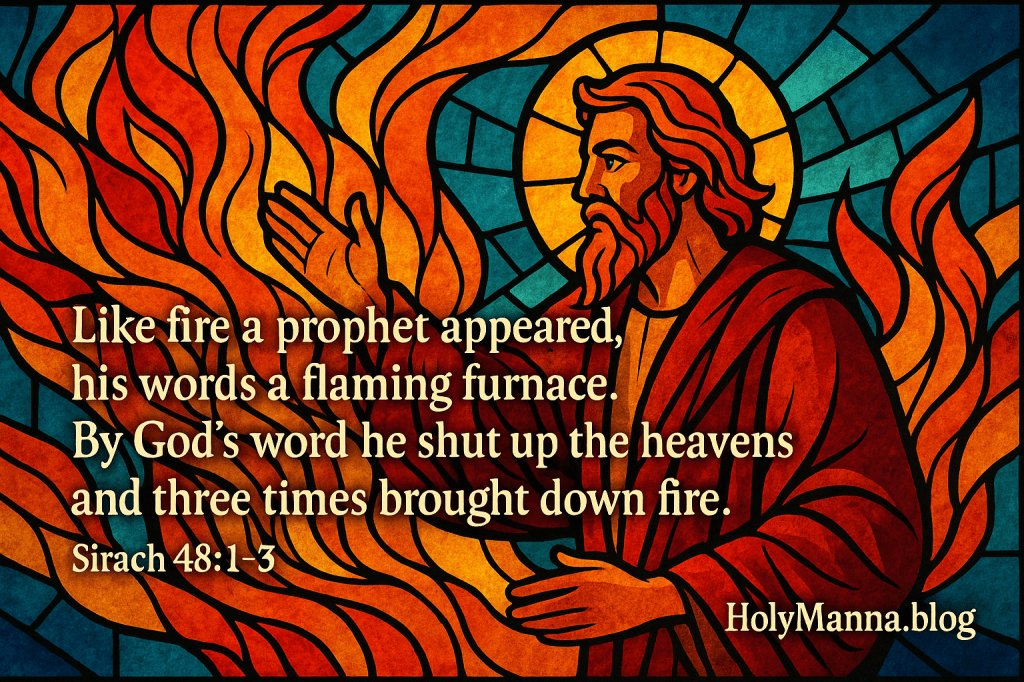
1 Until like fire a prophet appeared,
his words a flaming furnace.
2 The staff of life, their bread, he shattered,
and in his zeal he made them few in number.
3 By God’s word he shut up the heavens
and three times brought down fire.
4 How awesome are you, Elijah!
Whose glory is equal to yours?
9 You were taken aloft in a whirlwind,
in a chariot with fiery horses.
10 You are destined, it is written, in time to come
to put an end to wrath before the day of the Lord,
To turn back the hearts of parents toward their children,
and to re-establish the tribes of Israel.
11 Blessed is the one who shall have seen you before he dies!
Detailed Exegesis
Verse 1: “Until like fire a prophet appeared, his words a flaming furnace.”
Elijah is introduced not with a calm description but with the image of fire. Fire in Scripture represents the presence of God, purification, judgment, and passionate love. Elijah’s words are not mild suggestions. They burn away falsehood and lukewarmness. This verse reminds believers that authentic prophecy is not about being impressive or novel. It is about speaking the truth of God in a way that purifies hearts, even when it is uncomfortable. In the context of Advent, Elijah’s fiery words anticipate John the Baptist, whose preaching calls people to repentance and prepares the way of the Lord.
Verse 2: “The staff of life, their bread, he shattered, and in his zeal he made them few in number.”
This refers to the famine in Elijah’s time when God withheld rain because of Israel’s idolatry. The “staff of life” is a poetic way of speaking about bread, the basic support of human life. When the people turned away from the Lord, even ordinary blessings were disrupted. The phrase “he made them few in number” highlights the severe consequences of sin and stubbornness. Elijah’s prophetic ministry exposes how fragile life becomes when it is detached from God. This verse warns against a false security that assumes God’s gifts will continue no matter how the human heart responds.
Verse 3: “By God’s word he shut up the heavens and three times brought down fire.”
Elijah’s power is not his own. He shuts the heavens and calls down fire by the word of God. The three times he brings down fire likely recalls Mount Carmel, where fire falls on the sacrifice, and other moments where God vindicates His prophet. This shows that creation itself responds to God’s command when spoken through His faithful servant. In spiritual life, it suggests that when someone is deeply obedient, God can work through that person in ways that seem impossible. It also shows that both judgment and mercy are ultimately in God’s hands, not human manipulation.
Verse 4: “How awesome are you, Elijah! Whose glory is equal to yours?”
The author marvels at Elijah’s greatness, almost as if Elijah stands alone among the prophets. Of course, the real glory belongs to God, but Elijah reflects that glory so powerfully that the inspired writer cannot help but praise him. This prepares the way for the idea that Elijah’s mission extends beyond his earthly life. His story is not finished, and his role in God’s plan will echo into the future. This makes the link to John the Baptist and to the expectation that Elijah would return before the day of the Lord.
Verse 9: “You were taken aloft in a whirlwind, in a chariot with fiery horses.”
Here the text recalls Elijah’s mysterious departure in 2 Kings 2, when he is taken up in a whirlwind and fiery chariot. This dramatic exit confirms his unique role in salvation history. Elijah does not simply die in an ordinary way. He is taken up, which later feeds Jewish expectation that he would come again as a herald of the final intervention of God. The imagery of fire and whirlwind shows how closely he is associated with the presence and power of the Lord.
Verse 10: “You are destined, it is written, in time to come to put an end to wrath before the day of the Lord, to turn back the hearts of parents toward their children, and to re establish the tribes of Israel.”
This verse looks ahead to Elijah’s future mission. He is destined to “put an end to wrath” and to reconcile hearts before the day of the Lord. The phrase “turn back the hearts of parents toward their children” speaks of restored relationships and covenant fidelity within families. Sin always fractures relationships. When God prepares a people for His coming, He heals families and re establishes unity among His people. This connects to the Gospel where Jesus explains that Elijah’s role is fulfilled in John the Baptist, who calls Israel to repentance in preparation for the Messiah.
Verse 11: “Blessed is the one who shall have seen you before he dies!”
The reading ends with a beatitude, a declaration of blessedness for anyone who sees Elijah before death. To encounter this fiery prophet is to experience a grace of conversion before judgment. Spiritually, this suggests that someone is blessed when they allow God’s prophetic word to confront them before they stand before Him face to face. It is better to be purified now by hard truths than to ignore them and face them unprepared later.
Teachings
Elijah stands as a prototype of the prophetic mission that prepares the way for Christ. The Church teaches that John the Baptist fulfills this role as the immediate forerunner of the Lord. The Catechism of the Catholic Church describes John in this way: “John goes before the Lord in the spirit and power of Elijah, ‘to turn the hearts of the fathers to the children and the disobedient to the wisdom of the just.’” (CCC 523). This directly echoes the language of Sirach 48:10 and shows how the Old Testament expectation finds its fulfillment in the New Testament.
The prophetic mission is not merely about predicting the future. It is about calling people back to the covenant so that they can receive the One who comes. The Catechism also explains how the Holy Spirit forms the hearts of the faithful through the prophets: “In the Old Testament the prophets proclaimed a radical redemption of the People of God, purification from all their infidelities, a salvation which will include all the nations.” (CCC 64). Elijah’s fire is part of that purifying work.
Saints and Fathers of the Church often see Elijah as a model of zeal. Saint John Chrysostom admired his courage in confronting rulers and false worship. Elijah shows that genuine love for God sometimes requires standing almost alone against a culture that has turned away from the truth. The fiery chariot and whirlwind also helped shape early Christian understanding of how God exalts His faithful servants and points beyond earthly life to the mystery of resurrection and transformation in Christ.
In the light of Advent and the Memorial of Saint Lucy, this reading can be seen as a call to let God rekindle prophetic courage in the hearts of believers. Just as Elijah was a burning voice in his time, and John the Baptist in his, the Holy Spirit continues to raise up witnesses who shine in darkness. The Church remembers saints like Lucy because they lived this prophetic fire all the way to martyrdom. Their lives echo Elijah’s mission to “put an end to wrath” and to help restore hearts before the Lord comes.
Reflection
This reading invites every believer to ask if they are willing to let God’s word act like a refining fire in their life. Elijah’s story shows that God sometimes withdraws comforts, like the “staff of life,” in order to wake His people from spiritual laziness and to bring them back to Himself. It is not cruelty. It is mercy that refuses to let hearts stay numb and distant.
In daily life, this might look like moments of conviction when Scripture hits deeply, when a homily unsettles a comfortable pattern, or when a difficult event exposes how fragile worldly security really is. Instead of ignoring these moments, someone can respond by turning back to prayer, confession, and renewed trust. Families can take this reading as an invitation to reconciliation, healing of grudges, and concrete acts of mercy that “turn back hearts” toward one another.
Where is God using a hard truth to purify the heart right now?
Are there relationships that need to be healed so that hearts can be turned back before the Lord comes more deeply into a home or parish?
What would it look like to let God make faith “like fire,” not just a habit, but a living, burning love that others can actually feel?
Elijah’s fiery mission encourages believers in Advent to welcome not only the gentle light of Christmas but also the purifying flame that prepares the way, so that when Christ comes, He finds hearts already turning back to Him.
Responsorial Psalm – Psalm 80:2 4, 15 16, 18 19
The Cry Of The Vine That Longs For The Light
Psalm 80 comes from a time when Israel experienced distress, likely during or after a period of national crisis or invasion. The people feel abandoned, exposed, and spiritually withered. They turn to God not as a distant ruler but as the Shepherd of Israel and the divine gardener of the vine that He Himself planted. This psalm fits today’s theme by giving voice to the longing for restoration that Elijah announces and that Christ fulfills. During Advent, when the Church waits for the coming of the true Light, this psalm sounds like the heart of a people who know they cannot save themselves and who beg God to shine His face upon them again. On the Memorial of Saint Lucy, whose name means “light,” the repeated plea for God to restore and illumine His people takes on an even deeper resonance.
Psalm 80:2-4, 15-16, 18-19
New American Bible (Revised Edition)
2 O Shepherd of Israel, lend an ear,
you who guide Joseph like a flock!
Seated upon the cherubim, shine forth
3 upon Ephraim, Benjamin, and Manasseh.
Stir up your power, and come to save us.
4 O God, restore us;
light up your face and we shall be saved.
15 Turn back again, God of hosts;
look down from heaven and see;
Visit this vine,
16 the stock your right hand has planted,
and the son whom you made strong for yourself.
18 May your hand be with the man on your right,
with the son of man whom you made strong for yourself.
19 Then we will not withdraw from you;
revive us, and we will call on your name.
Detailed Exegesis
Verse 2: “O Shepherd of Israel, lend an ear, you who guide Joseph like a flock! Seated upon the cherubim, shine forth”
The psalm opens with a tender and majestic image. God is called “Shepherd of Israel”, which reveals both care and authority. He guides Joseph, meaning the tribes of the northern kingdom, like a flock. At the same time He is “seated upon the cherubim”, a reference to the Ark of the Covenant where God’s presence dwelt in the Temple. The verse holds together intimacy and transcendence. God is close enough to hear and yet exalted above the angels. The plea “shine forth” anticipates the Advent longing for the face of God to appear in Christ.
Verse 3: “upon Ephraim, Benjamin, and Manasseh. Stir up your power, and come to save us.”
The names Ephraim, Benjamin, and Manasseh call to mind specific tribes that often marched together in Israel’s camp and processions. They represent the people in their concrete history, not an abstract idea. The psalm begs God to “stir up your power” and “come to save us”, language that is echoed in the traditional Advent prayers of the Church. The people know that salvation is not self generated. God must rouse His power and intervene. This connects to the expectation of Elijah’s return and to the coming of the Messiah who saves through His suffering and resurrection.
Verse 4: “O God, restore us; light up your face and we shall be saved.”
This refrain is the beating heart of the psalm. The people ask not first for military strength or comfort but for restoration. The phrase “light up your face” recalls the priestly blessing in Numbers 6:24 26 where God’s shining face is the source of peace. Salvation here means communion with God, not just escape from trouble. When God’s face shines, life, joy, and order return. This is exactly what Advent prepares for: the revelation of the face of God in the Incarnate Son.
Verse 15: “Turn back again, God of hosts; look down from heaven and see; Visit this vine,”
The psalm shifts to the image of a vine, which represents Israel as God’s cherished planting. “Turn back again” flips the usual language of conversion. Often the people are told to turn back to God, but here they ask God to turn back to them, to look, to visit. This underlines how much they feel His absence. The word “visit” is loaded with meaning in Scripture. When God visits, He does so with mercy and judgment, to restore or to purify. In Advent, the Church expects exactly this divine visitation in Christ.
Verse 16: “the stock your right hand has planted, and the son whom you made strong for yourself.”
The vine is “the stock your right hand has planted”, emphasizing that Israel did not plant itself. It exists because of God’s initiative and care. The “son whom you made strong for yourself” can refer collectively to Israel as God’s son, and it also points mysteriously toward the Messiah, the true Son who embodies Israel and brings its mission to fulfillment. This phrase connects with the Gospel, where Jesus identifies Himself as the Son of Man who will suffer at the hands of those who fail to recognize God’s visitation.
Verse 18: “May your hand be with the man on your right, with the son of man whom you made strong for yourself.”
Here the psalm speaks of “the man on your right” and “the son of man”, terms that in their original context refer to the chosen representative of Israel, possibly the king. In the light of Christ, the Church sees in this verse a prophetic foreshadowing of Jesus seated at the right hand of the Father and bearing the title Son of Man. The prayer that God’s hand be with Him is fulfilled in the Resurrection and Ascension, where the Father vindicates the Son after His suffering, exactly as Jesus hints in The Gospel of Matthew 17:9 13.
Verse 19: “Then we will not withdraw from you; revive us, and we will call on your name.”
The psalm ends with a promise and a plea. The people say that once God restores and revives them, they will not turn away again. The request “revive us” is a prayer for spiritual resurrection, for a heart that can truly call on God’s name with fidelity. This matches today’s theme of restoration through prophetic preparation and the coming of the suffering Son of Man. It also echoes the life of Saint Lucy, whose martyrdom witnesses to a heart that refused to withdraw from Christ, even when threatened with death.
Teachings
This psalm reflects two key biblical images that the Church treasures: God as Shepherd and God as the keeper of the vine. The Catechism of the Catholic Church teaches that the Church herself is like a flock and a vineyard: “The Church is, accordingly, a sheepfold, the sole and necessary gateway to which is Christ. It is also the flock of which God himself foretold that he would be the shepherd… The Church is, finally, the cultivated field, the tillage of God. On that land the ancient olive tree grows whose holy roots were the prophets, and in which the reconciliation of Jews and Gentiles has been brought about and will be brought about again.” (CCC 754). This echoes the language of Psalm 80, where God is Shepherd and the people are His vine.
The repeated plea for God’s face to shine points toward the full revelation of God in Christ. The Catechism describes the Incarnation in this way: “The Word became flesh to be our model of holiness: ‘Take my yoke upon you, and learn from me; for I am gentle and lowly in heart.’” (CCC 459). When God’s face shines in the humanity of Jesus, believers see both the Shepherd who guides and the vine in which they are meant to live and bear fruit.
The psalm’s sense of exile and longing fits the Church’s understanding of Advent as a season of hope filled waiting. The Catechism explains Christian hope like this: “Hope is the theological virtue by which we desire the kingdom of heaven and eternal life as our happiness, placing our trust in Christ’s promises and relying not on our own strength, but on the help of the grace of the Holy Spirit.” (CCC 1817). The cry “restore us; light up your face and we shall be saved” is a perfect expression of that hope.
Saints have echoed this longing for God’s face. Saint Augustine often spoke of the human heart as restless until it rests in God. His famous line captures the soul of Psalm 80: “You have made us for yourself, O Lord, and our heart is restless until it rests in you.” (Confessions, I, 1). The vine of God cannot flourish when it tries to root itself in any other soil.
In light of Saint Lucy, the image of God’s shining face also carries a Eucharistic echo. In the Mass, the Church stands before the real presence of Christ and receives His light and life. The Shepherd feeds His flock and the gardener nourishes His vine. This is how God answers the psalm’s plea in the life of the Church today.
Reflection
This psalm meets believers right in the middle of their own spiritual dryness and confusion. It gives words for the times when God feels distant and when life feels more like a withered vine than a lush vineyard. Instead of pretending that everything is fine, the psalm teaches the courage to cry out: “O God, restore us; light up your face and we shall be saved.”
In daily life, this can mean turning to God honestly in prayer when the heart feels dull, distracted, or wounded. Someone can take the refrain of this psalm and make it part of morning or evening prayer, slowly letting it shape the desires of the heart. Families can pray it together when facing conflict or fatigue, asking God to heal relationships the way the psalm asks Him to care for His vine.
It can also lead to concrete choices. The Shepherd often restores His flock through the sacraments, especially Confession and the Eucharist. Making a good examination of conscience, seeking reconciliation, and returning to Mass with renewed attention are real ways to let God “visit this vine” and “revive” the soul.
Where does the heart feel like a neglected vineyard that needs the divine Gardener to come and tend it again?
What fruits might God want to grow if someone truly let Him “light up His face” over their life, their family, their parish?
Is there a simple, concrete step that can be taken this week to return to the Shepherd, such as a sincere confession, a quiet holy hour, or an act of mercy that reconnects the heart to His love?
Praying Psalm 80 during Advent, and on the Memorial of Saint Lucy, helps the soul stand honestly before God and say with trust: He planted this life, He has not forgotten it, and He can restore what looks withered with a single glance of His shining face.
Holy Gospel – The Gospel of Matthew 17:9 13
Recognizing Elijah, Recognizing Christ
This scene takes place just after the Transfiguration. Peter, James, and John have seen Jesus in glory with Moses and Elijah, the great representatives of the Law and the Prophets. As they come down the mountain, Jesus begins to connect that heavenly vision with the very real path of suffering that lies ahead. In first century Judaism, many believed that Elijah would return before the decisive Day of the Lord, based on prophecies like Sirach 48:10. The disciples, carrying this expectation, ask how Elijah fits into God’s plan. Jesus answers by revealing that Elijah has already come in the person of John the Baptist, yet he was not recognized and was mistreated.
This Gospel fits today’s theme of restoration through prophetic witnesses who prepare the way for the suffering Son of Man. Elijah’s fire, sung in the first reading, and the longing for God’s face in Psalm 80 find their fulfillment in John the Baptist and ultimately in Jesus Himself. On the Memorial of Saint Lucy, a virgin martyr whose name means “light,” this passage highlights how often the world fails to recognize the light of God shining through His witnesses, and how the road to glory usually passes through suffering.
Matthew 17:9-13
New American Bible (Revised Edition)
9 As they were coming down from the mountain, Jesus charged them, “Do not tell the vision to anyone until the Son of Man has been raised from the dead.” 10 Then the disciples asked him, “Why do the scribes say that Elijah must come first?” 11 He said in reply, “Elijah will indeed come and restore all things; 12 but I tell you that Elijah has already come, and they did not recognize him but did to him whatever they pleased. So also will the Son of Man suffer at their hands.” 13 Then the disciples understood that he was speaking to them of John the Baptist.
Detailed Exegesis
Verse 9: “As they were coming down from the mountain, Jesus charged them, ‘Do not tell the vision to anyone until the Son of Man has been raised from the dead.’”
Jesus places a holy silence over the Transfiguration until after the Resurrection. The disciples must learn that His glory cannot be understood apart from His Passion. The title “Son of Man” recalls Daniel 7 and points to His identity as the heavenly figure who receives authority from God, yet He will reach that glory through death and resurrection. The timing shows that God’s plan is progressive. Certain truths can only be understood on the far side of the cross.
Verse 10: “Then the disciples asked him, ‘Why do the scribes say that Elijah must come first?’”
The disciples voice a real theological question. The scribes teach, based on Scripture and tradition, that Elijah will return before the Day of the Lord. They have just seen Elijah on the mountain, and they are trying to put the pieces together. Their question proves they are thinking in terms of prophecy and fulfillment, but they still expect something visible and obvious, not a hidden fulfillment in a humble preacher like John the Baptist.
Verse 11: “He said in reply, ‘Elijah will indeed come and restore all things;’”
Jesus first affirms the teaching. The expectation is not wrong. Elijah “restores all things” by calling Israel back to conversion so that the people are ready for God’s saving intervention. This fits with Sirach 48:10, where Elijah is said to “turn back the hearts” and re establish the tribes of Israel. Restoration, in God’s mind, begins with repentance and a renewed heart, not simply political change.
Verse 12: “but I tell you that Elijah has already come, and they did not recognize him but did to him whatever they pleased. So also will the Son of Man suffer at their hands.”
Here Jesus reveals that Elijah has already come in John the Baptist. The tragedy is that many did not recognize him. They rejected and abused the very one sent to prepare them for the Messiah. The pattern is clear. If the forerunner suffers, the One he announces will suffer too. Jesus directly links John’s fate to His own. This verse shows that failure to recognize God’s prophetic messengers leads to a failure to recognize Christ Himself.
Verse 13: “Then the disciples understood that he was speaking to them of John the Baptist.”
At this moment the disciples grasp that John the Baptist is the “Elijah” figure. Their understanding is still partial, but a key light turns on. They begin to see that God’s plan often unfolds in ways that are more hidden and humble than expected. John did not call down fire from heaven like Elijah, yet his preaching and martyrdom were no less prophetic.
Teachings
The Church clearly teaches that John the Baptist is the immediate forerunner of Christ who comes in the spirit and power of Elijah. The Catechism of the Catholic Church states: “John is ‘Elijah [who] must come.’ The fire of the Spirit dwells in him and makes him the forerunner of the coming Lord. In John, the precursor, the Holy Spirit completes the work of ‘making ready a people prepared for the Lord.’” (CCC 718). This explains why Jesus can say that Elijah has already come. The prophetic mission of Elijah is fulfilled in John’s life, preaching, and martyrdom.
The Catechism also explains John’s role in preparing hearts through conversion: “John the Baptist is ‘more than a prophet.’ In him, the Holy Spirit concludes his speaking through the prophets. John completes the cycle of prophets begun by Elijah. He proclaims the imminence of the consolation of Israel; he is the ‘voice’ of the Consoler who is coming.” (CCC 719). This connects directly with today’s readings, where Elijah’s fire and the plea of Psalm 80 prepare for the consolation that comes in Christ.
The pattern of suffering before glory, which Jesus lays out in this Gospel, lies at the center of Christian life. The Catechism teaches: “By his Passion and death on the cross Christ has given a new meaning to suffering: it can henceforth configure us to him and unite us with his redemptive Passion.” (CCC 1505). The rejection that John faces, and the suffering that Jesus predicts for Himself, reveal a truth that applies to every disciple. Fidelity to God often leads to misunderstanding and pain, yet that path is precisely where God’s transforming grace is at work.
Saint Lucy mirrors this same logic. Her refusal to betray Christ in a hostile culture led directly to her suffering and death, yet through that martyrdom her light has shone through centuries. She stands in the same prophetic line as Elijah and John, showing that the witness of truth and purity will often be resisted but never extinguished.
Reflection
This Gospel invites believers to examine how they respond to the prophetic voices God sends into their lives. The people of Jesus’ time did not recognize John as the promised Elijah. They heard the words but rejected the call to conversion. In doing so, they also closed themselves off to Christ.
In daily life, God often speaks through Scripture, the teaching of the Church, the quiet conviction of conscience, faithful priests, and even courageous friends or family members who speak truth in love. Those voices can feel uncomfortable. They may call out sin, complacency, or compromise. This passage suggests that it is dangerous to dismiss such voices too quickly.
A practical response might include a renewed openness to the Sacrament of Reconciliation, where Christ Himself speaks through the priest, calling the soul back. It could mean taking time each week to pray with the Sunday or daily readings, asking for the grace not just to understand them intellectually but to recognize where they invite real change. It might also mean listening more humbly when someone offers correction or challenge, and bringing that to prayer instead of reacting defensively.
Are there “John the Baptist” figures that have been ignored or brushed aside because their message feels too demanding or inconvenient?
Where might God be asking for a deeper conversion so that His plan can unfold more fully in the heart and in the family?
How can the example of Saint Lucy, who recognized the worth of Christ above all earthly security, inspire a bolder and clearer witness in a culture that often does not recognize Him?
Sitting with this Gospel during Advent helps the heart learn the pattern of God’s work. First comes the prophet, then the cross, then the Resurrection. Those who learn to recognize and welcome the “Elijah” moments in life will be better prepared to recognize and welcome Christ Himself when He draws near.
Let Your Heart Catch Fire With His Light
The readings today sketch one clear path. God sends a fiery prophet, He awakens a longing cry in His people, and He fulfills every promise in the humble, suffering Son of Man. Sirach 48 shows Elijah “like fire”, raised up to “turn back the hearts” of Israel before “the day of the Lord”. Psalm 80 gives words to that awakened heart, begging, “O God, restore us; light up your face and we shall be saved”. The Gospel of Matthew 17:9 13 reveals that this promise is already at work in John the Baptist, the new Elijah, and in Jesus, who walks toward suffering and Resurrection to restore all things from the inside out.
The Memorial of Saint Lucy fits right into this pattern. Her name means “light,” and her martyrdom is a living answer to the readings. She recognized Christ in a culture that did not. She let His light matter more than comfort, fear, or compromise. She lived the same fire as Elijah, the same longing as Psalm 80, and the same costly fidelity as John the Baptist.
Advent is the Church’s way of saying that now is the time to let hearts be set on fire again, to stop pretending that darkness is normal, and to ask for a fresh visitation of God’s light. The Lord still sends prophetic voices. He still stirs up the cry of His people. He still comes as the gentle but unsparing Light who exposes, heals, and restores.
Where does the heart need Elijah’s fire today, not to destroy, but to purify what is half hearted or divided?
Where does the soul need to pray with Psalm 80, “revive us, and we will call on your name,” and really mean it?
Where is Christ inviting a Saint Lucy kind of courage, a quiet but firm decision to choose His light over the shadows that keep creeping back?
The invitation is simple and real. Ask the Holy Spirit to kindle a new desire for holiness. Take one concrete step of repentance, one honest prayer from the heart, one act of love that pushes against fear. Let Elijah’s fire, the psalm’s longing, the Gospel’s suffering Son of Man, and Saint Lucy’s shining courage meet in the ordinary details of the day. When that happens, the light of Christ does not stay on the page. It begins to glow in the heart, in the home, and in the world that still waits for Him, often without knowing it.
Let Your Heart Catch Fire With His Light
The readings today sketch one clear path. God sends a fiery prophet, He awakens a longing cry in His people, and He fulfills every promise in the humble, suffering Son of Man. Sirach 48 shows Elijah “like fire”, raised up to “turn back the hearts” of Israel before “the day of the Lord”. Psalm 80 gives words to that awakened heart, begging, “O God, restore us; light up your face and we shall be saved”. The Gospel of Matthew 17:9 13 reveals that this promise is already at work in John the Baptist, the new Elijah, and in Jesus, who walks toward suffering and Resurrection to restore all things from the inside out.
The Memorial of Saint Lucy fits right into this pattern. Her name means “light,” and her martyrdom is a living answer to the readings. She recognized Christ in a culture that did not. She let His light matter more than comfort, fear, or compromise. She lived the same fire as Elijah, the same longing as Psalm 80, and the same costly fidelity as John the Baptist.
Advent is the Church’s way of saying that now is the time to let hearts be set on fire again, to stop pretending that darkness is normal, and to ask for a fresh visitation of God’s light. The Lord still sends prophetic voices. He still stirs up the cry of His people. He still comes as the gentle but unsparing Light who exposes, heals, and restores.
Where does the heart need Elijah’s fire today, not to destroy, but to purify what is half hearted or divided?
Where does the soul need to pray with Psalm 80, “revive us, and we will call on your name,” and really mean it?
Where is Christ inviting a Saint Lucy kind of courage, a quiet but firm decision to choose His light over the shadows that keep creeping back?
The invitation is simple and real. Ask the Holy Spirit to kindle a new desire for holiness. Take one concrete step of repentance, one honest prayer from the heart, one act of love that pushes against fear. Let Elijah’s fire, the psalm’s longing, the Gospel’s suffering Son of Man, and Saint Lucy’s shining courage meet in the ordinary details of the day. When that happens, the light of Christ does not stay on the page. It begins to glow in the heart, in the home, and in the world that still waits for Him, often without knowing it.
Engage with Us!
Share your reflections in the comments below and help build a space where faith, honesty, and hope can grow together.
- How does Elijah’s fiery mission in Sirach 48:1 4, 9 11 challenge any areas of spiritual laziness or compromise, and what is one concrete way to let God’s word act like a refining fire in daily life this week?
- When you pray with Psalm 80:2 4, 15 16, 18 19, where do you most feel the cry “O God, restore us; light up your face and we shall be saved” in your own story, and how might God be inviting you to let Him visit and revive the “vine” of your heart and your family?
- In The Gospel of Matthew 17:9 13, Jesus explains that Elijah has already come in John the Baptist and was not recognized. Are there “John the Baptist” type voices in your life that you might be ignoring or resisting, and how can you grow in humility to recognize God’s invitations through them?
- Looking at the Memorial of Saint Lucy, whose name means “light,” what is one area of fear, impurity, or spiritual darkness where you feel called to choose the light of Christ more boldly, even if it costs comfort or approval?
May every reflection move hearts to live a deeper life of faith, to walk in trust, and to do everything with the love and mercy that Jesus has taught, so that His light shines through every choice, every word, and every act of charity.
Sacred Heart of Jesus, we trust in You!
Immaculate Heart of Mary, pray for us!
Saint Michael the Archangel, defend us in battle!
Follow us on Instagram and Facebook for more insights and reflections on living a faith-filled life.


Leave a comment