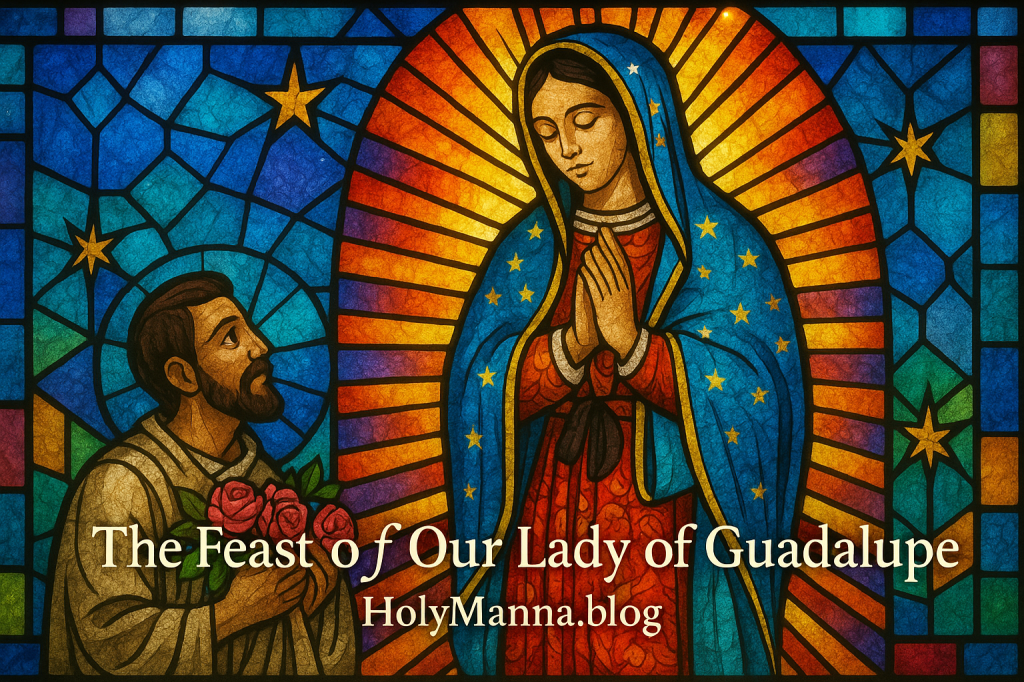
A Mother for the Americas
The Feast of Our Lady of Guadalupe, celebrated on December 12, honors the 1531 apparitions of the Blessed Virgin Mary to Saint Juan Diego on Tepeyac Hill near what is now Mexico City. The Church recognizes this moment as a turning point in the evangelization of the Americas and as a powerful revelation of Mary’s maternal closeness to the marginalized and those caught between cultures. Under this title she is known as Queen of Mexico, Empress of the Americas, and Patroness of the Americas. Her miraculous image on Juan Diego’s tilma functions as a kind of living catechism, filled with symbols that communicated the Gospel directly to Indigenous peoples who longed for hope and dignity. This feast is central to Marian devotion because it highlights Mary’s role as Mother of the Church and her unique mission in salvation history, beautifully affirmed in The Catechism (CCC 963 through 970), where she is described as Mother in the order of grace who continually draws the faithful to her Son.
Roses on Tepeyac
In December of 1531, only a decade after the Spanish conquest of the Aztec Empire, an Indigenous convert named Juan Diego Cuauhtlatoatzin walked toward Mass at dawn. As he passed Tepeyac Hill he heard heavenly birdsong followed by a gentle woman’s voice calling him by name. He soon saw a radiant lady who revealed herself as the Mother of the true God who gives life. She asked that a sacred house be built on that hill where she could show love, compassion, and mercy to all who sought her. Juan Diego delivered the message to Bishop Juan de Zumárraga, who received him kindly but asked for a sign. After several encounters with the Virgin, including one that occurred while he anxiously tended to his dying uncle, Mary comforted him with the words “Am I not here, I who am your Mother?”. She also healed his uncle completely and told him she wished to be known under the title Santa María de Guadalupe.
On December 12 she instructed Juan Diego to gather Castilian roses blooming miraculously on the frozen hillside. He filled his rough tilma with the flowers and brought them to the bishop. When he released them, the roses scattered to the floor and the bishop saw the now famous image of Our Lady of Guadalupe imprinted on the cactus fiber cloak. The tilma, which normally would have decayed within decades, remains perfectly preserved and is displayed in the Basilica of Our Lady of Guadalupe. In the years that followed, an extraordinary wave of conversions occurred throughout the region. It is widely recognized that millions of Indigenous people embraced the Catholic faith through the gentle message conveyed by Mary’s apparition and her miraculous image.
Four Encounters of Tenderness
The earliest detailed account of the apparitions, preserved in the Nican Mopohua, describes four encounters between Mary and Juan Diego and one with his uncle. These moments reveal Mary as a tender mother who speaks in Juan Diego’s native Nahuatl and addresses him with affectionate titles. In the first apparition she expresses her desire for a sacred house where she can hear the cries of the suffering. The second apparition encourages Juan Diego to persevere despite the bishop’s hesitation. The third and fourth apparitions provide comfort during his uncle’s illness and lead to the miracle of the roses and the image. Mary’s appearance to Juan Bernardino, in which she shares her title of Guadalupe, confirms the unity of her mission for both Indigenous and Spanish communities.
Over the centuries many faithful have testified to Mary’s intercession under this title. Stories of conversions, healings, reconciliations, and renewed faith continue to spread devotion to Our Lady of Guadalupe. While the Church carefully distinguishes between private experiences and official miracles, it consistently teaches that authentic Marian devotion deepens love for Jesus, increases sacramental life, and strengthens trust in God’s loving providence.
Woman Clothed with the Sun
The image of Our Lady of Guadalupe evokes the vision from The Book of Revelation: “A great sign appeared in heaven, a woman clothed with the sun, with the moon under her feet.” The tilma displays these very symbols. Mary stands before the sun, wears a mantle of stars, and rests her feet upon the moon. These elements visually express her place within God’s plan of salvation. The feast invites reflection on several Marian doctrines articulated in The Catechism. Mary is truly Mother of God, a title defended at the Council of Ephesus and reaffirmed in The Catechism (CCC 495). She participates uniquely in Christ’s work, acting as Advocate and Mediatrix in a way that flows entirely from His saving power, as taught in CCC 969. The events at Tepeyac beautifully illustrate this role by showing how she leads countless souls to Christ through humility and maternal care.
The tilma itself communicates deep theological meaning. The black ribbon around Mary’s waist symbolized pregnancy in Indigenous cultures, proclaiming that she carries the unborn Christ. Her facial features and clothing reveal a harmonious blending of Indigenous and Spanish elements, showing that the Gospel elevates culture rather than erasing it. This reflects the Church’s understanding of inculturation, in which the eternal truth of the Gospel takes root within a people and transforms their culture from within.
On Pilgrimage with Our Lady
The Basilica of Our Lady of Guadalupe in Mexico City, situated near Tepeyac Hill, is one of the most visited pilgrimage destinations in the world. The original shrine was built in the early eighteenth century, and the modern basilica completed in the twentieth century accommodates the millions who come each year. Pilgrims often travel long distances on foot as an act of penance or devotion. Once inside, many pass silently beneath the tilma on moving walkways, pausing for prayer, confession, and the celebration of the Eucharist.
Devotion to Our Lady of Guadalupe has spread across the globe. Parishes and chapels in many nations have adopted her image, and novenas, rosaries, consecrations, and feasts in her honor have become significant sources of renewal for the faithful. The Catechism (CCC 971) notes that Marian devotion is an essential dimension of Christian spiritual life when it leads believers more deeply into Christ’s mysteries. The countless devotions associated with Guadalupe do exactly this by strengthening love for the sacraments, inspiring repentance, and encouraging works of charity.
Songs, Candles, and Faith
The Feast of Our Lady of Guadalupe is woven into the cultural identity of Mexico and many communities throughout the Americas. Mary’s image appears on murals, clothing, household altars, and public art, serving as a constant reminder of hope. On the night of December 11, crowds gather to sing Las Mañanitas, a traditional serenade in her honor. The celebration continues on December 12 with processions, dances, flowers, and re enactments of the apparitions that pass the story on to younger generations.
The feast is especially dear to migrant communities who see in Our Lady of Guadalupe a mother who walks with them through uncertainty and hardship. Many parishes offer bilingual liturgies, inviting people of every background to unite under Mary’s mantle. Her image has also become a powerful sign in the pro life movement, reminding believers that Mary carried the unborn Christ and that every human life is sacred from the first moment of existence. Through these diverse celebrations the feast strengthens communities wounded by division, lifts the hearts of the poor, and calls the faithful to a renewed love of God.
Under Her Mantle
Our Lady of Guadalupe meets each person with tenderness and speaks directly to the fears and burdens of daily life. Her words to Juan Diego, “Am I not here, I who am your Mother?”, offer comfort to anyone anxious about family struggles, financial pressure, illness, temptation, or sorrow. They remind the faithful that God does not ignore the lowly but raises them with mercy. The tilma invites believers to reflect on the dignity of every culture and every human life, teaching that God transforms a people not by erasing their identity but by elevating it through grace.
In practical terms this feast encourages a Marian pattern of discipleship that includes prayer, sacramental life, courage in daily responsibilities, and charity toward the vulnerable. Small acts of devotion, such as praying the rosary, offering a decade for the unborn or the poor, returning to confession, or welcoming a lonely parishioner, become powerful ways to imitate Mary’s humble openness to grace. Under her guidance the faithful learn to carry Jesus into the world just as she did.
Engage with Us!
You are invited to share your thoughts and experiences related to Our Lady of Guadalupe in the comments below. Your reflections can help others recognize how the Blessed Mother continues to lead people closer to Jesus.
- How has the image or message of Our Lady of Guadalupe shaped your own faith journey?
- Where is God inviting you to trust more deeply in Mary’s words, “Am I not here, I who am your Mother?”, during the challenges of your life?
- How can devotion to Our Lady of Guadalupe inspire a renewed love for the sacraments and the reading of Scripture?
- In what ways can her example move you to defend the dignity of every human person in your home, parish, and community?
- What practical step can you take this week to welcome Jesus and Mary into your daily routine with greater openness and faith?
May this feast inspire all of us to walk in trust beneath the mantle of Our Lady of Guadalupe. May her maternal care strengthen our hope, deepen our love for Christ, and help us grow together in faith as sons and daughters of the Mother of the Americas.
Our Lady of Guadalupe, pray for us!
Follow us on Instagram and Facebook for more insights and reflections on living a faith-filled life.

 Holy Manna!
Leave a comment