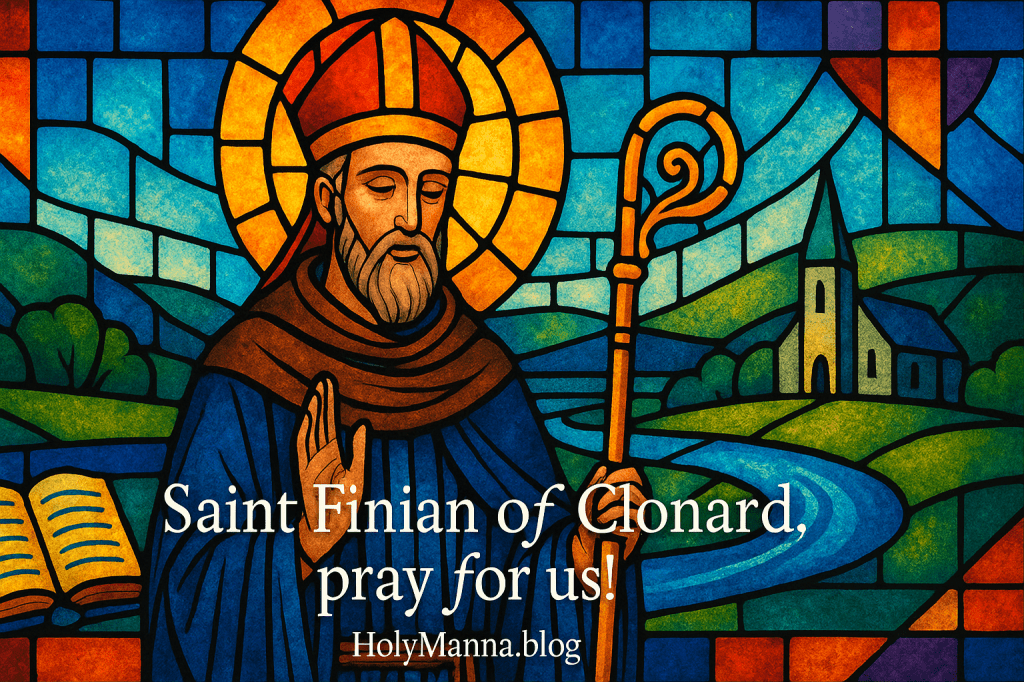
Saint of the Day: Saint Finian of Clonard
A Spiritual Powerhouse in Ireland
Saint Finian of Clonard stands as one of the most influential figures in early Irish Christianity. Born around 470 in Leinster, he became a monk, a founder of monasteries, and a spiritual father to an entire generation of saints. Because so many of Ireland’s greatest evangelizers were formed under his guidance, he is lovingly remembered as the Tutor of the Saints of Ireland and is recognized as a key architect of the island’s monastic tradition. Celebrated on December 12, his legacy continues wherever Christians treasure Scripture, embrace penance, and pass on the faith with fidelity and love.
From Leinster to Learning
Finian was born around 470 in Myshall in the Kingdom of Leinster to a Christian family of Ulster origin. Tradition names his father as Findlog and his mother as Telach. He was baptized by Saint Abban and later entrusted to Bishop Fortchern of Trim for formation in the Christian life. His early years were defined not by a dramatic conversion from paganism but by a deepening of faith that slowly shaped every part of his character and vocation.
As a young adult, Finian traveled abroad for further spiritual and intellectual formation. He studied at the renowned monastic center founded by Saint Martin of Tours in Gaul, a place known for its strict asceticism and profound reverence for Scripture. He then continued his studies in Wales under saints such as Cadoc and possibly Gildas, absorbing a vibrant monastic culture that emphasized learning, prayer, and self-denial.
Upon returning to Ireland, Finian began establishing Christian communities, including Aghowle in County Wicklow. His greatest foundation, however, was yet to come. He is most widely remembered for forming a generation of holy men known as the Twelve Apostles of Ireland, which included saints like Columba of Iona, Ciarán of Clonmacnoise, and Brendan of Clonfert. Their evangelizing missions across Ireland and beyond were the spiritual fruit of Finian’s guidance, teaching, and example.
Clonard Abbey and Living Miracles of Grace
Around 520, guided by divine inspiration, Finian settled in Clonard on the River Boyne. There he built a simple cell and church of clay and wattle and embraced a life of prayer, study, and ascetic discipline. This humble beginning soon blossomed into one of the greatest centers of spiritual learning in Ireland.
Clonard Abbey reportedly welcomed thousands of students at its height. These men came to learn Scripture, monastic discipline, and the path to holiness from Finian, who became a father to many of the saints who would later evangelize Ireland. The monastic rule he lived and taught drew from the Welsh tradition and the Desert Fathers, emphasizing austerity, prayer, hard work, and deep intimacy with the Word of God.
Finian’s greatest miracle was the astonishing spiritual fruit borne by his disciples. Their lives, communities, and missionary work gave shape to Irish Christianity for centuries. This beautifully reflects the teaching of The Catechism, which states that “since all the faithful form one body, the good of each is communicated to the others” (CCC 947). Finian’s holiness became a blessing for countless souls by way of those he formed and sent out.
Tradition speaks of Finian as a man whose prayers brought healing and spiritual comfort to many, even though the written record does not preserve long lists of specific miracles. His reputation as a holy intercessor is clear, as crowds sought both physical and spiritual healing from his blessing.
Another significant part of his legacy is the Penitential of Finnian, one of the earliest manuals offering guidance on confession and penance. Influenced by Saint John Cassian’s writings on the eight principal faults, this work helped confessors assign penances aimed at true conversion and spiritual growth. It aligns deeply with the teaching of The Catechism, which reminds us that “Jesus’ call to conversion and penance does not aim first at outward works but at the conversion of the heart” (CCC 1430).
A Holy Death in Time of Plague
Saint Finian did not suffer martyrdom, yet his life was marked by significant hardship. As an abbot in a turbulent Ireland filled with tribal conflicts and ongoing evangelization efforts, he endured challenges that tested both his leadership and his personal holiness. His heavy responsibilities in forming thousands of monks required immense patience, courage, and fidelity.
Finian embraced a life of profound simplicity, dedicated to what would later be defined as the evangelical counsels. The Catechism teaches that “the life consecrated to God is characterized by the public profession of the evangelical counsels of poverty, chastity, and obedience” (CCC 944 to 945). Though he lived centuries before the structure of religious life was formalized, Finian embodied these counsels through his poverty, purity of heart, and obedience to God’s will.
Around the year 549, a devastating plague struck Ireland, and Saint Finian died during the outbreak, likely in his sixties. He passed from this world as he had lived in it, surrounded by his monastic community and trusting entirely in the mercy of God.
A Legacy that Would Not Die
After his death, Finian was buried at Clonard, where his relics became objects of veneration. Pilgrims traveled to pray at the place where so many saints had been trained and where their spiritual father awaited the resurrection. Though Viking raids in later centuries destroyed many of Clonard’s structures, devotion to Saint Finian endured and spread.
By the ninth century, his feast appeared in Spanish martyrologies, proving that his influence reached far beyond Irish soil. Today he is honored as the patron of the Diocese of Meath and continues to be invoked as one of the great monastic fathers of Ireland. While detailed records of posthumous miracles are sparse, the enduring devotion to him across centuries testifies to many faithful souls who experienced his intercession in prayer.
The communion of saints reminds believers that saintly holiness continues to bear fruit long after their earthly life ends. The Catechism expresses this beautifully by affirming that “the good of each is communicated to the others” (CCC 947), meaning that the holiness of saints like Finian truly strengthens and uplifts the entire Church.
Learning from Saint Finian
Saint Finian’s example offers powerful lessons for today. His passionate love for Scripture invites every Catholic to rediscover the beauty of daily prayer with the Word of God. Even a few minutes with The Gospel of Matthew, Psalm 34, or the daily Mass readings can begin to reshape the heart. His penitential spirituality challenges modern believers to take sin seriously, not as a source of shame but as a place where healing and conversion can begin. His life reflects the truth expressed in The Catechism that interior conversion leads to outward works of penance that help reorder the heart toward God.
His role as a spiritual father inspires Catholics to consider who God has placed in their lives to form, guide, or encourage. Every believer is called to be a spiritual influence, whether for children, friends, students, or parish communities. Finian’s quiet, steady holiness shaped saints who changed nations, reminding all that simple daily fidelity can have a profound spiritual impact.
Finally, his embrace of the evangelical counsels shows that poverty, chastity, and obedience are pathways to freedom for every Christian, not just for monks or religious. Detachment, purity, and humble obedience to God’s will can transform ordinary lives into powerful witnesses of the Gospel.
Engage with Us!
Please share your thoughts and reflections in the comments below. Personal stories about Scripture, penance, or spiritual mentorship can inspire others who are also striving to live a faithful Catholic life.
- Which aspect of Saint Finian’s life resonates most deeply with you, and why?
- How is God inviting you into deeper conversion and penance in your daily life?
- Who has God placed in your life to guide spiritually, and how can you imitate Saint Finian’s example with them?
- How might you build a small “Clonard” in your own home through Scripture, prayer, and intentional spiritual practices?
- What does the communion of saints mean to you when you consider the holiness and intercession of saints like Finian?
May Saint Finian of Clonard inspire all to love Scripture wholeheartedly, to pursue true conversion with courage, and to embrace spiritual fatherhood or motherhood with generosity. May each of us live our faith with purpose and humility, doing everything with the love and mercy that Jesus teaches in His Church.
Saint Finian of Clonard, pray for us!
Follow us on Instagram and Facebook for more insights and reflections on living a faith-filled life.


Leave a comment