Feast of Our Lady of Guadalupe – Lectionary: 690A
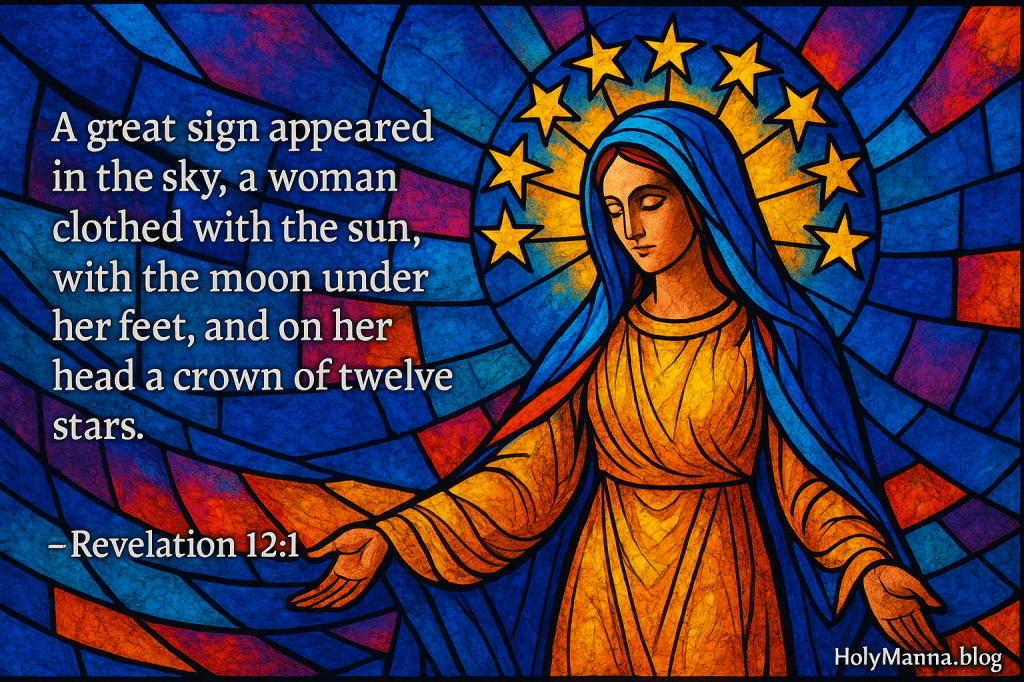
Clothed With the Sun
Sometimes God chooses the smallest and most wounded places to shine His brightest light through a woman’s trusting yes.
The Feast of Our Lady of Guadalupe celebrates Mary as the Woman clothed with the sun who steps into the heart of suffering and idolatry to bring the living Christ. In Revelation 11–12, the heavenly sign of “a woman clothed with the sun” and the ark of the covenant reveals a cosmic battle: a fragile mother, a murderous dragon, and a Child who will rule all nations. The Church has long seen in this Woman both Mary and the Church, protected by God while the enemy rages. The apparition of Our Lady of Guadalupe at Tepeyac echoes this vision in a striking way, as Mary appears radiant, standing above the moon, surrounded by rays, bearing Christ for the peoples of the Americas.
The readings also highlight how God wins victories through humble women who trust Him. In Judith 13 and 15, the people bless Judith as “the glory of Jerusalem”, because God used her courage to strike the enemy’s head. This points forward to Mary, whose motherhood participates in the crushing of the serpent promised in Genesis 3:15 and taught in CCC 411. In Luke 1:26–38, the Annunciation shows the hidden heart behind that victory. The angel greets Mary with “Hail, favored one! The Lord is with you”, and after honest questioning, she offers the simple, fearless surrender: “Behold, I am the handmaid of the Lord. May it be done to me according to your word.” As CCC 488–489 teaches, God prepared and invited Mary’s free consent so that the Son of God might take flesh for us.
Our Lady of Guadalupe brings all of this down into real history: a poor indigenous man, a hill outside Mexico City, a culture marked by bloodshed and despair, and an image that silently preaches the Gospel. Today’s readings and this feast together proclaim that God still enters the darkest battles through Mary’s maternal care and through the quiet yes of believers who trust Him in the middle of their own deserts and dragons. Where is the Lord inviting a Marian yes today, so that His light can break into the wounds of this time and place?
First Reading – Revelation 11:19; 12:1-6, 10
The Woman, the Dragon, and the Victory of God
This vision pulls back the curtain on a cosmic battle that stands behind the Feast of Our Lady of Guadalupe. Heaven opens, the ark of the covenant appears, and a radiant woman stands against a terrifying dragon. The Church sees in this woman both Mary and the Church, and in the Child the risen Christ who rules all nations. For today’s feast, the image of the woman clothed with the sun speaks powerfully to the tilma of Guadalupe, where Mary appears crowned, radiant, and standing above the moon, bearing Christ to a people trapped in fear and darkness. This reading sets the tone for the whole day. God’s people are not abandoned. In the middle of spiritual conflict, God protects the woman, preserves the Child, and proclaims that the accuser is cast out. Mary’s maternal presence at Tepeyac echoes this same promise of protection, victory, and hope.
Revelation 11:19; 12:1-6, 10
New American Bible (Revised Edition)
11:19 Then God’s temple in heaven was opened, and the ark of his covenant could be seen in the temple. There were flashes of lightning, rumblings, and peals of thunder, an earthquake, and a violent hailstorm.
The Woman and the Dragon. 12:1 A great sign appeared in the sky, a woman clothed with the sun, with the moon under her feet, and on her head a crown of twelve stars. 2 She was with child and wailed aloud in pain as she labored to give birth. 3 Then another sign appeared in the sky; it was a huge red dragon, with seven heads and ten horns, and on its heads were seven diadems. 4 Its tail swept away a third of the stars in the sky and hurled them down to the earth. Then the dragon stood before the woman about to give birth, to devour her child when she gave birth. 5 She gave birth to a son, a male child, destined to rule all the nations with an iron rod. Her child was caught up to God and his throne. 6 The woman herself fled into the desert where she had a place prepared by God, that there she might be taken care of for twelve hundred and sixty days.
10 Then I heard a loud voice in heaven say:
“Now have salvation and power come,
and the kingdom of our God
and the authority of his Anointed.
For the accuser of our brothers is cast out,
who accuses them before our God day and night.
Detailed Exegesis
Verse 11:19 – “Then God’s temple in heaven was opened, and the ark of his covenant could be seen in the temple. There were flashes of lightning, rumblings, and peals of thunder, an earthquake, and a violent hailstorm.”
Heaven is opened and the ark appears, which signals God’s presence and covenant faithfulness. The dramatic signs show that what follows is not a private vision but a world changing revelation. Many Catholic commentators see in the ark a figure of Mary, the new Ark who carries the true Presence, Jesus, in her womb, which prepares the way for the vision of the woman in the next verse.
Verse 12:1 – “A great sign appeared in the sky, a woman clothed with the sun, with the moon under her feet, and on her head a crown of twelve stars.”
This woman is radiant with divine light and crowned with twelve stars that recall the twelve tribes of Israel and the twelve apostles. She represents both Mary and the people of God. In the Feast of Our Lady of Guadalupe, this imagery is almost visibly fulfilled in the miraculous image where Mary is surrounded by rays, stands on the moon, and wears a star covered mantle.
Verse 12:2 – “She was with child and wailed aloud in pain as she labored to give birth.”
The woman is in real labor. Salvation is not abstract, it comes through real suffering and struggle. This reflects both Mary’s motherhood and the Church’s ongoing labor to bring Christ to the world. It also hints at the spiritual pain of conversion that whole cultures experienced when the Gospel took root, as in the massive turning to Christ after Guadalupe.
Verse 12:3 – “Then another sign appeared in the sky; it was a huge red dragon, with seven heads and ten horns, and on its heads were seven diadems.”
The dragon is terrifying, powerful, and crowned, symbolizing a counterfeit authority that opposes God. Later in Revelation this dragon is identified as Satan. The seven heads and ten horns indicate a fullness of worldly power. Evil looks overwhelming, yet it is still only a creature before God.
Verse 12:4 – “Its tail swept away a third of the stars in the sky and hurled them down to the earth. Then the dragon stood before the woman about to give birth, to devour her child when she gave birth.”
The dragon drags others into rebellion and stands ready to destroy life at its beginning. This shows how Satan targets the Child and, by extension, every work of God from the moment it starts. Spiritually, it reflects how the enemy tries to devour faith, hope, and vocations before they mature.
Verse 12:5 – “She gave birth to a son, a male child, destined to rule all the nations with an iron rod. Her child was caught up to God and his throne.”
The Child is clearly the Messiah. The phrase about ruling with an iron rod echoes Psalm 2, a royal Messianic psalm. The Child’s being caught up points to the resurrection and ascension. No matter how strong the dragon appears, Christ is already enthroned. Mary’s role is inseparable from His mission, which is why Catholic devotion always leads to Christ.
Verse 12:6 – “The woman herself fled into the desert where she had a place prepared by God, that there she might be taken care of for twelve hundred and sixty days.”
The desert is a place of trial and protection. God prepares a place for the woman, which shows his tender care for Mary and the Church in times of persecution. The symbolic time period expresses a limited and controlled duration of trial. God allows the struggle but sets boundaries around it.
Verse 12:10 – “Then I heard a loud voice in heaven say: ‘Now have salvation and power come, and the kingdom of our God and the authority of his Anointed. For the accuser of our brothers is cast out, who accuses them before our God day and night.’”
Heaven proclaims that salvation, power, and the kingdom have arrived in Christ. The accuser is cast down. Satan’s main weapon is accusation and discouragement. In Mary, believers receive a mother who intercedes rather than accuses, and in Christ they receive a Savior whose blood silences every accusation. This fits the experience of so many at Guadalupe who found mercy and dignity in Mary’s gaze.
Teachings
This reading reveals Mary’s unique place in salvation history. In Genesis 3:15, God promises enmity between the serpent and the woman, and between the serpent’s seed and her offspring. The Church sees this fulfilled in Mary and Jesus and reflected again in Revelation 12. CCC 411 teaches: “The Christian tradition sees in this passage an announcement of the ‘New Adam’ who, because he ‘became obedient unto death, even death on a cross’, makes amends superabundantly for the disobedience of Adam. Furthermore many Fathers and Doctors of the Church have seen the woman announced in the Protoevangelium as Mary, the mother of Christ, the ‘new Eve’. Mary benefited first of all and uniquely from Christ’s victory over sin: she was preserved from all stain of original sin and by a special grace of God committed no sin of any kind during her whole earthly life.”
The dragon is identified with Satan in Revelation 12:9, and CCC 2853 explains his defeat: “Victory over the ‘prince of this world’ was won once for all at the hour when Jesus freely gave himself up to death to give us his life. This is the judgment of this world, and the prince of this world is cast out. ‘He pursued the woman’ but had no hold on her: the new Eve, full of grace of the Holy Spirit, is preserved from sin and the corruption of death. Then the dragon was angry with the woman, and went off to make war on the rest of her offspring. Therefore the Spirit and the Church pray: ‘Come, Lord Jesus’, since his coming will deliver us from the Evil One.”
Saint Louis de Montfort reflects the same mystery when he writes in True Devotion to Mary: “God has established only one enmity, but it is an irreconcilable one, which will last and even go on increasing to the end of time. It is between Mary, his worthy Mother, and the devil, between the children and servants of the Blessed Virgin and the children and followers of Lucifer.” This enmity plays out in every age, including the time of the apparitions at Tepeyac, when Our Lady of Guadalupe opposed a culture of death with the life giving Gospel.
Reflection
This reading invites a very personal question: Where does the battle between the woman and the dragon touch daily life right now? The vision can seem distant and symbolic, but its patterns are very close. The enemy still tries to devour what God is bringing to birth in hearts, families, parishes, and cultures. God still opens a place of protection and care for those who stay close to Christ and his Mother.
In practical terms, this means choosing trust when fear rises, staying faithful to prayer when life feels like a desert, and rejecting the accusing voice that says holiness is impossible. It means asking Mary’s help to live a steady, humble yes in small daily decisions so that Christ can grow in the soul.
Where might God be asking for perseverance in a dry season rather than escape or compromise?
What accusations or lies need to be rejected in the light of this promise that the accuser is cast down?
How can devotion to Our Lady of Guadalupe deepen a sense of being personally seen, protected, and sent into this world as a witness to Christ’s victory?
Responsorial Psalm – Judith 13:18-19; 15:9
Blessed Woman, Sign of God’s Victory
The responsorial psalm for the Feast of Our Lady of Guadalupe takes words first spoken to Judith and places them on the lips of the Church as praise for Mary. In the story of Judith, God saves Israel through the courage of a widow who trusts Him when others are ready to give up. Her victory over Holofernes becomes a song for all generations. Today, those same words describe the even greater victory God works through Mary, especially as Our Lady of Guadalupe, who brings the true King into the heart of a culture marked by fear, violence, and despair. This psalm fits the theme of a humble woman through whom God crushes the enemy and lifts up His people with tender mercy.
Judith 13:18-19; 15:9
New American Bible (Revised Edition)
13:18 Then Uzziah said to her, “Blessed are you, daughter, by the Most High God, above all the women on earth; and blessed be the Lord God, the creator of heaven and earth, who guided your blow at the head of the leader of our enemies. 19 Your deed of hope will never be forgotten by those who recall the might of God.
15:9 When they came to her, all with one accord blessed her, saying:
“You are the glory of Jerusalem!
You are the great pride of Israel!
You are the great boast of our nation!
Detailed Exegesis
Verse 13:18 – “Then Uzziah said to her, ‘Blessed are you, daughter, by the Most High God, above all the women on earth; and blessed be the Lord God, the creator of heaven and earth, who guided your blow at the head of the leader of our enemies.’”
Uzziah, a leader of the people, recognizes that Judith’s courage comes from God. She is called blessed above all women, and God the creator is praised as the one who guided her hand. The language points forward to Mary, who will be greeted with “Blessed are you among women” in Luke 1:42. The reference to striking the head of the enemy recalls Genesis 3:15, where God promises that the offspring of the woman will crush the serpent’s head. In light of this feast, the verse becomes a bridge between Judith and Mary, showing how God loves to work through the trust and obedience of a woman who belongs completely to Him.
Verse 13:19 – “Your deed of hope will never be forgotten by those who recall the might of God.”
Judith’s act is remembered not simply as military skill but as a deed of hope. Her courage helps future generations remember God’s power. In the same way, every Marian feast is not just about Mary’s greatness, but about God’s faithfulness shining through her. Our Lady of Guadalupe becomes a living reminder that God does not forget the lowly, and that He still acts in history in ways that no one expects.
Verse 15:9 – “When they came to her, all with one accord blessed her, saying: ‘You are the glory of Jerusalem! You are the great pride of Israel! You are the great boast of our nation!’”
All the people bless Judith with a threefold acclamation. She is called the glory of Jerusalem, the pride of Israel, and the boast of the nation. These titles show how a single woman’s faith can lift an entire people. In the Catholic tradition, the Church joyfully applies similar titles to Mary. In her, the people of God see their glory, their pride, and their boast, not in a worldly sense, but as the place where God’s mercy has done great things.
Teachings
The Church has always seen Judith as a figure or type of Mary. She foreshadows the one through whom God will bring the definitive victory over sin and death. CCC 489 explains how God prepared for the coming of Christ through holy women in the Old Testament: “Throughout the Old Covenant the mission of many holy women prepared for that of Mary. At the very beginning there was Eve; despite her disobedience, she receives the promise of a posterity that will be victorious over the evil one, as well as the promise that she will be the mother of all the living. By virtue of this promise, Sarah conceives a son in spite of her old age. Against all human expectation God chooses those who were considered powerless and weak to show forth his faithfulness to his promises: Hannah, the mother of Samuel, Deborah, Ruth, Judith and Esther, and many other women. Mary ‘stands out among the poor and humble of the Lord, who confidently hope for and receive salvation from him.’”
The praises of Judith in Judith 13 and 15 echo in the Church’s praise of Mary. CCC 971 teaches about the honor given to Mary: “All generations will call me blessed: The Church’s devotion to the Blessed Virgin is intrinsic to Christian worship. The Church rightly honors the Blessed Virgin with special devotion. From the most ancient times the Blessed Virgin has been honored with the title of ‘Mother of God,’ to whose protection the faithful fly in all their dangers and needs.” The words spoken to Judith help believers understand why the Church does not hesitate to call Mary blessed, to seek her intercession, and to rejoice in her as the glory of the new Jerusalem, which is the Church.
In the history of the Americas, the apparition of Our Lady of Guadalupe is a concrete expression of this truth. At a time of deep division and suffering, God chose a poor indigenous man and a humble woman’s image to lead millions to Christ. Just as Judith’s deed of hope is never forgotten, the merciful intervention of Our Lady of Guadalupe continues to shape the identity and faith of entire peoples.
Reflection
This psalm invites grateful praise for the way God works through the lowly and the forgotten. It also quietly asks a personal question: Is there trust that God can do something beautiful and powerful through small acts of faith today? Just as Judith risked everything in obedience, and Mary opened her life completely to God’s plan, believers are invited to let their own ordinary lives become a place where God’s strength is made visible.
Practically, that can look like praising God in the middle of anxiety instead of letting fear speak the last word, honoring Mary and learning from her humility, and choosing hope when the situation seems impossible. It might mean asking Our Lady of Guadalupe for the courage to defend life, to protect the vulnerable, and to bring Christ into difficult spaces with gentleness and truth.
Where might God be inviting a courageous deed of hope that future generations could remember as a small part of His larger story?
How can time spent with Mary in prayer help trust grow in the Creator who still guides His people in every trial?
What words of blessing can be spoken over others today, so that they experience themselves as cherished instruments in God’s hands, just as Judith and Mary were?
Holy Gospel – Luke 1:26-38
Mary’s Yes That Changes History
The Annunciation in The Gospel of Luke shows the exact moment when God invites a young woman in Nazareth into the heart of His saving plan. This small, overlooked town in Galilee becomes the meeting point of heaven and earth when the angel Gabriel announces the coming of the Messiah. For the Feast of Our Lady of Guadalupe, this scene is the hidden root of everything that later unfolds at Tepeyac. The Mary who says yes in Nazareth is the same Mary who appears centuries later to Saint Juan Diego as the Mother who carries the true God in her womb. In this Gospel, God reveals that His kingdom comes not through worldly force, but through a humble woman who trusts His word and lets the Holy Spirit overshadow her.
Luke 1:26-38
New American Bible (Revised Edition)
26 In the sixth month, the angel Gabriel was sent from God to a town of Galilee called Nazareth, 27 to a virgin betrothed to a man named Joseph, of the house of David, and the virgin’s name was Mary. 28 And coming to her, he said, “Hail, favored one! The Lord is with you.” 29 But she was greatly troubled at what was said and pondered what sort of greeting this might be. 30 Then the angel said to her, “Do not be afraid, Mary, for you have found favor with God. 31 Behold, you will conceive in your womb and bear a son, and you shall name him Jesus. 32 He will be great and will be called Son of the Most High, and the Lord God will give him the throne of David his father, 33 and he will rule over the house of Jacob forever, and of his kingdom there will be no end.” 34 But Mary said to the angel, “How can this be, since I have no relations with a man?” 35 And the angel said to her in reply, “The holy Spirit will come upon you, and the power of the Most High will overshadow you. Therefore the child to be born will be called holy, the Son of God. 36 And behold, Elizabeth, your relative, has also conceived a son in her old age, and this is the sixth month for her who was called barren; 37 for nothing will be impossible for God.” 38 Mary said, “Behold, I am the handmaid of the Lord. May it be done to me according to your word.” Then the angel departed from her.
Detailed Exegesis
Verse 26 – “In the sixth month, the angel Gabriel was sent from God to a town of Galilee called Nazareth,”
The sixth month refers to Elizabeth’s pregnancy, linking John the Baptist and Jesus from the start. Gabriel, who appears in Daniel, is a messenger of major revelations. Nazareth is an ordinary, almost insignificant place, which shows that God loves to work in hidden and humble settings rather than in centers of power.
Verse 27 – “to a virgin betrothed to a man named Joseph, of the house of David, and the virgin’s name was Mary.”
Mary is a virgin and betrothed, which highlights both her purity and her real place within Israel’s family life. Joseph belongs to the house of David, so the Child will be truly heir to the Davidic promises. Naming Mary twice as virgin emphasizes that what is about to happen is entirely God’s work.
Verse 28 – “And coming to her, he said, ‘Hail, favored one! The Lord is with you.’”
Gabriel does not use Mary’s name at first. He greets her by a kind of new identity: favored one, or full of grace. This reveals that Mary already lives in a unique relationship with God’s grace. The words “The Lord is with you” echo Old Testament calls of great figures like Gideon and Moses, which signals that Mary is being drawn into a mighty mission.
Verse 29 – “But she was greatly troubled at what was said and pondered what sort of greeting this might be.”
Mary’s reaction is not shallow fear but deep reflection. She is troubled and she ponders. This shows a thoughtful, discerning heart that takes God seriously. She does not doubt God’s power but seeks to understand His will.
Verse 30 – “Then the angel said to her, ‘Do not be afraid, Mary, for you have found favor with God.’”
Gabriel reassures her personally by name. The command not to fear is tied to the fact that she has found favor with God. Her smallness and humility are not obstacles but the very reason she is chosen.
Verse 31 – “Behold, you will conceive in your womb and bear a son, and you shall name him Jesus.”
The promise becomes concrete. Mary will really conceive and carry this Child in her womb. The name Jesus means “The Lord saves,” revealing His mission. The body she offers will become the place where the Savior takes flesh.
Verse 32 – “He will be great and will be called Son of the Most High, and the Lord God will give him the throne of David his father,”
Gabriel uses royal and divine language. Son of the Most High points to His divine identity. The throne of David roots His kingship in the promises to Israel. This Child fulfills both God’s covenant with David and His eternal plan of salvation.
Verse 33 – “and he will rule over the house of Jacob forever, and of his kingdom there will be no end.”
This verse makes clear that the kingdom of Christ is not temporary or political in a narrow sense. It is everlasting and extends over all who belong to God’s people. The promise answers the longing for a king who truly brings justice and peace.
Verse 34 – “But Mary said to the angel, ‘How can this be, since I have no relations with a man?’”
Mary’s question is honest and chaste. She does not say, “This cannot be,” but “How can this be”. She believes the promise and asks how it will work with her commitment to virginity. This question reveals both her realism and her fidelity to God.
Verse 35 – “And the angel said to her in reply, ‘The holy Spirit will come upon you, and the power of the Most High will overshadow you. Therefore the child to be born will be called holy, the Son of God.’”
Gabriel answers by pointing to the Holy Spirit. The language of overshadowing recalls the cloud of God’s presence over the tabernacle in Exodus. Mary becomes the new living tabernacle and Ark of the Covenant. The Child is holy and truly the Son of God, not by human fatherhood but by divine action.
Verse 36 – “And behold, Elizabeth, your relative, has also conceived a son in her old age, and this is the sixth month for her who was called barren;”
Gabriel gives Mary a concrete sign in Elizabeth. God is already at work overcoming barrenness and impossibility. This shows that faith is not blind, since God often provides signs that confirm His word.
Verse 37 – “for nothing will be impossible for God.”
This short verse is the heart of the message. God is not limited by human weakness, age, or circumstance. The same God who opened Elizabeth’s womb will bring about the virginal conception of Jesus.
Verse 38 – “Mary said, ‘Behold, I am the handmaid of the Lord. May it be done to me according to your word.’ Then the angel departed from her.”
Mary responds with total surrender. She calls herself the handmaid of the Lord, which expresses humility and complete availability. Her yes opens the door for the Incarnation. Heaven waits for this human consent, and with it, salvation history moves forward. This same yes will echo later in the tenderness of Our Lady of Guadalupe, who comes as a Mother ready to serve and draw souls to her Son.
Teachings
The Church teaches that Mary’s role in salvation is real and free. CCC 488 states: “God sent forth his Son, but to prepare a body for him, he wanted the free cooperation of a creature. For this, from all eternity God chose for the mother of his Son a daughter of Israel, a young Jewish woman of Nazareth in Galilee, ‘a virgin betrothed to a man whose name was Joseph, of the house of David; and the virgin’s name was Mary.’” The Annunciation reveals that God respects human freedom so deeply that He waits for Mary’s yes.
CCC 494 highlights the importance of her consent: “At the announcement that she would give birth to ‘the Son of the Most High’ without knowing man, by the power of the Holy Spirit, Mary responded with the obedience of faith, certain that ‘with God nothing will be impossible’: ‘Behold, I am the handmaid of the Lord; let it be [done] to me according to your word.’ Thus, giving her consent to God’s word, Mary becomes the mother of Jesus.” Her yes is the model of the obedience of faith for every disciple.
Saint Bernard of Clairvaux, reflecting on this moment, imagined all creation holding its breath as it waited for Mary’s answer. In one of his homilies he writes: “The price of our salvation is offered to you. We shall be set free at once if you consent. Tearful Adam with his sorrowing family begs this of you, O loving Virgin, in their exile from Paradise. Abraham begs it, David begs it. All the other holy patriarchs, your ancestors, ask it of you, as they dwell in the country of the shadow of death. This is what the whole earth waits for, prostrate at your feet.” This poetic image shows how the Annunciation stands at the center of history.
In the story of Our Lady of Guadalupe, this same mystery continues. The Mother who once received the Word in Nazareth now appears to a poor indigenous man and offers the same Christ to a wounded people. The gentle authority of her words to Juan Diego flows from her identity as the handmaid of the Lord who once said yes and never took it back.
Reflection
This Gospel gently invites each believer to stand beside Mary and listen again to Gabriel’s message. God still sends His word into ordinary places, into daily routines, into quiet Nazareths where nothing impressive seems to be happening. The same Holy Spirit who overshadowed Mary wants to work quietly in the hearts of those who are willing to say yes in the middle of their real circumstances.
In practice, that can mean starting the day with a simple prayer of surrender, choosing purity and integrity when temptation appears, and trusting that no situation is beyond God’s reach. It can mean imitating Mary’s habit of pondering rather than reacting, especially when life feels confusing. Devotion to Our Lady of Guadalupe can help believers remember that God sees the lowly and values those whom the world ignores.
Where might God be speaking a new word into life right now that calls for trust rather than fear?
What concrete yes is God inviting today that might feel small but could open space for His grace to work more deeply?
How can Mary’s humble words, “Behold, I am the handmaid of the Lord. May it be done to me according to your word,” become a quiet rhythm in the heart throughout the day?
Walking With the Woman Clothed With the Sun
Today’s readings and the Feast of Our Lady of Guadalupe reveal one beautiful truth: God chooses a humble woman to stand at the heart of the fiercest battles and to bring Christ into the darkest places. In Revelation 11–12, the woman clothed with the sun faces the dragon, yet God protects her and her Child. In Judith 13 and 15, God saves His people through a courageous daughter of Israel who becomes “the glory of Jerusalem” and “the great pride of Israel”. In Luke 1:26–38, Mary listens, questions with faith, and then answers with that simple surrender that changes history: “Behold, I am the handmaid of the Lord. May it be done to me according to your word.”
Our Lady of Guadalupe gathers all of this into one living image. The Woman of Revelation shines visibly on the tilma at Tepeyac. The courage of Judith echoes in Mary’s tender yet strong presence to a suffering people. The yes of Nazareth continues to bear fruit in the Americas and in every heart that lets Christ enter through her motherly care. She is not a distant symbol. She is a real Mother who still comes close, especially to the small, the poor, the unseen, and the overwhelmed.
This day is an invitation to let that same pattern unfold in ordinary life. God still speaks into hidden Nazareths. God still defeats the dragon through quiet fidelity. God still remembers every deed of hope done in trust. A simple daily yes, a decade of the Rosary prayed with attention, a visit to the Blessed Sacrament, a choice for purity, mercy, or generosity when it feels costly, all of these become small Marian echoes of “May it be done to me according to your word.”
Where is the Lord asking for a Marian yes in the middle of real fears, wounds, or confusion right now? How can time spent with Our Lady of Guadalupe today deepen trust that nothing is impossible for God?
With Mary, the handmaid of the Lord and Mother of the Church, hearts can ask for the grace to live this day as an offering: to reject the voice of accusation, to cling to Christ in the desert, and to let His light shine through lives that are simple but fully surrendered.
Engage with Us!
Share your reflections in the comments below and let this feast of Our Lady of Guadalupe become a real conversation with God and with one another.
- First Reading – Revelation 11:19; 12:1-6, 10:
Where do you see the battle between the dragon and the woman playing out in your own life right now, and how is God inviting you to trust His protection more deeply? What is one concrete way you can cling to hope when it feels like the enemy is trying to devour something good that God is bringing to birth in you? - Responsorial Psalm – Judith 13:18-19; 15:9:
How does God’s praise of Judith as “the glory of Jerusalem” change the way you see the importance of faith filled women in your own story? What “deed of hope” can you offer this week, even if it feels small, so that others can remember the might and mercy of God? - Holy Gospel – Luke 1:26-38:
Which part of Mary’s response, “Behold, I am the handmaid of the Lord. May it be done to me according to your word,” speaks most to your heart today, and why? What is one specific area of your life where you feel called to move from fear to a simple yes, trusting that nothing will be impossible for God?
May these questions help you listen more closely to the Lord, walk more closely with Mary, and live each day with a faith that is real, concrete, and courageous. With every choice, big or small, may you seek to do all things with the love and mercy that Jesus taught, so that His light can shine through your life into a world that desperately needs Him.
Sacred Heart of Jesus, we trust in You!
Immaculate Heart of Mary, pray for us!
Saint Michael the Archangel, defend us in battle!
Follow us on Instagram and Facebook for more insights and reflections on living a faith-filled life.


Leave a comment