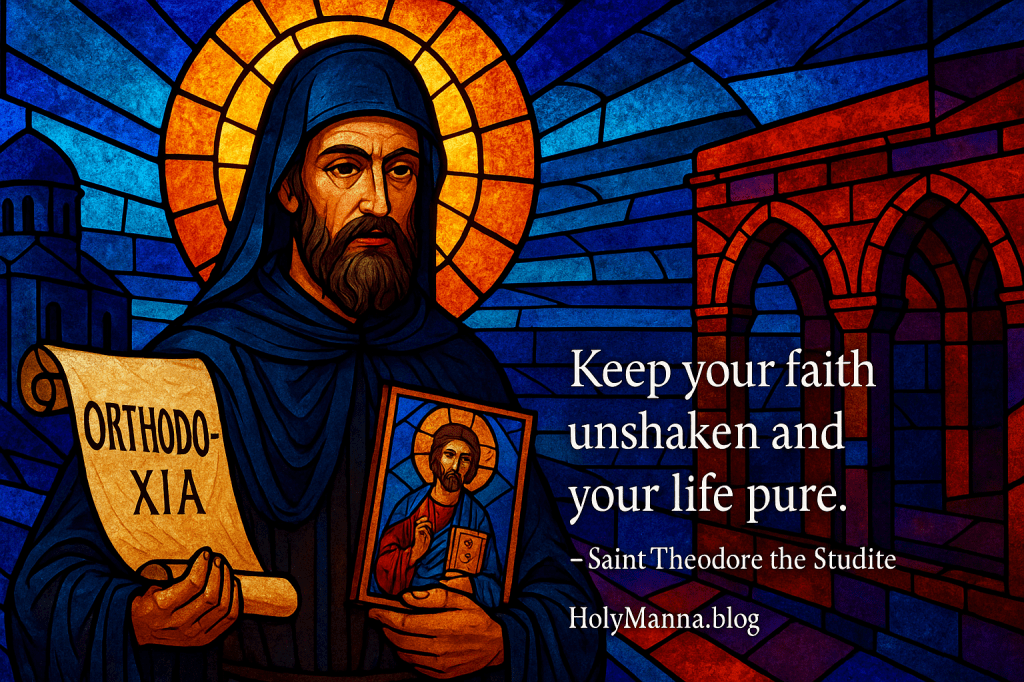
A Shepherd Who Guarded the Face of Christ
Saint Theodore the Studite, 759 to 826, is remembered as the towering abbot of the Stoudios Monastery in Constantinople and the most persuasive defender of the veneration of holy icons during the second iconoclast crisis. His reforms turned a sprawling community into a school of charity, prayer, and disciplined work that shaped Byzantine monasticism for centuries. He wrote catecheses, letters, and a monastic rule that formed hearts to love Christ in the liturgy and in daily labor. He taught that the honor shown to an image passes to the one depicted, since the Word truly took flesh. In a culture tempted to turn faith into ideas, Theodore insisted on a faith that was embodied, prayerful, obedient, and visible.
From Noble Roots to Monastic Fire
Theodore was born in Constantinople to a devout family, traditionally named Photinos and Theoktiste, and raised among relatives steeped in Christian learning. His uncle, Saint Plato, abbot of Sakkudion in Bithynia, became the decisive influence on his vocation. Around his early twenties, Theodore followed Plato into monastic life at Sakkudion, where the young monk absorbed a love for common prayer, shared labor, and firm obedience. He was ordained a priest by the holy Patriarch Tarasius in the era of Empress Irene, a moment when the Church was healing from the first wave of iconoclasm. Theodore soon emerged as a clear voice for order and holiness. When Irene called him and his monks into the city, he became abbot of the Stoudios Monastery. Under his fatherly leadership the community grew into hundreds of monks who prayed together, copied manuscripts, trained choirs, received the poor, and lived out a coenobitic life marked by evangelical poverty and loving discipline. He is best known for the Studite Rule, also called the Hypotyposis, and for the spiritual letters that guided not only monks but also lay faithful who sought counsel.
Icons, Work, and Holiness in Daily Life
Theodore’s life mattered because he showed that right worship shapes right living. He tied the veneration of icons directly to the mystery of the Incarnation. Because the Son of God truly became man, Christians may depict Him and honor His image, not as a mere ornament, but as a confession of faith that proclaims Jesus Christ come in the flesh. The Catechism expresses the same truth with clarity, “The Christian veneration of images is not contrary to the first commandment, the honor rendered to an image passes to its prototype.” (Catechism of the Catholic Church, 2132). In community he required steady work and mutual charity, reminding his monks that prayer and labor belong together. His homilies and catecheses underline purity of heart, reverence in the Divine Liturgy, and mercy for the poor. Among his most cherished exhortations near the end of his life are the words, “Keep your faith unshaken and your life pure.” Those words capture his entire program of holiness. Traditions from his monasteries also record divine consolations that strengthened the community in times of trial, including healings and providential protections that the brethren attributed to God’s mercy through their abbot’s intercession.
Scourged but Unbroken
Theodore’s courage came into sharp relief when he opposed the unlawful second marriage of Emperor Constantine VI. Fidelity to the Gospel cost him exile in 796, which he accepted with serenity and resolve. After a return under Empress Irene, new storms rose. He clashed with Emperor Nikephoros I over Church discipline, then faced the renewed fury of iconoclasm under Emperor Leo V. Theodore would not abandon the truth that the Word took flesh, so he was scourged, imprisoned, and shuttled from one place of confinement to another. Even in chains he continued to teach through letters that circulated among monks, bishops, and lay faithful. He wrote to Rome for help, appealed for a council to heal the Church, and urged his spiritual children to hold fast to Christ with peace in their hearts. Though not a martyr in the strict sense, he is honored as a confessor because he suffered for the faith yet persevered to the end. His witness can be summed up in the phrase many associate with his spirituality, a daily fidelity that feels like a quiet martyrdom, the martyrdom of submission, where obedience to Christ becomes a continual offering of love.
A Legacy That Breathed Life
Theodore died on November 11, 826, still barred from returning to his abbacy but rich in spiritual children. His relics were brought back to Stoudios in 844 after the final restoration of the holy icons. Accounts from the Byzantine tradition speak of healings at his tomb and favors granted to those who sought his intercession with faith. More enduring than any single wonder was the miracle of his legacy. The Studite Rule inspired Mount Athos and later shaped monastic life in Kievan Rus. Copyists, preachers, hymnographers, and pastors formed in his school kept the Gospel alive through prayer deeply rooted in the liturgy and through a life that wove obedience, poverty, and charity into a single fabric of love. Generations looked to his catecheses for clear, fatherly teaching on chastity of mind, purity of worship, and the sanctity of work offered to God.
How His Witness Lands Today
Saint Theodore helps Christians keep the faith tangible. He shows how to let sacred images draw the mind to Christ, how to let the liturgy train the heart, and how to let daily duties become prayer. The Catechism describes the evangelical counsels as a path to holiness for those called to consecrated life, “Christ proposes the evangelical counsels, in their great variety, to every disciple.” (Catechism of the Catholic Church, 915). In a distracted world, Theodore invites every household to become a small monastery. Set times for prayer. Give pride of place to the Sunday Eucharist. Place a crucifix and a holy icon where the family can pray. Practice simple renunciations so love can grow. Seek reconciliation quickly. Offer work, study, and service as a humble sacrifice to God. When discouragement comes, hold on to his final exhortation, “Keep your faith unshaken and your life pure.” It is not flashy advice, but it is the sturdy road to peace.
Engage with Us!
Share your thoughts and reflections below.
- What does venerating a sacred image stir in your heart about the reality of the Incarnation?
- Where might obedience and “the martyrdom of submission” correct self-will and deepen love in your family, parish, or workplace?
- How can you bring order, prayer, and meaningful work into your day so that your home becomes a small monastery of charity?
- Which saint’s image helps you pray right now, and why that saint?
Take courage in Saint Theodore’s witness. Keep your eyes on Christ, honor His holy images, and let every duty become an offering of love. Live the faith with confidence, and do everything with the love and mercy Jesus taught.
Saint Theodore the Studite, pray for us!
Follow us on Instagram and Facebook for more insights and reflections on living a faith-filled life.


Leave a Reply