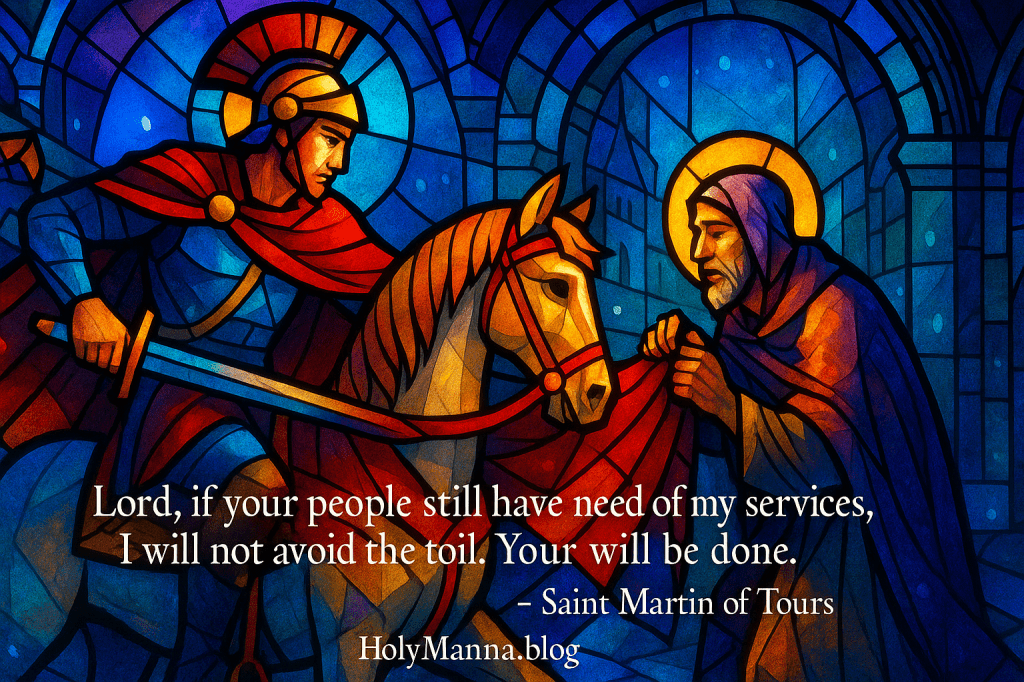
Cloak of Charity, Heart of a Bishop
Saint Martin of Tours shines as one of the earliest and most beloved confessors of the faith in Western Christianity. Remembered as a soldier who became a monk and then a bishop, he is celebrated for bold evangelization, deep humility, and a mercy that changed the culture of his day. The famous sharing of his cloak with a freezing beggar at the gate of Amiens became an icon of Christian charity because it revealed the heart of the Gospel in action. His pastoral leadership helped root monastic life in Gaul, form holy clergy, and bring the countryside to Christ. The Church keeps his feast on November 11, the day of his burial, and many turn to him as patron of soldiers, tailors, and the nation of France.
From Conscription to Conversion
Martin was born around 316 in Sabaria in Roman Pannonia, today Szombathely in Hungary, and grew up in Ticinum, now Pavia in Italy. His father served as a Roman military officer, and the family was not Christian. From a young age Martin felt drawn to the Church and became a catechumen, even as the expectations of the empire pressed him toward a soldier’s life. As a teenager he was conscripted into the cavalry and stationed in Gaul. One bitter winter at Amiens he encountered a man shaking from the cold. Moved by compassion, he cut his military cloak in half and wrapped the poor man in it. That night he saw a vision of Christ wearing the same half-cloak and saying to the angels that Martin, though only a catechumen, had clothed Him. Baptism soon followed, and the grace of that encounter set his path. When a campaign threatened to draw him into violence, he declared before his superiors, “I am a soldier of Christ; it is not lawful for me to fight.” He offered to stand unarmed at the front rather than shed blood, and by God’s providence he was released from service. The young convert then sought a life wholly given to the Gospel.
Building a School of Holiness
Martin attached himself to Saint Hilary of Poitiers, learned the discipline of the apostolic life, and founded a small community at Ligugé that is often regarded as the first monastery in Gaul. After years of prayer and evangelization he was chosen bishop of Tours in 371, a call he accepted with reluctance and reverence. To keep a monk’s heart in a bishop’s office, he established the monastery of Marmoutier across the Loire. From there he formed priests and missionaries, preached to villages that had never truly heard the Gospel, and challenged lingering pagan practices with patient courage. He became a father to the poor and a protector of the weak. Ancient witnesses describe him visiting remote hamlets on foot, praying through the night, and then confronting evil with a serenity that came from constant union with God.
Signs for the Sake of Souls
Martin’s life is filled with accounts that testify to God’s power working through a humble pastor for the salvation of people. He is remembered for healing the sick and freeing the oppressed, not to win attention but to draw hearts to Christ. Tradition records that he cleansed a leper with a kiss of love and that he raised a young catechumen who had died before baptism, restoring him to life through fervent prayer. Another well-known episode tells of Martin facing down pagans who challenged him to stand beneath a great pine as it was felled toward him. He traced the sign of the cross, the tree swerved in its fall, and many witnesses turned to the Lord. The fruit that followed these signs was not spectacle but conversion, reconciliation, and a new moral life. In Martin, charity and truth were never separated, and the works of God confirmed the preaching of the Gospel.
Trials Without Blood
Martin did not suffer martyrdom by the sword, yet his ministry bore the white martyrdom of daily self-offering. He endured mockery for refusing violence and spent time under guard before his discharge. He also faced the grinding conflicts of doctrine and politics that marked his century. During the Arian crisis he was forced into exile from Milan and spent a season in solitude on a small island, clinging to prayer while storms raged in the Church. Later, when the Emperor Maximus considered the execution of Priscillian and his followers, Martin pleaded that heresy not be punished by death, insisting that bishops must seek repentance rather than blood. He spoke hard truths to rulers yet never ceased to love the people entrusted to him. Near the end of his life, with fatigue heavy on his shoulders, he prayed with pastoral surrender, “Lord, if your people still have need of my services, I will not avoid the toil. Your will be done.” Those words remain a masterclass in stewardship and obedience.
A Mantle That Still Warms
Martin died at Candes around November 8, 397, while visiting clergy and reconciling feuding communities. His body was carried to Tours, and he was buried on November 11 amid extraordinary devotion. Almost immediately pilgrims flocked to his tomb, where healings and favors were reported in great number. The shrine at Tours became one of the most important pilgrimage destinations in medieval Europe, and the veneration of his relics fostered confidence in God’s mercy. His divided cloak, the cappa, was carefully preserved and guarded by clerics who were called cappellani. From these words the Christian world eventually received the terms “chapel” and “chaplain.” The vocabulary of worship still bears the imprint of his charity, and his intercession continues to draw believers to Christ.
Wearing Christ’s Cloak in a Cold World
The Church proposes the saints as living commentaries on the Gospel. “By canonizing some of the faithful, the Church recognizes the power of the Spirit of holiness within her and sustains the hope of believers.” Catechism of the Catholic Church, 828. Martin’s life shows that holiness is not an escape from the world but a mission to love it in truth. His act at Amiens was not a random moment of generosity. It was a sacramental way of seeing every neighbor as an image of Christ. “The works of mercy are charitable actions by which we come to the aid of our neighbor in his spiritual and bodily necessities.” Catechism of the Catholic Church, 2447. The rhythm of his days also teaches that mission without prayer becomes noise, and prayer without mission becomes complacency. Ask for his intercession to build a simple rule of life that keeps the heart near Jesus, the hands near the poor, and the mouth ready to speak the truth with charity. Let his surrender near death become a daily offering: “Your will be done.” When that prayer is real, the Holy Spirit makes ordinary lives into warm cloaks for a cold world.
Engage with Us!
What moved you most about Saint Martin’s story? Share below so others can be encouraged by your reflection.
- When have you recognized Jesus in someone “at the gate,” and how did you respond with concrete mercy?
- Where is the Lord inviting you to lay down old weapons of self-reliance and take up the armor of charity and prayer?
- What does Martin’s balance of truth and mercy teach about engaging error without losing love?
- How can you build a small “Marmoutier” in daily life, a rhythm of prayer that fuels outreach to those far from the Church?
- Which work of mercy will you put into action this week to “clothe Christ” in your community?
May the charity of Saint Martin wrap your day like a warm mantle. Live the faith with courage, and do everything with the love and mercy Jesus taught us.
Saint Martin of Tours, pray for us!
Follow us on Instagram and Facebook for more insights and reflections on living a faith-filled life.


Leave a Reply