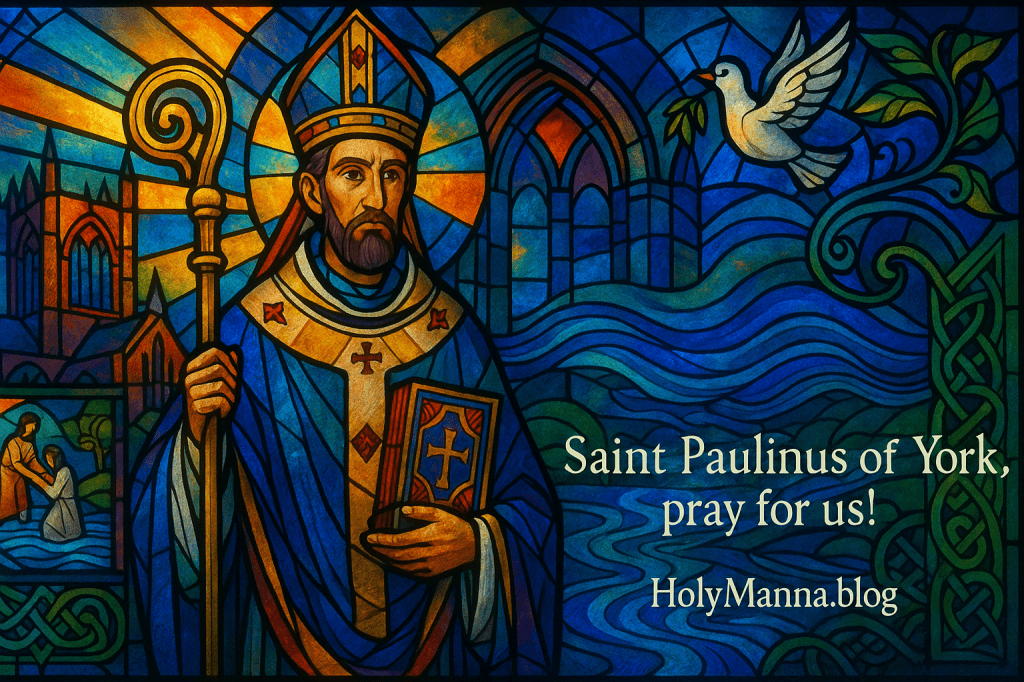
Fire on the Northern Horizon
Saint Paulinus of York blazed a missionary trail across seventh century England and helped plant the Church in the North. A Roman monk shaped by the Gregorian mission, he became the first Bishop of York and the trusted spiritual counselor to King Edwin and Queen Æthelburg of Northumbria. He is remembered as a relentless catechist, a baptizer of multitudes including the royal household, a builder of the earliest churches at York and Lincoln, and a shepherd who guarded his flock through political upheaval. His feast is kept on October 10. He died at Rochester in 644 after years of faithful episcopal service, leaving behind a living legacy of evangelization, sacramental life, and pastoral courage.
From Roman Cloister to Royal Court
Paulinus was born in or near Rome and formed in the monastic spirit that Pope Gregory the Great poured into the English mission. From that well of prayer and discipline came a man of ordered mind and generous heart, ready to serve wherever the Gospel required. In 625 he was consecrated bishop and dispatched as chaplain and missionary to accompany the Christian princess Æthelburg of Kent to her marriage with the pagan King Edwin of Northumbria. God used that placement at the royal hearth to reach an entire people. Paulinus instructed the queen’s household, advised the king with patient wisdom, and prepared the court for the light of Christ. He is most known as the first Bishop of York, the evangelist of Northumbria, and the baptizer of King Edwin at Easter in 627, a moment that set the North on a new Christian path.
Morning Till Night
The Venerable Bede paints Paulinus as a preacher who wore himself out in love for souls. At the royal site of Ad Gefrin near today’s Yeavering he spent a sustained mission teaching the faith day after day, baptizing in the nearby waters when instruction was complete. Bede says, “Paulinus… stayed there with them thirty six days, fully occupied in catechizing and baptizing… and when they were instructed, he washed them with the water of absolution in the river Glen.” His evangelization extended into Lindsey, where he built a stone church at Lincoln and continued the steady rhythm of preaching, catechizing, and conferring the sacraments. One observer described him with striking detail, “tall of stature, stooping somewhat… hair black… visage thin… nose slender and aquiline… an aspect both venerable and awe inspiring.” Those lines capture the gravity and gentleness that made his teaching compelling. Paulinus’s ministry shaped future saints as well. Among those baptized by him was the young Hilda, later the great abbess of Whitby, whose lifelong service to the Church began at the font where Paulinus stood as Christ’s minister. He also baptized the royal infant Eanfled on Pentecost of 626 after the queen vowed to dedicate the child to God. As catechist and pastor Paulinus labored “morning till night,” crafting a missionary model that unites clear teaching with ready access to the sacraments.
Storm and Steadfastness
Missionary gains were shaken when King Edwin fell in battle at Hatfield in 633 and Northumbria descended into turmoil. Paulinus faced the danger squarely and chose fidelity to his charge. He safeguarded Queen Æthelburg and her children, returning with them to Kent to ensure their safety and the continuity of Christian life. In Kent he accepted the see of Rochester and quietly continued episcopal ministry until his death. Rome had recognized the northern church’s importance by sending him the pallium, a sign of metropolitan dignity for York. By the time it arrived Paulinus had already withdrawn from the North, a poignant reminder that the Church’s plans unfold within the rhythms of history and providence. He was not martyred, but his perseverance amid loss, displacement, and political reversal is a kind of long martyrdom of patience borne for the Gospel.
Memory That Heals
After his death Paulinus was buried at Rochester, where his tomb became a place of prayer and remembrance for the bishop who first cast the Gospel’s net across the North. The churches he raised continued to be sources of grace. The early stone church at Lincoln, long associated with his ministry, was remembered as a place where God granted healings to those who sought Him with faith. The foundations Paulinus laid at York, Lincoln, and Ad Gefrin became permanent features of England’s Christian landscape, and devotion to him endured as to a father in the faith.
Baptism and Mission at the Core
Everything about Paulinus points to Baptism and mission. The Catechism of the Catholic Church calls Baptism “the basis of the whole Christian life, the gateway to life in the Spirit.” (CCC 1213). His life also embodies the Church’s missionary heart, for the Church “by her nature is missionary.” (CCC 850). Paulinus catechized before he baptized, showing that evangelization is not an event but a journey: announce Christ, patiently teach, invite conversion, and then open the font so grace may flood a soul. The Catechism also teaches that the sacraments are “powers that come forth” from Christ’s Body and “are masterworks of God in the new and everlasting covenant.” (CCC 1116). Paulinus trusted those masterworks, confident that the Lord Himself was at work when he preached, absolved, and baptized.
How to Walk the Paulinus Path Today
There are no surviving words known to be by Saint Paulinus himself. Yet his deeds speak with evangelical clarity. He teaches us to begin with prayer and patient instruction, to love people enough to stay with them “morning till night,” and to place the sacraments at the center of renewal. He models courage that is neither rash nor timid, a shepherd’s instinct to protect the vulnerable and keep the faith alive when politics turn dark. In our homes and parishes his pattern can guide us. Start by renewing your own baptismal promises in prayer. Learn or review the basics of the faith with someone who is searching, perhaps walking through the Creed or the sacraments together. Invite a friend to Mass and to RCIA or OCIA. Make the Sacrament of Reconciliation a regular habit so that your witness springs from a heart alive with grace. Finally, trust the slow work of God. As Paulinus discovered, the Church often advances by quiet fidelity as much as by dramatic victories. How is the Lord inviting you to take one concrete step this week to teach the faith, to accompany a seeker, or to bring someone to the waters where Christ gives new life?
Engage with Us!
We would love to hear your thoughts and prayer reflections in the comments below.
- Where do you see opportunities to “catechize before you baptize” in your own family or friendships, patiently preparing hearts for the sacraments?
- How does Bede’s picture of Paulinus working “morning till night” stir your desire to share the Gospel in your workplace or neighborhood?
- What concrete step could you take this week to make Baptism’s grace more active in your life, whether through renewed prayer, frequent confession, or works of mercy?
- When trials come, how can Paulinus’s steady trust in God encourage you to keep serving without resentment or fear?
May Saint Paulinus intercede for us, that we may live our faith openly, love the Church faithfully, and do everything with the love and mercy Jesus taught us.
Saint Paulinus of York, pray for us!
Follow us on Instagram and Facebook for more insights and reflections on living a faith-filled life.


Leave a Reply