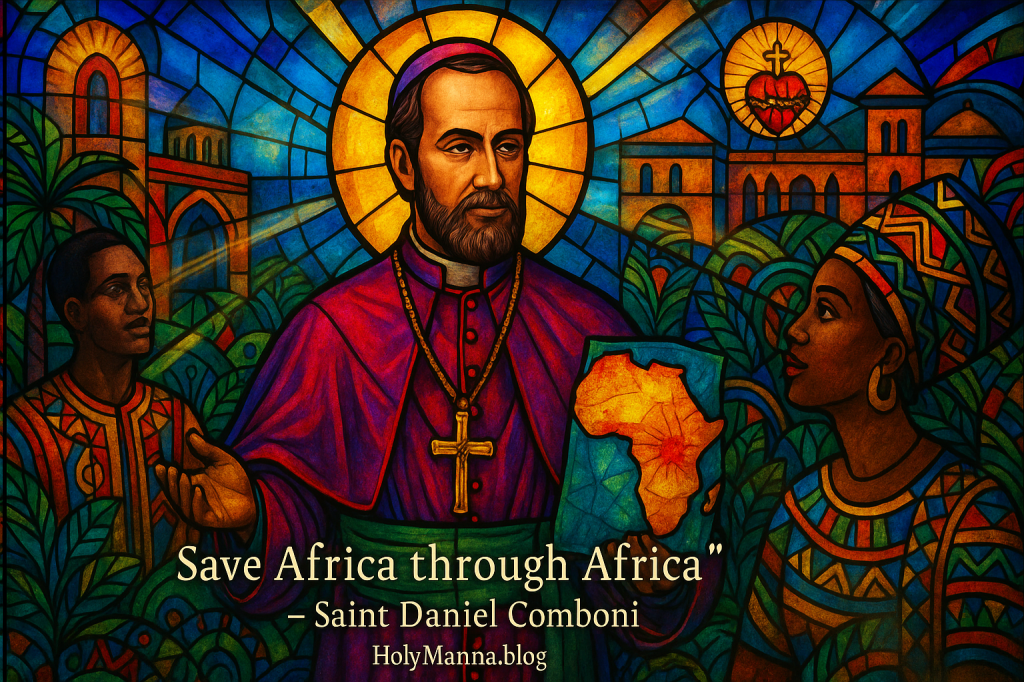
Apostle to Africa
Saint Daniel Comboni, born in 1831 and called home to God in 1881, stands in the Church as a prophetic missionary whose heart beat with the love of the Sacred Heart of Jesus for the peoples of Central Africa. He founded the Comboni Missionaries of the Heart of Jesus and the Comboni Missionary Sisters, formed local leaders for evangelization, fought the slave trade, and became the first Vicar Apostolic of Central Africa. His vision breathed with the confidence that the Gospel takes deepest root when it is welcomed, preached, and led from within a people’s own culture. Summed up in his famous line “Save Africa through Africa”, Comboni’s life anticipated what the Catechism teaches about mission as the Church’s very nature and about the Holy Spirit as the principal agent of that mission. He is remembered for a charity that was practical, patient, and courageous, for a strategy of evangelization centered on education and formation, and for a fatherly love that made him a true shepherd of souls.
From Lake Garda to a Burning Call
Daniel was born in Limone sul Garda in northern Italy to Luigi Comboni and Domenica Pace, a family poor in possessions but rich in faith. As a boy he worked the fields, learned perseverance, and discovered the nearness of God in daily toil. Gifted teachers recognized his intelligence and piety and helped him reach the Verona Institute run by Fr. Nicola Mazza, where his vocation to the priesthood matured alongside a growing attraction to the missions of the Sudan. Ordained a priest in 1854, he set out for Africa in 1857 with fellow missionaries. The heat, distance, and disease nearly broke them, and he returned to Italy with a body weakened but a heart purified. In that furnace of suffering, his resolve crystallized in a cry of love for a people and a place: “Africa or death!” This was not bravado, but a promise to spend himself completely for Christ and for the men and women he came to call his own. He would later tell the people entrusted to him, “I will make common cause with you, and the happiest of my days will be when I can give my life for you.”
Save Africa through Africa
In 1864, praying at the Tomb of Saint Peter, Comboni received a decisive light for the work God was asking of him. He drafted his Plan for the Regeneration of Africa, a strategy that placed African dignity, agency, and leadership at the center of evangelization. Formation would be the key: schools, catechumenates, technical training, and the nurturing of vocations to the priesthood and consecrated life, so that the Gospel would be taught, sung, preached, and lived by Africans themselves. His oft repeated motto “Save Africa through Africa” captured an approach we now call inculturation. He traveled tirelessly across Europe to awaken prayer and support, spoke to bishops and benefactors, recruited missionaries, engaged public opinion against the slave trade, and founded houses where candidates could be formed in languages, pedagogy, medicine, and catechesis. He named his congregation after the Heart of Jesus because he believed missionary zeal is born from contemplation of that Heart, ablaze with mercy for the poor and abandoned.
Shepherd Under the Sun
Comboni knew the Cross as a companion. He buried missionaries and catechists taken by fever. He faced calumnies from those who misunderstood his methods, endured scarcity, and saw schools destroyed by conflict and famine. He learned local languages, sat with tribal leaders, and negotiated to protect the vulnerable. Even when cholera and hunger ravaged the region, he refused to leave his flock. In 1877 he was consecrated a bishop and appointed Vicar Apostolic of Central Africa, a responsibility he carried with tenderness and steel. He visited distant stations, reconciled disputes, and never tired of defending the dignity of every person. We have no record of spectacular public miracles during his life, yet his heroic charity, luminous faith, and endurance under crushing conditions functioned as signs that drew many to Christ. Near his death in Khartoum on October 10, 1881, he offered a final testimony of hope that still galvanizes his spiritual family: “I am dying, but my work will not die.”
A Legacy Confirmed by Signs
After his holy death, the Church discerned heavenly confirmations of his intercession. A Brazilian girl, Maria José de Oliveira Paixão, experienced a sudden and complete healing after prayers to Comboni, a grace recognized in the cause that led to his beatification. Years later, in Khartoum, a mother named Lubna Abdel Aziz suffered a life threatening hemorrhage and recovered rapidly following fervent prayer through Comboni’s intercession, an extraordinary healing recognized for his canonization. The Church proclaimed him Blessed in 1996 and Saint in 2003. These signs do not glorify the saint as an end in himself. They point to the living Heart of Jesus, who delights to answer the prayers of the poor and to crown the virtues of his servants. They also confirm that Comboni’s fatherly love continues, now from heaven, where he prays that every culture may hear the Gospel through its own sons and daughters.
Where His Story Still Speaks
Pilgrims who visit Limone sul Garda can pray in the simple home where Daniel grew up and in the chapel where his vocation was nourished, now a place of missionary memory and thanksgiving. In Verona, his spiritual sons and daughters venerate his remains and tell the story of God’s fidelity through Comboni’s perseverance. Across Africa and the world, schools, parishes, and colleges bear his name. These places are not museum pieces. They are living outposts of the Sacred Heart, where young people are formed to become nurses, teachers, priests, sisters, and lay leaders, and where Comboni’s conviction continues to shape evangelization and social uplift.
Holiness That Looks Like Love
Comboni teaches us that evangelization is not an import, it is an incarnation. He believed the Gospel flourishes when local communities are trusted, taught, and empowered. His life mirrors the Catechism’s teaching that the Church is missionary by her very nature, that the Holy Spirit is the principal agent of mission, and that love for the poor is at the center of Christian life. He also witnessed to the truth that every human person possesses equal dignity and must never be reduced to an object of exploitation. In his spirit, you can begin at home. Pray daily for the missions. Learn the names and stories of missionaries in your parish network. Support the formation of local leaders through scholarships and mentoring. Practice the corporal and spiritual works of mercy. Let the Heart of Jesus shape your decisions about time, money, and attention. Above all, keep before your eyes his blazing motto “Save Africa through Africa” and translate it to your context: bring Christ to your world through your daily fidelity. How might God be inviting you to serve the poor and to share Christ in your culture today?
Engage with Us!
I would love to hear how Saint Daniel Comboni touches your heart. Share your thoughts and any intentions for the missions in the comments.
- Where is the Holy Spirit prompting you to serve the poor and the forgotten right now?
- How can you help form “local leaders of faith” in your parish, family, or community?
- What cross in your life can become a missionary witness when carried with love?
- How might you tangibly support the Church’s mission this week through prayer, fasting, almsgiving, or volunteering?
May the Lord who inflamed Saint Daniel Comboni with missionary charity set our hearts ablaze, so that we live our faith with courage, compassion, and the merciful love that Jesus taught us.
Saint Daniel Comboni, pray for us!
Follow us on Instagram and Facebook for more insights and reflections on living a faith-filled life.


Leave a Reply