Friday of the Twenty-seventh Week in Ordinary Time – Lectionary: 465
Choosing the Stronger King
What if today is the day you choose, without wobbling, whom your heart will serve? In Joel 1:13–15; 2:1–2, Israel hears the shofar from Zion and is summoned to a national fast because “the day of the Lord is coming… a day of darkness and gloom”. This prophetic alarm arose in a culture where sacred assemblies, sackcloth, and communal repentance were concrete signs that the people wanted God to be their true King again. Psalm 9:2–3, 6, 8–9, 16 answers that urgency by praising the Lord who judges with fairness. The psalmist’s worship is not sentimental. It is anchored in covenant reality: “The Lord rules forever… [and] judges the peoples with fairness.” In Luke 11:15–26, Jesus stands inside that same storyline and declares that the decisive hour has arrived. His exorcisms are not party tricks. They are the visible advance of God’s reign. “If it is by the finger of God that I drive out demons, then the kingdom of God has come upon you.” He identifies Himself as the Stronger One who disarms the strongman and claims the house. That means neutrality is an illusion: “Whoever is not with me is against me.”
Historically and religiously, these texts converge on the biblical motif of the Day of the Lord: a time when God visits His people in judgment and salvation, exposing rival kingdoms and calling for wholehearted return. In Second Temple Judaism, exorcism signified the clash of kingdoms. Jesus’ phrase “the finger of God” echoes Exodus 8:19, where Pharaoh’s magicians concede divine power. The Church reads this as Christ unveiling the Kingdom in power while demanding a response. As The Catechism teaches, Christ’s exorcisms are signs that “the Kingdom of God is making its entrance into the world” (CCC 550, italics indicate citation). That Kingdom summons conversion, not once but as a life posture (CCC 1427–1432), and equips the Church to continue Christ’s liberating work through prayer, sacraments, and the ministry of deliverance (CCC 1673).
The theme that binds today’s readings is urgent allegiance and vigilant conversion. God’s just throne in Psalm 9 explains Joel’s alarm and frames Jesus’ warning about an emptied house. A heart “swept clean” but left uninhabited does not stay neutral; it becomes vulnerable to a return of darkness. The remedy is not mere avoidance of evil but active communion with the Stronger King who indwells and defends His people. Where is the Lord inviting you today to move from cautious neutrality to confident fidelity, from occasional repentance to Spirit-filled vigilance?
First Reading – Joel 1:13–15; 2:1–2
Return Before the Day
Joel addresses a people shaken by devastation and calls them to a public, penitential return to the Lord. In ancient Israel, communal fasting, sackcloth, and solemn assembly were concrete religious practices that signified covenant repentance. The cessation of grain offerings and libations meant that ordinary temple worship had been interrupted, which intensified the emergency. The prophetic trumpet from Zion functioned as a sacred alarm that rallied priests, elders, and all inhabitants to seek God together. Within today’s theme of urgent allegiance and vigilant conversion, Joel situates the community at the threshold of the Day of the Lord, a moment when God’s justice and salvation break in. The summons is not to panic but to penitence. It prepares us to recognize in Psalm 9 the throne of just judgment and in Luke 11 the Stronger One whose Kingdom confronts darkness. The same God who judges is eager to restore those who return to Him with their whole heart.
Joel 1:13-15; 2:1-2
New American Bible (Revised Edition)
Cry Out to the Lord
1:13 Gird yourselves and lament, you priests!
wail, ministers of the altar!
Come, spend the night in sackcloth,
ministers of my God!
For the grain offering and the libation
are withheld from the house of your God.
14 Proclaim a holy fast!
Call an assembly!
Gather the elders,
all who dwell in the land,
To the house of the Lord, your God,
and cry out to the Lord!
15 O! The day!
For near is the day of the Lord,
like destruction from the Almighty it is coming!
The Day Approaches
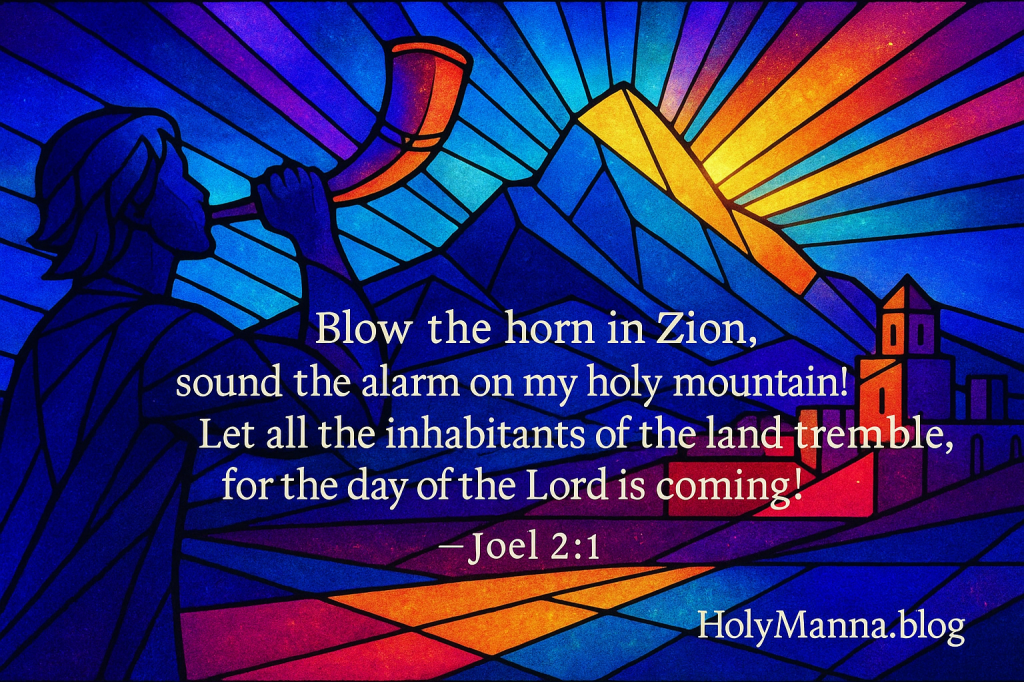
2:1 Blow the horn in Zion,
sound the alarm on my holy mountain!
Let all the inhabitants of the land tremble,
for the day of the Lord is coming!
Yes, it approaches,
2 a day of darkness and gloom,
a day of thick clouds!
Like dawn spreading over the mountains,
a vast and mighty army!
Nothing like it has ever happened in ages past,
nor will the future hold anything like it,
even to the most distant generations.
Detailed Exegesis
Verse 1:13 – “Gird yourselves and lament, you priests! wail, ministers of the altar! Come, spend the night in sackcloth, ministers of my God! For the grain offering and the libation are withheld from the house of your God.”
Priests stand in the breach on behalf of the people. Their lament and nightlong vigil model the nation’s proper response. The withheld offerings signal that sin and calamity have disrupted worship. Joel teaches that when liturgy is hindered, the right response is not resignation but intercession. The priestly sorrow is medicinal. It draws the whole body back to the Lord. In light of today’s theme, this verse roots conversion in the house of God and shows that personal repentance is inseparable from communal worship and priestly prayer.
Verse 14 – “Proclaim a holy fast! Call an assembly! Gather the elders, all who dwell in the land, To the house of the Lord, your God, and cry out to the Lord!”
Fasting and assembly are not optional spiritual extras. They are covenant actions that bind the people together in truth. The elders symbolize memory and responsibility; all inhabitants indicate total participation. The command to “cry out” makes prayer the primary work. This verse aligns with the Gospel’s insistence on decisive allegiance. A holy fast reorders desire toward God and makes space for His Kingdom.
Verse 15 – “O! The day! For near is the day of the Lord, like destruction from the Almighty it is coming!”
Joel’s exclamation communicates both urgency and awe. “The day of the Lord” combines judgment on evil with deliverance for those who return. Nearness intensifies responsibility. The image of destruction warns against presumption. Placed alongside Psalm 9, this verse reminds us that God’s justice is not arbitrary. He “judges the peoples with fairness.” The nearness of the Day invites immediate conversion.
Verse 2:1 – “Blow the horn in Zion, sound the alarm on my holy mountain! Let all the inhabitants of the land tremble, for the day of the Lord is coming! Yes, it approaches,”
The trumpet (shofar) creates sacred attention. Trembling is not despair; it is reverent realism. God’s approach calls the people out of distraction and into readiness. Today’s Gospel reveals how that approach looks in Jesus: the Kingdom arrives as a liberating power that disarms the strongman. Joel’s alarm prepares us to welcome the Stronger King.
Verse 2 – “a day of darkness and gloom, a day of thick clouds! Like dawn spreading over the mountains, a vast and mighty army! Nothing like it has ever happened in ages past, nor will the future hold anything like it, even to the most distant generations.”
“Darkness and gloom” describe the severity of judgment, while the simile of dawn suggests an unstoppable advance. The “mighty army” image may recall locust devastation or an invading force, but the theological point is clearer than the historical detail: when God visits, no rival power stands. The incomparable scale underlines the folly of neutrality. In the light of Luke 11, the only safe place is fidelity to Christ, whose arrival exposes and overthrows darkness.
Teachings
Joel’s call exposes the heart of true penance. The Catechism clarifies the relationship between outward signs and interior conversion: “Jesus’ call to conversion and penance, like that of the prophets before him, does not aim first at outward works, ‘sackcloth and ashes,’ fasting and mortification, but at the conversion of the heart, interior conversion. Without this, such penances remain sterile and false; however interior conversion urges expression in visible signs, gestures and works of penance.” CCC 1430. Interior return that expresses itself in fasting, assembly, and prayer is exactly what Joel orders.
Joel’s nearness of the Day matches the Church’s proclamation of the Kingdom and the demand it makes on us: “Jesus calls to conversion. This call is an essential part of the proclamation of the kingdom: ‘The time is fulfilled, and the kingdom of God is at hand; repent, and believe in the gospel.’” CCC 1427. The prophetic trumpet becomes the Gospel invitation to turn now and believe.
The clash between God’s reign and the powers of darkness that Luke 11 makes visible is summarized doctrinally: “The coming of God’s Kingdom is the defeat of the kingdom of Satan.” CCC 550. Joel’s ominous imagery finds its resolution in Christ who conquers the strongman and gathers the scattered.
The personal shape of repentance is not vague sentiment but a radical reorientation: “Interior repentance is a radical reorientation of our whole life, a return to God with all our heart, an end of sin, a turning away from evil, with repugnance toward the evil actions we have committed.” CCC 1431. Joel names the hour. The Catechism names the movement of the heart.
The tradition also warns that external practices must become works of mercy and charity. Saint John Chrysostom exhorts: “Do you fast? Give me proof of it by your works. If you see a poor man, take pity on him. Let the mouth also fast from disgraceful speeches and railings. For what good is it if we abstain from birds and fishes and yet bite and devour our brothers?” This patristic wisdom perfectly fits Joel’s call to a holy fast that renews love of God and neighbor.
Reflection
Joel’s trumpet asks for your attention today. Conversion begins where you stand, with the concrete life you live. You can answer the alarm by turning to God in prayer, by making time for a simple fast appropriate to your state in life, and by seeking reconciliation through a sincere examination of conscience. You can enter the assembly by prioritizing Sunday Mass and, if possible, weekday worship. You can let your fast become mercy by practicing generosity toward someone in need and by guarding your speech. You can refuse neutrality by choosing daily allegiance to Jesus in small, specific acts of obedience. Where is the Lord inviting you to move from delay to decision and from vague regret to concrete return? What would it look like to let your house be not only swept but filled with the presence of the Stronger King through prayer, sacrament, and charity today?
Responsorial Psalm – Psalm 9:2-3, 6, 8-9, 16
The Throne That Judges and Saves
In Psalm 9, the worshiper stands before the Lord who rules forever and judges with fairness. In Israel’s prayer life, psalms of praise were not sentimental songs but covenant declarations that God actively puts the world right. Many scholars note that Psalm 9 and Psalm 10 form a single acrostic in Hebrew, which hints at a comprehensive confession of God’s justice from A to Z. This psalm fits today’s theme by revealing the character of the Judge whom Joel announces and whom Jesus embodies as the Stronger One in Luke 11. The Lord’s courtroom is not a human tribunal. It is the place where the oppressed find refuge, where evil collapses into the trap it set, and where praise becomes the faithful response of those who choose God’s Kingdom now.
Psalm 9:2-3, 6, 8-9, 16
New American Bible (Revised Edition)
2 I will praise you, Lord, with all my heart;
I will declare all your wondrous deeds.
3 I will delight and rejoice in you;
I will sing hymns to your name, Most High.
6 You rebuked the nations, you destroyed the wicked;
their name you blotted out for all time.
8 The Lord rules forever,
has set up his throne for judgment.
9 It is he who judges the world with justice,
who judges the peoples with fairness.
16 The nations fall into the pit they dig;
in the snare they hide, their own foot is caught.
Detailed Exegesis
Verse 2: “I will praise you, Lord, with all my heart; I will declare all your wondrous deeds.”
Wholehearted praise is an act of covenant allegiance. To declare God’s deeds is to refuse neutrality and to recount salvation history. The psalmist responds to God’s initiative, which aligns with the call in Joel to assemble and cry to the Lord. The Church teaches that praise recognizes God as God and not merely as a benefactor, which trains the heart for vigilant conversion.
Verse 3: “I will delight and rejoice in you; I will sing hymns to your name, Most High.”
Delight in God Himself anchors joy beyond circumstances. Singing to the divine Name affirms that the Lord is enthroned regardless of the darkness described by Joel. In the light of the Gospel, rejoicing in the Lord strengthens the believer’s interior house so that it is not left empty but filled with the presence of God.
Verse 6: “You rebuked the nations, you destroyed the wicked; their name you blotted out for all time.”
God’s rebuke is not petty anger. It is the moral correction of history. The blotting out of wicked names evokes the end of oppressive regimes and the permanence of divine justice. This anticipates Jesus’ victory over demonic powers in Luke 11, where the Stronger One disarms the strongman and redistributes the spoils.
Verse 8: “The Lord rules forever, has set up his throne for judgment.”
The throne image centers the psalm. Judgment is not a random event. It flows from God’s eternal kingship. This stabilizes the urgency in Joel: the Day is near because the throne already stands. Christ’s exorcisms are signs that this throne’s authority is advancing in time and space.
Verse 9: “It is he who judges the world with justice, who judges the peoples with fairness.”
Divine judgment is perfectly just and fair, unlike human courts that can err. This verse guards us from fear that is rooted in ignorance of God’s character. The righteous Judge does not mismeasure. He weighs truth and mercy without compromise. Choosing Christ is choosing to stand within this fairness.
Verse 16: “The nations fall into the pit they dig; in the snare they hide, their own foot is caught.”
Evil is self-defeating. The trap reverses upon the trapper. This moral boomerang reveals how sin collapses inwardly, much like the unclean spirit that returns to an empty house and brings a worse state. The lesson is vigilance: fill the house with God, or the pit you dig becomes your own.
Teachings
The psalm models praise as a primary posture of the Church. The Catechism teaches: “Praise is the form of prayer which recognizes most immediately that God is God. It lauds God for his own sake, gives him glory not because of what he does, but simply because HE IS.” CCC 2639. This explains the psalmist’s focus on God’s Name and throne.
Adoration and allegiance naturally follow. The Catechism states: “Adoration is the first act of the virtue of religion. To adore God is to acknowledge him as God, as the Creator and Saviour, the Lord and Master of everything that exists, as infinite and merciful Love.” CCC 2096. Psalmic praise matures into adoration, which directly answers Joel’s summons to return to the Lord with the whole heart.
The psalm exalts God’s justice. The Catechism defines the virtue that mirrors God’s fairness in us: “Justice is the moral virtue that consists in the constant and firm will to give their due to God and neighbor.” CCC 1807. Participating in divine justice means concrete acts that render to God worship and to neighbor love.
Finally, the throne for judgment points to the Last Day. The Catechism explains: “Following in the steps of the prophets and John the Baptist, Jesus announced the judgment of the Last Day in his preaching. Then will the conduct of each one and the secrets of hearts be brought to light. Then will the culpable unbelief that counted the offer of God’s grace as nothing be condemned. Our attitude to our neighbor will disclose acceptance or refusal of grace and divine love.” CCC 678. The psalm’s fairness is eschatological and demands present conversion.
The saints echo this interior stance. Saint Augustine confesses: “You are great, O Lord, and greatly to be praised. Great is your power and your wisdom is without measure. And man, though but a tiny part of your creation, wants to praise you… You have made us for yourself, and our heart is restless until it rests in you.” Confessions I, 1. Praise orders the heart to its true rest and fortifies it against the return of darkness.
Reflection
Let this psalm teach you to take your place before the throne each day. Begin your morning by declaring one wondrous deed of God in Scripture and one in your own life. Turn your commute or a brief walk into a hymn by speaking a simple act of adoration such as, “Lord, you are my King and Judge, and I trust your fairness.” Practice justice by giving someone his or her due today through a kept promise, a fair judgment, or a generous act that costs you something. Examine your heart in the evening and ask where you tried to build your own throne rather than submit to God’s. What might change if you began and ended your day with praise instead of anxiety or distraction? Where is the Lord inviting you to render to Him adoration and to your neighbor true justice so that your house is not left empty but filled with His presence?
Holy Gospel – Luke 11:15–26
The Stronger One Claims the House
In Luke 11:15–26, Jesus confronts accusations that He casts out demons by Beelzebul and answers with a prophetic logic rooted in Israel’s faith. In Second Temple Judaism, exorcism signified a clash of kingdoms, and Jesus’ works place Him inside the larger biblical drama of the Day of the Lord announced in Joel. When He speaks of “the finger of God”, He echoes Exodus 8:19, where Pharaoh’s magicians concede that God’s own power is at work. Jesus identifies Himself as the Stronger One who defeats the strongman, divides his spoils, and makes neutrality impossible. This Gospel fits today’s theme by demanding urgent allegiance and vigilant conversion. It is not enough to be rid of evil. The house of the soul must be occupied by the King.
Luke 11:15-26
New American Bible (Revised Edition)
15 Some of them said, “By the power of Beelzebul, the prince of demons, he drives out demons.” 16 Others, to test him, asked him for a sign from heaven. 17 But he knew their thoughts and said to them, “Every kingdom divided against itself will be laid waste and house will fall against house. 18 And if Satan is divided against himself, how will his kingdom stand? For you say that it is by Beelzebul that I drive out demons. 19 If I, then, drive out demons by Beelzebul, by whom do your own people drive them out? Therefore they will be your judges. 20 But if it is by the finger of God that [I] drive out demons, then the kingdom of God has come upon you. 21 When a strong man fully armed guards his palace, his possessions are safe. 22 But when one stronger than he attacks and overcomes him, he takes away the armor on which he relied and distributes the spoils. 23 Whoever is not with me is against me, and whoever does not gather with me scatters.
The Return of the Unclean Spirit. 24 “When an unclean spirit goes out of someone, it roams through arid regions searching for rest but, finding none, it says, ‘I shall return to my home from which I came.’ 25 But upon returning, it finds it swept clean and put in order. 26 Then it goes and brings back seven other spirits more wicked than itself who move in and dwell there, and the last condition of that person is worse than the first.”
Detailed Exegesis
Verse 15 – “By the power of Beelzebul, the prince of demons, he drives out demons.”
The charge aims to discredit Jesus by attributing His liberating works to demonic collusion. It acknowledges the reality of the exorcisms while denying their divine source. The stage is set for Jesus to expose the incoherence of evil and reveal the Kingdom’s arrival.
Verse 16 – “Others, to test him, asked him for a sign from heaven.”
A demand for a sign attempts to control the terms of faith. Signs already given in deliverance are dismissed in favor of spectacle. Jesus will redirect attention from curiosity to conversion, since the true sign is God’s reign breaking into human bondage.
Verse 17 – “Every kingdom divided against itself will be laid waste and house will fall against house.”
Jesus begins with a principle of self-destruction. Division corrodes any kingdom from within. If His exorcisms were demonic, Satan would be dismantling his own realm. The saying also warns hearers that a divided heart cannot stand. Allegiance must be undivided.
Verse 18 – “And if Satan is divided against himself, how will his kingdom stand? For you say that it is by Beelzebul that I drive out demons.”
Jesus applies the principle directly. The accusation collapses logically. The exorcisms are not intra demonic squabbles. They are evidence that a superior reign has entered history. The Stronger One is present.
Verse 19 – “If I, then, drive out demons by Beelzebul, by whom do your own people drive them out? Therefore they will be your judges.”
Jesus appeals to acknowledged Jewish exorcists. If exorcism as such were suspect, then their ministry would also be condemned. Their works instead stand as witnesses that exorcism belongs to God’s saving action and that Jesus is its climactic agent.
Verse 20 – “But if it is by the finger of God that [I] drive out demons, then the kingdom of God has come upon you.”
The decisive claim is made. The “finger of God” signals direct divine intervention. The phrase moves the question from theory to decision. If the Kingdom has come upon you, then postponement is disobedience. Joel’s trumpet now sounds through Christ.
Verse 21 – “When a strong man fully armed guards his palace, his possessions are safe.”
Jesus acknowledges the real, though limited, dominion of the evil one. Apart from a stronger power, the strongman holds captives in relative peace. The image sets up the overthrow that follows.
Verse 22 – “But when one stronger than he attacks and overcomes him, he takes away the armor on which he relied and distributes the spoils.”
Here is the Gospel in miniature. Christ is the Stronger One who disarms the enemy and liberates his captives. The spoils are persons reclaimed for God. Liberation is not abstract. It is the transfer of people from darkness to the Kingdom of the beloved Son.
Verse 23 – “Whoever is not with me is against me, and whoever does not gather with me scatters.”
Neutrality is exposed as a myth. The human heart is a gathering place or a scattering force. Allegiance to Christ brings communion. Refusal fractures and disperses. The verse presses for a concrete choice.
Verse 24 – “When an unclean spirit goes out of someone, it roams through arid regions searching for rest but, finding none, it says, ‘I shall return to my home from which I came.’”
Deliverance opens a period of vigilance. The expelled spirit seeks reentry. The arid places signify barrenness apart from God. Without indwelling grace, the battle resumes at the threshold.
Verse 25 – “But upon returning, it finds it swept clean and put in order.”
Mere moral tidiness is not protection. A swept house without a new occupant is vulnerable. Moral reform without communion becomes a polished vacancy. The Gospel aims not at emptiness of vice but fullness of God.
Verse 26 – “Then it goes and brings back seven other spirits more wicked than itself who move in and dwell there, and the last condition of that person is worse than the first.”
Vacancy escalates vulnerability. The warning is pastoral. After a grace of liberation, the Christian must welcome the Lord’s indwelling through faith, sacrament, prayer, and charity. The end goal is habitation, not hygiene.
Teachings
The Catechism identifies Christ’s exorcisms as signs of the Kingdom’s triumph. “The coming of God’s Kingdom means the defeat of Satan’s: ‘If it is by the Spirit of God that I cast out demons, then the kingdom of God has come upon you.’ Jesus’ exorcisms free some individuals from the domination of demons. They anticipate Jesus’ great victory over ‘the ruler of this world.’ The Kingdom of God will be definitively established through Christ’s cross: ‘God reigned from the wood.’” CCC 550.
The Church continues Christ’s liberating ministry with discernment and authority. “When the Church asks publicly and authoritatively in the name of Jesus Christ that a person or object be protected against the power of the Evil One and withdrawn from his dominion, it is called exorcism. Jesus performed exorcisms and from him the Church has received the power and office of exorcizing. In a simple form, exorcism is performed at the celebration of Baptism. The solemn exorcism, called a ‘major exorcism,’ can be performed only by a priest and with the permission of the bishop. The priest must proceed with prudence, strictly observing the rules established by the Church.” CCC 1673.
Conversion is the proper response to the Kingdom’s nearness. “Jesus calls to conversion. This call is an essential part of the proclamation of the kingdom: ‘The time is fulfilled, and the kingdom of God is at hand; repent, and believe in the gospel.’” CCC 1427. The interior shape of that conversion is clear. “Interior repentance is a radical reorientation of our whole life, a return to God with all our heart, an end of sin, a turning away from evil, with repugnance toward the evil actions we have committed.” CCC 1431.
The Church also teaches the limits of the enemy’s power and the primacy of divine providence. “The power of Satan is, nonetheless, not infinite. He is only a creature, powerful from the fact that he is pure spirit, but still a creature. He cannot prevent the building up of God’s reign. Although Satan may act in the world out of hatred for God and his kingdom in Christ Jesus, and although his action may cause grave injuries of a spiritual nature and, indirectly, even of a physical nature to each person and to society, this action is permitted by divine providence.” CCC 395.
Finally, the Lord teaches us to pray for protection as a daily stance. “In this petition [‘And lead us not into temptation’] we pray that God would not allow us to take the way that leads to sin. We are engaged in the battle ‘between flesh and spirit’; this petition implores the Spirit of discernment and strength.” CCC 2846.
Reflection
Choose the Stronger One today. After any experience of grace, fill the house. Begin by making an explicit act of allegiance to Jesus Christ in prayer. Go to the sacraments with intentionality, especially Confession and the Eucharist, so that the Lord’s presence truly dwells within you. Establish a daily rhythm that leaves no empty rooms: morning praise, brief noon recollection, and evening examen. Practice concrete charity that gathers rather than scatters by reconciling with someone and by speaking truth with gentleness. Renounce in Christ’s name any compromises that keep the door ajar. Guard your imagination and your attention, since these are doorways. Where might your discipleship still be undecided, and how will you choose today to be with Jesus rather than against Him? What practices will keep your house not only swept but occupied by the Lord who overcomes the strongman and distributes the spoils as gifts of freedom and love?
Sound the Trumpet, Fill the House
Joel 1:13–15; 2:1–2 sounds a sacred alarm that the Day of the Lord is near and calls God’s people to a shared fast, heartfelt repentance, and renewed worship. Psalm 9:2–3, 6, 8–9, 16 steadies that urgency with praise of the King who already sits upon the throne of just judgment and who rules with perfect fairness. Luke 11:15–26 reveals how that Day arrives in Jesus, the Stronger One who casts out demons by “the finger of God” and makes neutrality impossible through His claim, “Whoever is not with me is against me.” Together these readings summon decisive allegiance and vigilant conversion. It is not enough to be rid of evil. The soul must be indwelt by the Lord, or the last state becomes worse than the first. As The Catechism reminds us, “Jesus calls to conversion. This call is an essential part of the proclamation of the kingdom: ‘The time is fulfilled, and the kingdom of God is at hand; repent, and believe in the gospel.’” CCC 1427. It also assures us of the outcome of this choice: “The coming of God’s Kingdom means the defeat of Satan.” CCC 550.
Here is the call to action. Choose Christ openly and fill your house with His presence. Praise God each morning as Psalm 9 teaches. Fast in a way suitable to your state of life as Joel commands, and let that fast become concrete mercy. Go to Confession with a sincere heart and receive the Eucharist with faith so that the Stronger One truly dwells within you. Guard the doorways of your attention and imagination. Practice reconciliation and speak words that gather rather than scatter. End your day with an examen that welcomes the light of the King. Where is the Lord inviting you to stop postponing and to walk into His Kingdom today? What step will you take now so that your heart is not merely swept but joyfully occupied by the One who overcomes the strongman and shares the spoils as freedom, peace, and love?
Engage with Us!
We would love to hear your reflections in the comments below. Share how the Lord is speaking to you through these readings and encourage one another in faith.
- First Reading: Joel 1:13–15; 2:1–2: Where is the Spirit prompting you to make a concrete act of repentance today? What form of fasting or prayerful vigil could you embrace to return to the Lord with your whole heart? How might you help your parish, family, or friends answer the call to assemble and cry out to God together?
- Responsorial Psalm: Psalm 9:2–3, 6, 8–9, 16: What wondrous deeds of God can you declare aloud today as an act of praise? How does trusting the Lord’s fair judgment free you from anxiety or resentment? Where do you need to practice justice toward God in worship and toward your neighbor in concrete charity?
- Holy Gospel: Luke 11:15–26: In what area of life do you still attempt neutrality instead of choosing to stand with Jesus? What practices will keep your “house” not only swept but filled with Christ’s presence each day? Which doorway of attention or imagination needs guarding so that the Stronger One reigns within you?
Go forth with courage, fill your life with prayer, sacraments, and charity, and do everything with the love and mercy Jesus taught us.
Sacred Heart of Jesus, we trust in You!
Immaculate Heart of Mary, pray for us!
Saint Michael the Archangel, defend us in battle!
Follow us on Instagram and Facebook for more insights and reflections on living a faith-filled life.


Leave a comment