Heart Set on the Captives: The Horizon of His Holiness
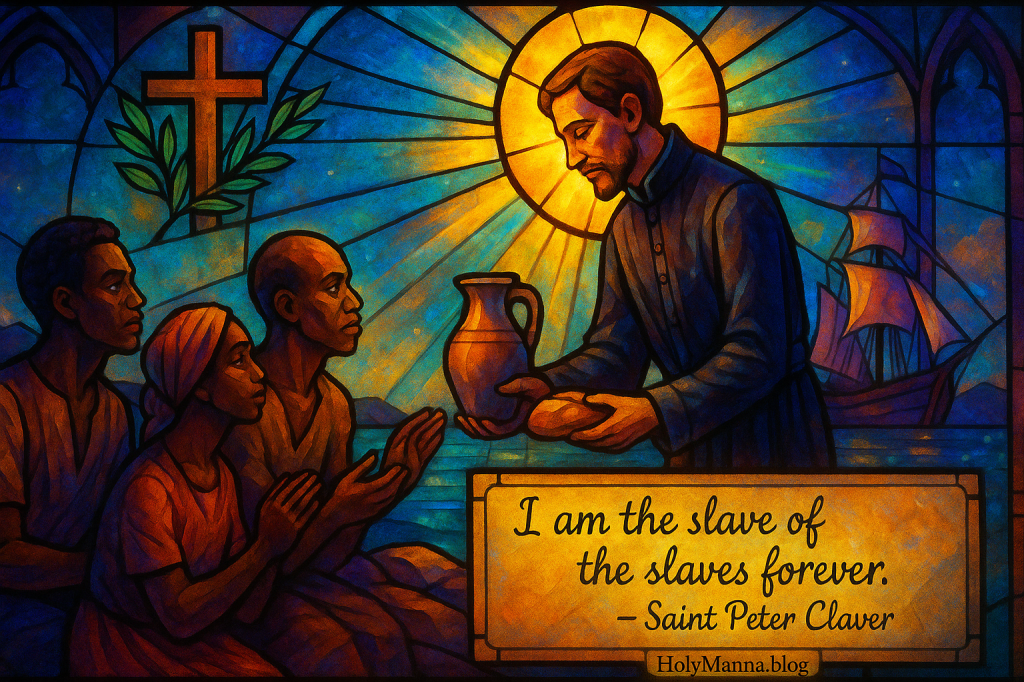
Saint Peter Claver, SJ is a blazing sign of the Gospel’s mercy in the face of history’s cruelty. For more than forty years in Cartagena de Indias, he ran to the docks when slave ships arrived, descended into the stifling holds with water, fruit, balsam, and cloth, and met trauma with tenderness and truth. He taught through interpreters drawn from Kongo and Angola, used pictures and short prayers to proclaim Christ, and baptized vast numbers after careful instruction. He made plantation circuits to defend the newly baptized, regularize marriages, and press owners toward justice. He habitually signed himself with a vow that summed up his mission and identity: “Petrus Claver, aethiopum semper servus.” (“I am the slave of the slaves forever.”) His feast is on September 9, and he is honored as patron of missions to African peoples, of slaves and seafarers, and of Colombia. His holiness was not a single dramatic act, but a long obedience of concrete love.
From Verdú to Cartagena
Peter was born in 1581 at Verdú in Catalonia to a hardworking family whose quiet faith formed him early. Gifted yet deeply humble, he entered the Society of Jesus in 1602. While studying philosophy in Mallorca he befriended the holy Jesuit porter Saint Alphonsus Rodríguez, who repeatedly urged him to offer his life for the most abandoned. That counsel, received in prayer, set his course. In 1610 he sailed for New Granada. He completed theology, was ordained a priest in Cartagena in 1616, and apprenticed under Father Alonso de Sandoval, whose ministry to enslaved Africans shaped Peter’s pastoral imagination. In 1622 he professed final vows and sealed a personal promise to belong entirely to those he served: “the slave of the slaves forever.” From then on, his priesthood was a living catechesis on Christ who “came not to be served but to serve,” a daily demonstration that evangelization begins where wounds are deepest.
Love in Service of Others
Peter learned ship schedules and reached the quay before the hatches opened. He carried citrus to fight scurvy, water for the parched, salves for sores, and clean cloth for fevered bodies. He communicated affection first with actions and then, through interpreters, offered the Gospel with images, gestures, and simple, memorable sentences. He instructed, baptized, and then returned for sustained catechesis and the sacraments. He spent long hours in hospitals and prisons, insisted on reverence for the Blessed Sacrament, and lived austerely so that his words would be transparent. A line long associated with his method captures the sequence he embodied: “We must speak to them with our hands by giving, before we try to speak to them with our lips.” His example teaches that Christian proclamation becomes credible when mercy moves first and justice follows through.
The Miracles of Charity
The most authoritative accounts of Peter’s life dwell less on spectacular prodigies than on the quiet wonder of steadfast mercy. Still, Cartagena preserved memories of healings that followed his anointings, of sudden consolations during his visits, and of a peculiar warmth of hope carried by his worn cloak, which he often laid over the shivering and the sick. Whether a cure occurred or not, those he served encountered the nearness of God through his patient presence, his touch, and his prayers. The deeper miracle was communal and enduring: men and women brutalized by the trade discovered in the Church a family, a name, a sacramental life, and the moral armor to resist the lie that they were property. Peter’s daily catechesis turned despair into discipleship.
Trials Without Hatred
Peter met resistance from traders and some officials who found his advocacy and interventions inconvenient. He also endured misunderstanding from those who doubted the value of his methods in a world bent toward profit. In later years he suffered debilitating illness that left him dependent and, at times, neglected. He accepted these humiliations as a share in the Cross and offered his hidden suffering for the people God had entrusted to him. He died in Cartagena on September 8, 1654. Though many had overlooked him in life, his death revealed the stature of his sanctity, and the city honored him with a public outpouring of veneration. He did not shed blood for Christ, but he poured out his strength in a long white martyrdom of charity that conformed him to the Heart of Jesus.
Wonders After Sunset
After his death, the faithful reported favors and healings through his intercession, especially among the sick and among communities scarred by racial hatred or human trafficking. The Church examined miracles, recognized cures, and raised him to the altars, canonizing him in 1888. Pilgrims today venerate his relics in Cartagena’s Sanctuary of Saint Peter Claver and pray where he once boarded ships and bandaged wounds. The shrine and his story continue to inspire clergy and laity to take up ministries that visit the sick, serve migrants, and defend the dignity of those most easily discarded.
A Catholic Lens for Today
Saint Peter Claver’s witness accords with the Church’s perennial doctrine. The Catechism of the Catholic Church teaches with clarity: “Every form of social or cultural discrimination in fundamental personal rights on the grounds of sex, race, color, social conditions, language, or religion must be curbed and eradicated as incompatible with God’s design.” (CCC 1935). It also speaks with force about slavery: “The seventh commandment forbids acts or enterprises that… lead to the enslavement of human beings, to their being bought, sold and exchanged like merchandise.” (CCC 2414). Peter made these paragraphs visible. He also leaves us a practicable program for evangelization: “We must speak to them with our hands by giving, before we try to speak to them with our lips.” Begin where the pain is sharpest. Offer material help, listening, and prayer. Stay for the long work of catechesis and the sacraments. Learn names and defend dignity in concrete ways. Ask his intercession for courage to resist every modern form of slavery and for a mercy that perseveres.
Walking in His Footsteps Today
How do we imitate Saint Peter Claver? Begin by touching wounds with practical love: listen first, bring what heals, and then speak Christ. Learn to see Christ in the least beloved, as Peter did stepping into darkness with light and relief. Pray at his tomb if you can, or join ministries that visit the sick, the imprisoned, migrants, and survivors of trafficking. Let Peter’s motto become ours: to belong to others in Christ so fully that our time, attention, and resources become a shelter for those who suffer.
Engage with Us!
- Where is the Lord asking you to “speak with your hands” before your lips this week?
- Which concrete work of mercy can you adopt in Peter Claver’s spirit for the next month?
- What prejudices or fears does the Holy Spirit want to uproot in your heart so that you can love more freely?
- How might you help combat modern slavery and human trafficking in your city through prayer, advocacy, or support of Catholic initiatives?
Go forth encouraged. Live a life of faith that touches wounds, tells the truth about human dignity, and does everything with the love and mercy Jesus taught us.
Saint Peter Claver, pray for us!
Follow us on Instagram and Facebook for more insights and reflections on living a faith-filled life.


Leave a Reply