Memorial of Saint Peter Claver, Priest – Lectionary: 438
Mercy That Confronts the Powers
Where is Christ inviting you to deepen your roots so that His mercy can flow through you toward the ones the world overlooks? Today’s readings trace a single arc from identity to mission. In Colossians 2:6-15, Saint Paul urges us to “walk in him”, to live “rooted in him” because in Christ “the whole fullness of the deity” dwells bodily and we share in that fullness through baptism. In this same mystery we were buried and raised, and Christ has “despoil[ed] the principalities and the powers”, making a public spectacle of all that dehumanizes. The early Christians in Colossae faced seductive blends of pagan and folk religiosity; Paul answers with the absolute sufficiency of Christ and the new, liberated life conferred by baptism (see CCC 1265–1270).
Psalm 145 trains our hearts to praise the King whose reign is mercy itself: “The Lord is gracious and merciful, slow to anger and abounding in mercy.” The psalm gives the Church her language for proclaiming God’s royal character, a rule that lifts the lowly and restores the broken. In Luke 6:12-19, Jesus spends the night in prayer, then chooses the Twelve, and immediately stands among the poor and afflicted, healing all who draw near because “power came forth from him and healed them all.” This is the pattern of apostolic life: communion, then commission; contemplation, then concrete mercy (see CCC 849–850).
On the Memorial of Saint Peter Claver, the Word becomes flesh in history. The seventeenth-century Jesuit of Cartagena signed himself “slave of the slaves forever”, entering the stifling holds of slave ships to baptize, tend wounds, and defend the dignity of those the world treated as cargo. His witness exposes “empty philosophies” that justify oppression and echoes the Church’s clear teaching that slavery is a grave offense against human dignity (see CCC 1935, CCC 2414; cf. The Catechism). Read in this light, today’s texts invite us to be a people rooted in Christ’s victory, singing the King’s mercy, and stepping onto the level ground of our cities where Christ still heals through His chosen disciples. Will you let your baptismal roots feed a life of courageous, practical mercy today?
First Reading – Colossians 2:6-15
Baptized Into Christ’s Fullness, Freed From Empty Powers
The Christians in Colossae lived at a cultural crossroads where Greek speculation, folk spiritualities, and pressures from ritual observances blended into a compelling but confused religious marketplace. Into that swirl, Saint Paul proclaims the absolute sufficiency of Christ. In Him, the fullness of the living God dwells, and in Him the baptized already share that fullness. The language of “circumcision” and “principalities and powers” situates this text within Israel’s covenant history and the world of contested spiritual authority. Paul insists that the decisive act is not a human ritual, but our union with Christ through baptismal death and resurrection. Read within today’s theme, the passage grounds our identity and mission: rooted in Christ, we resist dehumanizing ideologies, and we pour out His merciful reign. This lands powerfully on the Memorial of Saint Peter Claver, who, rooted in Christ and fortified by the sacraments, confronted the brutal “powers” that treated enslaved Africans as cargo and instead served them as icons of Christ.
Colossians 2:6-15
New American Bible (Revised Edition)
6 So, as you received Christ Jesus the Lord, walk in him, 7 rooted in him and built upon him and established in the faith as you were taught, abounding in thanksgiving. 8 See to it that no one captivate you with an empty, seductive philosophy according to human tradition, according to the elemental powers of the world and not according to Christ.
Sovereign Role of Christ. 9 For in him dwells the whole fullness of the deity bodily, 10 and you share in this fullness in him, who is the head of every principality and power. 11 In him you were also circumcised with a circumcision not administered by hand, by stripping off the carnal body, with the circumcision of Christ. 12 You were buried with him in baptism, in which you were also raised with him through faith in the power of God, who raised him from the dead. 13 And even when you were dead [in] transgressions and the uncircumcision of your flesh, he brought you to life along with him, having forgiven us all our transgressions; 14 obliterating the bond against us, with its legal claims, which was opposed to us, he also removed it from our midst, nailing it to the cross; 15 despoiling the principalities and the powers, he made a public spectacle of them, leading them away in triumph by it.
Detailed Exegesis
Verse 6 – “So, as you received Christ Jesus the Lord, walk in him,”
Paul reminds the community that Christian life begins by receiving a Person who is Lord. To “walk in him” is covenant language that signals a lifetime of discipleship. The Church teaches that faith is both gift and response, becoming a lived adherence to Jesus as Lord, not a mere idea or system of ethics. The verse sets the tone: doctrine flowers into a way of life.
Verse 7 – “rooted in him and built upon him and established in the faith as you were taught, abounding in thanksgiving.”
“Rooted” evokes a living organism; “built” evokes a temple. Both images converge in the baptized who grow by grace and become stones in God’s dwelling. The note of thanksgiving reveals the Eucharistic shape of Christian existence. Gratitude guards the heart from the pride that seeks other foundations.
Verse 8 – “See to it that no one captivate you with an empty, seductive philosophy according to human tradition, according to the elemental powers of the world and not according to Christ.”
Paul warns against teachings that displace Christ with merely human systems or occult speculations about cosmic forces. The danger is not reason itself, but reasoning detached from Revelation. In every age, the Church unmasks ideologies that reduce the human person and rejects spiritualities that bypass Christ.
Verse 9 – “For in him dwells the whole fullness of the deity bodily,”
This is a high Christology. The fullness of God does not merely touch Jesus; it dwells in Him bodily. Against any view that treats Jesus as a partial glimpse of God, Paul confesses the Incarnate Lord as the definitive presence of God among us. The Church guards this confession in her creeds and worship.
Verse 10 – “and you share in this fullness in him, who is the head of every principality and power.”
Union with Christ is participation, not just imitation. Because He is Head over all powers, those united to Him need not fear rival spiritual authorities. Baptized life is a share in His victory. This verse breaks the spell of fear that keeps people tethered to superstitions or oppressive systems.
Verse 11 – “In him you were also circumcised with a circumcision not administered by hand, by stripping off the carnal body, with the circumcision of Christ.”
Paul recasts covenant identity around Christ. The decisive “cut” is not surgical but sacramental. In baptism, the old solidarity with sin is stripped away. This fulfills the prophetic hope of a circumcised heart and inaugurates a people marked by interior transformation.
Verse 12 – “You were buried with him in baptism, in which you were also raised with him through faith in the power of God, who raised him from the dead.”
Baptism is real incorporation into the Paschal Mystery. The same divine power that raised Jesus works in the baptized. The verse illumines why Christian morality is resurrection morality. We are not straining on our own; we are living from a new principle of life.
Verse 13 – “And even when you were dead in transgressions and the uncircumcision of your flesh, he brought you to life along with him, having forgiven us all our transgressions;”
Grace precedes and empowers our response. God’s mercy does not merely erase a ledger; it vivifies. Forgiveness is inseparable from new life. Paul’s “with him” underscores communion with Christ as the locus of restoration.
Verse 14 – “obliterating the bond against us, with its legal claims, which was opposed to us, he also removed it from our midst, nailing it to the cross;”
The “bond” suggests a record of debt. Christ’s Cross does not bypass justice; it fulfills and transforms it. The indictment is taken up into Love’s self-offering and loses its power to condemn those united to Him. The Cross becomes the decisive public act of God’s liberating justice.
Verse 15 – “despoiling the principalities and the powers, he made a public spectacle of them, leading them away in triumph by it.”
The Cross is a triumphal procession. What looked like defeat unmasks the impotence of evil. Powers that dehumanize are exposed and led captive. This verse frames Christian service as sharing in Christ’s triumph, which is why saints like Peter Claver could face entrenched injustice with courageous mercy.
Teachings
Paul’s baptismal vision aligns with the Church’s doctrine of Baptism as the foundation of Christian life and mission. “Holy Baptism is the basis of the whole Christian life, the gateway to life in the Spirit, and the door which gives access to the other sacraments. Through Baptism we are freed from sin and reborn as sons of God; we become members of Christ, are incorporated into the Church and made sharers in her mission.” CCC 1213. This participation language echoes Paul’s insistence that we were buried and raised “with him.”
Because baptism grafts us into Christ’s Body, it carries social demands grounded in the equal dignity of every person. “The equality of men rests essentially on their dignity as persons and the rights that flow from it: every form of social or cultural discrimination in fundamental personal rights on the grounds of sex, race, color, social conditions, language, or religion must be curbed and eradicated as incompatible with God’s design.” CCC 1935. Paul’s proclamation that Christ has “despoiled the principalities and powers” empowers the Church to resist structures that deny this dignity.
In continuity with this, the Church condemns slavery as a violation of the seventh commandment. “The seventh commandment forbids acts or enterprises that for any reason lead to the enslavement of human beings, to their being bought, sold and exchanged like merchandise, in disregard for their personal dignity.” CCC 2414. Saint Peter Claver’s self-description as “slave of the slaves forever” became a living commentary on Colossians 2: rooted in Christ’s fullness, he defied “empty philosophies” that rationalized oppression and manifested the King’s merciful reign among the most despised.
Reflection
Christ has not given you a map as much as a new heart and a new belonging. Your baptism means you already share in His fullness. You do not need lesser powers to secure your identity or your future. You need deeper roots in Him. Begin by renewing your baptismal promises in prayer and by making a sincere, concrete act of thanksgiving today for the grace already at work in you. Ask the Lord to show you one place where fear, superstition, or cultural pressure still captivates your heart, and then bring it to the Cross where He has already triumphed. Take one step of merciful love toward someone who is overlooked, perhaps through a work of corporal mercy or a quiet, costly act of advocacy for a person’s dignity in your workplace or neighborhood. What old allegiance is Christ inviting you to renounce today so that you may walk more freely in Him? Where is He calling you to make His triumph visible through courageous, practical mercy?
Responsorial Psalm – Psalm 145:1-2, 8-11
The King Whose Mercy Becomes Our Mission
Composed within Israel’s worshiping life, Psalm 145 is a royal hymn that names God as King and celebrates His merciful reign. In Jewish prayer it frames daily praise, and in the Church it trains our hearts to adore the Lord whose power is revealed as compassion. Read with Colossians 2:6-15 and Luke 6:12-19, this psalm anchors today’s theme: rooted in Christ’s fullness, chosen in prayer, and poured out in mercy for every person. The psalmist’s vision of a gracious King who is “good to all” prepares us to recognize Christ healing the multitudes and to resist any “powers” or ideologies that diminish human dignity. On the Memorial of Saint Peter Claver, this praise becomes concrete history. The Jesuit “slave of the slaves” allowed the King’s mercy to shape his speech, his touch, and his advocacy for those treated as less than human. The psalm therefore invites us not only to sing, but also to embody the kingdom it proclaims.
Psalm 145:1-2, 8-11
New American Bible (Revised Edition)
The Greatness and Goodness of God
1 Praise. Of David.
I will extol you, my God and king;
I will bless your name forever and ever.
2 Every day I will bless you;
I will praise your name forever and ever.
8 The Lord is gracious and merciful,
slow to anger and abounding in mercy.
9 The Lord is good to all,
compassionate toward all your works.
10 All your works give you thanks, Lord
and your faithful bless you.
11 They speak of the glory of your reign
and tell of your mighty works,
Detailed Exegesis
Verse 1 – “I will extol you, my God and king; I will bless your name forever and ever.”
Praise begins by naming God personally as “my God and king.” Adoration acknowledges God’s sovereignty and situates all human authority beneath His reign. The resolve to bless God’s name “forever and ever” signals that praise is not a mood but a covenant stance that reorients the worshiper’s whole life.
Verse 2 – “Every day I will bless you; I will praise your name forever and ever.”
The daily cadence of praise forms a habitus of the heart. For Christians, this resonates with the Church’s daily liturgy and the Eucharistic life of thanksgiving. Praise each day becomes the wellspring for mission each day, so that mercy is not sporadic but sustained.
Verse 8 – “The Lord is gracious and merciful, slow to anger and abounding in mercy.”
This creedal refrain echoes God’s self-revelation to Moses in Exodus. God’s royal identity is defined by compassion, patience, and overflowing mercy. In Christ this is made visible as He heals and reconciles. The Church learns her tone from this verse, speaking truth without rage and offering mercy without limit.
Verse 9 – “The Lord is good to all, compassionate toward all your works.”
Universal goodness dismantles partiality. God’s compassion extends to every person. This undergirds the Church’s insistence on the equal dignity of all and exposes any practice that treats people as property or as problems. Praise opens our eyes to the image of God in every face.
Verse 10 – “All your works give you thanks, Lord and your faithful bless you.”
Creation itself is a choir. The faithful join that cosmic thanksgiving with intentional blessing. Gratitude transforms the heart from self-preoccupation to God-centeredness and readies the disciple to recognize gifts received as gifts to be shared.
Verse 11 – “They speak of the glory of your reign and tell of your mighty works,”
Praise overflows into proclamation. To speak of the King’s glory is to evangelize. It is to narrate God’s deeds in such a way that others can hope. This verse links liturgy and life. What we sing before God, we tell before the world.
Teachings
The psalm’s language of adoration aligns with the virtue of religion. “Adoration is the first act of the virtue of religion. To adore God is to acknowledge him as God, as the Creator and Savior, the Lord and Master of everything that exists, as infinite and merciful Love.” CCC 2096. Such adoration reshapes our view of every person and every power.
Because the Lord is “good to all,” the Church insists on the inalienable dignity of each human being. “The equality of men rests essentially on their dignity as persons and the rights that flow from it: every form of social or cultural discrimination in fundamental personal rights on the grounds of sex, race, color, social conditions, language, or religion must be curbed and eradicated as incompatible with God’s design.” CCC 1935. This principle illumines Saint Peter Claver’s witness among enslaved Africans.
The works of mercy are the concrete echo of God’s merciful reign. “The works of mercy are charitable actions by which we come to the aid of our neighbor in his spiritual and bodily necessities.” CCC 2447. To praise the King while neglecting His little ones would contradict the psalm’s vision.
In light of today’s memorial, the Church explicitly rejects systems that commodify persons. “The seventh commandment forbids acts or enterprises that for any reason lead to the enslavement of human beings, to their being bought, sold and exchanged like merchandise, in disregard for their personal dignity.” CCC 2414. Saint Peter Claver’s chosen identity as “slave of the slaves forever” is a Christlike protest and a hymn of mercy lived out on the docks and in the sickrooms of Cartagena.
Reflection
Begin and end your day with a few lines of Psalm 145 spoken aloud, letting God’s kingship and mercy shape your imagination. Practice gratitude by naming three concrete gifts you have received and asking how each can be shared. Choose one corporal or spiritual work of mercy to enact this week for someone who cannot repay you. Examine your speech and social interactions and remove any sarcasm or dismissal that diminishes the dignity of others. Ask a friend or family member how you can speak more of “the glory of His reign” in your home and workplace. Where is the Lord inviting you to let daily praise become daily mercy? Whom is God bringing to your path today so that your words and actions can tell of His mighty works?
Holy Gospel – Luke 6:12-19
Chosen in Prayer, Sent in Power, Healing on Level Ground
In the unfolding of Luke 6:12-19, Saint Luke draws us into the heart of Jesus’ mission at a decisive moment. Jesus retires to the mountain for nocturnal prayer, then calls and names the Twelve, and immediately descends to stand with them on level ground among crowds aching for healing and deliverance. In first century Judea, a mountain evokes covenant encounter, while the public naming of Twelve signals the reconstitution of Israel around the Messiah. The list of names makes the apostolic college concrete and historical, not mythic. The level ground scene echoes the prophetic hope that God’s salvation will meet people where they are. Within today’s theme, this Gospel shows the pattern of all authentic ministry. Communion with the Father births a community of apostles, and that community steps into the world’s pain so that Christ’s mercy can touch every person. On the Memorial of Saint Peter Claver, we recognize the same pattern. Rooted in prayer and sent by Christ, he descended into the lowest decks to bind wounds and proclaim the dignity of those the world called slaves.
Luke 6:12-19
New American Bible (Revised Edition)
12 In those days he departed to the mountain to pray, and he spent the night in prayer to God. 13 When day came, he called his disciples to himself, and from them he chose Twelve, whom he also named apostles: 14 Simon, whom he named Peter, and his brother Andrew, James, John, Philip, Bartholomew, 15 Matthew, Thomas, James the son of Alphaeus, Simon who was called a Zealot, 16 and Judas the son of James, and Judas Iscariot, who became a traitor.
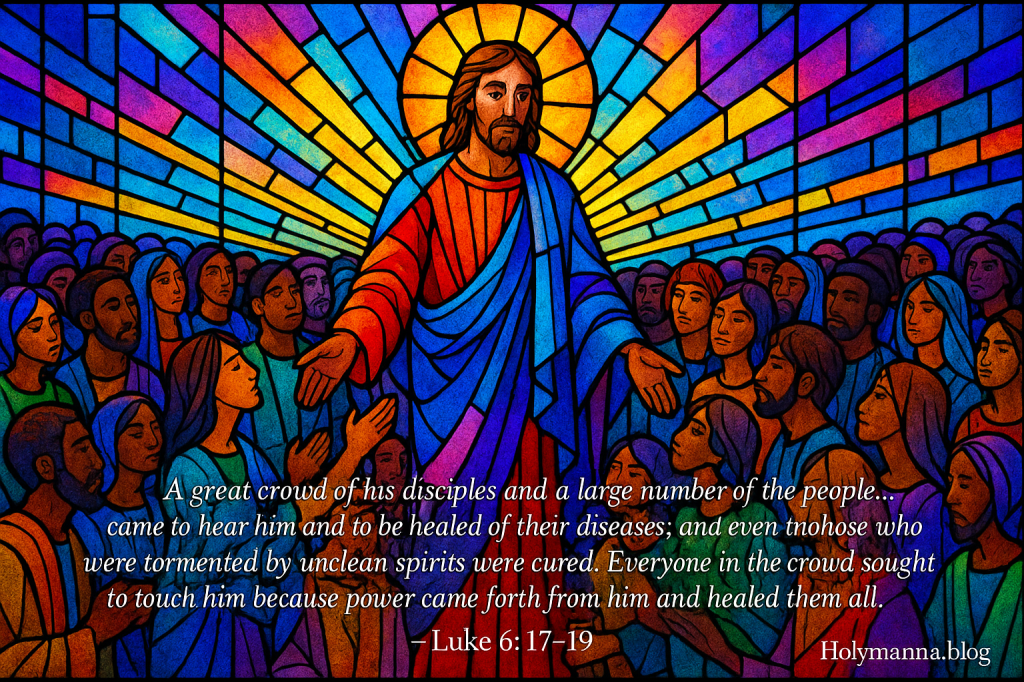
Ministering to a Great Multitude. 17 And he came down with them and stood on a stretch of level ground. A great crowd of his disciples and a large number of the people from all Judea and Jerusalem and the coastal region of Tyre and Sidon 18 came to hear him and to be healed of their diseases; and even those who were tormented by unclean spirits were cured. 19 Everyone in the crowd sought to touch him because power came forth from him and healed them all.
Detailed Exegesis
Verse 12 – “In those days he departed to the mountain to pray, and he spent the night in prayer to God.”
Luke highlights Jesus’ habit of sustained, solitary prayer before pivotal acts. The mountain recalls Sinai and signals a covenant moment. The night of prayer teaches the Church that discernment precedes decision and that mission flows from communion with the Father.
Verse 13 – “When day came, he called his disciples to himself, and from them he chose Twelve, whom he also named apostles:”
From the wider circle of disciples, Jesus freely chooses Twelve and gives them the name “apostles,” which means “sent ones.” The number Twelve signifies the restoration of Israel. Naming indicates authority and identity. The apostolic college is not a human association but a divine initiative.
Verse 14 – “Simon, whom he named Peter, and his brother Andrew, James, John, Philip, Bartholomew,”
The list begins with Simon, whom Jesus named Peter, indicating his primacy. Brothers, fishermen, and ordinary workers are included. God’s call dignifies ordinary lives and redirects them toward extraordinary service.
Verse 15 – “Matthew, Thomas, James the son of Alphaeus, Simon who was called a Zealot,”
The presence of a former tax collector and a Zealot displays the reconciling power of Christ. In Jesus, former enemies become co-workers. The apostolic band itself is a sign of the Kingdom’s ability to heal social fractures.
Verse 16 – “and Judas the son of James, and Judas Iscariot, who became a traitor.”
Luke’s sober note about betrayal underscores the realism of salvation history. God’s plan advances even through human failure. The Church remembers that holiness is God’s gift, not guaranteed by proximity to sacred things.
Verse 17 – “And he came down with them and stood on a stretch of level ground. A great crowd of his disciples and a large number of the people from all Judea and Jerusalem and the coastal region of Tyre and Sidon”
Jesus descends with the Twelve to stand among the needy. Level ground conveys accessibility and signals that grace meets us where we live. The geographic sweep anticipates the universal reach of the Gospel and hints at inclusion of the nations.
Verse 18 – “came to hear him and to be healed of their diseases; and even those who were tormented by unclean spirits were cured.”
Hearing and healing belong together. The Word addresses the mind and the mercy touches the body. Deliverance from unclean spirits reveals the arrival of God’s reign and the defeat of hostile powers.
Verse 19 – “Everyone in the crowd sought to touch him because power came forth from him and healed them all.”
Touch becomes a channel of divine power. The Lord’s holiness is not fragile. It is contagious life. Luke underlines the superabundance of grace in Jesus. The scene prepares the Church to be the Body through whom Christ still touches the world.
Teachings
The Gospel’s opening emphasis on Jesus’ prayer is the pattern for Christian discernment. “Jesus often draws apart to pray in solitude, on a mountain, preferably at night.” CCC 2602. Before choosing the Twelve, the Son seeks the Father’s will in sustained prayer, which grounds apostolic authority in divine communion rather than human strategy.
The constitution of the Twelve reveals the apostolic foundation of the Church. “From the beginning of his public life Jesus chose certain men, twelve of them, to be with him and to participate in his mission.” CCC 551. Their mission endures through sacramental succession. “In order that the mission entrusted to them might be continued after their death, the apostles consigned, by will and testament as it were, to their immediate collaborators the duty of completing and consolidating the work they had begun.” CCC 861. The Gospel list of names witnesses to a concrete, historical college that remains the Church’s living foundation.
Jesus’ healing presence discloses the Kingdom’s nearness. “Christ’s compassion toward the sick and his many healings of every kind of infirmity are a resplendent sign that ‘God has visited his people’ and that the Kingdom of God is close at hand.” CCC 1503. The physical act of contact also bears theological weight. “The hand. Jesus heals the sick and blesses children by laying hands on them.” CCC 699. In the apostolic Church, this continues through the sacraments and pastoral charity, which is why saints like Peter Claver made Christ’s healing tangible among the most afflicted.
Read on today’s memorial, the Gospel condemns any force that dehumanizes. The apostolic mission includes public witness to human dignity, which the Church names clearly. “The equality of men rests essentially on their dignity as persons and the rights that flow from it: every form of social or cultural discrimination in fundamental personal rights on the grounds of sex, race, color, social conditions, language, or religion must be curbed and eradicated as incompatible with God’s design.” CCC 1935. Saint Peter Claver’s ministry on the docks of Cartagena made this doctrine visible through acts of mercy and fearless advocacy.
Reflection
Begin where Jesus begins. Set aside intentional time for prayer before important choices, even if it means a quiet hour at night. Name the people God is entrusting to you, and pray for them by name, asking for the grace to serve them as Christ served the Twelve. Seek opportunities to stand on level ground with those who suffer, not above them. Offer your presence, your listening, and your touch in appropriate, respectful ways that communicate dignity. Ask the Lord for the courage to confront any habit or cultural pattern that reduces people to commodities. Participate in the Church’s sacramental life, where Christ’s power still flows to heal and reconcile. Where is the Lord inviting you to come down the mountain and stand with Him among the overlooked? How can your words, your hands, and your choices become channels of His healing today?
Rooted in Christ, Sent in Mercy
Today’s Word gives us a clear path from identity to mission. In Colossians 2:6-15, Paul calls us to “walk in him”, to live “rooted in him”, and to trust the Cross where Christ has already triumphed over the powers that dehumanize. Psalm 145 teaches our lips and hearts the language of the Kingdom as we proclaim, “The Lord is gracious and merciful”, and learn to see every person through the eyes of divine compassion. In Luke 6:12-19, Jesus prays through the night, chooses the Twelve, and then stands on level ground so that “power came forth from him and healed them all”. The Memorial of Saint Peter Claver shows this pattern embodied in history. Rooted in Christ, he stepped into the holds of slave ships to baptize, to bind wounds, and to defend the dignity of those the world refused to see. Read together, the readings and the memorial invite us to be a Eucharistic people who praise the King’s mercy, resist empty ideologies, and bring healing love to the most overlooked in our midst, in fidelity to CCC 1935 and CCC 2414.
Here is the invitation for us now. Return to prayer with intention. Name Jesus as Lord and ask for deeper roots in Him. Renew your baptismal identity by making a sincere act of thanksgiving and by seeking the sacraments, especially Reconciliation and the Eucharist. Let praise become practice by choosing a concrete work of mercy this week for someone who cannot repay you. Speak up for human dignity wherever it is diminished. Ask for the courage to stand on level ground with those who suffer and to be a channel of Christ’s healing. Where is Jesus asking you to come down the mountain and stand with Him today? How will you let His merciful reign shape your words, your touch, and your choices this week?
Engage with Us!
We would love to hear from you in the comments below. Share what moved you, what challenged you, and how you sense the Lord speaking through today’s Word and the Memorial of Saint Peter Claver.
- First Reading (Colossians 2:6-15): Where is Jesus inviting you to deepen your roots in Him and to walk in Him with renewed gratitude today? What old allegiance or fear is He asking you to leave at the Cross so that you can live from the freedom of your baptism?
- Responsorial Psalm (Psalm 145:1-2, 8-11): How can daily praise reshape your words and actions so that others experience God’s compassion through you? Which person in your life most needs you to reflect the Lord who is gracious and merciful, slow to anger, and abounding in mercy?
- Holy Gospel (Luke 6:12-19): What choice or relationship do you need to carry into focused prayer before you act, following Jesus who prayed through the night? Where is the Lord asking you to stand on level ground with those who suffer so that His healing love can reach them through your presence?
Go in peace with courage. Live a life of faith that is rooted in Christ, nourished by prayer and praise, and expressed in concrete works of love. Do everything with the mercy Jesus taught us, and may the example of Saint Peter Claver strengthen you to uphold the dignity of every person you meet.
Sacred Heart of Jesus, we trust in You!
Immaculate Heart of Mary, pray for us!
Saint Michael the Archangel, defend us in battle!
Follow us on Instagram and Facebook for more insights and reflections on living a faith-filled life.


Leave a comment