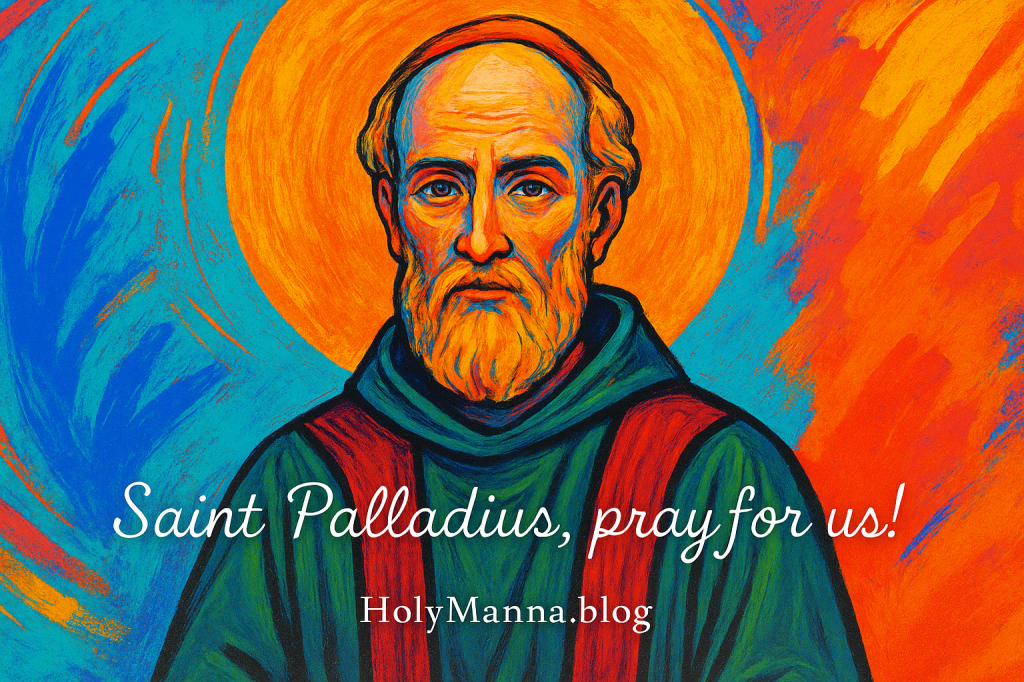
The Forgotten Forerunner
Before Saint Patrick’s name rang out across the emerald fields of Ireland, another man quietly carried the Gospel to its shores. Saint Palladius was the first bishop sent to minister to the Irish, a role he embraced with courage, humility, and unwavering obedience to the Church. Sent by Pope Celestine I in 431 AD, his mission was not one of grand success or miraculous revival—but of planting seeds, setting foundations, and paving the way for future generations of believers. In a world that often praises only those who achieve visible results, Saint Palladius reminds us that the true measure of success in the Christian life is faithfulness. He is a saint for all who labor in quiet corners, for those who love and serve without applause, and for every soul who has ever wondered if their efforts in God’s name mattered. His story is not loud—but it is holy.
From Roman Nobility to Apostolic Mission
Saint Palladius was born into a life of privilege and influence. His father, Exuperantius, served as the Praetorian Prefect of Gaul, a powerful position in the late Roman Empire. This suggests Palladius was raised in a setting of education, civic responsibility, and likely Christian faith, as the empire was already shifting toward Christianity in his lifetime. His upbringing would have provided access to Roman learning, Latin literature, and ecclesial thought—an excellent preparation for someone destined to serve the Church.
From this elite background, Palladius chose a path of deep service to God. He became a deacon in Rome, where his love for the faith and administrative abilities likely brought him close to Pope Celestine I. It was in this role that he became known for his fidelity and pastoral concern—not only for Rome but for the needs of the universal Church. In 431, when news reached the Vatican of scattered Christian communities among the Irish, the pope chose Palladius to become the first bishop to the Irish believing in Christ.
This appointment was no small task. Ireland, still largely pagan and tribal, was considered a land on the fringes of the known world. Yet Palladius obeyed without hesitation. He traveled to the southeastern part of the island—likely the region of Wicklow—where early Christian communities had emerged, perhaps through contact with Roman Britain or traders. His task was to shepherd these fledgling groups and expand the faith. Though his mission lasted only a short time, possibly less than a year, his obedience made him the first apostolic figure to walk Irish soil in Christ’s name, a title often forgotten in the shadow of Saint Patrick.
Seeds of Grace
Unlike some saints whose lives are filled with dazzling public miracles, the life of Saint Palladius speaks through the quiet, enduring power of perseverance. There are no recorded miraculous healings, visions, or supernatural signs in the surviving accounts of his mission. And yet, his very survival in an unfamiliar and hostile land, his ability to plant the Gospel among foreign peoples, and his foundation of churches in places like Wicklow and Kildare are no less the work of divine providence.
Early Irish sources and archaeological evidence suggest that he founded at least three Christian communities, and that he brought with him books, sacred vessels, and relics—objects of reverence that became instrumental in Irish Christian worship. At Killala in County Mayo and Tigroney near Avoca, Christian stones and holy sites carry traces of Palladius’ work. These weren’t just structures—they were sanctuaries, symbols of hope in a land still under the sway of paganism. His mission laid the very groundwork on which Saint Patrick and others would later build.
Is it not miraculous that a Roman-born bishop could arrive on the windswept coasts of Ireland and plant even a single Christian community? That these sites would continue to be recognized centuries later is itself a testament to how God works through even the smallest faithful gestures. As Psalm 126:6 reminds us: “Those who go out weeping, bearing the seed for sowing, shall come home with shouts of joy, carrying their sheaves.”
Exiled but Not Defeated
Saint Palladius’ mission was marked not by triumphant conversions but by hardship, resistance, and eventual expulsion. Though he came bearing the full authority of the Holy Father, many Irish chieftains viewed him with suspicion. His message of one God, his rejection of tribal deities, and his Roman background likely alienated him in a culture bound tightly to its ancestral traditions and spiritual leaders, the druids.
The Annals of Ireland suggest that he was driven out by the local rulers, forced to flee after a short time. For many, this would have seemed like failure. But the saints see things differently. Palladius did not rage or despair. Instead, he turned to a new mission field: Scotland.
He journeyed to the land of the Picts, settling in northeast Scotland, particularly in Fordoun in Aberdeenshire. There, he continued preaching Christ among another pagan people. Again, his efforts were marked by hardship, but also quiet endurance. He died between 432 and 437 AD, possibly in exile, but certainly in grace.
Though he never suffered martyrdom by sword or fire, Palladius lived the “white martyrdom”—the martyrdom of those who renounce worldly comfort, acceptance, and reputation for the sake of the Gospel. In this, he models Luke 14:27: “Whoever does not carry his own cross and come after me cannot be my disciple.”
A Whisper in the Hills
After his death, Saint Palladius’ presence did not vanish. Instead, his memory lingered in the landscape—in churches, shrines, and stories passed down through generations. In Fordoun, where he is believed to be buried, a holy well, stone slab, and early Christian chapel became pilgrimage destinations. People visited these sacred sites seeking healing and divine assistance, and many reported cures from illness and spiritual comfort through his intercession.
In Ireland, the communities he founded remained. His legacy, though hidden beneath the towering fame of Saint Patrick, was never forgotten. Churches bearing his name in Wicklow, Clonard, and other areas stand as testaments to his pioneering spirit. In Kildare, relics and oral traditions point to his presence among the earliest Christian settlers.
Today, modern scholars are re-evaluating his contribution, recognizing him as a foundational figure in Ireland’s Christian story. Without him, there might not have been a Saint Patrick’s mission. Palladius shows us that some saints are called not to finish the race, but to build the starting line for others.
Faithful in Obscurity
In an age that prizes fame, recognition, and results, Saint Palladius speaks a quieter truth: it is not how much you accomplish that makes you holy, but how faithfully you serve in the place God puts you. Palladius was sent to a land not ready to receive him, and though he was rejected, he responded with perseverance, trust, and love.
How many of us feel like our work, our prayers, or our efforts go unnoticed? How often do we long to see the fruits of our labor but are met only with silence? Saint Palladius shows us that God sees what the world does not. His life echoes the words of 1 Corinthians 15:58: “Be steadfast, immovable, always abounding in the work of the Lord, knowing that in the Lord your labor is not in vain.”
We, too, are called to plant seeds of grace, even if we never see the harvest. Like Palladius, we may serve in obscurity, face rejection, or be misunderstood. But every act of obedience—every “yes” whispered in faith—builds up the Kingdom of God.
Are you willing to be faithful even if no one applauds? Will you keep sowing love, truth, and holiness even when the ground seems hard and dry?
Saint Palladius urges us to trust that God is at work—always, deeply, and eternally.
Engage with Us!
We’d love to hear how Saint Palladius’ life speaks to you. Share your thoughts in the comments or reflect on the questions below with a friend or prayer group.
Reflection Questions:
- Have you ever felt called to serve in a way that didn’t go as you expected? How did you respond?
- What does faithfulness look like in your current stage of life—even if no one else sees it?
- How can you support someone else’s mission, trusting that it’s part of God’s greater plan?
Let’s continue to support one another in our walk of faith—remembering that even when the fruit is unseen, love never fails (cf. 1 Corinthians 13:8). Let’s strive, like Saint Palladius, to do everything with love, as our Lord Jesus did.
Saint Palladius, pray for us! 🌱
Follow us on Instagram and Facebook for more insights and reflections on living a faith-filled life.


Leave a Reply