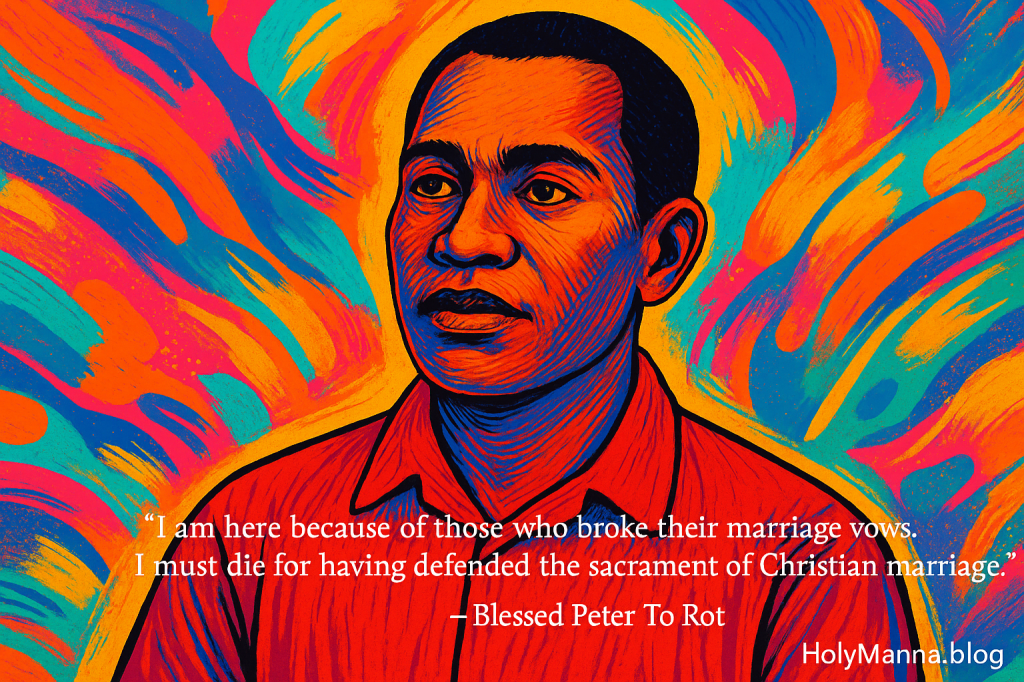
A Modern Day Hero of Faith and Courage
In the lush and vibrant jungles of Papua New Guinea, amid towering palms and ocean breezes, God raised up a quiet, strong soul for an extraordinary mission. Blessed Peter To Rot was not a priest or a bishop, but a humble catechist—a layman—who lived and died with the heart of a martyr. His courage, compassion, and deep love for Christ and the Church turned a remote village into sacred ground. In a time when faith was outlawed and truth threatened by force, Peter chose fidelity to God over safety, truth over silence, and love over fear. His life speaks powerfully to all of us in the modern world who struggle to live our faith with boldness in a culture increasingly hostile to Christian values.
Born of Faith, Formed for Mission
Peter To Rot was born around 1912 in Rakunai, East New Britain, in what is now Papua New Guinea. His family was among the first fruits of missionary work in the region. His father, Angelo To Puia, was a village chief who courageously embraced the Catholic faith, setting the tone for his son’s spiritual formation. Growing up in a household of deep prayer and Gospel values, Peter absorbed the teachings of the Church from a young age. He was known for his honesty, prayerfulness, and joy, and quickly gained the attention of local missionaries. Recognizing his maturity and potential, they sent him to St. Paul’s Mission School to train as a catechist. There, his vocation was born—not to the priesthood, but to the sacred duty of teaching, guiding, and spiritually fathering his fellow villagers. His formation was rooted not only in theology and Scripture, but in virtue and service.
A Heart on Fire for the Gospel
After completing his training, Peter returned home and embraced his role as a catechist with deep zeal. He wasn’t just a teacher; he was a spiritual shepherd, a counselor, and a friend. He led prayer meetings, taught children and adults alike, prepared them for the sacraments, and supported the sick and elderly. His house became a place of welcome, his hands instruments of service, and his words full of conviction. The people trusted him deeply because he lived what he taught. He also married Paula Ia Varpit, with whom he had three children, embodying the vocation of marriage with the same fidelity he gave to his ministry. Through his family life and lay service, Peter became a living image of the Church’s call for the laity to be salt and light in the world (cf. Matthew 5:13-16).
The Cross of Occupation
World War II changed everything. In 1942, Japanese forces invaded and occupied Papua New Guinea, banning Christian worship, imprisoning priests, and spreading fear. In this dark moment, Peter’s hidden strength began to shine even brighter. With the priests gone, he became the spiritual rock of his village. Under the cover of night, he gathered believers to pray, to receive catechesis, and to deepen their trust in Christ. He celebrated liturgies of the Word, baptized infants, and comforted the afflicted—all while knowing he was being watched.
His greatest challenge came when the Japanese authorities began enforcing polygamy, directly contradicting Catholic teaching on the sanctity of marriage. Peter would not be silent. He taught clearly that “What God has joined together, no human must separate” (cf. Matthew 19:6). His defiance was not born of rebellion, but of fidelity to truth. He was adamant that Christian marriage could not be compromised, no matter the cost. That cost would soon come knocking.
A Crown Won Through Suffering
In April 1945, Peter was arrested for defying the order to cease religious activities and for preaching against the legalization of polygamy. He was thrown into a squalid prison, denied visits from his wife, and subjected to increasing psychological and physical torment. Yet those who saw him reported that his peace and resolve never wavered. He continued to pray, counsel other prisoners, and entrust himself to the Lord.
On July 7, 1945, the guards offered him what seemed like medical treatment—but it was poison. He was given a lethal injection and quietly murdered in his cell. His death was hidden, but his martyrdom did not go unnoticed. The villagers mourned the loss of their spiritual leader, but they also knew: a saint had been born in their midst. His blood had been poured out as a witness to Christ—martyria in the truest sense of the word.
A Light That Could Not Be Hidden
The Church, like the people of Rakunai, recognized the radiant holiness of Peter To Rot’s life and death. In 1995, during his apostolic visit to Papua New Guinea, Pope Saint John Paul II beatified Peter in front of tens of thousands of joyful and tearful faithful. In his homily, the pope declared: “Blessed Peter To Rot is an outstanding example of the lay faithful who bear witness to the Gospel with courage and dedication, even unto death.” He was the first martyr from Papua New Guinea to be beatified—forever linking his story with the universal Church and lifting up the dignity of the lay vocation.
Whispers of Heaven
While beatification as a martyr does not require a miracle, stories of favors and healings have surfaced over the years through Peter’s intercession. People have reported conversions, spiritual peace, and even physical healings after praying through him. Though not all are formally documented, the devotion of the faithful testifies to the graces God continues to pour out through this humble catechist. His memory lives not only in statues and feast days but in the lived faith of a people who continue to call on his name.
A Saint for Our Time
Today, Blessed Peter To Rot is honored as a national hero in Papua New Guinea and a model for laypeople around the world. Schools, churches, and youth groups bear his name. He is especially revered as a protector of Christian marriage and family life—an intercessor for those struggling to remain faithful in difficult circumstances. In a world where truth is often twisted and compromise is celebrated, Peter reminds us that the Gospel is worth everything. His story calls us to fidelity, even when it costs us comfort, reputation, or life itself. Every July 7th, we are invited to remember not just his death, but the eternal life he now enjoys—and the invitation extended to all of us to walk the narrow road of holiness.
Let His Fire Burn in You
Blessed Peter To Rot challenges us to ask: What am I willing to suffer for my faith? His life calls us to reflect deeply on our witness as Christians in the modern world. Do we live with quiet courage, like Peter? Are we faithful in our daily duties, devoted to our families, and prayerful in secret as well as in public? Are we preparing ourselves now for whatever trials may come?
As The Catechism of the Catholic Church reminds us: “The witness of the martyrs remains a model for all… the supreme form of the witness to the truth” (CCC 2473). Blessed Peter lived that witness not with bitterness or pride, but with love, humility, and joy. His story is a flame meant to ignite our own.
Engage with Us!
Share your thoughts in the comments below!
- What part of Blessed Peter To Rot’s life story inspires you the most?
- How do you show courage and steadfastness in your faith?
- Am I willing to speak truth when it’s unpopular?
Let’s support and encourage each other to live with faith and dedication.
Blessed Peter To Rot, pray for us! 🔥
Follow us on Instagram and Facebook for more insights and reflections on living a faith-filled life.


Leave a Reply